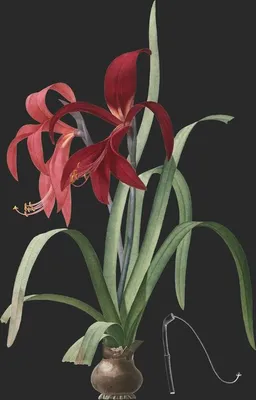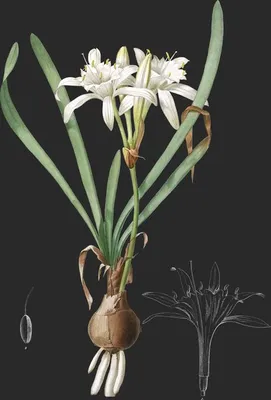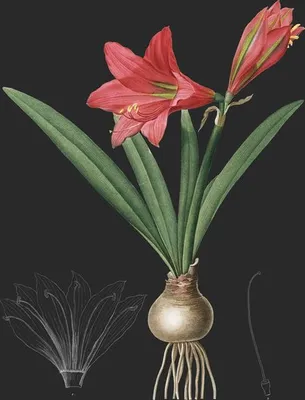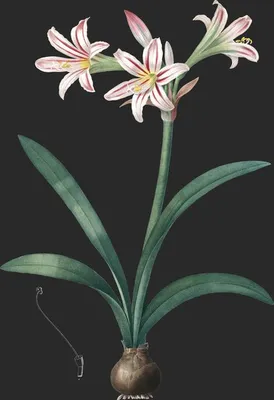
Galanthus Nivalis
Galanthine Perce-Neige
About this plate
Description
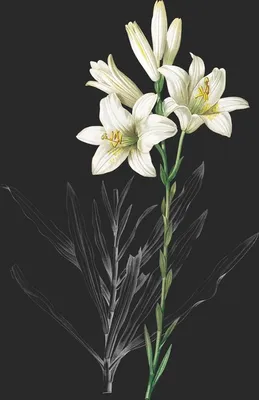
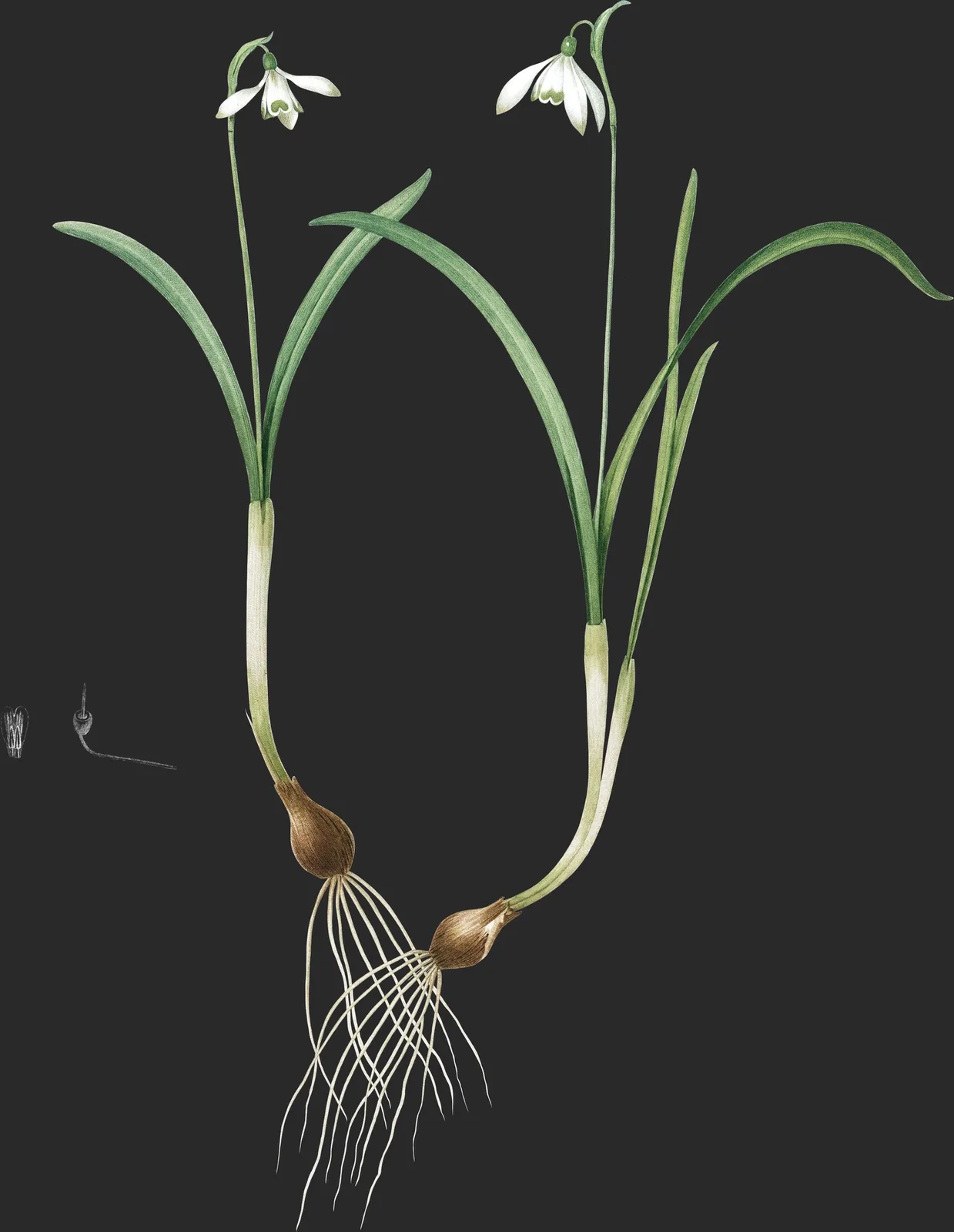
Sa racine est une bulbe ovoïde composée de tuniques, qui émet à sa base des radicules simples, et à son sommet une couple de feuilles oblongues, étroites, lisses et obtuses; ces feuilles sortent d’une gaine mince et membraneuse: d’entre elles sort une hampe grèle, lisse, longue de 10–15 centimètres, et terminée par une seule fleur, Celle-ci est blanche, pendante, portée sur un pédicelle gréle, lequel sort d’une spathe oblongue d’une seule pièce et fendue sur le côté. Le périgone adhère par sa base avec l’ovaire, et se divise en six lobes profonds et différents entre eux: les trois intérieurs sont oblongs, pointus, d’un blanc de lait; les trois extérieurs sont demi-avortés, calleux, échancrés en cœur au sommet, verdatres et de moitié plus courts. Les étamines sont au nombre de six: leurs filaments sont courts; leurs anthères droites, oblongues, rapprochées. De l’ovaire placé sous la fleur sort un style filiforme de la longueur des étamines: le fruit est une capsule ovale, obtuse, à trois loges, à trois valves, à plusieurs graines globuleuses.
Histoire
La Galanthine, aussi nommée Galant d’hiver, croit naturellement dans les prairies humides et ombragées de l’Europe. La variété A se trouve en France, en Angleterre, en Allemagne: la variété B, qui est un peu plus grande dans toutes ses parties, a été trouvée en Hongrie et en Autriche. ♃.
Cette jolie plante fleurit dès la fin de l’hiver, dès que la terre est dépouillée de neige; quelquefois même elle la perce pour parvenir à la lumière. Cette précocité de sa fleuraison Ta fait introduire dans les jardins, malgré son humble stature: ses oignons restent en terre plusieurs années sans inconvénient.
On en cultive une variété à fleurs doubles, qui est moins précoce et plus délicate.
Fam. des Narcisses. Juss.—Hexandrie monogynie. Lin.
- Galanthus nivalis. Lin. Spec. 413. Mill, Dict. ? 1. Lam. Dict. 2. p. 590. illustr. t. 230. Scop. carn. éd. a. ? 391. Jacq. Austr. t. 330. engl. bot. t. 19. Willd. Spec. 2. p. 29. Pers. ench. 1. p. 349. Fl. franç, et syn. ? 1987. Gil. Elem. 1. p. 365. f. 218.
- Galanthus uniflorus petalis alternis cordatis brevioribus. Hall. helv. ? 1254.
- Galanthus. Lin. hort. Cliff. 134.
- Leucoium bulbosum trifolium minus. C. Bauh. Pin. 56.
- Leucoium bulbosum minus triphyllum. J. Bauh. hist. 2. p. 591. ic.
- Leucoium bulbosum pracox minus. Clus. hist. 1. p. 169. ic. Pann. p. 181. 182. Bry. Flor. nov. ic.
- Leucoium bulbosum triphyllum. Dod. Pempt. 230.
- Leucoium bulbosum minus præcox tribus petalis albis minoribus cingentibus terna minora herbacci coloris. Moris. oxon. s. 4. p. 364. t. 9 f. 23.
- Leucoium bulbosum alterum. Tabern. ic. 614.
- Leuco-narcisso-lirion minimum. Lob. ic. 123.
- Leuco-narcissus trifolius præcox. Theat. Flor. t. 21.
- Narcisso-leucoium trifolium minus. Tourn. inst. 387.
- Narcissus sextus. Cam. épit. 956. Math. comm. 860. ic.
- Erangelia. Renealm. Spec. p. 97. t. 96.
- B. Narcisso-leucoium trifolium majus. Tourn. inst. 387.
- Leucoium bulbosum pracox Byzantinum. J. Bauh. hist. 2. p. 591. ic. Clus. hist. 1. p. 169. ic. Bry. Fl. nov. ic.
- Leucoium bulbosum majus precox Byzantinum tribus petalis albis majoribus terna minora herbacea seu viridia cingentibus. Moris. oxon. 2. s. 4. p. 364.
Twelve ways of seeing
- measured cast amber
- slightly upright 1.29 : 1
- published 1807
- Plate 200
Not a catalogue entry but a way of looking: how to stand, what to notice, how the line was cut, when it flowers, where it came from, who made it — and then the poems and the classics that taught China to see the same flower. Read the twelve in order and the plate opens.
-
First Look
真山水之川谷,远望之以取其势,近看之以取其质。
—— 宋·郭熙《林泉高致·山水训》
Mountains and valleys: from afar take their momentum, up close take their texture — the two distances from which any picture is read.
Slightly taller than wide; the eye lands above centre. Then step in close: watch where colour meets line, and whether the line ever breaks. Third, find where the green is deepest: the whole tonal order is measured from that patch.
-
Name and Thing
The binomial is Galanthine perce-neige: the first word is the genus it belongs among, the second the epithet that sets it apart. Two words carry a whole provenance. The older system filed it under Amaryllidaceæ by overall affinity; Linnaeus, counting stamens only, placed it in Hexandria — two ways of asking what a plant is. No established Chinese name exists, so it is cited by its binomial alone.
-
Form and Colour
Measured on this plate: flower colour is sparing, 0.8% of the sheet against 2.8% of foliage, the cast tending amber — as with pale or white blooms, outline and tone do the talking. Bulbous plants store the year underground — bulb, corm or tuber — then send up a few thick leaves and a single scape, with six tepals in cup, funnel or star. Filed under green — a moss green, a colour that comes mostly from leaf and stem. Three things fix the habit: leaf arrangement, tepal count, and how the flower is borne.
-
Composition
Slightly taller than wide, the plant set a little above centre. (about 1.29 : 1) No details are appended: a plate for looking, not for keying out. The plant covers only 7% of the sheet, centred above centre; the emptiness is where the eye rests. Blank paper is not unfinished work: it is where the eye rests.
-
Line and Colour
The first half of the nineteenth century moved from copper to steel to lithography; stipple could render the softest transition. There is evidence on the back too: the plate mark pressed into the paper, the slight relief of the pigment, lines worn shallow in a later printing.
-
Season
Early spring to early summer, genus by genus: tulips and hyacinths first, gladiolus and amaryllis later. The year 1807 on the plate is that of publication, not of flowering — the gathering came a year or two earlier. Note the season. Phenology is the most practical tool of appreciation.
-
Provenance
Three homelands: the Mediterranean, Central Asia and South Africa. The tulip came from Ottoman gardens and became a Dutch mania; South African bulbs filled European glasshouses after 1800. The localities on the plate are those of a century ago; plants travel and places change their names.
-
The Book and the Hand
“The Liliaceae” was drawn by Pierre-Joseph Redouté and published 1802-1816. This plate is Plate 200, book page 200. The image is public domain; the hand-colouring is still one person's hand.
-
Poetic Resonance
东风夜放花千树,更吹落、星如雨。
—— 宋·辛弃疾《青玉案·元夕》
East wind at night sets a thousand trees of flowers alight, then blows them down like rain of stars.
The poem gives the mood first and the picture supplies the form; set the line beside the plate and the green the corolla becomes its resting point.
-
The Written Tradition
论画以形似,见与儿童邻。
—— 宋·苏轼《书鄢陵王主簿所画折枝》
To judge a painting by likeness alone is the view of a child.
Li Bai's 'orchid wine, fragrant with yujin' is often misread as tulips; the Tang yujin was a turmeric-like root used to scent wine — same name, different plant. Keep the line; it will surface the next time you meet the same plant.
-
Symbolism
The tulip was an imperial emblem in Istanbul and a speculative bubble in Amsterdam; the hyacinth sprang from a boy's blood in Greek myth. What bulbs share is concealment: next year kept underground. Flower language was added later; the flower knows nothing of it, and that innocence is part of its power.
-
What to Take Away
If you keep one line, keep Guo Xi's: from afar its momentum, up close its texture. Two centuries on, the plant may still flower in some garden; the one on this sheet stopped in the season of 1807.