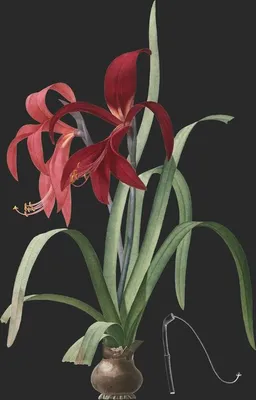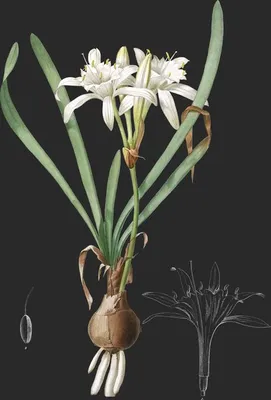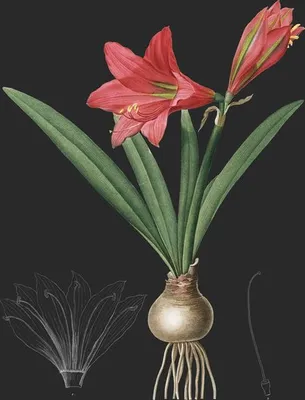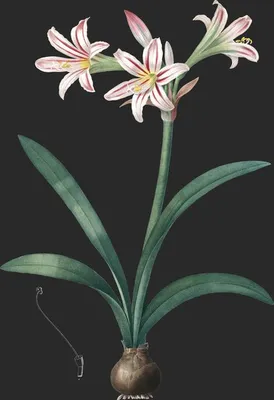
Hæmanthus Albiflos
Hémanthe a Fleurs Blanches
Hémanthe a Fleurs Blanches
About this plate
Description
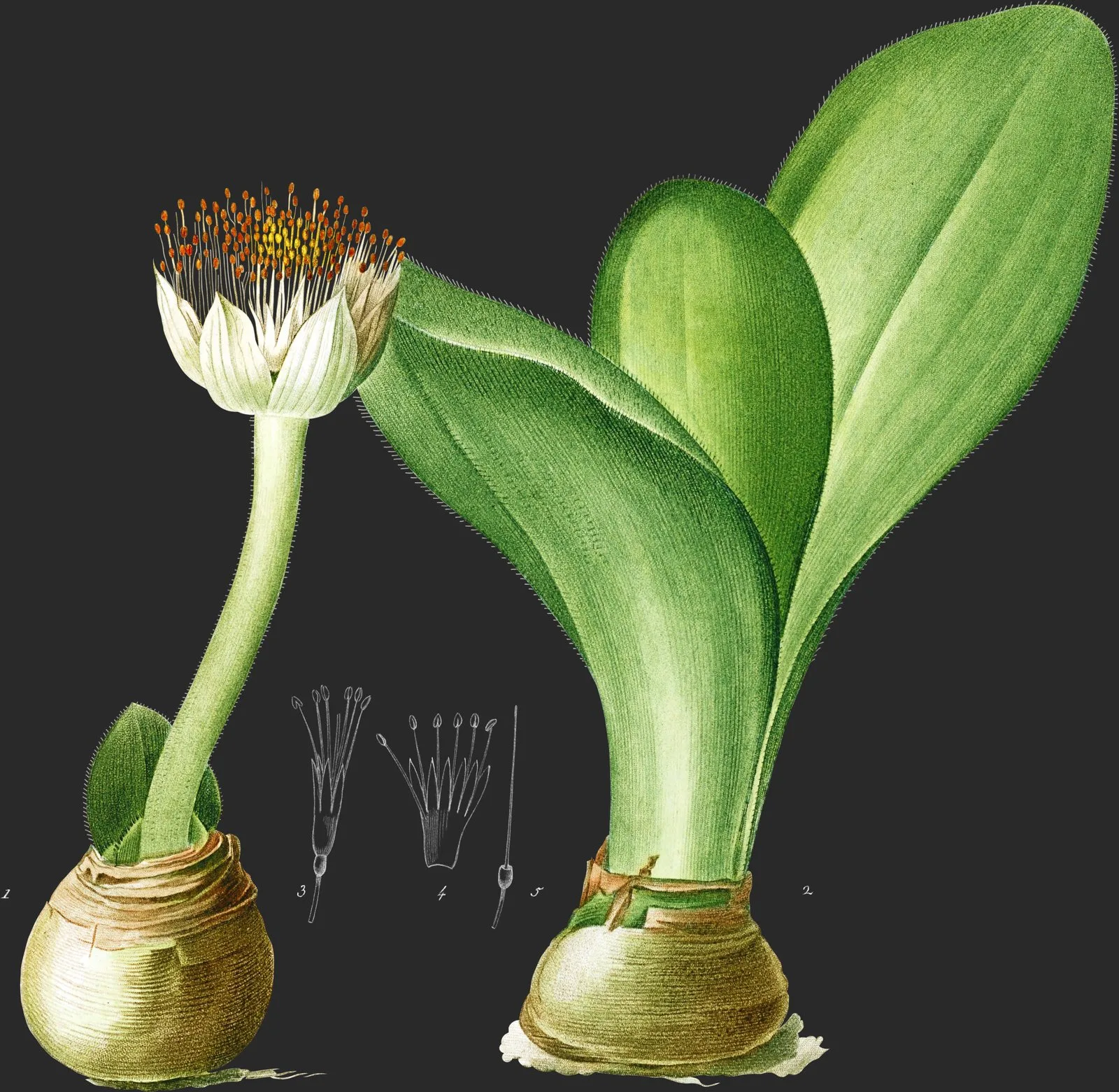
Une bulbe arrondie, grosse comme un abricot, couverte de tuniques bru-nes, épaisses, donne naissance à une hampe épaisse, verte, un peu comprimée, plus ou moins inclinée, hérissée de poils blancs nombreus, longue de sept a huit centimètres à l’époque de la loraison, mais acquérant ensuite une longueur double.
Les fleurs forment au sommet de cette hampe une ombelle serrée, enfermée. dans une spathe ou collerette à quatre ou six folioles à pen près égales, ovales aigues, blanchätres, avec leurs nervures vertes, longues de trois centimètres ciliées. Des bractées linéaires, membraneuses, séparent les leurs, qui sont supportées par des pédicelles épais, longs de cinq millimètres.
Le périgone est blanc, long de deux centimètres, divisé, dans les trois quarts de sa longueur, en six lanières linéaires, aigués, blanches, dressées, légèrement divergentes. Sa partie inférieure est ovoïde et séparée des lanières par un léger étranglement.
Les étamines sont au nombre de six, presque deux fois aussi longues que lesdivisions du périgone, à la base desquelles elles sont insérées. Leurs filaments sont filiformes, un peu en forme d’alene, blanes, droits, à peine divergents. Ils supportent des anthères ovales, vacillantes, orangées.
L’ovaire est ovale-triangulaire, adhérent, d’un vert foncé. Le style est fili-forme, droit, aussi long que les étamines. Le stigmate est petit, à trois lobes.
Le fruit est une baie arrondie, rouge, a trois loges, renfermant des semences solitaires.
Au moment de la floraison, l’on commence à apercevoir à côté de la hampe un faiscean de jeunes feuilles, qui grandissent peu à peu, mais qui n’acquièrent leur entier développement qu’après la maturité du fruit. Ces feuilles, d’abord ovales-elliptiques, s’allongent ensuite et deviennent oblongnes, en forme de langue. Elles sont un peu aigués, coriaces, d’un vert foncé sur leur surface interne, d’un vert plus pale sur l’externe, hérissées sur leurs deux faces de poils plus ou moins nombreux.
Histoire
L’Hémanthe à fleurs blanches est indigène du cap de Bonne-Espérance. I1 n’est introduit que depuis une vingtaine d’années dans les jardins d’Europe. Il est encore fort rare dans ceux de Paris. C’est dans celui de M. Boursaut que nous l’avons décrit et figuré.
Explication de la planche
- La plante entière à l’époque de la floraison.
- La méme avec les feuilles entièrement développées.
- Une fleur entière.
- Une fleur fendue latéralement, et ouverte.
- L’ovaire et le style.
Fam. des Narcisses. Juss.—Hexandrie monogynie. Lin.
- Hæmanthus albillos. Il. foliis ellipticis acutinsculis planis glabris margine ciliatis, involuero tetraphyllo umbellâ rotundatâ breviore, limbo patalo. Willd. sp. pl. 2. 27. Pers. enchir. 1. p. 348. Gawl. in Curt. bot mag. 1239.
- Hæmanthas albillos. H. foliis lanceolatis ciliatis, scapo hirsuto declinato. Jacq. hort. Schœnbr. 1. p. 31. t. 59.
Twelve ways of seeing
One plate, read twelve times over: its name, its colour, the burin and the brush, the shape of the sheet, the season, the soil it came from, the book it belongs to, its language of flowers, the poem it answers to, the lore behind it, how to look, and what remains.
-
The Name
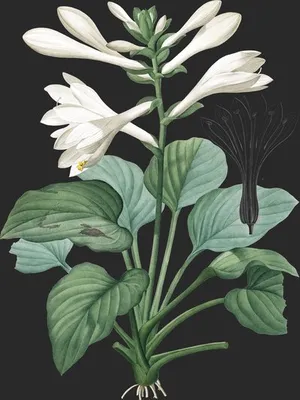
The plate is titled “Hæmanthus Albiflos”, numbered Plate 398 (book page 398). No reliable binomial survives on the plate, so it must be cited by its original title. Neither a Chinese name nor a reliable binomial survives: the plate can only be cited by its printed title, and left to speak for itself.
-
Form and Colour
Bulbous plants store the year underground — bulb, corm or tuber — then send up a few thick leaves and a single scape, with six tepals in cup, funnel or star. Filed under green — a moss green. That colour comes mostly from leaf, calyx and stem; the flower occupies a small patch. A botanical plate establishes the plant before it points at the bloom. A single plant, laid out on the sheet with nothing hidden.
-
Line and Colour
The first half of the nineteenth century moved from copper to steel to lithography. Stipple could render the softest transition — Redouté's roses depend on it — while lithography suited broad, gentle washes. Look closely at the line and the colour: an unbroken line means engraving, colour crossing the outline by half a millimetre means hand-colouring. Craft leaves franker evidence than inscriptions.
-
Composition
Nearly square, plant and details sharing the corners — an arrangement of a plate rather than a picture. (about 0.98 : 1). No details are appended: this is a plate for looking, not for keying out.
-
Season
Early spring to early summer, genus by genus: tulips and hyacinths first, gladiolus and amaryllis later. The year 1812 on the plate is the year of publication, not of flowering — the gathering came a year or two earlier.
-
Provenance
Three homelands: the Mediterranean, Central Asia and South Africa. The tulip came from Ottoman gardens and became a Dutch mania; South African bulbs filled European glasshouses after 1800. The volume was made in 1802-1816, when most of this knowledge came from living plants under glass rather than from the wild.
-
The Book
“The Liliaceae” was drawn by Pierre-Joseph Redouté and published 1802-1816. This plate is Plate 398, book page 398. The image is in the public domain; the hand-colouring on the paper is still one person's hand, two centuries ago.
-
Symbolism
The tulip was an imperial emblem in Istanbul and a speculative bubble in Amsterdam; the hyacinth sprang from a boy's blood in Greek myth. What bulbs share is concealment: next year kept underground. Flower language was added later; the flower knows nothing of it, and that innocence is part of its power.
-
Poetic Resonance
东风夜放花千树,更吹落、星如雨。
—— 宋·辛弃疾《青玉案·元夕》
East wind at night sets a thousand trees of flowers alight, then blows them down like rain of stars.
The poem gives the mood first and the picture supplies the form; set the line beside the plate and the green the corolla becomes its resting point.
-
Classical Lore
Li Bai's 'orchid wine, fragrant with yujin' is often misread as tulips; the Tang yujin was a turmeric-like root used to scent wine — same name, different plant. Chinese flower books ranked plants by character; European floras described them by form and name. This plate belongs to the second tradition, yet bears reading by the first. Printed in 1812, at the moment the two traditions began to see each other.
-
How to Look
Look at the base: tulips overlap in two whorls to make a cup, hyacinths pack small flowers into a spike, gladiolus sets its blooms in a single row facing one way. Finally, the edge of the sheet: where the plant is cropped tells you how it was seen — specimen, garden plant, or wild thing.
-
Afterword
Two centuries on, the plant may still flower in some garden; the one on this sheet stopped in the season of 1812.