Hyacinthus Viridis
伞花虎眼万年青·Hyacinthus Viridis
Jacinthe Verte
About this plate
Description
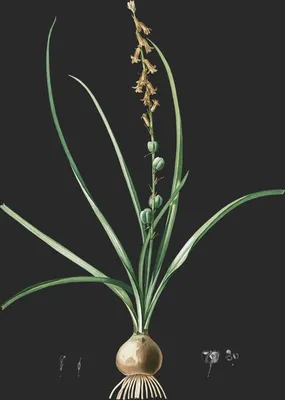
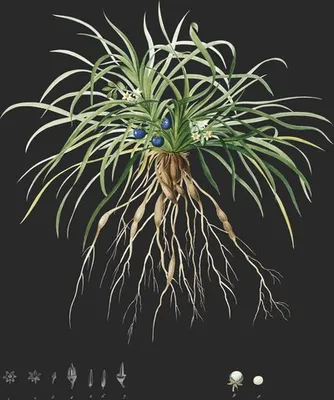
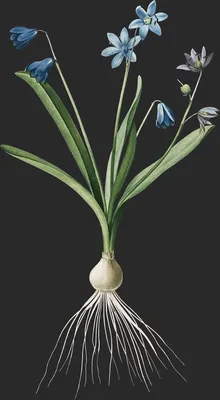
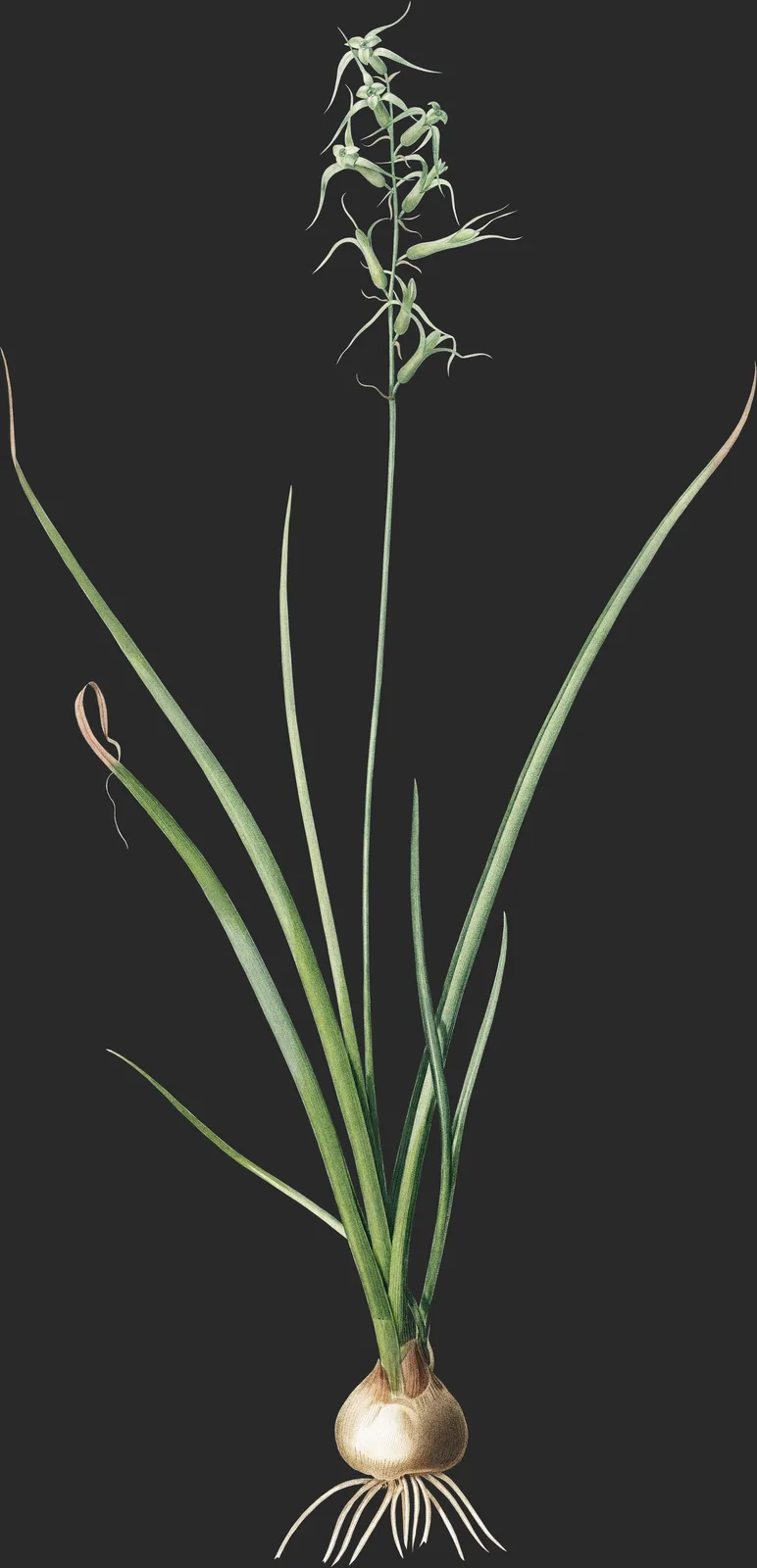
La bulbe de cette plante est arrondie, un peu déprimée, assez grosse; ses feuilles, qui naissent toutes de la racine, sont linéaires, étroites, peu nombreuses, un peu plus courtes que la hampe: celle-ci est droite, grêle, faible, longue de 2 à 4 décimètres, terminée par une grappe lâche composée de six à sept fleurs pédicellées, presque droites, très-remarquables par leur couleur verte et par la forme bizarre de leur périgone: à la base de chaque pédicelle est une bractée lancéolée, un peu plus longue que le pédicelle, et terminée en pointe très-acérée.
Le périgone est d’une seule pièce, en cloche alongée, à six lobes disposés sur deux rangs, divisés à-peu-près jusqu’au milieu de la longueur; les trois lobes extérieurs sont fort étroits, presque filiformes à leur sommet, étalés, longs de a centimètres; les trois intérieurs sont oblongs, droits, rapprochés, et de moitié au moins plus courts que les extérieurs. Les étamines ont des anthères jaunes, linéaires, presque sessiles à l’entrée du tube et cachées par les lobes intérieurs. L’ovaire est oblong, triangulaire, presque égal à la lon-queur du tube: le style est très-court, terminé par un stigmate épais. Je n’ai jamais vu mürir le fruit de cette plante, quoiqu’elle fleurisso souvent.
Histoire
La Jacinthe verte est originaire du Cap de Bonne-Espérance. On la cultive depuis 6o ans environ dans les jardins de botanique, où elle se distingue toujours par la singulière couleur de ses fleurs. ♃.
Elle fleurit en été.
Observations
Cette espèce et la précédente constituent un petit groupe particulier, inter-médinire entre les vraies Jacinthes et les Lachénales, et dont MM. Thunberg et Medikus ont fait un genre distinet; le premier, sous le nom de Zuccagnia; le second, sous celui de Dipcadi. Ce groupe dillère en effet des Lachénales, en ce que les trois lanières externes de la fleur, qui dans les Lachénales sont plus courtes que les intérieures, sont les plus longues dans les Zuccagnia; ce caractère étant d’égale valeur avec celui qui a autorisé la formation du genre Lachenalia, semblerait nécessiter l’adoption du Zuccagnia; mais cette diffe-rence de longueur des lanières de la fleur, qui est bien tranchée dans la Jacinthe verte, ne l’est presque pas dans la Jacinthe tardive, qui ctablit ainsi ume liaison entre les deux groupes. Ce motif m’a engagé à admettre la classification de M. Persoon, et à considérer les Zuccagnias, non comme un genre propre, mais comme une section prononcée parmi les Jacinthes.
Fam. des Asphodèles. Juss.—Hexandrie monogynie. Lin.
- Hyacinthus viridis. H. floribus campanulato-cylindraceis, laciniis exterioribus longissimis apice filiformibus recurvatis.
- Hyacinthus viridis. H. corollarum exterioribus laciniis subulatis longissimis. Lin. Spec. 454. Murr. comm. Gœtt. 1781. p. 44. t. 5. Jacq. ic. rar. 1. t. 66. Misc. 2. p. 331. Houtt. pfl. syst. 2. p. 418. t. 84. f. 1.
- Hyacinthus viridis. H. floribus viridibus, corollarum laciniis exterioribus subulatis longissimis. Lam. Dict. 3. p. 191.
- Hyacinthus viridis. H. petalis exterioribus subulatis longissimis, foliis linearibus canaliculatis scapo longioribus. Pers. ench. 1. p. 375.
- Zuccagnia viridis. Thunb. Diss. nov. gen. pl. par. ix. Rœm. arch. 2. p. 2.
- Lachenalia viridis. L. corollis cylindricis, laciniis exterioribus setaceo-acuminatis, foliis linearibus brevioribus. Thunb. prod. 64.
- Lachenalia viridis. L. corollis cylindricis, petalis tribus exterioribus longissimis subulatis. Ait. Kew. 1. p. 462.
- Lachenalia viridis. L. corollis campanulato-cylindricis pedunculatis, petalis exterioribus longissimis filiformibus recurvatis, folis lincaribus canaliculatis scapo longioribus. Willd. Spec. 2. p. 174.
- Dipcadi viride. D. racemo secundo, laciniis corollæ tribus exterioribus longissimis lanceolato-setaceis, foliis linearibus canaliculatis scapo brevioribus. Mænch. suppl. 267.
Ten ways of seeing
- measured cast amber
- upright 2.07 : 1
- published 1807
- Plate 203
Not a catalogue entry but a way of looking: how to stand, what to notice, how the line was cut — then, halfway, a line of Chinese poetry: how the ancients saw this same flower. After it, the flower's language, its season and homeland, its book; and at the end one line of classical prose — and a pair of eyes to take away.
-
First Look
搜尽奇峰打草稿。
—— 清·石涛《苦瓜和尚画语录》
Exhaust the strange peaks, and then make the sketch.
The sheet is vertical: the eye climbs and settles in the upper half. Let the plant stand before you look for detail. Then step in close: watch where colour meets line, and whether the line ever breaks. Third, find where the green is deepest: the whole tonal order is measured from that patch.
-
Name and Thing
The binomial is Jacinthe verte: the first word is the genus it belongs among, the second the epithet that sets it apart. Two words carry a whole provenance. The older system filed it under Asparagaceæ by overall affinity; Linnaeus, counting stamens only, placed it in Hexandria — two ways of asking what a plant is. No established Chinese name exists, so it is cited by its binomial alone.
-
Form and Colour
Measured on this plate: flower colour is sparing, 0.8% of the sheet against 3.0% of foliage, the cast tending amber — as with pale or white blooms, outline and tone do the talking. A bulb of overlapping fleshy scales gives the lily its Chinese name, 'hundred-fold'; six tepals reflex as the flower opens, around six stamens with long, T-shaped anthers. Filed under green — a moss green, a colour that comes mostly from leaf and stem. Read the outline, then the colour layers, then the brush.
-
Composition
Tall and narrow, the plant rising in one movement with generous margins — the upright format of most floras. (about 2.07 : 1) No details are appended: a plate for looking, not for keying out. The plant covers only 8% of the sheet, centred below centre; the emptiness is where the eye rests. Blank paper is not unfinished work: it is where the eye rests.
-
Line and Colour
The first half of the nineteenth century moved from copper to steel to lithography; stipple could render the softest transition. Decide first whether it was printed or painted; only then discuss whether it is beautiful. If you mean to copy it: take its skeleton, its margins and the order of its colours; the burin's hatching is the language of copper — suggest it with pencil density, do not imitate it stroke for stroke.
-
Poetic Resonance
更乞两丛香百合,老翁七十尚童心。
—— 宋·陆游《窗前作小土山蓻兰及玉簪最后得香百合并种之戏作》
The poem gives the mood first and the picture supplies the form; set the line beside the plate and the green the corolla becomes its resting point.
-
Symbolism
In the West the white lily is Marian purity, held by the angel of the Annunciation; in China the name sounds like 'a hundred years in harmony', a wedding wish. Flower language was added later; the flower knows nothing of it, and that innocence is part of its power.
-
Season and Place
the flowers last only days, so artists drew them just as they opened. Temperate north — China, Japan, Europe. Long used in Chinese medicine, lilies were hunted in East Asia by nineteenth-century collectors and transformed European gardens. The year 1807 on the plate is that of publication, not of flowering — the gathering came a year or two earlier. The volume was made in 1802-1816, when most of this knowledge came from living plants under glass.
-
The Book and the Hand
“The Liliaceae” was drawn by Pierre-Joseph Redouté and published 1802-1816. This plate is Plate 203, book page 203. The image is public domain; the hand-colouring is still one person's hand.
-
The Written Tradition
百合之根,以众瓣合成也。
—— 明·李时珍《本草纲目·菜部》
The root of the lily is many scales gathered into one — hence the name bai he, “a hundred joined”.
The Bencao Gangmu describes the bulb as garlic-like, edible and medicinal; Song writers already noted that the leaves vary while the flowers stay white. Keep the line; it will surface the next time you meet the same plant.
What to Take Away
Carry three rules away: whole before detail; line before colour; picture before book. The flower of that year is dust, yet its image on paper has outlived every living cousin.