Ornithogalum Arabicum
Ornithogale d’Arabie
Ornithogale d’Arabie
About this plate
Description
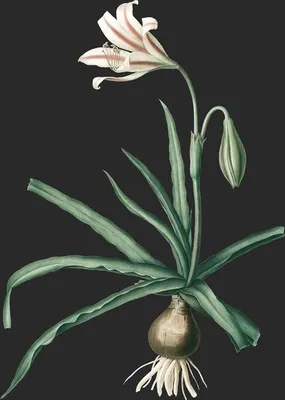
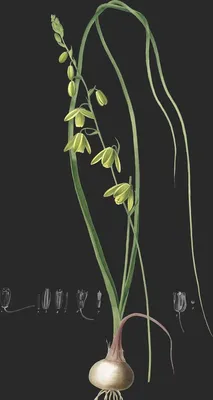
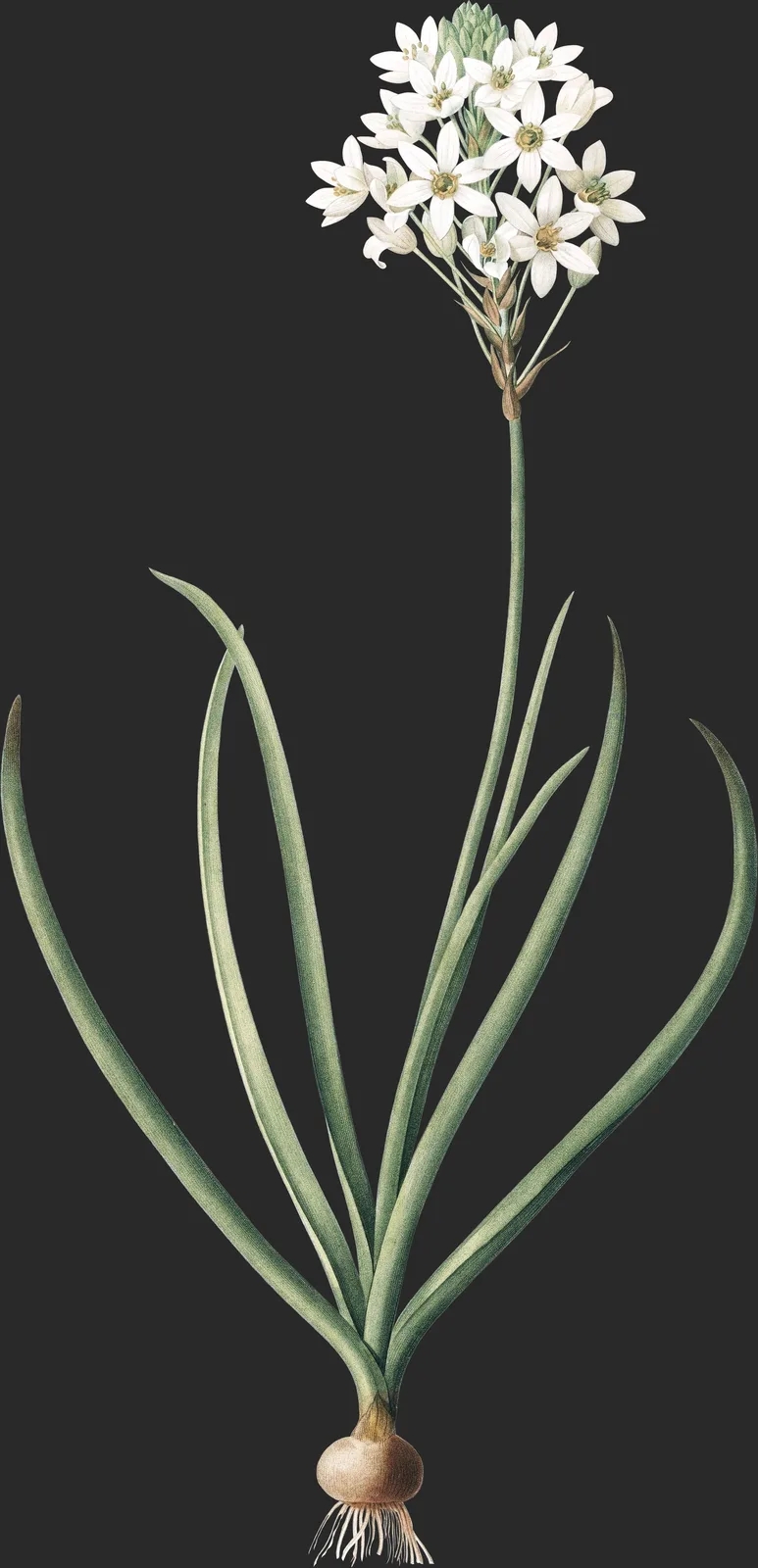
Le nom de Melanomphale que Reneaulme avait donné à l’Ornithogale d’Arabie, et qu’on aurait peut-être dû lui conserver, indique mieux que nos phrases spécifiques le caractère vraiment distinetif de cette plante; c’est-à-dire, la couleur noire de son ovaire comparée avec la blancheur de la corolle.
Cette belle Liliacée sort d’une bulbe blanchâtre, revêtue de plusieurs tu-niques; elle pousse des feuilles glabres assex semblables à celles de la Jacinthe d’Orient; du milieu d’entre elles s’élève, à la hauteur de 3–5 décimètres, une hampe droite et cylindrique; elle porte à son sommet une grappe de fleurs assez courte, et qui semble un véritable corymbe, parce que les pédicelles inférieurs s’alongent de manière que les fleurs sont presque toutes placées à la même hauteur. A la base de chaque pédicelle est une bractée concave, lan-céolee, pointue, demifoliacée, égale à la longueur du pédicelle avant la flo-raison, devenant ensuite de moitié plas courte à l’époque de la maturité.
La corolle a la forme d’une large cloche, et se divise très-profondément en six lanières ovales-oblongues, concaves, un peu obtuses; les trois lanières exté. rieures se terminent par une petite masse calleuse, qui se divise quelquefois en trois dentelures.
Les filaments des étamines sont blancs, comprimés, de moitié plus courts que la corolle, et alternativement larges ou étroits à leur base; ils portent des anthères jaunes, droites, ovales-oblongues, remplies d’un pollen jaune. L’ovaire est presque globaleux, lisse, d’un vert foncé, surtout à la fin de la floraison, à peu près caché à la naissance de la fleur par les appendices, qui se trouvent à. la base des filaments des étamines placées devant les lanières intérieures de la corolle; le style est blanc, filiforme, égal à la longueur des organes máles, terminé par un stigmate épais, à trois dents obtuses.
Le fruit n’a pas mari dans les serres du Muséum, ou nous avons décrit cette plante; d’après Desfontaines, c’est une capsule oblongue, obtuse, à trois an-gles, a trois valves, à trois loges, pleines de graines noires et anguleuses.
Histoire
Cet Ornithogale est orginaire des pays qui entourent la Méditerranée: on l’a trouvé en Arabie, en Syrie, aux environs d’Alexandrie, d’Alger, et dernièrement enfin dans l’ile de Corse, d’où il a été rapporté par MM. Miot et Noisette. ♃.
Il fleurit à l’entrée du printemps; dans son pays natal, il se plait dans les champs cultivés; dans nos jardins, on le cultive dans la serre tempérée.
Fam. des Asphodèles. Juss.—Hexandrie mongynie. Lin.
- Ornithogalam arabicum. O. floribus corymbosis, pedunculis scapo humilio-ribus, filamentis subemarginatis. Lin. Spec. 441. Desf. atl. 1. p. 296. Roy. Lugd-b. 39. Mill. Dict. n. 8. Poi. Voy. a. p. 148. Lam. Dice. 4. p. 616.
- Ornithogalum arabicum. O. corymbo multifloro, filamentis subulatis, corollà late campanulata, petalis exterioribus obsoletè tridentatis. Ait. Kew. 1. p. 419. Willd. Spec. 3. p. 193.
- Ornithogalum arabicum. Clus. Hist. 186. ic. Besl. Eynst. ver. 5. 1. 19. f. 1.
- Ornithogalum umbellatum maximum. C. Bauh. Pin. 69. Tourn. Inst. 378. Shaw. Specim. n. 448. Rudb. Elys. 9. p. 130. f. 1.
- Ornithogalum majus. Dod. Pempt. 291. ic.
- Lilium alexandrinum Neotericorum. Lob. Ic. 149.
- Lilium alexandrinum, sive Ornithogalum majus syriacum. J. Bauh. Hist. 2. p. 639. ic.
- Melanomphale. Reneaulm. Specim. 89. 1. 90.
Twelve ways of seeing
- measured cast amber
- upright 2.07 : 1
- published 1804
- Plate 63
Not a catalogue entry but a way of looking: how to stand, what to notice, how the line was cut, when it flowers, where it came from, who made it — and then the poems and the classics that taught China to see the same flower. Read the twelve in order and the plate opens.
-
First Look
凡画山水,意在笔先。
—— 唐·王维《山水论》
In painting, the intention precedes the brush.
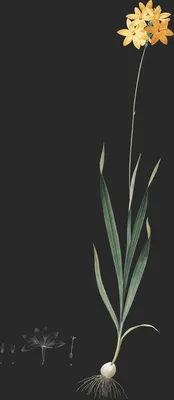
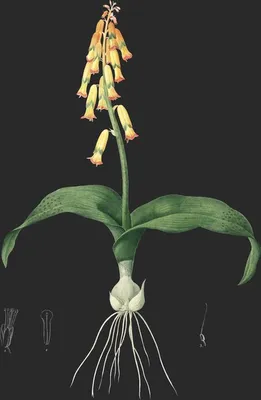
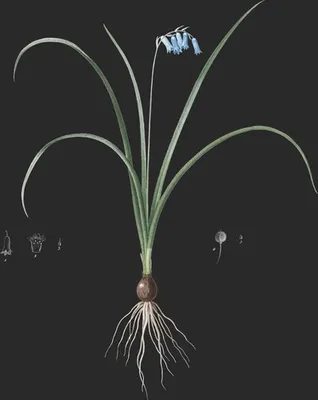
The sheet is vertical: the eye climbs and settles in the upper half. Let the plant stand before you look for detail. Then step in close: watch where colour meets line, and whether the line ever breaks. Third, find where the green is deepest: the whole tonal order is measured from that patch. The pose leans right: the upper half carries 11 points further right than the lower — a living thing, not a diagram.
-
Name and Thing
The binomial is Ornithogalum arabicum: the first word is the genus it belongs among, the second the epithet that sets it apart. Two words carry a whole provenance. The older system filed it under Asphodelaceæ by overall affinity; Linnaeus, counting stamens only, placed it in Hexandria — two ways of asking what a plant is. No established Chinese name exists, so it is cited by its binomial alone.
-
Form and Colour
Measured on this plate: flower colour is sparing, 1.0% of the sheet against 3.6% of foliage, the cast tending amber — as with pale or white blooms, outline and tone do the talking. Bulbous plants store the year underground — bulb, corm or tuber — then send up a few thick leaves and a single scape, with six tepals in cup, funnel or star. Filed under green — a moss green, a colour that comes mostly from leaf and stem. Read the outline, then the colour layers, then the brush.
-
Composition
Tall and narrow, the plant rising in one movement with generous margins — the upright format of most floras. (about 2.07 : 1) No details are appended: a plate for looking, not for keying out. The plant covers only 15% of the sheet, centred near the centre; the emptiness is where the eye rests. Blank paper is not unfinished work: it is where the eye rests.
-
Line and Colour
The first half of the nineteenth century moved from copper to steel to lithography; stipple could render the softest transition. Decide first whether it was printed or painted; only then discuss whether it is beautiful.
-
Season
Early spring to early summer, genus by genus: tulips and hyacinths first, gladiolus and amaryllis later. The year 1804 on the plate is that of publication, not of flowering — the gathering came a year or two earlier. Note the season. Phenology is the most practical tool of appreciation.
-
Provenance
Three homelands: the Mediterranean, Central Asia and South Africa. The tulip came from Ottoman gardens and became a Dutch mania; South African bulbs filled European glasshouses after 1800. The volume was made in 1802-1816, when most of this knowledge came from living plants under glass.
-
The Book and the Hand
“The Liliaceae” was drawn by Pierre-Joseph Redouté and published 1802-1816. This plate is Plate 63, book page 63. The image is public domain; the hand-colouring is still one person's hand.
-
Poetic Resonance
卢家少妇郁金堂,海燕双栖玳瑁梁。
—— 唐·沈佺期《古意呈補闕喬知之》
The poem gives the mood first and the picture supplies the form; set the line beside the plate and the green the corolla becomes its resting point.
-
The Written Tradition
论画以形似,见与儿童邻。
—— 宋·苏轼《书鄢陵王主簿所画折枝》
To judge a painting by likeness alone is the view of a child.
Li Bai's 'orchid wine, fragrant with yujin' is often misread as tulips; the Tang yujin was a turmeric-like root used to scent wine — same name, different plant. Keep the line; it will surface the next time you meet the same plant.
-
Symbolism
The tulip was an imperial emblem in Istanbul and a speculative bubble in Amsterdam; the hyacinth sprang from a boy's blood in Greek myth. What bulbs share is concealment: next year kept underground. Flower language was added later; the flower knows nothing of it, and that innocence is part of its power.
-
What to Take Away
Carry three rules away: whole before detail; line before colour; picture before book. The flower of that year is dust, yet its image on paper has outlived every living cousin.