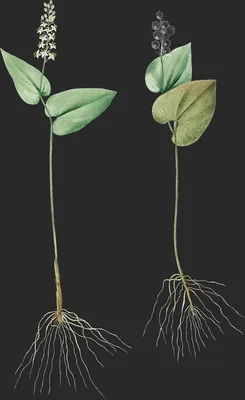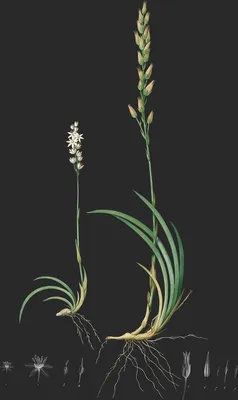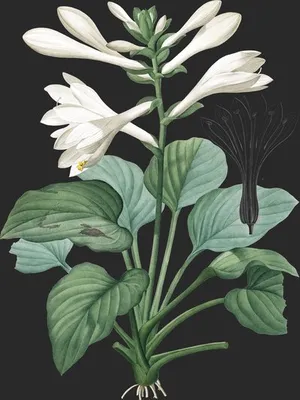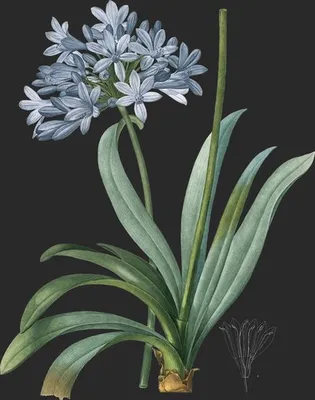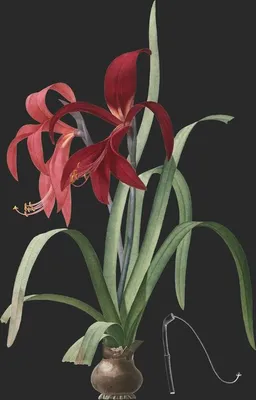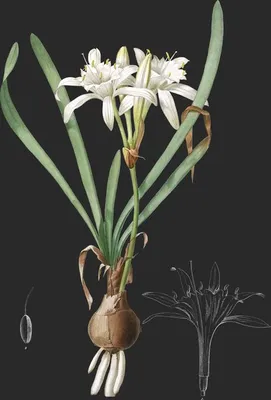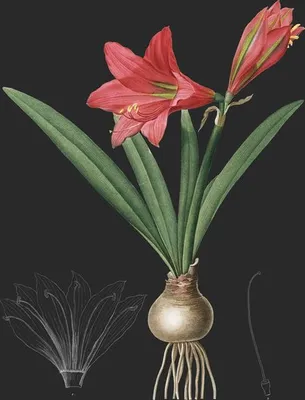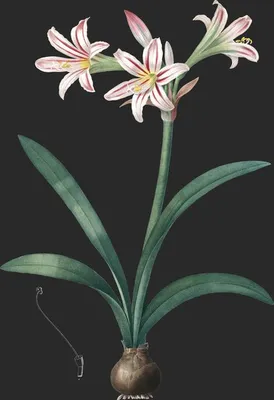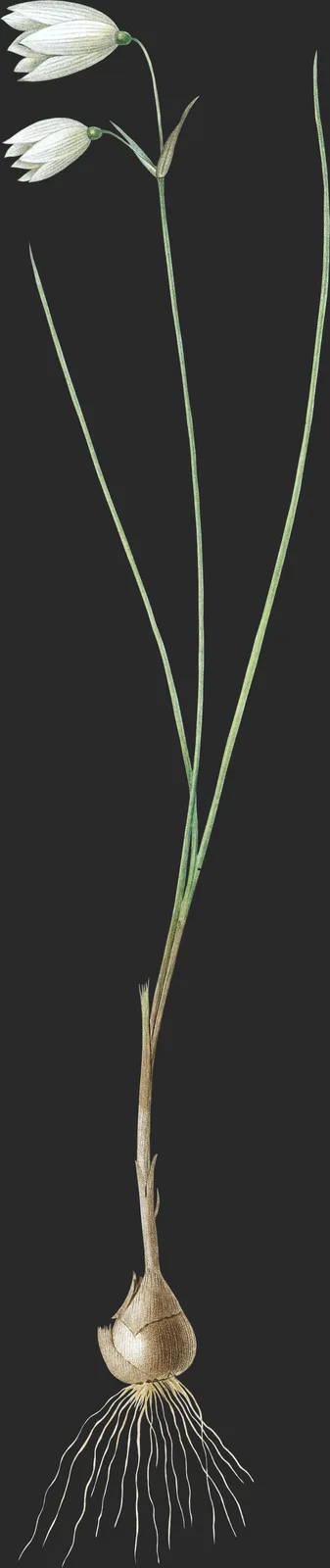
Leucoium Grandiflorum
Nivéole a Grandes Fleurs
Nivéole a Grandes Fleurs
Ten ways of seeing
- measured cast amber
- upright 4.75 : 1
First Look
江馆清秋,晨起看竹,烟光日影露气,皆浮动于疏枝密叶之间。
—— 清·郑板桥《题画竹》
On an autumn morning at the river lodge I looked at the bamboo: mist, sunlight, dew, all drifting among the sparse and dense leaves.
The sheet is vertical: the eye climbs and settles in the upper half. Let the plant stand before you look for detail. Then step in close: watch where colour meets line, and whether the line ever breaks. Third, find where the orange is deepest: the whole tonal order is measured from that patch.
Name and Thing
The binomial is Leucoium grandiflorum: the first word is the genus it belongs among, the second the epithet that sets it apart. Two words carry a whole provenance. The older system filed it under Amaryllidaceæ by overall affinity; Linnaeus, counting stamens only, placed it in Hexandria — two ways of asking what a plant is. No established Chinese name exists, so it is cited by its binomial alone.
Form and Colour
Measured on this plate: flower colour covers 1.6% of the sheet, foliage 1.1%, the cast amber with a second note of yellow-green. No other plate shares exactly this measure. Bulbous plants store the year underground — bulb, corm or tuber — then send up a few thick leaves and a single scape, with six tepals in cup, funnel or star. Filed under orange — an amber orange, built in washes from a pale ground. A single plant, laid out with nothing hidden.
Composition
The sheet is tall. No details are appended: a plate for looking, not for keying out. The plant covers only 9% of the sheet, centred a little left of centre; the emptiness is where the eye rests.
Line and Colour
The first half of the nineteenth century moved from copper to steel to lithography; stipple could render the softest transition. There is evidence on the back too: the plate mark pressed into the paper, the slight relief of the pigment, lines worn shallow in a later printing. If you mean to copy it: take its skeleton, its margins and the order of its colours; the burin's hatching is the language of copper — suggest it with pencil density, do not imitate it stroke for stroke.
Poetic Resonance
满园花菊郁金黄,中有孤丛色似霜。
—— 唐·白居易《重陽席上賦白菊》
The poem gives the mood first and the picture supplies the form; set the line beside the plate and the orange the corolla becomes its resting point.
Symbolism
The tulip was an imperial emblem in Istanbul and a speculative bubble in Amsterdam; the hyacinth sprang from a boy's blood in Greek myth. What bulbs share is concealment: next year kept underground. This plate leans orange, which in flower language adds one more degree of feeling. In a flora it is a species first and a symbol second; the order is worth keeping.
Season and Place
Early spring to early summer, genus by genus: tulips and hyacinths first, gladiolus and amaryllis later. Three homelands: the Mediterranean, Central Asia and South Africa. The tulip came from Ottoman gardens and became a Dutch mania. The year 1807 on the plate is that of publication, not of flowering — the gathering came a year or two earlier. Read the locality and the flowering season both with a discount: one is hearsay, the other a ten-day peak.
The Book and the Hand
“The Liliaceae” carries only Pierre-Joseph Redouté's name. The image is public domain; the hand-colouring is still one person's hand.
What to Take Away
Next time you stand before a flowering plant, give it three minutes: leaf arrangement, direction of the flower, the darkest patch. A flora exists to be consulted; look long enough and you forget to consult — someone in 1807 gave a whole day to a single flower.
About this plate
Description
Une bulbe ovoïde, recouverte de tuniques brunes, de la grosseur d’une cerise, donne naissance à plusieurs fibres radicales simples. Elle émet de sa partie supérieure quelques feuilles dont les extérieures sont réduites à de simples écailles embrassantes, et dont les intérieures sont droites, grêles, planes, linéaires, très-étroites, presque obtuses, aussi longues que la tige.
Celle-ci est nue, grèle, longue de trois décimètres, cylindrique, glabre, ainsi que la totalité de la plante. Elle porte à son sommet deux fleurs blanches portées chacune sur un pédicelle propre, penchées au temps de la fleuraison. Ces fleurs ont à la base des pédicelles une spathe à deux valves opposées, mem-braneuses, oblongues, pointues, un peu concaves, plus courtes que les pédi-celles: ceux-ci sont presque toujours inégaux en longueur.
Le périgone est adhérent par sa base avec l’ovaire, à six parties ovales-oblongues, un peu pointues, mais nullement calleuses au sommet, longues de so à 25 millimètres, marquées de 5 à 7 veines longitudinales, disposées a-peu-prés en forme de cloches.
Les étamines ont des filaments très-courts: elles sont placées au fond de la cloche, devant chacun des lobes du périgone. Leurs anthères sont jaunes, linéaires, & deux loges qui s’ouvrent par deux pores à l’extrémité.
L’ovaire est sous la fleur, globuleux, verdâtre. Le style est grêle, simple, filiforme. Le stigmate est simple.
Je n’ai pas vu le fruit.
Histoire
Cette plante croit dans le royaume de Maroc, où elle a été observée par MM. Schousboë et Broussonet. Elle n’est point cultivée dans les jardins d’Europe, et la figure qu’on en voit ici est faite d’après un échantillon très-bien desséché. Nous la donnons afin d’éclaircir la synonymie de cette plante, dont nous avons déja fait mention au № 150 de cet ouvrage.
Nous avions regardé cette plante et celle à fleur rose décrite plus haut comme deux variétés d’une même espèce; mais elles constituent certainement deux espèces dillérentes. Celle-ei diffère de la première, parce qu’elle a constamment deux fleurs, que ces fleurs sont blanches, et deux fois plus grandes. Nous lui avons donné le nom de Nivéole à grande fleur, pour éviter la confusion que le nom de Trichoplyllum pourrait faire naitre. Ce nom a été primitivement donne par Rencaulme au Leucoum autannale, qui aurait dû le conserver. M. Schousboe la transporté à l’espèce que nous présentons ici. Nous l’avons nous-même attribué à l’espèce à fleur rose. Nous croyons donc plus convenable de donner à notre plante le nom de Lescoium grandiforum; et à celle du numéro 150, celui de Leucoium roseum que M. Martin lui avait primitivement donné. Voici sa phrase spécifique et sa synonymie.
Fam. des Narcisses. Juss.—Hexandrie monogynie. Lin.
- Leucoium trichophyllum. L. spatha diphylla biflorá, petalis lanceolatis acutis, stylo filiformi. Schousb. Maroc. p. 140. Pers. ench. 1. p. 349. non syn.
- Leucoium trichophyllum. A. Lil. vol. 3. n. 150.
- Leucoium roseum. L. spathâ bivalvi unillorâ, petalis lanceolatis acutis, stylo filiformi.
- Leucoium roseum. Martin. bibl. plys. econ. n. v. pluv. an 13. Lois. Fl. gall. 1. p. 190. t. 8.
- Leucoium trichophyllum. B. Lil. n. 150. t. 150. f. 1. syn. n. 1986.