Lilium Bulbiferum
Lis Bulbifère
Lis Bulbifère
About this plate
Observations
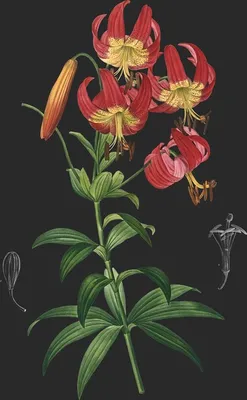
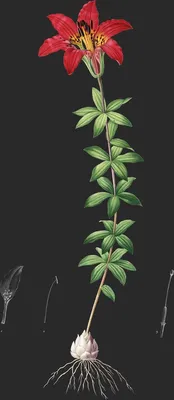
Le Lis bulbifère est si répandu et si bien connu, que nous croyons inutile d’en donner ici une description; mais nous appellerons plutôt l’attention des botanistes sur les variétés de cette plante, que nous classons principalement d’après l’excellent article inséré à ce sujet par M. Lamarck dans le Dictionnaire encyclopédique.
La variété A, qui est peut-être la souche originale d’une espèce distincte, se trouve sauvage dans différentes parties de l’Europe, en Suisse, en Dau-phiné, en Provence, etc. Elle ne porte pas de bulbes sur sa tige; ses feuilles sont souvent à cinq nervures plus prononcées que les autres; sa fleur est tachetée de points noirs à l’intérieur.
La variété B se trouve cultivée dans presque tous les jardins, à cause de la beauté de ses fleurs et de la facilité que la présence des bulbes donne pour sa multiplication. Elle a été trouvée sauvage en Autriche et en Styrie, d’après le témoignage de l’Ecluse. Elle porte des bulbes sessiles à l’aisselle des feuilles et à l’origine des pédoncules; ses feuilles sont un peu plus étroites et à trois nervures saillantes.
La variété C est conservée dans les jardins sous les noms de Lis-orange-nain ou de Lis de feu. Elle n’a pas encore été trouvée sauvage, et diffère fort peu de la précédente: sa tige est de moitié plus basse, garnie de bulbes axillaires, et ne porte qu’une ou deux fleurs.
Ces trois races différentes offrent encore quelques variétés connues des jar-diniers, notamment celles à fleurs doubles, celles à feuilles panachées, etc.
La variété D, qui n’est connue que par la description que Thunberg en a donnée dans les Transactions Linnéennes, est originaire du Japon, et parait différer beaucoup des races ci-dessus désignées. Elle a les feuilles supérieures verticillées trois ou quatre ensemble, élargies à leur base, presque embriquées les unes sur les autres; elle ne parait pas porter de bulbes: au reste, la description est trop incorrecte pour qu’on puisse avoir aucune opinion fixe à l’égard de cette plante. La phrase spécifique dit que la tige est velue, et la description qu’elle est glabre. La première parle des fleurs comme si elles étaient nom-breuses; la seconde comme si elles étaient solitaires.
Fam. des Lis. Juss.—Hexandrie monogynie. Lin.
- Lilium bulbiferum. L. foliis sparsis, floribus campanulatis erectis intùs scabris. Lin. Spec. 433. hort. Cliff. 120. hort. Ups. 80. Rey. Lugd-b. 31. Gmel. Sib. 1. p. 41. Gron. orient. 104. Jacq. Austr. t. 226. Scop. carn. n. 404. Knorr. del. 1. t. 1. 4. Hoffm. Germ. 118. Roth. Germ. I. 152. II. 396. Willd. Spec. 2. p. 85. Lam. Dict. 3. p. 535. Flor. fr. 3. p. 202. n. 1911.
- A. Caule non bulbifero.
- Lilium croceum Chaix. in Vill. Dauph. 1. p. 322. Pers. ench. 1. p. 358.
- Lilium bulbiferum. Vill. Dauph. 2. p. 275. Jacq. Austr. t. 226. Scop. carn. № 404.
- Lilium caule folioso, foliis sulcatis, floribus campanulatis, intùs floccosis. Hall. Helv. n. 1232.
- Lilium purpureo croceum majus. C. Bauh. pin. 76. Tourn. inst. 369. Moris. hist. 2. p. 411. s. 4. t. 21. f. 17.
- Lilium rubens seu croceum majus. J. Bauh. 2. p. 688. Ray. hist. 1110. № 3.
- Lilium purpureum majus. Dod. pempt. 198.
- Martagon chymistarum. Lob. icon. t. 164. f. 1. 2.
- B. Caule bulbifero multifloro elato.
- Lilium bulbiferum. Mill. Dict. № 3. Pers. ench. 1. p. 358.
- Lilium bulbiferum latifolium majus. C. Bauh. pin. 77. Tourn. inst. 370. Moris. hist. 3. p. 411. s. 4. t. 21. f. 19.
- Lilium bulbiferum majus. J. Bauh. 2. p. 690.
- Lilium cruentum bulbos majusculos squamatim compactos gerens. Lob. icon. 1. 165. f. 1. 2.
- Martagon bulbiferum. Clus. hist. 1. p. 136. 137. f. 1. 2. 3.
- C. Caule bulbifero paucilloro humili.
- Lilium humile. Mill. Dict. № 4.
- Lilium bulbiferum minus. C. Bauh. pin. 77.
- Lilium purpureo-croceum minus. C. Bauh. pin. 77. Tourn. 370.
- Lilium purpureum minus. Dod. pempt. 198.
- Lilium croceum. Fuchs. hist. 365. ic.
- D. Caule non bulbifero (?), foliis basi latioribus superioribus verticillatis inferioribus sparsis.
- Lilium philadelphicum Thunb. Jap. 135.
- Lilium bulbiferum. Thunb. act. soc. Lin. 2. p. 333.
Ten ways of seeing
- measured cast yellow-green
- upright 1.41 : 1
- published 1807
- Plate 210
Not a catalogue entry but a way of looking: how to stand, what to notice, how the line was cut — then, halfway, a line of Chinese poetry: how the ancients saw this same flower. After it, the flower's language, its season and homeland, its book; and at the end one line of classical prose — and a pair of eyes to take away.
-
First Look
六法者何?一、气韵生动是也;二、骨法用笔是也;三、应物象形是也;四、随类赋彩是也;五、经营位置是也;六、传移模写是也。
—— 南齐·谢赫《古画品录》
The six laws: spirit resonance alive; bone-method in the brush; matching form; colour by kind; planning the placing; copying the masters.
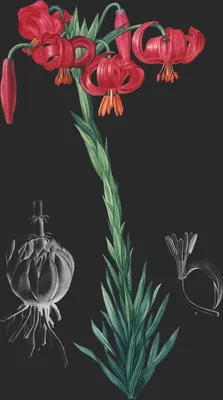
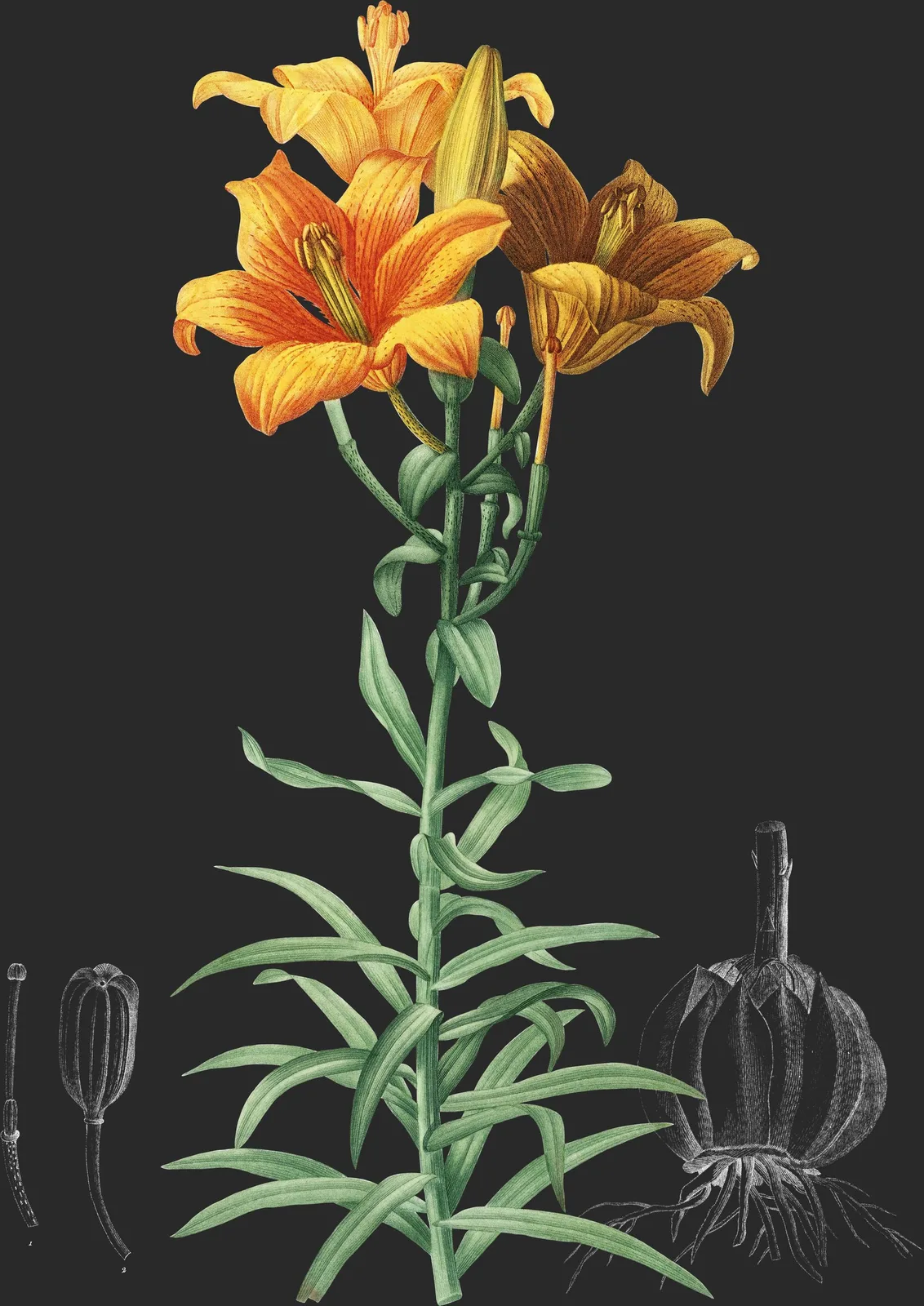
The sheet is vertical: the eye climbs and settles in the upper half. Let the plant stand before you look for detail. Then step in close: watch where colour meets line, and whether the line ever breaks. Third, find where the yellow is deepest: the whole tonal order is measured from that patch.
-
Name and Thing
The binomial is Lilium bulbiferum: the first word is the genus it belongs among, the second the epithet that sets it apart. The genus name Lilium: Lilium comes from Greek leirion, the classical name for the white lily. The older system filed it under Liliaceæ by overall affinity; Linnaeus, counting stamens only, placed it in Hexandria — two ways of asking what a plant is. No established Chinese name exists, so it is cited by its binomial alone.
-
Form and Colour
Measured on this plate: flower colour covers 10.3% of the sheet, foliage 7.4%, the cast yellow-green with a second note of amber. No other plate shares exactly this measure. A bulb of overlapping fleshy scales gives the lily its Chinese name, 'hundred-fold'; six tepals reflex as the flower opens, around six stamens with long, T-shaped anthers. Filed under yellow — a honey-yellow, built in washes from a pale ground. Read the outline, then the colour layers, then the brush.
-
Composition
Tall and narrow, the plant rising in one movement with generous margins — the upright format of most floras. (about 1.41 : 1) No details are appended: a plate for looking, not for keying out. The plant covers only 23% of the sheet, centred near the centre; the emptiness is where the eye rests. Blank paper is not unfinished work: it is where the eye rests.
-
Line and Colour
The first half of the nineteenth century moved from copper to steel to lithography; stipple could render the softest transition. Decide first whether it was printed or painted; only then discuss whether it is beautiful. If you mean to copy it: take its skeleton, its margins and the order of its colours; the burin's hatching is the language of copper — suggest it with pencil density, do not imitate it stroke for stroke.
-
Poetic Resonance
故乡寒食荼醾发,百合香浓邸舍深。
—— 宋·宋祁《山橙花》
The poem gives the mood first and the picture supplies the form; set the line beside the plate and the yellow the corolla becomes its resting point.
-
Symbolism
In the West the white lily is Marian purity, held by the angel of the Annunciation; in China the name sounds like 'a hundred years in harmony', a wedding wish. This plate leans yellow, which in flower language adds one more degree of feeling. Meanings change their tune: the same flower can say opposite things within a century.
-
Season and Place
Early to high summer, June and July. Temperate north — China, Japan, Europe. Long used in Chinese medicine, lilies were hunted in East Asia by nineteenth-century collectors and transformed European gardens. The year 1807 on the plate is that of publication, not of flowering — the gathering came a year or two earlier. Read the locality and the flowering season both with a discount: one is hearsay, the other a ten-day peak.
-
The Book and the Hand
“The Liliaceae” was drawn by Pierre-Joseph Redouté and published 1802-1816. This plate is Plate 210, book page 210. The image is public domain; the hand-colouring is still one person's hand.
-
The Written Tradition
百合之根,以众瓣合成也。
—— 明·李时珍《本草纲目·菜部》
The root of the lily is many scales gathered into one — hence the name bai he, “a hundred joined”.
The Bencao Gangmu describes the bulb as garlic-like, edible and medicinal; Song writers already noted that the leaves vary while the flowers stay white. You need not parse every word: take the line, and the flower acquires a second face.
What to Take Away
If you keep one line, keep Guo Xi's: from afar its momentum, up close its texture. The flower of that year is dust, yet its image on paper has outlived every living cousin.