Lilium Pyrenaicum
田旋花
Lis des Pyrénées
About this plate
Description
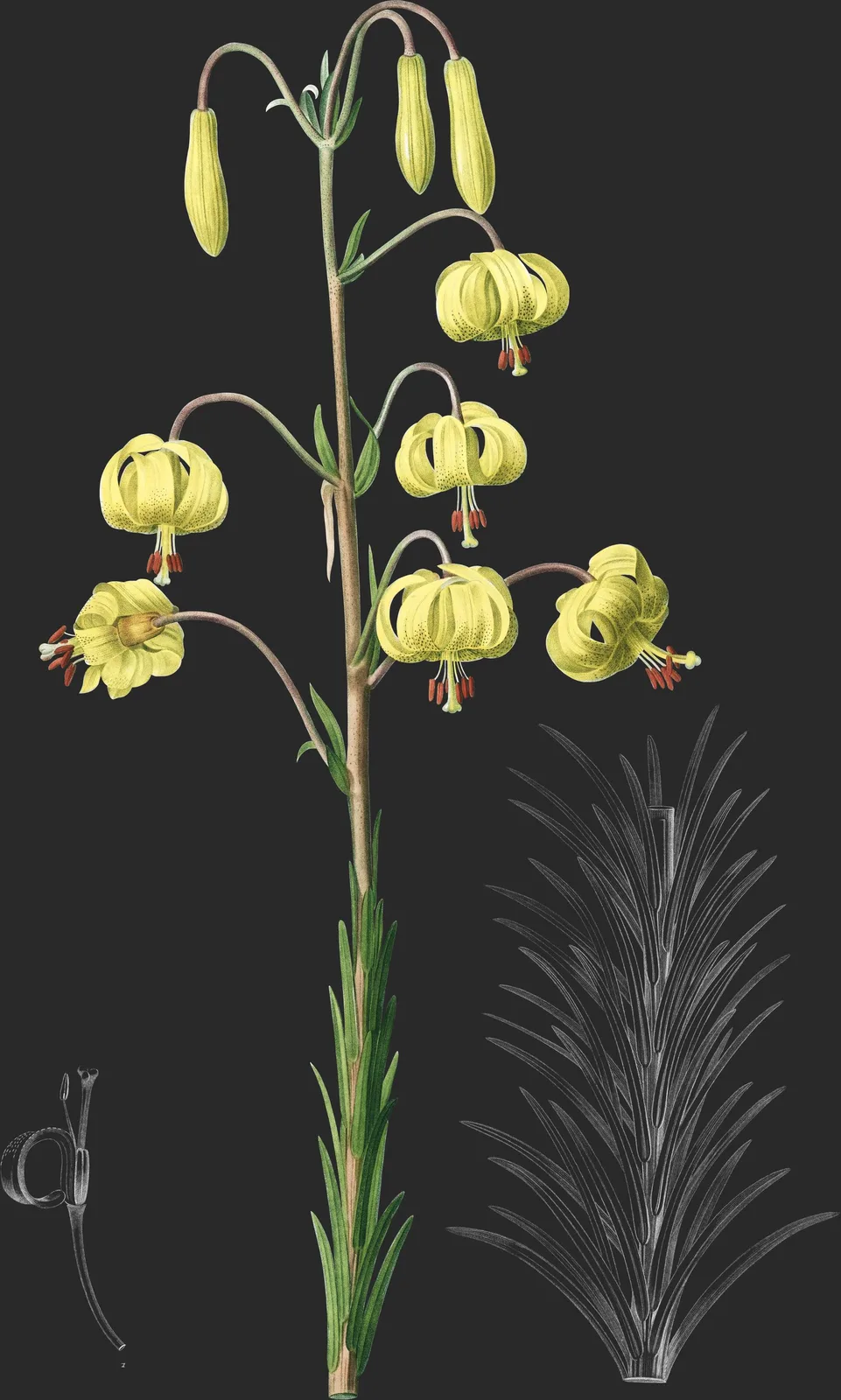
Cette plante a beaucoup de rapport avec le Lis pompon que nous avons représenté, planche 7 de cet ouvrage; mais elle parait en dillérer d’une manière constante par ses fleurs jaunes en petit nombre, et presque disposées en ombelle.
Une bulbe arrondie, jaunâtre, dont les écailles sont la plupart marquées de trois sillons, donne naissance à une tige droite, ferme, simple, épaisse comme le petit doigt, et qui s’élève à 7–8 décimètres de hauteur. Ses feuilles sont éparses, nombreuses, rapprochées les unes des autres, étroites, linénires-lancéolées, nerveuses en dessous, bordées de petits cils blanchâtres, et plus petites a mesure qu’elles approchent du haut de la plante.
Les fleurs sont pédonculées, souvent terminales et commedisposées en ombelle, au nombre de 1 à 3 dans la plante sauvage, un plus grand nombre dans les individus cultivés, pendantes à peu près comme dans le Martagon. Les pédicelles sont alongés, mouchetés de taches noirâtres, munis de deux petites feuilles à leur base.
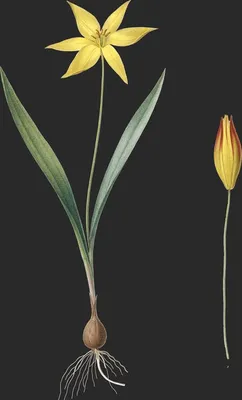
Les corolles sont de couleur jaune, un peu verdatres à leur base du côté extérieur, composées de six pétales oblongs, roulés en dehors, marqués à l’intérieur de petites proéminences noiratres ou violettes. Les étamines portent des anthères couleur de minium. Le style se termine par un gros stigmate à troislobes.
Histoire
Cette belle espèce de Lis croit naturellement dans les pentes herbeuses des Pyrénées, principalement au mont Laurenti. ♃.
On la cultive dans le Jardin des Plantes de Paris, depuis longtemps, sans que ses caractères se soient altérés. Elle y était deja eultivée du temps de Robin, qui la le premier fait connaitre à l’Ecluse. Celui-ci en a publié deux bonnes figures, accompagnées d’une description. Tous les anciens botanistes regardaient cette plante comme distinete du Lis pompon; elle fut ensuite oubliée jusqu’en 1773, que M. Gouan en publia une nouvelle description.
Elle peut servir à l’ornement des bosquets, parce qu’elle aime les lieux frais et un peu ombragés; son odeur est un peu désagréable.
Explication de la planche
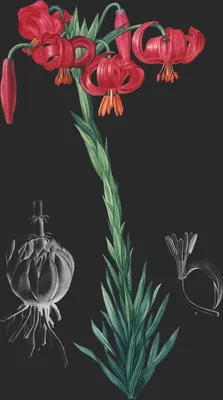
La plante de grandeur naturelle, coupée en deux morceaux.
- Le pistil, une étamine et un pétale dans leur position.
Fam. des Lis. Juss.—Hexandrie monogynie. Lin.
- Lilium pyrenaicum. L. corollis revolutis, foliis sparsis lanceolatis, floribus flavis paucis subumbellatis. Lil. n. 103. Fl. franç. ed. 3. n. 1913.
- Lilium pyrenaicum. L. foliis lanceolatis sparsis, floribus subumbellatis, corollis revolutis. Gouan. obs. p. 25. Desf. cat. 24.
- Lilium flavam. Lam. Fl. franç. 3. p. 283.
- Lilium pomponium, var. β. Lam. Dict. 3. p. 536.
- Lilium flavum angustifolium. C. Bauh. pin. 79. Tourn. inst. 371. Ray. ext. 355.
- Lilium nutante flore flavo. J. Bauh. hist. 2. p. 697.
- Lilium montanum flavo flore. Clus. hist. append. p. 256. fig. 1 et 2. Lob. adv. ?. 505. ??.
Twelve ways of seeing
- measured cast yellow-green
- upright 1.67 : 1
- published 1805
- Plate 145
Not a catalogue entry but a way of looking: how to stand, what to notice, how the line was cut, when it flowers, where it came from, who made it — and then the poems and the classics that taught China to see the same flower. Read the twelve in order and the plate opens.
-
First Look
六法者何?一、气韵生动是也;二、骨法用笔是也;三、应物象形是也;四、随类赋彩是也;五、经营位置是也;六、传移模写是也。
—— 南齐·谢赫《古画品录》
The six laws: spirit resonance alive; bone-method in the brush; matching form; colour by kind; planning the placing; copying the masters.
The sheet is vertical: the eye climbs and settles in the upper half. Let the plant stand before you look for detail. Then step in close: watch where colour meets line, and whether the line ever breaks. Third, find where the yellow is deepest: the whole tonal order is measured from that patch. The pose leans left: the upper half carries 16 points further left than the lower — a living thing, not a diagram.
-
Name and Thing
The binomial is Lilium pyrenaicum: the first word is the genus it belongs among, the second the epithet that sets it apart. The genus name Lilium: Lilium comes from Greek leirion, the classical name for the white lily. The older system filed it under Liliaceæ by overall affinity; Linnaeus, counting stamens only, placed it in Hexandria — two ways of asking what a plant is. The Chinese name 田旋花 is a modern rendering of the Latin, not an old garden name.
-
Form and Colour
Measured on this plate: flower colour covers 8.0% of the sheet, foliage 1.9%, the cast yellow-green with a second note of amber. No other plate shares exactly this measure. A bulb of overlapping fleshy scales gives the lily its Chinese name, 'hundred-fold'; six tepals reflex as the flower opens, around six stamens with long, T-shaped anthers. Filed under yellow — a honey-yellow, built in washes from a pale ground. A single plant, laid out with nothing hidden.
-
Composition
Tall and narrow, the plant rising in one movement with generous margins — the upright format of most floras. (about 1.67 : 1) No details are appended: a plate for looking, not for keying out. The plant covers only 15% of the sheet, centred near the centre; the emptiness is where the eye rests. Cover the margins with your thumb and the plate suffocates; uncover them and the flower breathes again.
-
Line and Colour
The first half of the nineteenth century moved from copper to steel to lithography; stipple could render the softest transition. There is evidence on the back too: the plate mark pressed into the paper, the slight relief of the pigment, lines worn shallow in a later printing.
-
Season
Early to high summer, June and July; the flowers last only days, so artists drew them just as they opened. The year 1805 on the plate is that of publication, not of flowering — the gathering came a year or two earlier. The plate records ten days of peak; the other three hundred are leaf, fruit and rest.
-
Provenance
Temperate north — China, Japan, Europe. Long used in Chinese medicine, lilies were hunted in East Asia by nineteenth-century collectors and transformed European gardens. In the same volume the kin are shelved together; set several plates side by side.
-
The Book and the Hand
“The Liliaceae” was drawn by Pierre-Joseph Redouté and published 1802-1816. This plate is Plate 145, book page 145. The image is public domain; the hand-colouring is still one person's hand.
-
Poetic Resonance
方石斛栽香百合,小盆山养水黄杨。
—— 宋·陆游《龟堂杂兴十首 其五》
The poem gives the mood first and the picture supplies the form; set the line beside the plate and the yellow the corolla becomes its resting point.
-
The Written Tradition
生川谷。《吴普》曰:百合一名重迈,一名中庭,生冠朐及荆山。(艺文类聚引云:一名重匡)《名医》曰:一名重箱,一名摩罗,一名中逢花,一名强瞿,生荆州,二月八月,采根,暴干。
—— 神农本草经·百合第一百七十
The Bencao Gangmu describes the bulb as garlic-like, edible and medicinal; Song writers already noted that the leaves vary while the flowers stay white. The difference is not of quality but of question: Europe asks what it is, China asks whom it resembles.
-
Symbolism
In the West the white lily is Marian purity, held by the angel of the Annunciation; in China the name sounds like 'a hundred years in harmony', a wedding wish. This plate leans yellow, which in flower language adds one more degree of feeling. Flower language was added later; the flower knows nothing of it, and that innocence is part of its power.
-
What to Take Away
If you keep one line, keep Guo Xi's: from afar its momentum, up close its texture. The flower of that year is dust, yet its image on paper has outlived every living cousin.