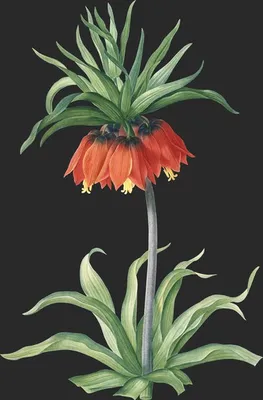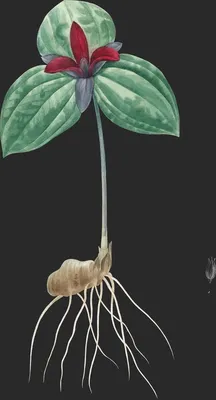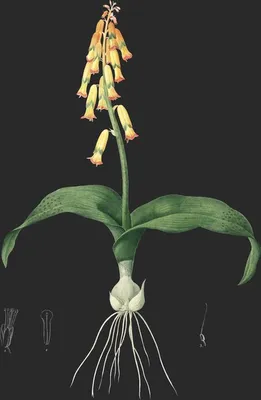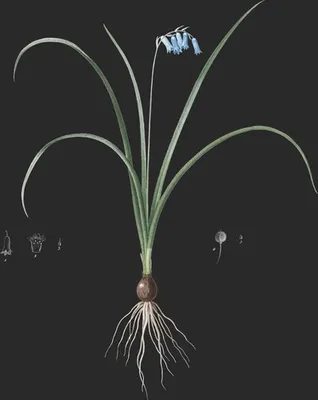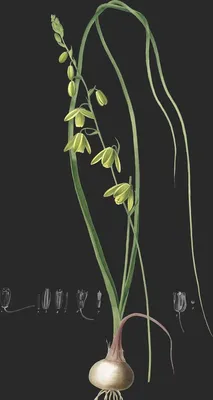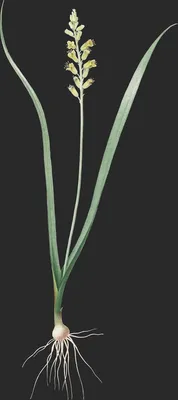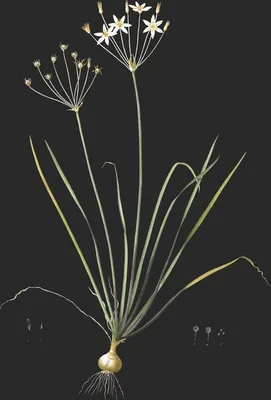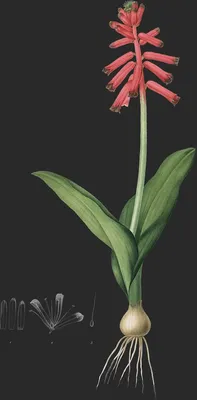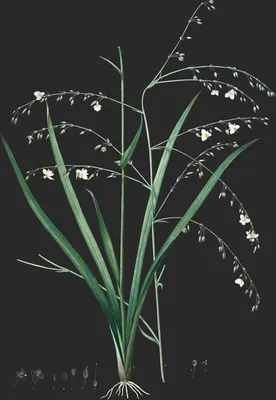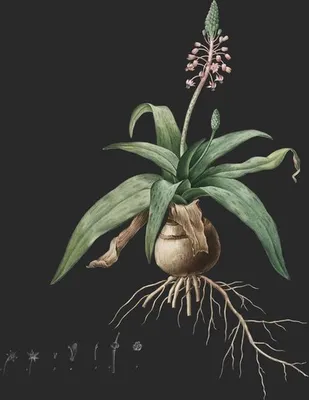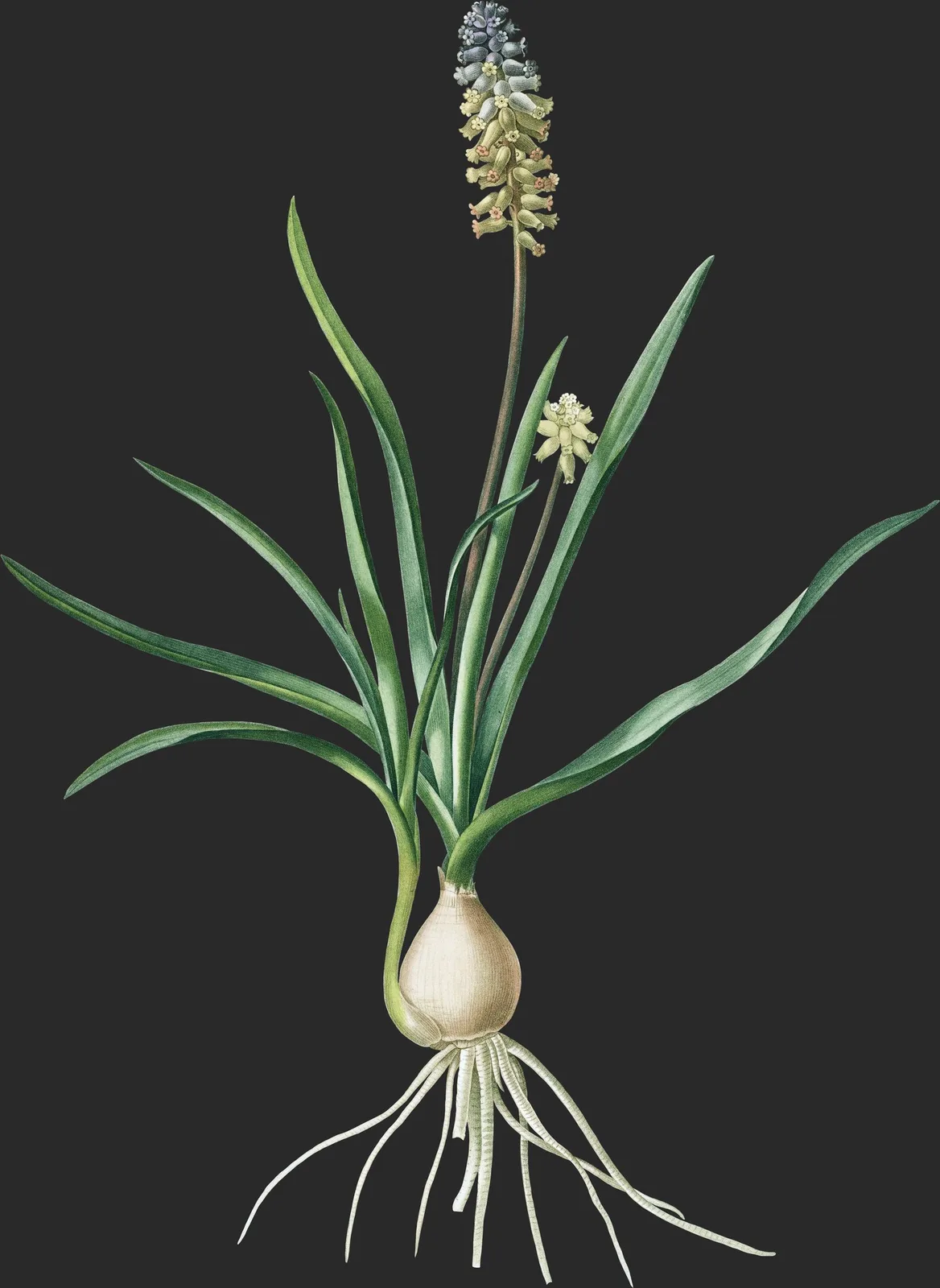
Muscari Ambrosiacum
Muscari Odorant
Ten ways of seeing
- measured cast yellow-green
- upright 1.37 : 1
First Look
江馆清秋,晨起看竹,烟光日影露气,皆浮动于疏枝密叶之间。
—— 清·郑板桥《题画竹》
On an autumn morning at the river lodge I looked at the bamboo: mist, sunlight, dew, all drifting among the sparse and dense leaves.
The sheet is vertical: the eye climbs and settles in the upper half. Let the plant stand before you look for detail. Then step in close: watch where colour meets line, and whether the line ever breaks. Third, find where the green is deepest: the whole tonal order is measured from that patch.
Name and Thing
The binomial is Muscari odorant: the first word is the genus it belongs among, the second the epithet that sets it apart. Two words carry a whole provenance. The older system filed it under Asphodelaceæ by overall affinity; Linnaeus, counting stamens only, placed it in Hexandria — two ways of asking what a plant is. No established Chinese name exists, so it is cited by its binomial alone.
Form and Colour
Measured on this plate: flower colour covers 1.4% of the sheet, foliage 4.4%, the cast yellow-green with a second note of amber. No other plate shares exactly this measure. A bulb of overlapping fleshy scales gives the lily its Chinese name, 'hundred-fold'; six tepals reflex as the flower opens, around six stamens with long, T-shaped anthers. a moss green. A single plant, laid out with nothing hidden.
Composition
The sheet is tall. No details are appended: a plate for looking, not for keying out. The plant covers only 11% of the sheet, centred near the centre; the emptiness is where the eye rests.
Line and Colour
The first half of the nineteenth century moved from copper to steel to lithography; stipple could render the softest transition. There is evidence on the back too: the plate mark pressed into the paper, the slight relief of the pigment, lines worn shallow in a later printing. If you mean to copy it: take its skeleton, its margins and the order of its colours; the burin's hatching is the language of copper — suggest it with pencil density, do not imitate it stroke for stroke.
Poetic Resonance
两丛香百合,一架粉长春。
—— 宋·陆游《北窗偶题四首 其一》
The poem gives the mood first and the picture supplies the form; set the line beside the plate and the green the corolla becomes its resting point.
Symbolism
In the West the white lily is Marian purity, held by the angel of the Annunciation; in China the name sounds like 'a hundred years in harmony', a wedding wish. Meanings change their tune: the same flower can say opposite things within a century.
Season and Place
the flowers last only days, so artists drew them just as they opened. Temperate north — China, Japan, Europe. Long used in Chinese medicine, lilies were hunted in East Asia by nineteenth-century collectors and transformed European gardens. The year 1805 on the plate is that of publication, not of flowering — the gathering came a year or two earlier. Read the locality and the flowering season both with a discount: one is hearsay, the other a ten-day peak.
The Book and the Hand
“The Liliaceae” carries only Pierre-Joseph Redouté's name. The image is public domain; the hand-colouring is still one person's hand.
What to Take Away
Next time you stand before a flowering plant, give it three minutes: leaf arrangement, direction of the flower, the darkest patch. A flora exists to be consulted; look long enough and you forget to consult — someone in 1805 gave a whole day to a single flower.
About this plate
Description
Cette espèce, qui a donné son nom au genre entier, est remarquable par la forte odeur de muse qu’exhalent ses fleurs, d’ailleurs petites, peu apparen-tes, et d’une couleur sale et mal décidée.
Sa bulbe est blanche, ovoide, de la grosseur d’un petit œuf de poule, garnie de tuniques membraneuses; elle émet, par sa base, des racines simples, blanches, épaisses, marquées de petites cannelures transversales: ses feuilles, qui naissent de la bulbe, sont de consistance molle, de couleur glauque, d’abord droites, puis étalées, oblongues, presque aigués, un peu calleuses au sommet, courbées en gouttière, à peu près égales à la longueur de la hampe: celle-ci est droite, cylindrique, simple, verte, haute de 2–3 décimètres, terminée par une grappe droite, serrée, ovale-oblongue, composée de petites fleurs, d’abord horizontales, ensuite un peu déjetées en bas. Ces fleurs sont portées sur des pédicelles cylindriques, longe de 2–3 millimètres; à leur base se trouvent ordinairement deux bractées très-courtes, obtuses ou un peu den-tées, dont une latérale, et l’autre placée immédiatement sous le pédicelle.
La corolle est en forme de grelot ovoïde, un peu resserrée à la base, presque fermée au sommet, monopétale, terminée par un disque calleux, hexa-gone, chargé de six dents obtuses qui bordent l’orifice: ces fleurs ont une teinte d’un gris jaunatre sale, qui se change, peu après la fécondation, en une couleur rousse ou feuille morte.
Les étamines sont au nombre de six, insérées sur la corolle, un peu au dessous du milieu de sa longueur; leurs filets sont très-courts; leurs anthères ovoïdes, d’un pourpre brun, a deux loges pleines d’un pollen blanchâtre. L’ovaire est libre, triangulaire, verdâtre; le style court, fort épais, terminé par un stigmate épais et triangulaire. Je n’ai pas vu ses fruits.
Histoire
Cette plante passe pour indigène de la Perse; mais on la trouve sauvage dans quelques parties du midi de l’Europe, et notamment, selon Gouan, aux environs de Montpellier. ♃.
Elle porte les noms de Muscari, Musc, Groppe de Jacinthe: on la cultive dans plusieurs jardins, à cause de l’odeur agréable de ses fleurs, qui, lorsqu’elles sont en grande masse, parfument lair à une grande distance.
On la multiplie de cayeux: elle se plait dans les lieux ombragés et un peu humides.
Observations
Le genre Muscari, établi par Tournefort, avait été réuni par Linné avec celui des Jacinthes; mais ensuite, Miller, Monch et Desfontaines, ont né-tabli ce genre, aussi tranché par le port que par les caractères: il diffère en ellet, non-seulement des Jacinthes, mais de toutes les Liliacées, par sa corolle en grelot, à six dents.
Miller parait avoir confondu, sous une seule dénomination, le Muscari odorant, auquel sa description se rapporte, et le Muscari à Grappe, auquel appartiennent tous ses synonymes, à l’exception de celui de l’Ecluse: ces deux plantes sont cependant essentiellement distinctes.
Fam. des Asphodèles. Juss.—Hexandrie monogynie. Lin.
- Muscari ambrosiacum. M. spicâ oblongâ; corollis cylindricis, conformibus, hermaphroditis; bracteis duabus, alterâ infra pedunculum, alterá laterali. Mœnch. meth. 633. Fl. fr. 3.e ed. n. 1925.
- Muscari racemosum. M. corollis ovatis, summis, sessilibus; foliis laxis. Mill. Dict. n. 3. excl. syn.
- Hyacinthus muscari. H. corollis ovatis, omnibus aqualibus. Lin. Spec. 454. Hort. Cliff. 126. Hort. Ups. 85. Roy. Lugd-b, 28. Kniph. cent. 10. n. 52. Gouan. Hort. Monsp. 178. Willd. Spec. 2. p. 169. Pers. Ench. 375.
- Hyacinthus muscari. H. corollis ovatis, subsessilibus et uniformibus; foliis planiusculis. Lam. Dict. 3. p. 193.
- Hyacinthus racemosus, moschatus. C. Bauh. pin. 43. Ray. hist. 1162.
- Muscari obsoletiore flore. Clus. hist. 1. p. 178. Tourn. inst. 348.
- Hyacinthus odoratissimus, dictus Dipeadi et Muscari. J. Bauh, hist. 2. p. 578.
- Hyacinthus spurias, recentiorum alter. Dod. Pempt. 217.
- Dipcadi chalcedonieum et Italorum. Lob. ic. 109. f. 2.
- Hyacinthus racemosus, seu Botryoides major. Moris. hist. 2. p. 372. s. 4. t. 11. f. 6.