Neottia Speciosa
Néottie a Fleurs Roses
Néottie a Fleurs Roses
About this plate
Description
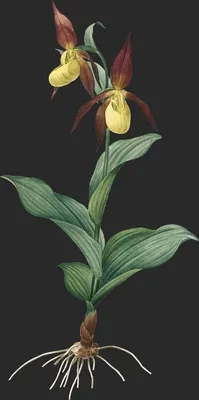
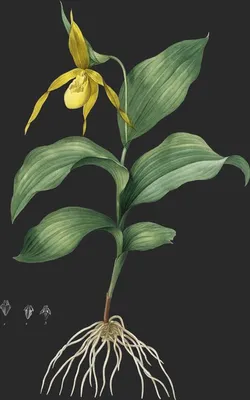
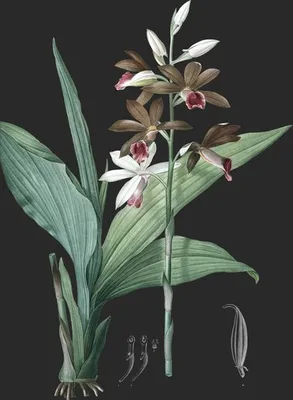
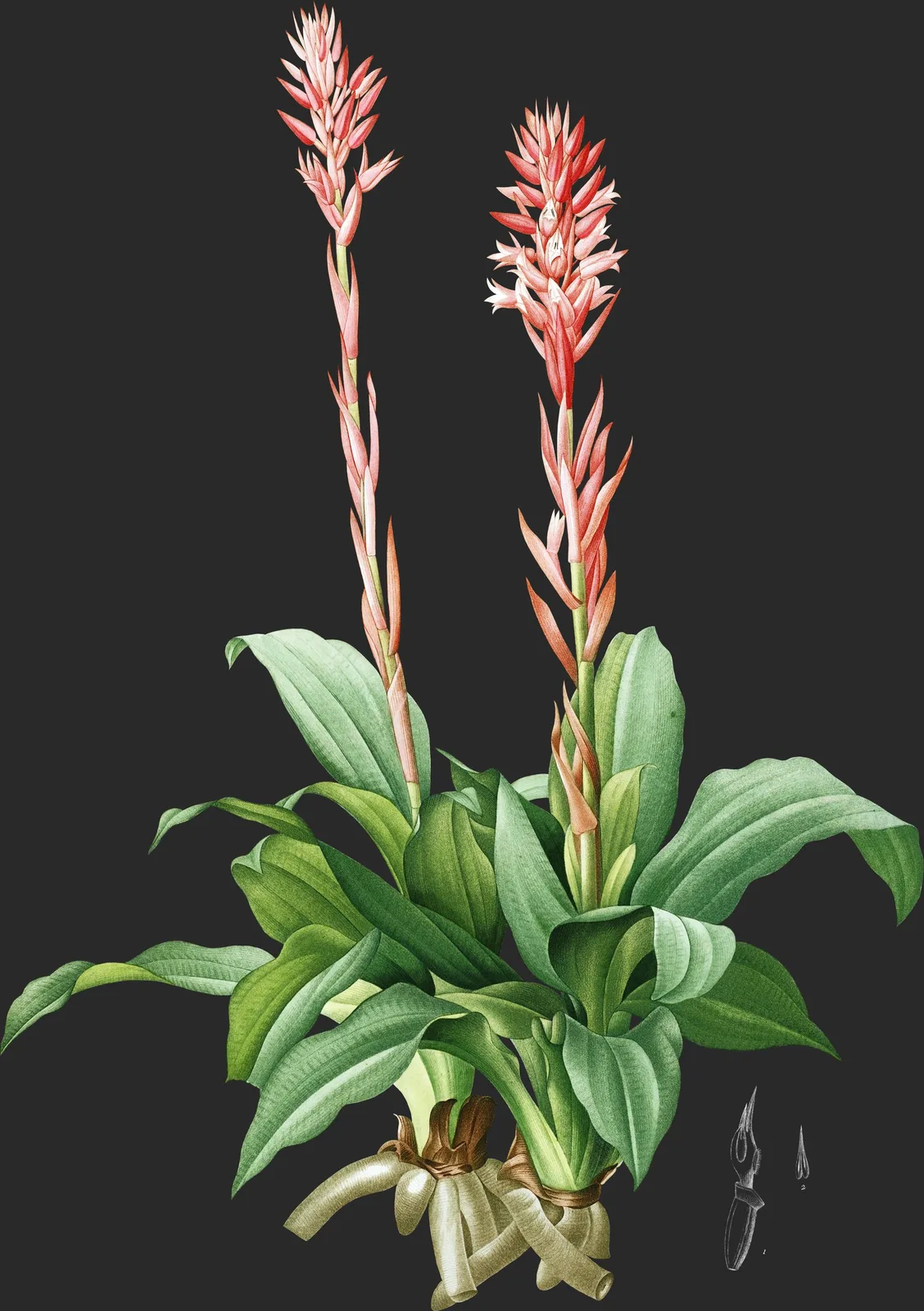
La racine de cette belle plante est formée de tubercules fusiformes de la grosseur du petit doigt, longs d’un décimètre environ, d’une couleur brune. Elle donne naissance à un faisceau de feuilles peu nombreuses, ovales-lancéo-les, aigues, rétrécies dans le bas en un pétiole court, engainant, entières, plus ou moins ondulées sur les bords, glabres, mais couvertes d’une multitude de points élevés qui les font paraitre légèrement rades au toucher.
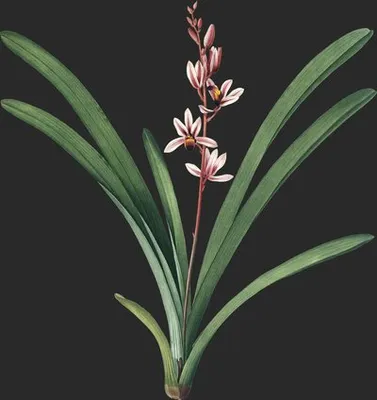
Au milieu de ces feuilles s’élève, a la hauteur de trois décimètres environ, une tige cylindrique, droite, glabre, d’un vert très-pale dans le bas, rougeâtre dans le haut, chargée inférieurement d’an petit nombre de feuilles semblables aux radicales, et supérieurement d’une grappe de fleurs. Sa partie moyenne est en partie couverte par de fausses bractées lancéolées; dressées, d’un beau rose pâle.
Les fleurs sont assez nombreuses presque sessiles, d’un bean rose, ainsi que les bractées qui les accompagnent, et qui contribuent beaucoup à l’embellissement de la plante. Ces bractées sont lancéolées, aiguës, aussi longues que la fleur.
Le périgone est divise, jusqu’à l’ovaire, en six segments lancéolés, aigus, a peu prés égaux en longueur, peu divergents, surtout dans le bas. Les trois exterieurs d’une couleur un peu plas foncée que les autres, et surtout les deux plas inférieurs, présentent à leur base une sorte de renllement ou de gibbosité. Les trois segments supérieurs, dont un externe et deus internes, sont reunis en faisceau, et sembles au premier aspect formés d’une seule foliole à trois dents. Le segment inférieur et intérieur, ou le nectaire, diffère peu des autres divisions. Il est seulement un peu dejeté en bas, et blanc à l’intérieur, courbé en gouttière dans sa partie moyenne, de manière à recevoir les organes géni-taux, et creusé à sa base de deux fossettes nectarifères.
L’ovaire est oblong, rétréci inférieurement, blanchâtre ou d’un rose pâle, triangulaire, creusé de deux sillons sur chacune de ses faces, un peu contourné en spirale.
Les organes génitaux sont assez semblables à ceux des autres espèces du même genre; mais, quoique nous en ayons fait, à l’époque où la plante a fleuri, une description très-détaillée, comme elle ne s’accorde point avec celle qui en a été donnée par Jacquin, et comme nous ne sommes point à même de la vérifier dans ce moment par de nouvelles observations, nous ne la donnerons point ici. Lorsque la plante aura fleuri de nouveau et nous aura permis de décider de l’exactitude de notre première description, nous la publierons dans les additions qui termineront ce volume ou le suivant.
Histoire
La Niottie a leurs roses habite les régions equinosiales de l’Amérique. Nous l’avons décrite et figurée d’après des individus qui ont fleuri le printemps der nier dans les serres du jardin de M. Boursaut.
Fam. des Orchidées. Juss.—Gynandrie diandrie. Lin.
- Neottia speciosa. N. labello lanceolato indiviso, scapo bracteato, bracteis flore longioribus, foliis oblongis marginem versus undulatis. Willd. sp. pl. 4. p. 72. Gawl. in Curt. bot. mag.
- Neottia speciosa. N. foliis radicalibus undulatis, lato-lanceolatis, basi attenuatis, floribus confertis spicatis incarnatis speciosissimis. Andr. bot. rep. 1. p. 3. t. 3.
- Neottia speciosa. N. foliis crenato-undulatis, spathis superioribus rubris. Jacq. ic. rar. 3. t. 600. Collect. 3. p. 174. Swartz. Orchid. p. 226.
- Serapias speciosa. S. foliis lanecolatis mndulatis, floribus subsessilibus, nectarii labio lanceolato acuminato indiviso. Gmel. syst. p. 59.
Twelve ways of seeing
- measured cast red
- upright 1.42 : 1
- published 1812
- Plate 404
Not a catalogue entry but a way of looking: how to stand, what to notice, how the line was cut, when it flowers, where it came from, who made it — and then the poems and the classics that taught China to see the same flower. Read the twelve in order and the plate opens.
-
First Look
夫象物必在于形似,形似须全其骨气。
—— 唐·张彦远《历代名画记》
Likeness is the threshold; bone-and-breath is the point.
The sheet is vertical: the eye climbs and settles in the upper half. Let the plant stand before you look for detail. Then step in close: watch where colour meets line, and whether the line ever breaks. Third, find where the green is deepest: the whole tonal order is measured from that patch.
-
Name and Thing
The binomial is Neottia speciosa: the first word is the genus it belongs among, the second the epithet that sets it apart. Here the epithet speciosa means “showy” — the name records the feature the namer noticed first. The older system filed it under Orchidaceæ by overall affinity; Linnaeus, counting stamens only, placed it in Gynandria — two ways of asking what a plant is. No established Chinese name exists, so it is cited by its binomial alone.
-
Form and Colour
Measured on this plate: flower colour covers 5.7% of the sheet, foliage 12.7%, the cast red with a second note of yellow-green. No other plate shares exactly this measure. Orchids carry pseudobulbs or fleshy roots; six tepals, one modified into a lip that serves as a landing stage, and a column uniting stamens and pistil — a structure unique to the family. Filed under green — a moss green, a colour that comes mostly from leaf and stem. Three things fix the habit: leaf arrangement, tepal count, and how the flower is borne.
-
Composition
Tall and narrow, the plant rising in one movement with generous margins — the upright format of most floras. (about 1.42 : 1) No details are appended: a plate for looking, not for keying out. The plant covers only 23% of the sheet, centred below centre; the emptiness is where the eye rests. Old plates set the plant slightly off centre, with unequal margins — that small imbalance is what keeps it alive.
-
Line and Colour
The first half of the nineteenth century moved from copper to steel to lithography; stipple could render the softest transition. Decide first whether it was printed or painted; only then discuss whether it is beautiful.
-
Season
Varies by genus: temperate terrestrials flower in spring and summer, tropical epiphytes almost year-round. The year 1812 on the plate is that of publication, not of flowering — the gathering came a year or two earlier. The plate records ten days of peak; the other three hundred are leaf, fruit and rest.
-
Provenance
Worldwide, richest on tropical mountains. Chinese cymbidiums come from the hills of the south; the orchids drawn for European portfolios came largely from the cloud forests of Central America and Southeast Asia. In the same volume the kin are shelved together; set several plates side by side.
-
The Book and the Hand
“The Liliaceae” was drawn by Pierre-Joseph Redouté and published 1802-1816. This plate is Plate 404, book page 404. The image is public domain; the hand-colouring is still one person's hand.
-
Poetic Resonance
玉白兰芳不相顾,青楼一笑轻千金。
—— 唐·温庭筠《懊恼曲》
The poem gives the mood first and the picture supplies the form; set the line beside the plate and the green the corolla becomes its resting point.
-
The Written Tradition
芝兰生于深林,不以无人而不芳;君子修道立德,不为穷困而改节。
—— 《孔子家语·在厄》
The orchid grows deep in the forest and is fragrant though no one comes; so the gentleman cultivates virtue and does not alter it in hardship.
Confucius, finding an orchid flowering alone in a valley, is said to have composed the 'Lament for the Orchid'; in the Li Sao, orchids are worn as a girdle of virtue. The difference is not of quality but of question: Europe asks what it is, China asks whom it resembles.
-
Symbolism
In China the orchid is the gentleman who blooms unseen; in Victorian Europe it was luxury and obsession, a single new species worth a fortune. In a flora it is a species first and a symbol second; the order is worth keeping.
-
What to Take Away
If you keep one line, keep Guo Xi's: from afar its momentum, up close its texture. The flower of that year is dust, yet its image on paper has outlived every living cousin.