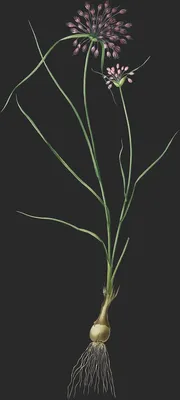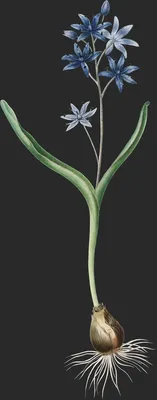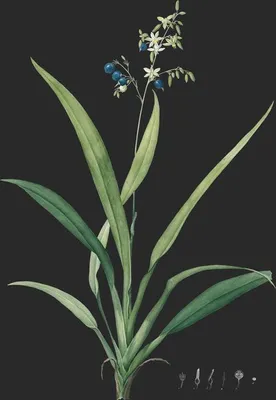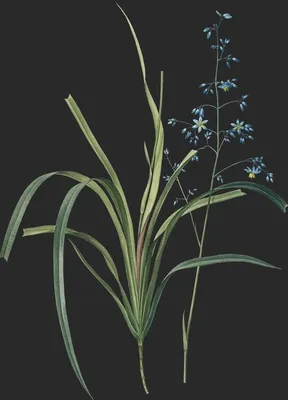
Ornithogalum Nutans
Ornithogale Penché
Ornithogale Penché
About this plate
Description
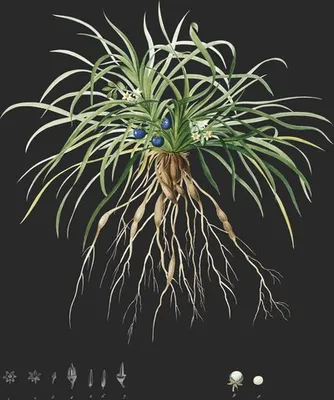
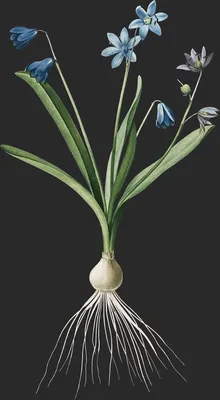
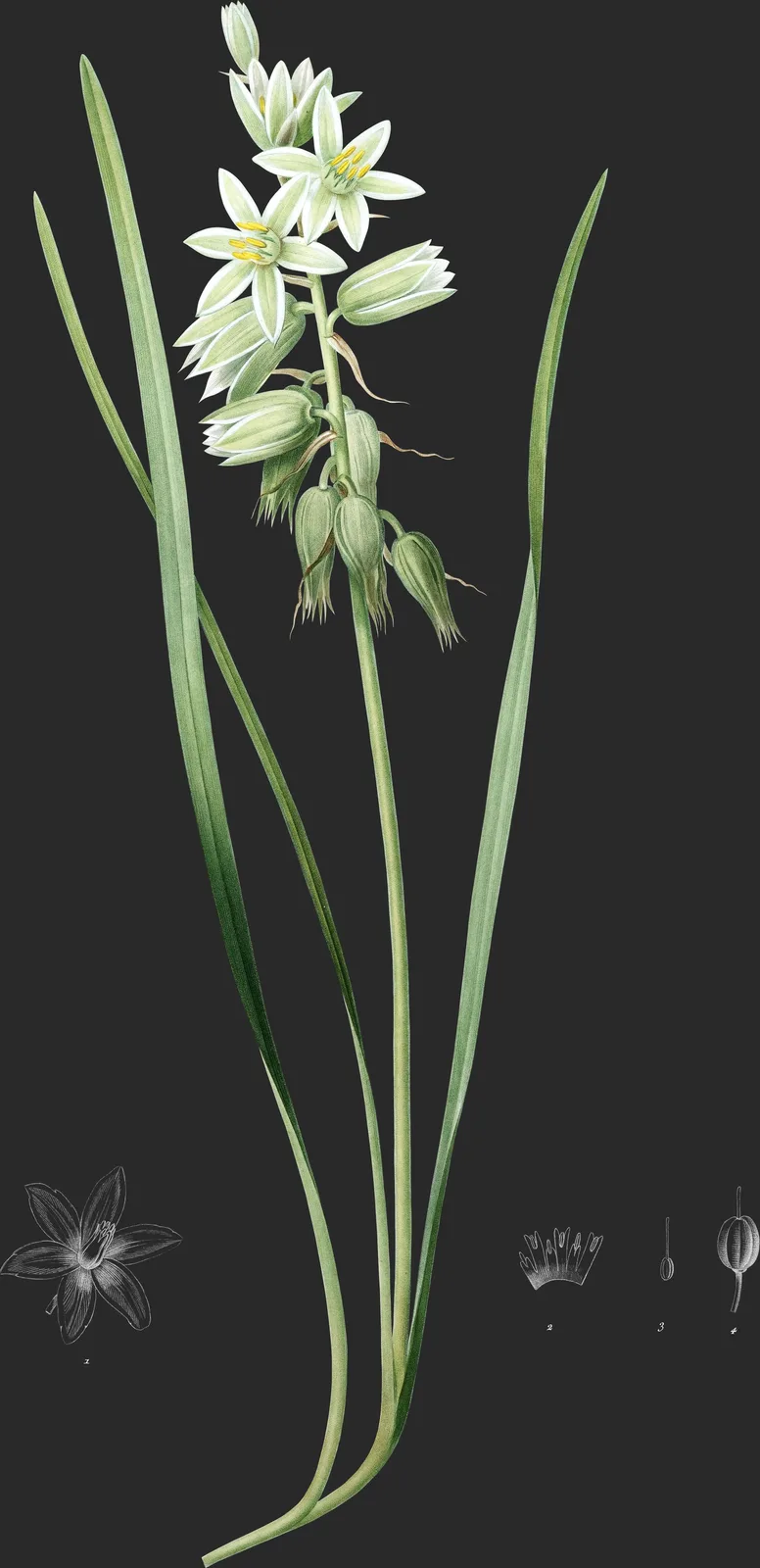
Une bulbe grêle et conique donne naissance à un faisceau de feuilles radi-cales, linéaires, courbées en gouttière, striées longitudinalement, glabres, aiguis et égales en hauteur à la hampe. Celle-ci est nue, droite, cylindrique, d’un vert clair, haute de trois à quatre décimètres. Elle est terminée par une grappe de six à douze fleurs verdâtres, dirigées d’un même côté, d’abord éta-lées, puis pendantes. Les pédicelles qui les supportent sont épais, arqués, longs d’un à deux centimètres, munis à leur base d’une bractée membraneuse, lan-céolée, aigue, deux fois plus longue qu’eux.
Le périgone est divisé jusqu’à sa base en six segments égaux, lancéolés, demi-étalés, rétrécis en pointe au sommet, verts dans le milieu, blanes sur les bords.
Les filaments des étamines sont membraneux, fort larges, inégaux. Trois d’entre eux plus courts présentent à leur sommet une échanerure peu pro-fonde, du milieu de laquelle nait un filament très-court, en forme d’alène, qui supporte une anthère jaune, oblongue et linéaire. Les trois autres sont beaucoup plus profondément échancrées, de manière à former deux cornes, dont la longueur atteint celle de l’anthère située au milieu d’elles.
L’ovaire est libre, ovoïde, marqué de six sillons. Le style est filiforme, blane, strié longitadinalement, un peu plus long que les étamines, et terminé par un stigmate simple.
Le fruit est une capsule de la même forme que l’ovaire, à trois valves, à trois loges, dont chacune renferme des graines nombreuses disposées sur deux rangs.
Histoire
L’Ornithogale à fleurs penchées croit dans les prairies de la France, de l’Italie, de la Suisse et de l’Allemagne. Il est peu répandu, et particulier à certains cantons. Ce sont des échantillons cultivés dans le jardin de M. Vilmoria qui ont servi à la figure ci-jointe, et à notre description. Il fleurit au printemps.
Explication de la planche
La Plante entière de grandeur naturelle.
- Une fleur isolée et ouverte.
- Les étamines.
- L’ovaire et le style.
- La capsule.
Fam. des Asphodèles. Juss.—Hexandrie monogynie. Lin.
- Ornithogalum nutans. O. floribus secundis pendulis, nectario stamineo campaniformi. Lin. sp. pl. 44. Mill dict. n. 4. Jacq. Austr. t. 301. Roth. Germ. 1. 151. 2. 395. Willd. sp. pl. 2. p. 125. Lam. dict. 4. p. 617. Curt. bot. mag. 269. Fl. Fr. éd. 3. 1949. Pers. enchir. 1. p. 365.
- Ornithogalam floribus secundis pendulis, filamentis latis emarginatis. Hort. Cliff. 124. Hort. Ups. 84. Roy. Lugd-b. 32.
- Ornithogalum floribus spicatis, senescentibus pendulis, filamentis staminum alternis, majoribus bicornibus. Hall. Helv. 1216.
- Ornithogalum exoticum, magno flore minori innato. Bauh. pin. 70. Rudb. elys. 1. p. 137. f. 12 Tournef. inst. 379.
- Ornithogalum neupolitanum. Clus. app. alt. J. Bauh. hist. 2. 631.
Twelve ways of seeing
- measured cast yellow-green
- upright 2.06 : 1
- published 1809
- Plate 253
Not a catalogue entry but a way of looking: how to stand, what to notice, how the line was cut, when it flowers, where it came from, who made it — and then the poems and the classics that taught China to see the same flower. Read the twelve in order and the plate opens.
-
First Look
夫象物必在于形似,形似须全其骨气。
—— 唐·张彦远《历代名画记》
Likeness is the threshold; bone-and-breath is the point.
The sheet is vertical: the eye climbs and settles in the upper half. Let the plant stand before you look for detail. Then step in close: watch where colour meets line, and whether the line ever breaks. Third, find where the green is deepest: the whole tonal order is measured from that patch. The pose leans left: the upper half carries 9 points further left than the lower — a living thing, not a diagram.
-
Name and Thing
The binomial is Ornithogalum nutans: the first word is the genus it belongs among, the second the epithet that sets it apart. Two words carry a whole provenance. The older system filed it under Asparagaceæ by overall affinity; Linnaeus, counting stamens only, placed it in Hexandria — two ways of asking what a plant is. No established Chinese name exists, so it is cited by its binomial alone.
-
Form and Colour
Measured on this plate: flower colour is sparing, 0.4% of the sheet against 7.3% of foliage, the cast tending yellow-green — as with pale or white blooms, outline and tone do the talking. Bulbous plants store the year underground — bulb, corm or tuber — then send up a few thick leaves and a single scape, with six tepals in cup, funnel or star. Filed under green — a moss green, a colour that comes mostly from leaf and stem. Three things fix the habit: leaf arrangement, tepal count, and how the flower is borne.
-
Composition
Tall and narrow, the plant rising in one movement with generous margins — the upright format of most floras. (about 2.06 : 1) No details are appended: a plate for looking, not for keying out. The plant covers only 14% of the sheet, centred a little left of centre; the emptiness is where the eye rests. Old plates set the plant slightly off centre, with unequal margins — that small imbalance is what keeps it alive.
-
Line and Colour
The first half of the nineteenth century moved from copper to steel to lithography; stipple could render the softest transition. Decide first whether it was printed or painted; only then discuss whether it is beautiful.
-
Season
Early spring to early summer, genus by genus: tulips and hyacinths first, gladiolus and amaryllis later. The year 1809 on the plate is that of publication, not of flowering — the gathering came a year or two earlier. The best time to read such a plate is its flowering season: three minutes under the tree explains what no text can.
-
Provenance
Three homelands: the Mediterranean, Central Asia and South Africa. The tulip came from Ottoman gardens and became a Dutch mania; South African bulbs filled European glasshouses after 1800. In the same volume the kin are shelved together; set several plates side by side.
-
The Book and the Hand
“The Liliaceae” was drawn by Pierre-Joseph Redouté and published 1802-1816. This plate is Plate 253, book page 253. The image is public domain; the hand-colouring is still one person's hand.
-
Poetic Resonance
兰陵美酒郁金香,玉碗盛来琥珀光。
—— 唐·李白《客中行》
Fine wine of Lanling, fragrant with turmeric; poured in a jade bowl, it glows like amber.
The poem gives the mood first and the picture supplies the form; set the line beside the plate and the green the corolla becomes its resting point.
-
The Written Tradition
宁古无时,宁朴无巧,宁俭无俗。
—— 明·文震亨《长物志》
Better old than fashionable, better plain than clever, better spare than vulgar.
Li Bai's 'orchid wine, fragrant with yujin' is often misread as tulips; the Tang yujin was a turmeric-like root used to scent wine — same name, different plant. Keep the line; it will surface the next time you meet the same plant.
-
Symbolism
The tulip was an imperial emblem in Istanbul and a speculative bubble in Amsterdam; the hyacinth sprang from a boy's blood in Greek myth. What bulbs share is concealment: next year kept underground. Meanings change their tune: the same flower can say opposite things within a century.
-
What to Take Away
Appreciation is not knowledge but habit — one more look each time. Two centuries on, the plant may still flower in some garden; the one on this sheet stopped in the season of 1809.