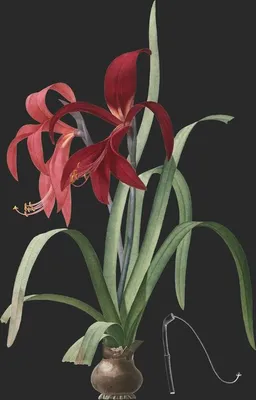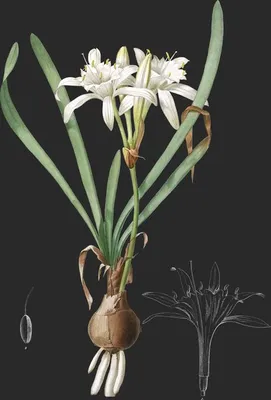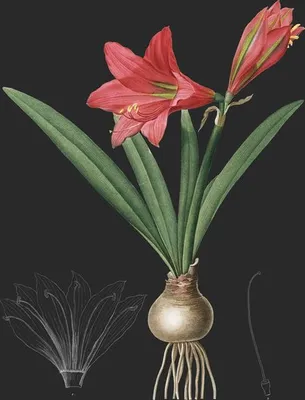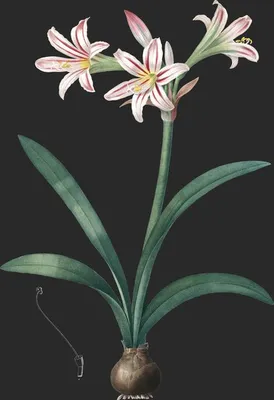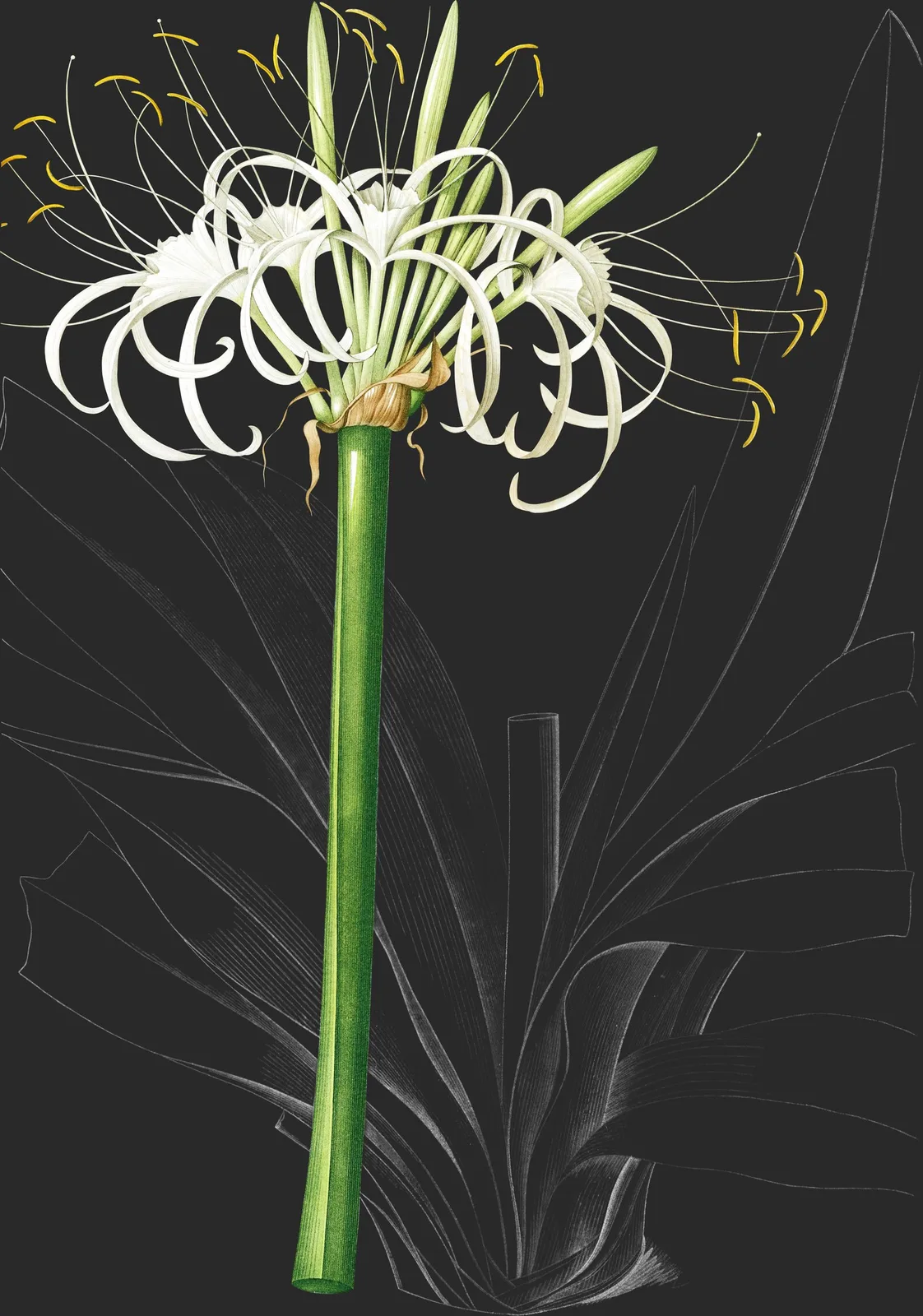
Pancratium Declinatum
Pancrace a Tiges Penchées
Pancrace a Tiges Penchées
About this plate
Description
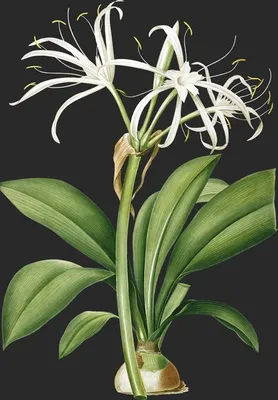
Une bulbe arrondie, déprimée, couverte de tamiques, laches et brunes, émet par sa partie supérieure un fisceau de feuilles distiques dans le bas, dirigées de tons les côtés dans le haut, demi-étalées, lancéolées, aiguës, entières, longues de six ou sept décimètres, larges d’un décimètre, ou même plas, un peu rétrécies dans le bas, mais nullement pétiolées.
De l’aisselle de ces fenilles sortent successivement, à des époques plus ou moins éloignées et pendant presque toute l’année, des hampes solitaires, droites, roides, fortement comprimées, a deux tranchants aigus, striées, glabres, d’un vert pâle.
Les fleurs sont au nombre de douze ou vingt, sessiles au sommet de la hampe, disposées en ombelle; elles exhalent une odeur foible, mais agréable. Les valves de la spathe sont ovales, membraneuses, assez courtes.
Le tube du périgone est long de sept centimètres, à peu près cylindrique, strie, droit, d’un vert très-pale. Les divisions du limbe sont longues de onze ou douze centimètres, linéaires, d’un très-beau blane, aigues, courbées en gouttière, fortement renversées en dehors, recourbées et presque roulées en dessous. Les trois intérieures portent en dedans, auprès de leur sommet, une petite pointe velue.
Le nectaire, ou sorte de collerette qui réunit les étamines, est en forme d’entonnoir à douze dents, dont six accompagnent les étamines, et six sont intermédiaires. Ces dernières sont plus ou moins développées, et souvent fendues en deux. Les filaments sont en forme d’alène, arqués, blancs dans le bas, verts dans le haut, presque aussi longs que les divisions du périgone. Ils supportent des anthères linéaires, vacillantes, orangées, insérées vers le tiers de leur longueur.
L’ovaire est sessile, court, triangulaire. Le style est filiforme, léchi à sa sortie da tube, terminé par un stigmate en forme de tête triangulaire.
Histoire
Le Pancrace à tiges penchées est originaire des Antilles, ou il est, à ce qu’il parait, assez commun. On le cultive dans la plupart des jardins de botanique; mais il était assez rare, josqu’à ces derniers temps, dans cenx de Paris. Nous le décrivons d’après des individus cultivés dans celui de M. Bicquelin.
Observations
Nous avons décrit dans le précédent volume, en y appliquant avec quelque doute le nom de Pancratium declinatum, une plante qui se rapprochait en effet de cette espèce à plusieurs égards, mais qu’un examen plus attentif nous fait regarder maintenant comme une espèce distincte. Les caractères qui distinguent ces deux plantes sont, la largeur beaucoup plus grande des feuilles dans celle que nous venons de décrire, leur nombre plus considérable, lodeur moins forte des fleurs, la courbure considérable des divisions du périgone, la longueur proportionnellement plus grande des étamines, les dentelures du nectaire, la couleur orangée des anthères, et surtout l’absence de l’ondulation très-marquée que l’on remarque à la base de trois des divisions du périgone dans l’espèce précédemment décrite. Nous croyons en conséquence devoir considérer cette dernière comme une espèce à part, que nous désignons de la manière suivante.
Pancratium patens. P. spatha multillora, foliis lato-linearibus, floribus sessilibus, laciniis linearibus rectiosculis tabo longioribus, interioribus basi undulatis, nectario obconico, intervallis staminum repandis.
Il est assez probable que le Pancrace à tiges inclinées n’est autre chose que le Pancratium caribæum de Linné; mais il est bien dillicile de s’en assurer. Nous avons adopté le nom de Pancratium declinatum qui lui a été donné par Jacquin, de préférence à celui de P. amœnum employé depuis par Salisbury, parce qu’il est plus ancien.
Fam. des Narcisses. Juss.—Hexandrie monogynie. Lin.
- Paneratiom declinatum. P. spathâ moltiflorâ, scapo compresso ancipiti, corollæ laciniis tabam subescedentibas, folis lingulatis. Jacq. Amer. p. 99. Hort. Vind. 3. p. 11. t. 10. Pers. enchir. 1. p. 351.
- Paneratium amœnum. P. spathâ moltillorâ, foliis elliptico-lanceolatis, nectarii dentibus sex staminiferis, intermedais acutis bipartitis. Willd. sp. pl. 2. p. 44.
- Paneratiam amœnum. P. foliis lanceolatis glabris, corollæ tubo teretinscalo dense striato, laciniis tubo longioribus recurvis linearibus aqualiter concavis, coronæ sinubus lingulâ bifidâ. Salisb. act. Soc. Lin. Lond. 2. p. 71. t. 10.
- Pancratium caribæum. P. spathâ multillorâ, foliis oblongo-linearibas, nectarii dentibus sex staminiferis, intermediis simplicibus acutis. Willd. hort. Berol. 73. Enum. p. 352.
- Pancratium caribæum. P. spathâ multiflorâ, foliis lanceolatis. Lin. sp. pl. 418?
- Narcissus Americanus flore multipliei albo hexagono odorato. Comm. 2. p. 173. t. 87?
Twelve ways of seeing
- measured cast yellow-green
- upright 1.43 : 1
- published 1812
- Plate 414
Not a catalogue entry but a way of looking: how to stand, what to notice, how the line was cut, when it flowers, where it came from, who made it — and then the poems and the classics that taught China to see the same flower. Read the twelve in order and the plate opens.
-
First Look
夫象物必在于形似,形似须全其骨气。
—— 唐·张彦远《历代名画记》
Likeness is the threshold; bone-and-breath is the point.
The sheet is vertical: the eye climbs and settles in the upper half. Let the plant stand before you look for detail. Then step in close: watch where colour meets line, and whether the line ever breaks. Third, find where the green is deepest: the whole tonal order is measured from that patch.
-
Name and Thing
The binomial is Pancratium declinatum: the first word is the genus it belongs among, the second the epithet that sets it apart. Two words carry a whole provenance. The older system filed it under Amaryllidaceæ by overall affinity; Linnaeus, counting stamens only, placed it in Hexandria — two ways of asking what a plant is. No established Chinese name exists, so it is cited by its binomial alone.
-
Form and Colour
Measured on this plate: flower colour covers 1.2% of the sheet, foliage 4.3%, the cast yellow-green with a second note of amber. No other plate shares exactly this measure. Bulbous plants store the year underground — bulb, corm or tuber — then send up a few thick leaves and a single scape, with six tepals in cup, funnel or star. Filed under green — a moss green, a colour that comes mostly from leaf and stem. Read the outline, then the colour layers, then the brush.
-
Composition
Tall and narrow, the plant rising in one movement with generous margins — the upright format of most floras. (about 1.43 : 1) No details are appended: a plate for looking, not for keying out. The plant covers only 14% of the sheet, centred a little left of centre; the emptiness is where the eye rests. Cover the margins with your thumb and the plate suffocates; uncover them and the flower breathes again.
-
Line and Colour
The first half of the nineteenth century moved from copper to steel to lithography; stipple could render the softest transition. Take a loupe to three places: petal edge, leaf vein, caption. An unbroken line means engraving; colour crossing the outline means a hand.
-
Season
Early spring to early summer, genus by genus: tulips and hyacinths first, gladiolus and amaryllis later. The year 1812 on the plate is that of publication, not of flowering — the gathering came a year or two earlier. The best time to read such a plate is its flowering season: three minutes under the tree explains what no text can.
-
Provenance
Three homelands: the Mediterranean, Central Asia and South Africa. The tulip came from Ottoman gardens and became a Dutch mania; South African bulbs filled European glasshouses after 1800. The volume was made in 1802-1816, when most of this knowledge came from living plants under glass.
-
The Book and the Hand
“The Liliaceae” was drawn by Pierre-Joseph Redouté and published 1802-1816. This plate is Plate 414, book page 414. The image is public domain; the hand-colouring is still one person's hand.
-
Poetic Resonance
郁金香是兰陵酒,枉入诗人赋咏来。
—— 宋·王安石《答熊本推官金陵寄酒》
The poem gives the mood first and the picture supplies the form; set the line beside the plate and the green the corolla becomes its resting point.
-
The Written Tradition
人无癖不可与交,以其无深情也。
—— 明·张岱《陶庵梦忆》
Never make a friend of a man without an obsession: he has no deep feeling.
Li Bai's 'orchid wine, fragrant with yujin' is often misread as tulips; the Tang yujin was a turmeric-like root used to scent wine — same name, different plant. The difference is not of quality but of question: Europe asks what it is, China asks whom it resembles.
-
Symbolism
The tulip was an imperial emblem in Istanbul and a speculative bubble in Amsterdam; the hyacinth sprang from a boy's blood in Greek myth. What bulbs share is concealment: next year kept underground. Meanings change their tune: the same flower can say opposite things within a century.
-
What to Take Away
Carry three rules away: whole before detail; line before colour; picture before book. A flora exists to be consulted; look long enough and you forget to consult — someone in 1812 gave a whole day to a single flower.