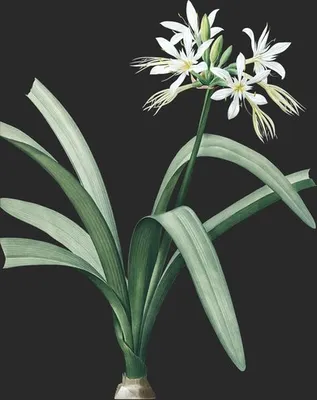
Pancratium Littorale
全能花属·Pancratium Littorale
Pancrace de Rivage
Ten ways of seeing
- measured cast yellow-green
- upright 1.41 : 1
First Look
六法者何?一、气韵生动是也;二、骨法用笔是也;三、应物象形是也;四、随类赋彩是也;五、经营位置是也;六、传移模写是也。
—— 南齐·谢赫《古画品录》
The six laws: spirit resonance alive; bone-method in the brush; matching form; colour by kind; planning the placing; copying the masters.
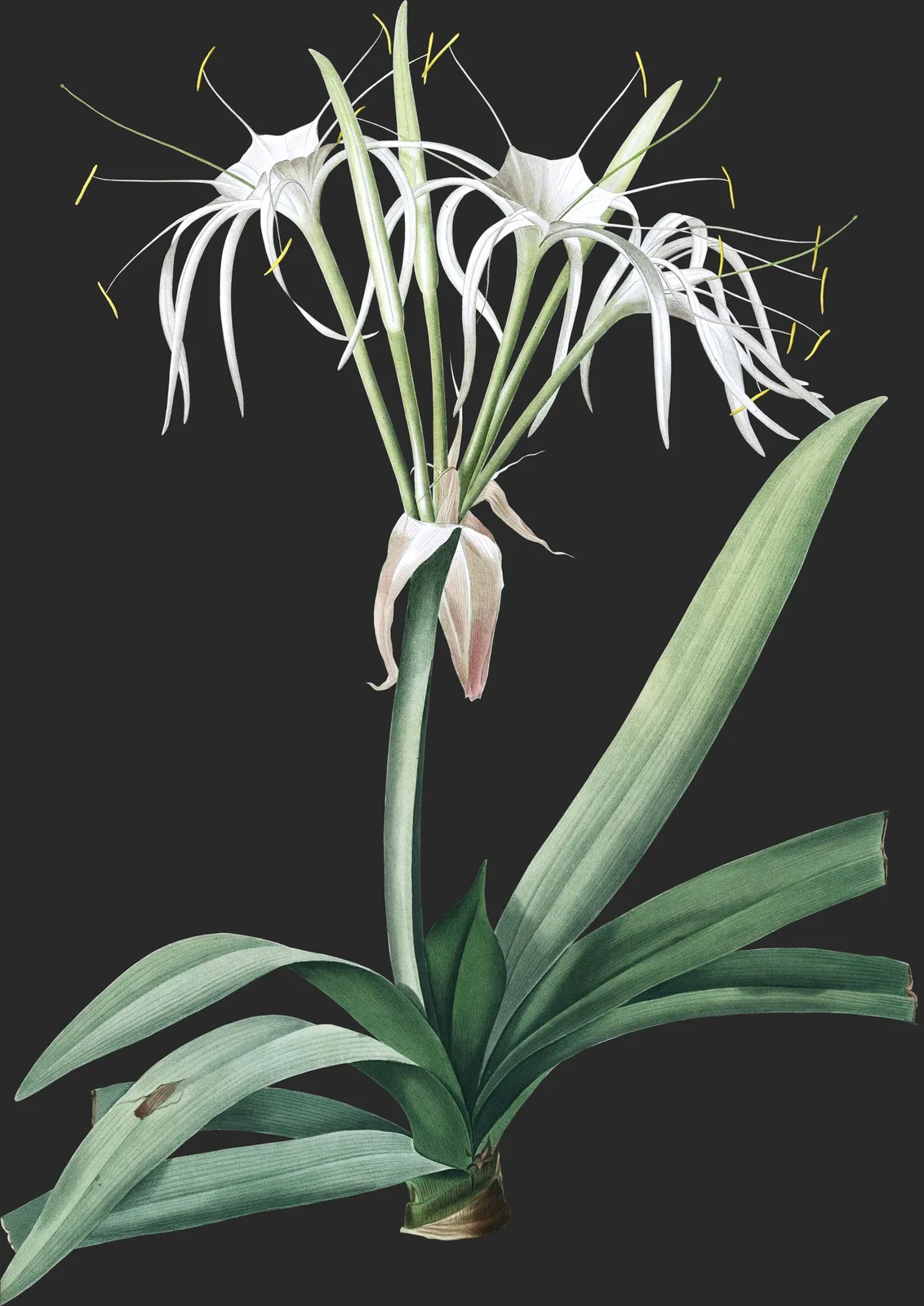
The sheet is vertical: the eye climbs and settles in the upper half. Let the plant stand before you look for detail. Then step in close: watch where colour meets line, and whether the line ever breaks. Third, find where the green is deepest: the whole tonal order is measured from that patch. The pose leans right: the upper half carries 8 points further right than the lower — a living thing, not a diagram.
Name and Thing
The binomial is Pancratium littorale: the first word is the genus it belongs among, the second the epithet that sets it apart. Two words carry a whole provenance. The older system filed it under Amaryllidaceæ by overall affinity; Linnaeus, counting stamens only, placed it in Hexandria — two ways of asking what a plant is. No established Chinese name exists, so it is cited by its binomial alone.
Form and Colour
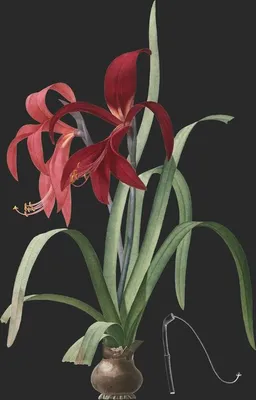
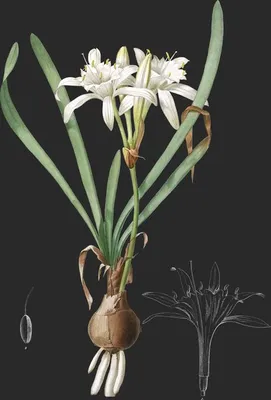
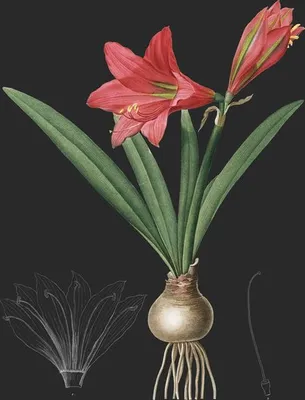
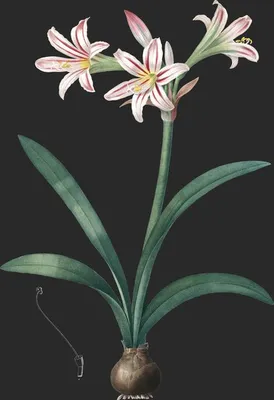
Measured on this plate: flower colour is sparing, 0.4% of the sheet against 7.9% of foliage, the cast tending yellow-green — as with pale or white blooms, outline and tone do the talking. Bulbous plants store the year underground — bulb, corm or tuber — then send up a few thick leaves and a single scape, with six tepals in cup, funnel or star. a moss green. Three things fix the habit: leaf arrangement, tepal count, and how the flower is borne.
Composition
The sheet is tall. No details are appended: a plate for looking, not for keying out. The plant covers only 25% of the sheet, centred near the centre; the emptiness is where the eye rests.
Line and Colour
The first half of the nineteenth century moved from copper to steel to lithography; stipple could render the softest transition. Decide first whether it was printed or painted; only then discuss whether it is beautiful. If you mean to copy it: take its skeleton, its margins and the order of its colours; the burin's hatching is the language of copper — suggest it with pencil density, do not imitate it stroke for stroke.
Poetic Resonance
不语亭亭俨薄妆,画裙双凤郁金香。
—— 唐·杜牧《偶呈鄭先輩》
The poem gives the mood first and the picture supplies the form; set the line beside the plate and the green the corolla becomes its resting point.
Symbolism
The tulip was an imperial emblem in Istanbul and a speculative bubble in Amsterdam; the hyacinth sprang from a boy's blood in Greek myth. What bulbs share is concealment: next year kept underground. Flower language was added later; the flower knows nothing of it, and that innocence is part of its power.
Season and Place
Early spring to early summer, genus by genus: tulips and hyacinths first, gladiolus and amaryllis later. South African bulbs filled European glasshouses after 1800. The year 1805 on the plate is that of publication, not of flowering — the gathering came a year or two earlier. The bud and the ripe fruit on one branch tell the season; the name in the title often tells the journey.
The Book and the Hand
“The Liliaceae” carries only Pierre-Joseph Redouté's name. From drawing to plate the sheet passed through several hands — the engraver aimed at accuracy, the colourist at speed, and between them lies each plate's unevenness.
What to Take Away
If you keep one line, keep Guo Xi's: from afar its momentum, up close its texture. A flora exists to be consulted; look long enough and you forget to consult — someone in 1805 gave a whole day to a single flower.
About this plate
Description
Cette espèce de Pancrace se distingue sans dilliculté de toutes les autres, à sa spathe, d’où sortent plusieurs fleurs, à ses feuilles linéaires-lancéolées, et à ce que la membrane qui unit les filets des étamines ne porte entre chacun deux aucun lobe ni aucune dentelure bien marquée.
Sa bulbe donne naissance en dessous à plusieurs radicules fibreuses, blanches, cylindriques, peu rameuses, et en dessus à plusieurs feuilles disposées sur deux rangs opposés, assez étalées, linéaires-lancéolées, pointues, longues de 3–4 décimètres sur 4 centimètres de largeur.
La hampe est droite, comprimée, un peu plus courte que les feuilles, glabre ainsi que le reste de la plante, terminée par 5 ou 6 fleurs blanches, grandes, un peu odorantes, sessiles et disposées en une espèce d’ombelle; ces fleurs sortent d’une spathe à deux valves, membraneuses, blanches, lancéolées, pointues, embrassantes à leur base, égales à la moitié de la largeur du tabe. Celui-ci est eylindrique, long de 12 centimètres, droit, un peu verdâtre en dehors, divisé en six lanières étalées, linéaires, pointues et calleuses au sommet, et un peu plus courtes que le tube.
Les étamines sont au nombre de six, insérées à la gorge de la fleur, et très-saillantes; leurs filets sont réunis, dans leur partie inférieure, par une membrane pétaloïde, qui a très-improprement reçu le nom de nectaire; cette membrane a à-peu-près la forme d’une cloche, et ses bords sont entiers ou peu érodés entre chaque étamine; les filets sont droits, divergents, longs de 5 centimètres dans la partie libre et saillante au dessus de la membrane; les anthères sont longues, linéaires, vacillantes, remplies d’un pollen de couleur jaune-orangée.
L’ovaire est adhérent avee la base du périgone, de couleur verte, de forme ovoïde, presque triangulaire. Le style est filiforme, verdâtre vers son sommet, un peu plus long que les étamines, terminé par un stigmate calleux, épais, à trois angles, et presque à trois lobes fort courts.
Le fruit n’est point parvenu à sa maturité.
Histoire
Ce Pancrace croit dans les sables maritimes de lile de Terrabomba, voisine de Carthagène, dans l’Amérique méridionale: elle y a été observée par M. Jacquin. ♃.
On le cultive dans les serres du Muséum d’Histoire Naturelle: il y a fleuri à la fin de l’été.
Fam. des Narcisses. Juss.—Hexandrie monogynie. Lin.
- Pancratium littorale. P. spathâ multiflorâ, foliis lineari-lanceolatis, coronæ sinubus repandis.
- Pancratium littorale. P. spathâ multiflorâ, foliis lineari-lanceolatis, nectarii dentibus sex staminiferis, spatio intermedio repando. Willd. Spec. 2. p. 43. Pers. Ench. 1. p. 351.
- Pancratium littorale. P. folis lineari-lanceolatis glabris, corollæ tubo triangulo septem seu octo-pollicari, laciniis tubo brevioribus, basi coronæ adnatis recurvis linearibus, coronce sinubus repandis. Salisb. act. soc. Lin. 2. p. 74. t. 13.
- Paneratium littorale. P. scapo ancipiti multifloro, foliis ensiformibus, corollæ laciniis tubo duplò brevioribus, limbo interiore brevi. Sav. in Lam. Dict. 4. p. 734.
- Paneratium littorale. P. spathâ multiflorâ, foliis lanceolato-linearibus, bifariis, corollæ laciniis linearibus tubo brevioribus, nectario subintegro. Ait. Kew. 1. p. 412.
- Paneratium littorale. P. spathâ multiflorâ, scapo compresso ancipiti, corollas laciniis tubo duplò brevioribus, foliis ensiformibus. Jacq. amer. 99. t. 101. hort. Vind. 3. p. 41. t. 75.
- Paneratium foliis ensiformibus, spathâ multiflorâ, floribus magnis, candidis, fragrantibus. Trew. Ehret. p. 6. t. 27.