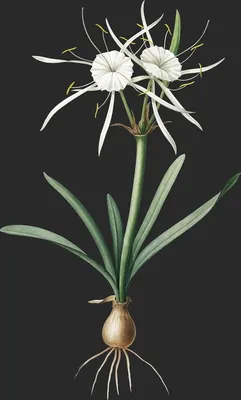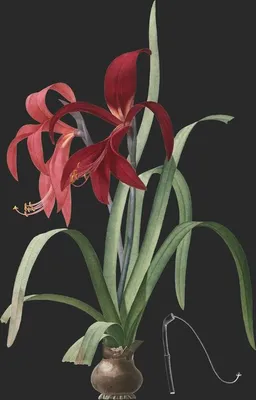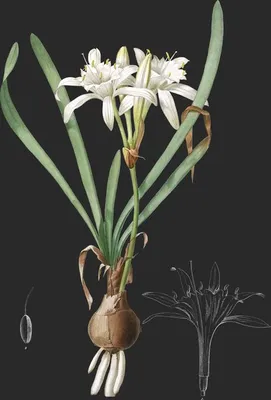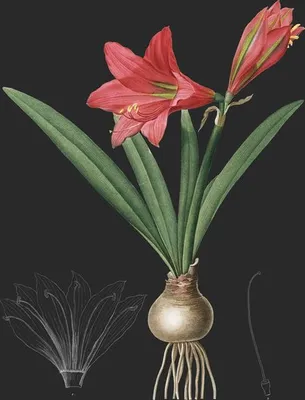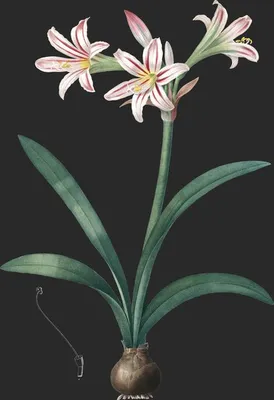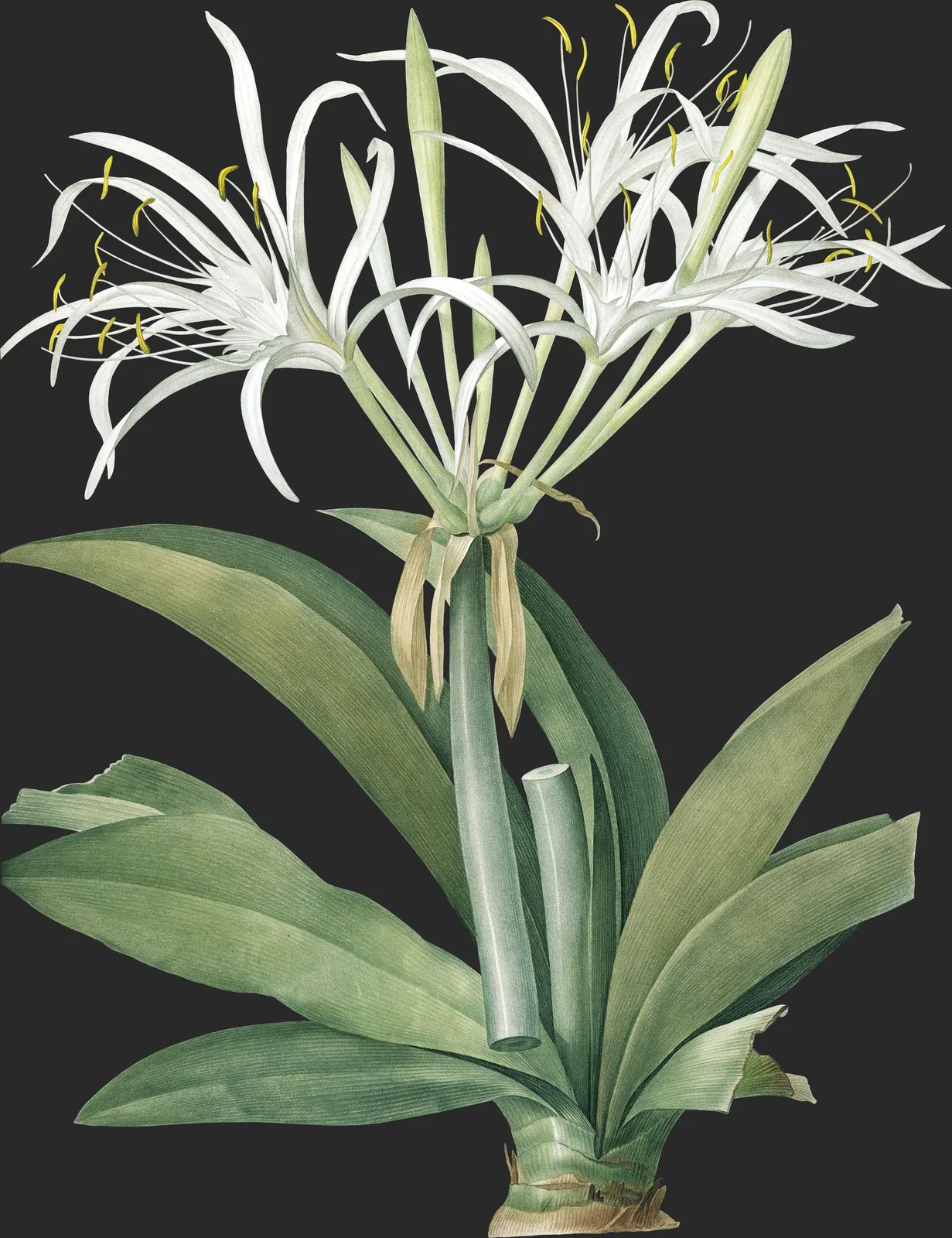
Pamcratium Speciosum
Pancrace a Belles Fleurs
Ten ways of seeing
- measured cast yellow-green
- upright 1.30 : 1
First Look
竖划三寸,当千仞之高;横墨数尺,体百里之迥。
—— 南朝宋·宗炳《画山水序》
A vertical stroke of three inches stands for a cliff of a thousand fathoms; a few feet of ink holds a hundred li.
The sheet is vertical: the eye climbs and settles in the upper half. Let the plant stand before you look for detail. Then step in close: watch where colour meets line, and whether the line ever breaks. Third, find where the green is deepest: the whole tonal order is measured from that patch.
Name and Thing
The binomial is Pamcratium speciosum: the first word is the genus it belongs among, the second the epithet that sets it apart. Two words carry a whole provenance. The older system filed it under Amaryllidaceæ by overall affinity; Linnaeus, counting stamens only, placed it in Hexandria — two ways of asking what a plant is. No established Chinese name exists, so it is cited by its binomial alone.
Form and Colour
Measured on this plate: flower colour covers 2.1% of the sheet, foliage 21.4%, the cast yellow-green with a second note of amber. No other plate shares exactly this measure. Bulbous plants store the year underground — bulb, corm or tuber — then send up a few thick leaves and a single scape, with six tepals in cup, funnel or star. a moss green. Read the outline, then the colour layers, then the brush.
Composition
The sheet is tall. No details are appended: a plate for looking, not for keying out. The plant fills 42% of the sheet, centred near the centre — the herbarium way, drawn to be read whole.
Line and Colour
The first half of the nineteenth century moved from copper to steel to lithography; stipple could render the softest transition. Decide first whether it was printed or painted; only then discuss whether it is beautiful. If you mean to copy it: take its skeleton, its margins and the order of its colours; the burin's hatching is the language of copper — suggest it with pencil density, do not imitate it stroke for stroke.
Poetic Resonance
卢家小妇郁金堂,海燕双栖玳瑁梁。
—— 唐·沈佺期《雜曲歌辭 獨不見》
The poem gives the mood first and the picture supplies the form; set the line beside the plate and the green the corolla becomes its resting point.
Symbolism
The tulip was an imperial emblem in Istanbul and a speculative bubble in Amsterdam; the hyacinth sprang from a boy's blood in Greek myth. What bulbs share is concealment: next year kept underground. Flower language was added later; the flower knows nothing of it, and that innocence is part of its power.
Season and Place
Early spring to early summer, genus by genus: tulips and hyacinths first, gladiolus and amaryllis later. Three homelands: the Mediterranean, Central Asia and South Africa. The tulip came from Ottoman gardens and became a Dutch mania. The year 1805 on the plate is that of publication, not of flowering — the gathering came a year or two earlier. Read the locality and the flowering season both with a discount: one is hearsay, the other a ten-day peak.
The Book and the Hand
“The Liliaceae” carries only Pierre-Joseph Redouté's name. From drawing to plate the sheet passed through several hands — the engraver aimed at accuracy, the colourist at speed, and between them lies each plate's unevenness.
What to Take Away
Carry three rules away: whole before detail; line before colour; picture before book. Two centuries on, the plant may still flower in some garden; the one on this sheet stopped in the season of 1805.
About this plate
Description
Cette espèce se distingue des précédentes par la grandeur de tontes ses parties, et notamment par la largeur de ses fenilles, et par les dents longues, acérées, qui se trouvent sur les bords de la couronne entre chaque étamine.
Sa bulbe est arrondie, brunâtre; ses feuilles sont rétrécies à la base et lancéolées, oblongues dans le reste de leur limbe, glabres, ainsi que le reste de la plante; longues de 2 à 3 décimètres, irrégulièrement déjetées en deux rangs. La hampe est droite, longue de 3 décimètres, glauque, cylindrique vers le sommet, comprimée à sa base, terminée par 5 à 7 fleurs blanches, sessiles, en ombelle: á la base de ces fleurs sont plusieurs bractées membraneuses, oblongues, pointues, et qui proviennent du déchirement de la spathe.
Le périgone a un tube presque triangulaire, verdâtre à sa base, long de 6–7 centimètres, terminé par six lanières étalées, linéaires, un peu plus longues que le tube, légèrement concaves, pointues, et calleuses au sommet. Les étamines partent du sommet du tube et sont plus courtes que les lanières du périgone; leurs filets sont réunis, a-peu-près jusqu’au milieu de leur longueur, par une membrane pétaloïde en forme de cloche; entre chaque filet, cette membrane se prolonge en une dent très-saillante, très-aigue. Les anthères sont linéaires, vacillantes; le pollen est de couleur jaune.
L’ovaire est triangulaire, vert, assez court, adhérent avec la base du périgone; le style est cylindrique, blane dans la partie cachée par le tube, vert à son sommet, plas long que les étamines, plus court que les lanières du périgone le stigmate est en tête presque triangulaire.
Je n’ai pas vu le fruit.
Histoire
Cette espèce de Panerace est cultivée depuis asser longtemps dans les jardins de botanique, mais avait été confondue avec d’autres: elle en a été distinguée par M. Salisbury. On ignore sa patrie. L’analogie peut faire soupçonner qu’elle est indigène des Antilles. On la cultive dans la serre chaude. ♃.
Fam. des Narcisses. Juss.—Hexandrie monogynie. Lin.
- Pancratium speciosum. P. spathâ multiflorâ, foliis elliptico-lanceolatis, coronæ sinubus dente acuto instructis.
- Paneratium speciosum. P. spathâ multillorâ, foliis ellipticis, nectarii dentibus sex staminiferis intermediis simplicibus acutis. Willd. Spec. 2. p. 44.
- Pancratium speciosum. P. foliorum petiolis angustis, corollæ tubo triangulo raré striato, lacinis tubo longioribas patenti-recurvatis linearibus alternis concavioribus, coronæ sinabus ligalâ bifidâ. Salisb. act. soc. Lin. 2. p. 73. t. 12.