Narcissus Odorus
水仙属·Narcissus Odorus
Narcisse Odorant
About this plate
Description
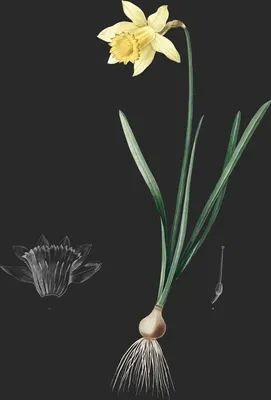
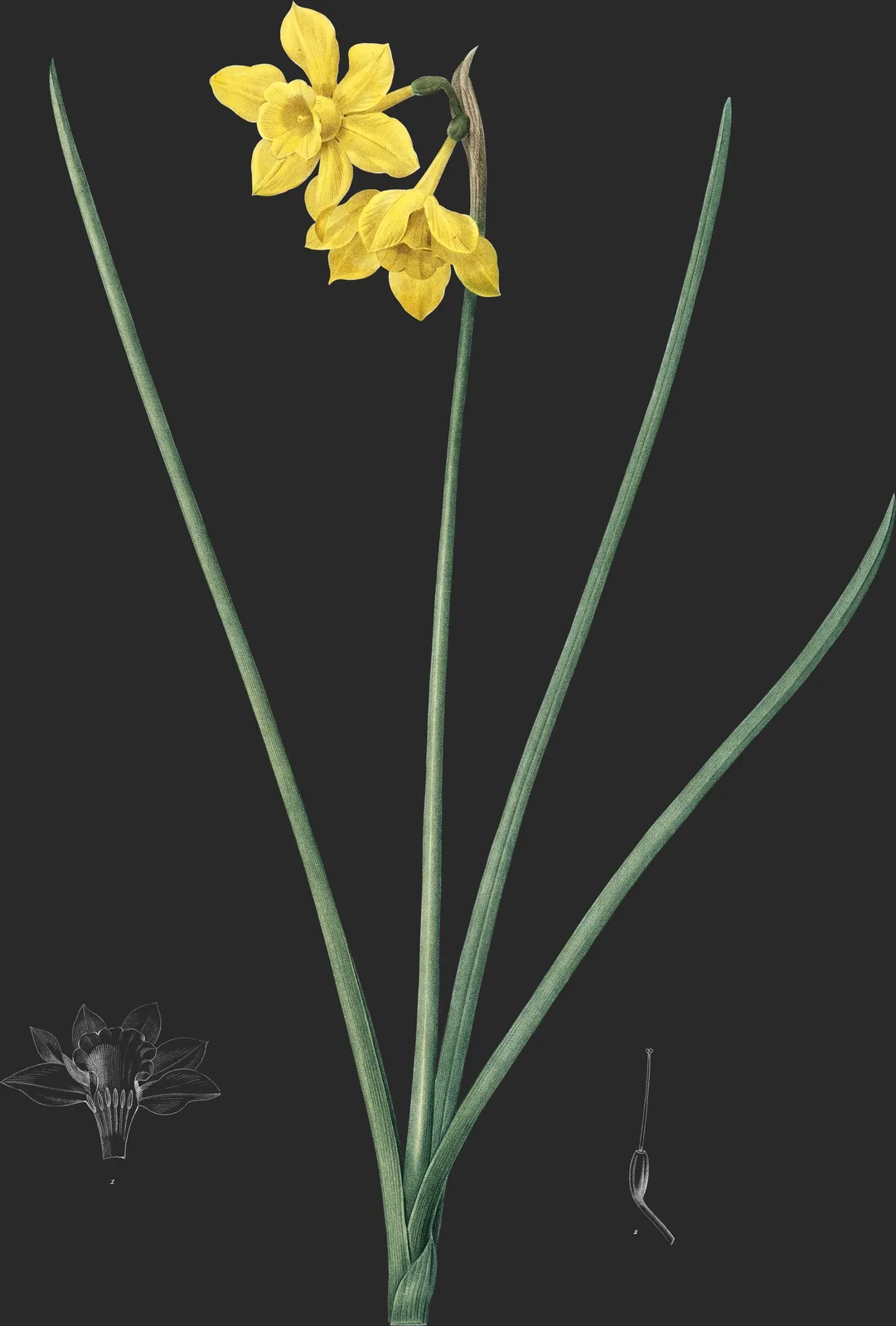
Cette espèce se distingue de tous les autres Narcisses, au godet de sa fleur, qui est en forme de cloche, de moitié plas court que les lanières du périgone, et divisé en six lobes réguliers et arrondis.
Une bulbe arrondie donne naissance à quelques feuilles linéaires, courhées en gouttière, droites, égales à la longueur de la hampe, obtuses au sommet, d’un vert un peu glauque, larges d’un centimètre vers leur base, et de 3–4 millimètres à leur sommet.
La hampe sélève à 3 décimètres de hauteur, droite, cylindrique, pleine à l’intérieur, légèrement comprimée vers le sommet; elle se termine par une, deux ou rarement trois fleurs jaunes, doubles en grandeur de celles du Narcisse tazette, étalées horizontalement, légèrement odorantes: ces fleurs sortent d’une spathe marcescente, monophylle, tubuleuse à sa base, fendue latéralement depuis le milieu de sa longueur, pointue à son sommet; elles sont portées sur des pédicelles cyliudriques plus courts que la spathe.
Le périgone a son tube eylindrique évasé an sommet, plus court que le limbe, adhérent par la base avec l’ovaire; le limbe est partagé en six lanières ovales, dont les trois extérieures se terminent par une petite pointe; le godet ou prolongement du tabe (appelé nectaire par Linné) est de moitié plus court que le limbe, divisé sur les bords en six lobes larges et obtus. Les étamines sont droites, insérées sur le milieu da tube du périgone; leurs anthères sont jaunes, linéaires, et atteignent i peine la base du godet.
L’ovaire est lisse, d’un vert foncé, triangulaire, adhérent avec la base du périgone; le style est jaune, filiforme, un peu plas court que le nectaire, terminé par trois stigmates courts et obtas. Le froit est une capsule à trois loges, que je n’ai pas vu parvenir à maturité.
Histoire
Le Narcisse odorant que nous avons observé au Muséum d’Histoire naturelle avait été envoyé de File de Corse, par Lasalle: il a été aussi trouvé dans les environs de Montpellier, par M. Gouan. Haller le cite, d’après de Saussure, comme indigine des environs de Genève; mais il est douteux que cette plante soit indigène de ce pays: elle n’y a pas été retrouvée depuis longtemps, et le lieu où elle est indiquée par Haller est si voisin de la ville et de plusieurs jardins, que ce Narcisse pourrait bien y avoir été autrefois planté.
Le Narcisse odorant fleurit de très-bonne heure, a la fin de l’hiver ou i l’entrée du printemps. ♃.
Fam. des Narcisses. Juss.—Hexandrie monogynie. Lin.
- Narcissus odoras. N. spathâ subbillorâ, coronâ campanulatâ sextida segmentis dimidio breviore, folis semicylindricis. Syn. Fl. gall. 165.
- Narcissus odoras. N. spathâ sabbiflorâ, nectario campanulato sexfido lævi, dimidio petalis breviore, foliis semicylindricis. Lin. Spec. 416. Amœn. acad. 4. p. 311. Lam. Dict. enc. 4. p. 425. excl. var. Gou. Fl. monsp. 303. Crantz. inst. 485. Curt. bot. mag. t. 78. Willd. Spec. 2. p. 38. Pers. ench. p. 350. Sut. Fl. helv. 1. p. 189. Lois. Fl. gall. 191.
- Narcissus odorus. N. subtriflorus, nectario apice crispo. Haworth. trans. soc. Lin. 5. p. 244.
- Narcissus odorus. N. scapo ancipiti unifloro exstriato, nectario petalis duplò breviore erecto sexfido crenulato, antheris reflexis. Gou. illustr. p. 23. excl. syn. et var. plerisque.
- Narcissus foliis junceis carinatis, scapo umilloro, seypho sexies emarginato. Hall. helv. n. 1951.
- Narcissus polyanthos, flore minore stellato toto luteo. Rudb. elys. 2. p. 6o. f. 7.
- Narcissus angustifolias sive juncifolius maximus amplo calyce. Park. theatr. t. 89. f. 5.
- Narcissus juncifolias primus amplo calice. Clus. hist. 1. p. 158. ic.
- Narcissus juncifolius flavus, amplo calice. J. Bauh. hist. 2. p. 608. ic. Clus.
Twelve ways of seeing
- measured cast yellow-green
- upright 1.48 : 1
- published 1805
- Plate 157
Not a catalogue entry but a way of looking: how to stand, what to notice, how the line was cut, when it flowers, where it came from, who made it — and then the poems and the classics that taught China to see the same flower. Read the twelve in order and the plate opens.
-
First Look
江馆清秋,晨起看竹,烟光日影露气,皆浮动于疏枝密叶之间。
—— 清·郑板桥《题画竹》
On an autumn morning at the river lodge I looked at the bamboo: mist, sunlight, dew, all drifting among the sparse and dense leaves.
The sheet is vertical: the eye climbs and settles in the upper half. Let the plant stand before you look for detail. Then step in close: watch where colour meets line, and whether the line ever breaks. Third, find where the yellow is deepest: the whole tonal order is measured from that patch.
-
Name and Thing
The binomial is Narcisse odorant: the first word is the genus it belongs among, the second the epithet that sets it apart. Two words carry a whole provenance. The older system filed it under Amaryllidaceæ by overall affinity; Linnaeus, counting stamens only, placed it in Hexandria — two ways of asking what a plant is. No established Chinese name exists, so it is cited by its binomial alone.
-
Form and Colour
Measured on this plate: flower colour covers 3.5% of the sheet, foliage 2.4%, the cast yellow-green. No other plate shares exactly this measure. Bulbous plants store the year underground — bulb, corm or tuber — then send up a few thick leaves and a single scape, with six tepals in cup, funnel or star. Filed under yellow — a honey-yellow, built in washes from a pale ground. Read the outline, then the colour layers, then the brush.
-
Composition
Tall and narrow, the plant rising in one movement with generous margins — the upright format of most floras. (about 1.48 : 1) No details are appended: a plate for looking, not for keying out. The plant covers only 10% of the sheet, centred above centre; the emptiness is where the eye rests. Old plates set the plant slightly off centre, with unequal margins — that small imbalance is what keeps it alive.
-
Line and Colour
The first half of the nineteenth century moved from copper to steel to lithography; stipple could render the softest transition. Decide first whether it was printed or painted; only then discuss whether it is beautiful.
-
Season
Early spring to early summer, genus by genus: tulips and hyacinths first, gladiolus and amaryllis later. The year 1805 on the plate is that of publication, not of flowering — the gathering came a year or two earlier. Note the season. Phenology is the most practical tool of appreciation.
-
Provenance
Three homelands: the Mediterranean, Central Asia and South Africa. The tulip came from Ottoman gardens and became a Dutch mania; South African bulbs filled European glasshouses after 1800. In the same volume the kin are shelved together; set several plates side by side.
-
The Book and the Hand
“The Liliaceae” was drawn by Pierre-Joseph Redouté and published 1802-1816. This plate is Plate 157, book page 157. The image is public domain; the hand-colouring is still one person's hand.
-
Poetic Resonance
总待别人般数尽,袖中拈出郁金芽。
—— 唐·王建《宮詞一百首 八十五》
The poem gives the mood first and the picture supplies the form; set the line beside the plate and the yellow the corolla becomes its resting point.
-
The Written Tradition
宁古无时,宁朴无巧,宁俭无俗。
—— 明·文震亨《长物志》
Better old than fashionable, better plain than clever, better spare than vulgar.
Li Bai's 'orchid wine, fragrant with yujin' is often misread as tulips; the Tang yujin was a turmeric-like root used to scent wine — same name, different plant. The difference is not of quality but of question: Europe asks what it is, China asks whom it resembles.
-
Symbolism
The tulip was an imperial emblem in Istanbul and a speculative bubble in Amsterdam; the hyacinth sprang from a boy's blood in Greek myth. What bulbs share is concealment: next year kept underground. This plate leans yellow, which in flower language adds one more degree of feeling. Flower language was added later; the flower knows nothing of it, and that innocence is part of its power.
-
What to Take Away
Appreciation is not knowledge but habit — one more look each time. Two centuries on, the plant may still flower in some garden; the one on this sheet stopped in the season of 1805.