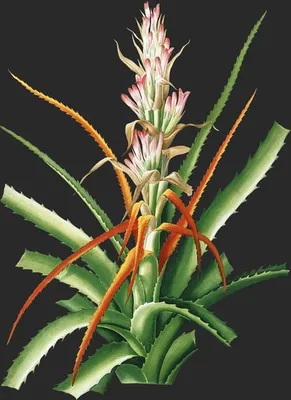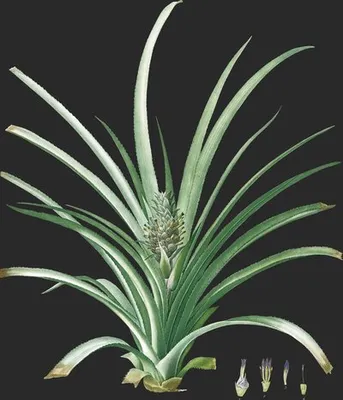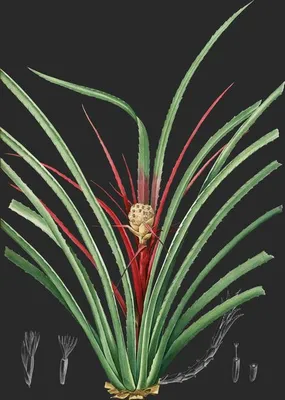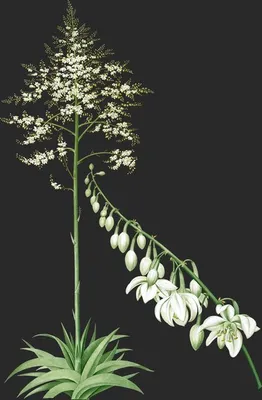
Pitcairnia Angustifolia
Pitcairnia a Feuille Étroite
Pitcairnia a Feuille Étroite
About this plate
Description
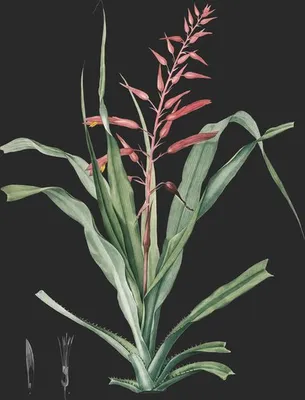
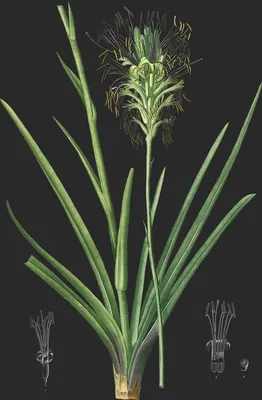
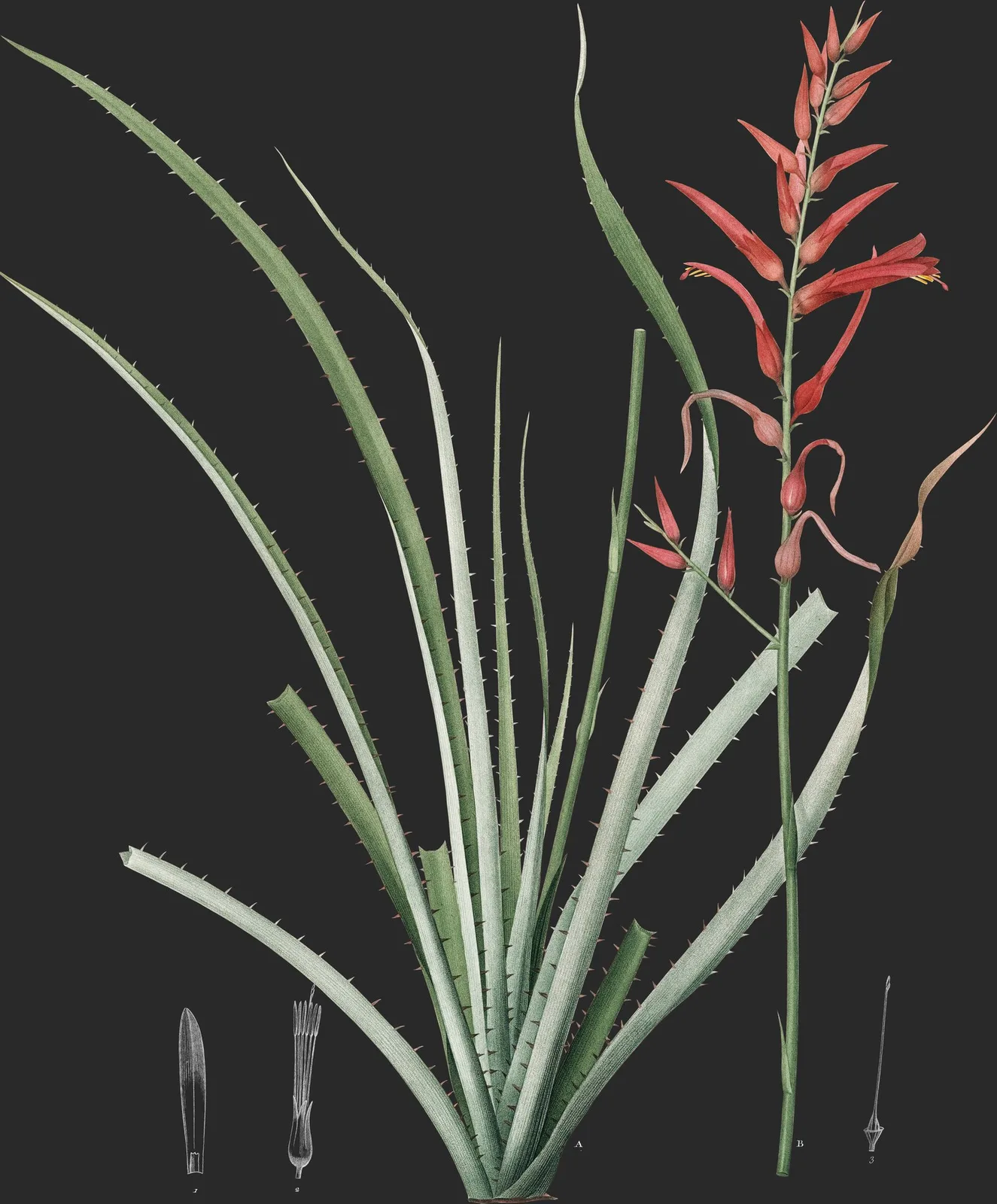
Les feuilles du Pitcairnia à feuille étroite suflisent pour faire reconnaitre cette espèce; elles naissent en toufte de la racine, mais sont plus droites, moins étalées, plus fermes, plus étroites que dans les autres espèces du genre; leur largeur ne dépasse guère un centimètre, même à leur base, ce qui fait qu’elles paraissent plutôt linéaires que lancéolées; leur surface supérieure est concave; mais ce qui les caractérise, c’est qu’elles sont bordées dans toute leur longueur de dents cornées, épineuses, brunes, écartées, droites et nullemens crochues.
La tige, qui s’élève du milieu des feuilles, et qui porte elle-même quelques feuilles à sa base, est couverte, surtout dans un age avancé, de la même pellicule cotonneuse qu’on observe à la face inférieure des feuilles; on la retrouve sur la face inférieure des bractées, sur les pédicelles et sur le calice, qui est de nature analogue aux feuilles: la tige, lorsqu’elle est chargée de fleurs, s’élève jusqu’à 6–8 décimètres, et dépasse la longueur des feuilles plus sensiblement que dans le Pitcairnia Faux-Ananas. La grappe de fleurs est plus läche, moins garnie que dans l’espèce suivante: elle se distingue surtout à ses pédicelles et à ses bractées, beaucoup plus courts que la longueur du calice, et en ce qu’elle est peu rameuse à sa base; mais je n’oserais aflirmer que ce dernier caractère soit constant. Les détails de la fleur ne m’ont présenté aucun caractère digne d’être noté.
Histoire
Cette espèce est cultivée dans le Jardin du Muséum d’Histoire naturelle, où elle a été rapportée par le zelé et malheureux Riedley, jardinier de l’expédition du capitaine Baudin; il l’avait recueillie dans l’ile de Sainte-Croix, dont elle est originaire.
On la cultive dans la serre chaude, où elle fleurit en été. ♃.
Explication de la planche
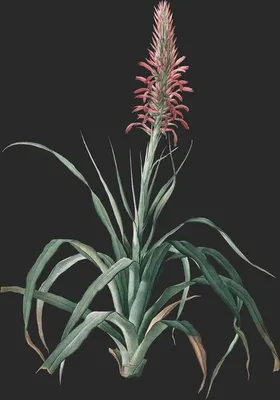
- La partie inférieure de la plante, savoir, les feuilles radicales et le bas de la tige.
- La partie supérieure de la tige.
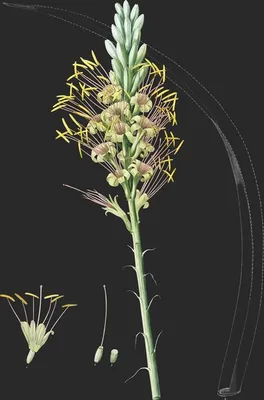
- Une des lanières extérieures de la fleur, pour montrer son écaille.
- La fleur, dont on a enlevé la corolle, pour montrer le calice, les étamines et le pistil.
- Le pistil, dont on a enlevé le calice qui lui était adhérent.
Fam. des Ananas. Juss.—Hexandrie monogynie. Lin.
- Piteairnia angustifolia. P. floribus lasé racemosis, pedicellis calice brevioribus, Toliis undique ciliato-spinosis.
- Piteairnia augustifolia. P. foliis ciliato-spinosis, pedunculis germinibusque tomentosis. Ait. Kew. 1. p. 40 1. Willd. Spec. 2. p. 10. Poir. Dict. enc. 5. p. 535.
Twelve ways of seeing
- measured cast red
- slightly upright 1.21 : 1
- published 1804
- Plate 76
Not a catalogue entry but a way of looking: how to stand, what to notice, how the line was cut, when it flowers, where it came from, who made it — and then the poems and the classics that taught China to see the same flower. Read the twelve in order and the plate opens.
-
First Look
夫象物必在于形似,形似须全其骨气。
—— 唐·张彦远《历代名画记》
Likeness is the threshold; bone-and-breath is the point.
Slightly taller than wide; the eye lands above centre. Then step in close: watch where colour meets line, and whether the line ever breaks. Third, find where the green is deepest: the whole tonal order is measured from that patch.
-
Name and Thing
The binomial is Pitcairnia angustifolia: the first word is the genus it belongs among, the second the epithet that sets it apart. Here the epithet angustifolia means “narrow-leaved” — the name records the feature the namer noticed first. The older system filed it under Bromeliaceæ by overall affinity; Linnaeus, counting stamens only, placed it in Hexandria — two ways of asking what a plant is. No established Chinese name exists, so it is cited by its binomial alone.
-
Form and Colour
Measured on this plate: flower colour covers 2.5% of the sheet, foliage 4.6%, the cast red with a second note of amber. No other plate shares exactly this measure. Tropical plants defy temperate habits: heavy, saturated flowers with strong scent, leathery or dissected leaves, stems that climb, swell, or reduce to spines. Filed under green — a moss green, a colour that comes mostly from leaf and stem. A single plant, laid out with nothing hidden.
-
Composition
Slightly taller than wide, the plant set a little above centre. (about 1.21 : 1) No details are appended: a plate for looking, not for keying out. The plant covers only 18% of the sheet, centred below centre; the emptiness is where the eye rests. Blank paper is not unfinished work: it is where the eye rests.
-
Line and Colour
The first half of the nineteenth century moved from copper to steel to lithography; stipple could render the softest transition. Craft leaves franker evidence than inscriptions.
-
Season
The tropics have no four seasons, only wet and dry; flowering follows the first rains, so a month on the plate often means 'after the rain'. The year 1804 on the plate is that of publication, not of flowering — the gathering came a year or two earlier. The plate records ten days of peak; the other three hundred are leaf, fruit and rest.
-
Provenance
Central and South America, Southeast Asia, India, Ceylon. Eighteenth- and nineteenth-century artists either sailed with the ships or drew from living specimens under glass. The volume was made in 1802-1816, when most of this knowledge came from living plants under glass.
-
The Book and the Hand
“The Liliaceae” was drawn by Pierre-Joseph Redouté and published 1802-1816. This plate is Plate 76, book page 76. The image is public domain; the hand-colouring is still one person's hand.
-
Poetic Resonance
山城过雨百花尽,榕叶满庭莺乱啼。
—— 唐·柳宗元《柳州二月榕葉落盡偶題》
The poem gives the mood first and the picture supplies the form; set the line beside the plate and the green the corolla becomes its resting point.
-
The Written Tradition
人无癖不可与交,以其无深情也。
—— 明·张岱《陶庵梦忆》
Never make a friend of a man without an obsession: he has no deep feeling.
Ji Han's fourth-century Records of the Plants of the South is China's earliest regional flora; Europe's counterpart was the exotic flora brought home by voyages — both by-products of empire and trade. The difference is not of quality but of question: Europe asks what it is, China asks whom it resembles.
-
Symbolism
In China these plants carry no classical symbolism; their meaning is newness — new worlds, new species, new trade routes. They show natural history's expanding edge. In a flora it is a species first and a symbol second; the order is worth keeping.
-
What to Take Away
If you keep one line, keep Guo Xi's: from afar its momentum, up close its texture. The flower of that year is dust, yet its image on paper has outlived every living cousin.