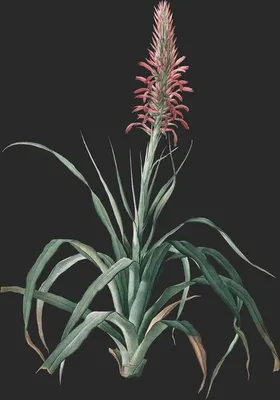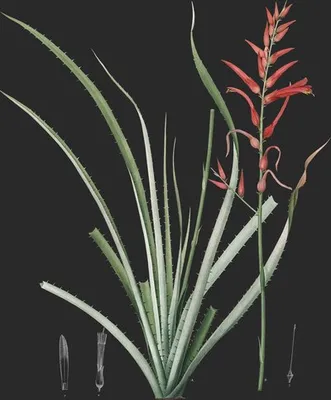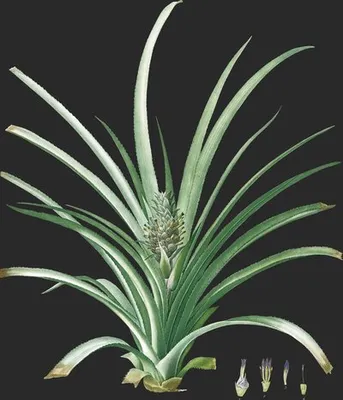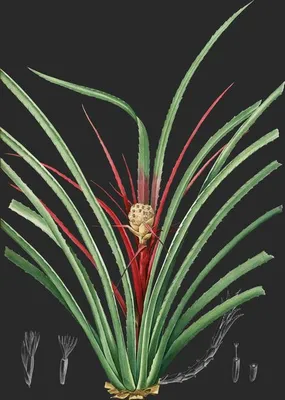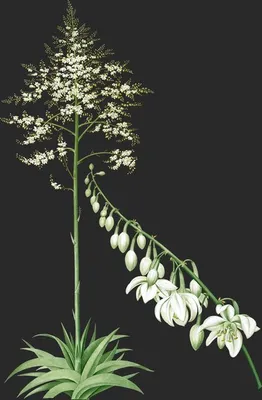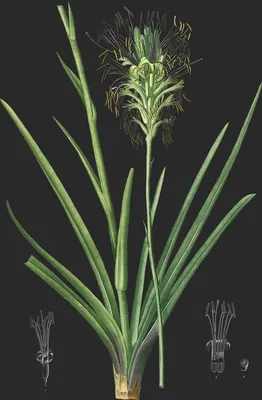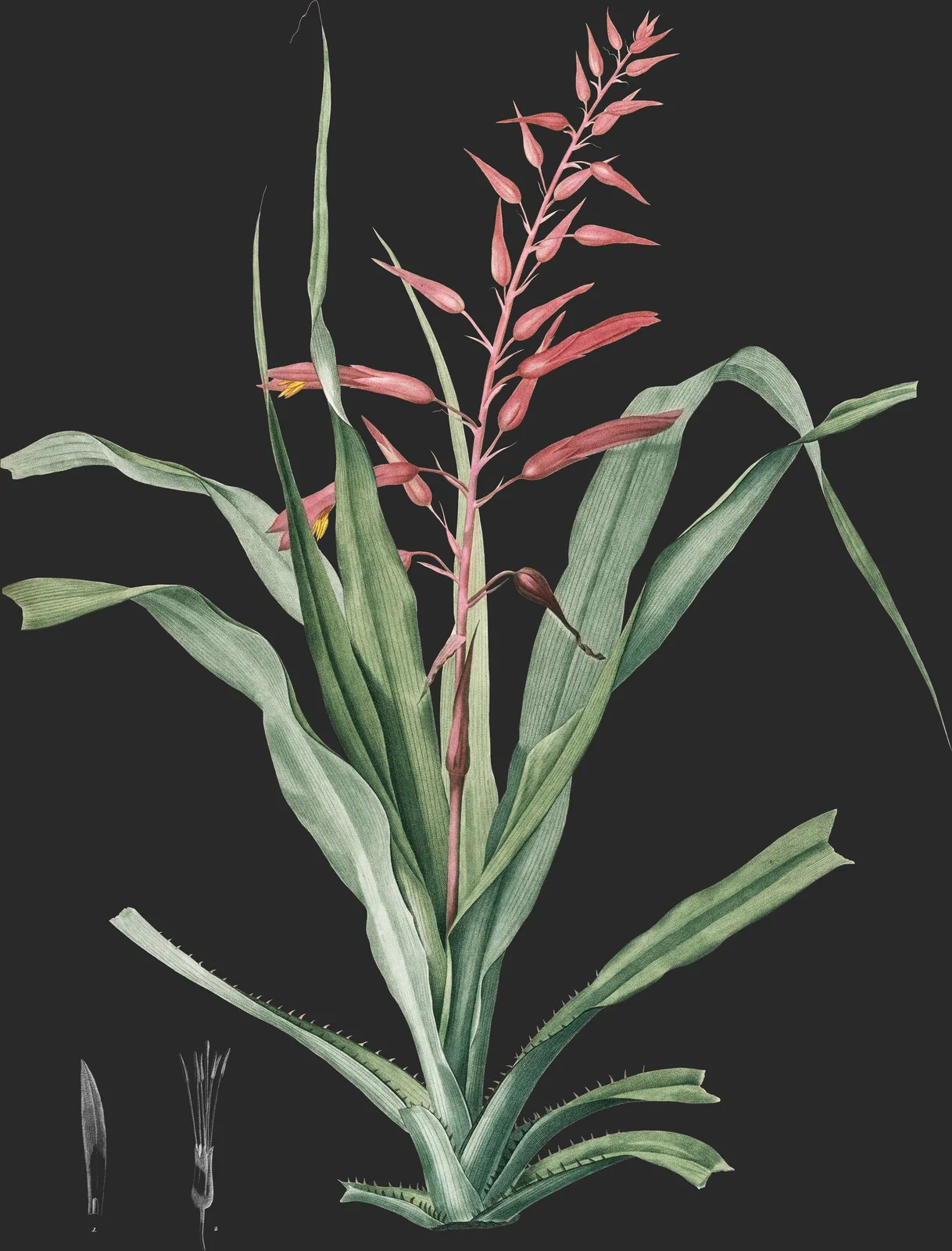
Pitcairnia Bromeliæfolia
艳红凤梨属·Pitcairnia Bromeliæfolia
Pitcairnia Faux-Ananas
Ten ways of seeing
- measured cast red
- upright 1.31 : 1
First Look
真山水之川谷,远望之以取其势,近看之以取其质。
—— 宋·郭熙《林泉高致·山水训》
Mountains and valleys: from afar take their momentum, up close take their texture — the two distances from which any picture is read.
The sheet is vertical: the eye climbs and settles in the upper half. Let the plant stand before you look for detail. Then step in close: watch where colour meets line, and whether the line ever breaks. Third, find where the green is deepest: the whole tonal order is measured from that patch.
Name and Thing
The binomial is Pitcairnia faux-ananas: the first word is the genus it belongs among, the second the epithet that sets it apart. Two words carry a whole provenance. The older system filed it under Bromeliaceæ by overall affinity; Linnaeus, counting stamens only, placed it in Hexandria — two ways of asking what a plant is. No established Chinese name exists, so it is cited by its binomial alone.
Form and Colour
Measured on this plate: flower colour covers 3.1% of the sheet, foliage 6.2%, the cast red. No other plate shares exactly this measure. Tropical plants defy temperate habits: heavy, saturated flowers with strong scent, leathery or dissected leaves, stems that climb, swell, or reduce to spines. a moss green. Read the outline, then the colour layers, then the brush.
Composition
The sheet is tall. No details are appended: a plate for looking, not for keying out. The plant covers only 22% of the sheet, centred near the centre; the emptiness is where the eye rests.
Line and Colour
The first half of the nineteenth century moved from copper to steel to lithography; stipple could render the softest transition. Take a loupe to three places: petal edge, leaf vein, caption. An unbroken line means engraving; colour crossing the outline means a hand. If you mean to copy it: take its skeleton, its margins and the order of its colours; the burin's hatching is the language of copper — suggest it with pencil density, do not imitate it stroke for stroke.
Poetic Resonance
一骑红尘妃子笑,无人知是荔枝来。
—— 唐·杜牧《過華清宮絕句三首 一》
The poem gives the mood first and the picture supplies the form; set the line beside the plate and the green the corolla becomes its resting point.
Symbolism
In China these plants carry no classical symbolism; their meaning is newness — new worlds, new species, new trade routes. They show natural history's expanding edge. Meanings change their tune: the same flower can say opposite things within a century.
Season and Place
The tropics have no four seasons, only wet and dry. Central and South America, Southeast Asia, India, Ceylon. Eighteenth- and nineteenth-century artists either sailed with the ships or drew from living specimens under glass. The year 1804 on the plate is that of publication, not of flowering — the gathering came a year or two earlier. See this kind of plate in the flowering season if you can: once you have met the living flower, you stop reading only colour.
The Book and the Hand
“The Liliaceae” carries only Pierre-Joseph Redouté's name. A plate is collective work: drawer, engraver and colourist were different hands, and the unnamed ones decided how good it looks.
What to Take Away
Appreciation is not knowledge but habit — one more look each time. The flower of that year is dust, yet its image on paper has outlived every living cousin.
About this plate
Description
Cette espèce a été si bien décrite par L’Héritier et par Swartz, qu’il est inutile d’entrer dans aueun détail a son égard; elle semble tenir le milieu entre le Pitcairnia à feuille étroite, dont elle a la floraison, et le Pitcairnia & large feuille, dont elle se rapproche par le feuillage.
Sa racine pousse une touffe de feuilles longues de 5 décimètres, larges de 2 à 3 centimètres, un peu étalées, surtout vers le sommet, plas minces et moins concaves que dans l’espèce précédente, et remarquables, parce qu’elles ne portent d’épines sur leurs bords que dans la moitié inférieure de leur lon-gueur, et que ces épines sont rapprochées, courtes et crochues. La tige porte dans sa partie inférieure des feuilles plus nombreuses, plus larges et plus serrées que dans le Pitcairia à feuille étroite; elle n’est pas sensiblement couverte de duvet cotonneux, non plus que les pédicelles et les calices, et elle dépasse peu la longueur des feuilles. Cette tige est terminée par une grappe lache, constamment simple, et chaque fleur est portée sur un pédicelle long de 1 à a centimètres, c’est-i-dire, égal à la longueur du calice; ces pédicelles ont à leur base une bractée qui atteint à peu près la même longueur qu’eux.
Histoire
Le Pitcairnia Faux-Ananas croit naturellement dans les lieux montueus de la Jamaïque. ♃.
On le caltive dans la plupart des jardins de botanique de l’Europe; il exige la serre chaude, et fleurit assez fréquemment en été.
Explication de la planche
La Plante de grandeur naturelle.
- Une des lanières intérieures de la fleur vue en dedans, pour montrer son écaille.
- La fleur débarrassée de le corolle, pour montrer le calice, les étamines et le pistil.
Fam. des Ananas. Juss.—Hexandrie monogynie. Lin.
- Pitcairnia bromeliefolia. P. floribus las racemosis, pedicellis calycem equan-tibus, foliis inferne ciliato-spinosis.
- Piteairnia bromeliæfolia. L’Herit. sert. angl. p. 7. 1. 11. Swarta. Fl. Ind. occid. 1. p. 580.* Lam. illusir. t. 224.
- Pitcairnia bromeliæfolia. P. foliis ciliato-spinosis, peduncalis germinibusque glaberrimis. Ait. Kew. 1. p. 401. Schneev. ic. fasc. 4. t. 11. Willd. Spec. 2. p. 10. Poir. Dict. enc. 5. p. 534.
- Hepetis angustifolia. Swartz. prod. 56.