Rosa Centifolia var Prolifera-Foliacea
Le Rosier Prolifère-Foliacé
Le Rosier Prolifère-Foliacé
About this plate
Description
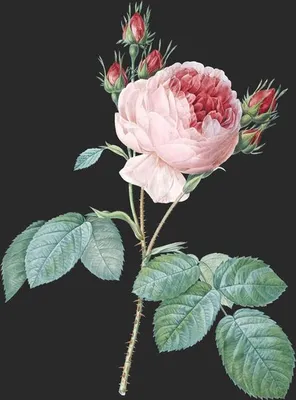
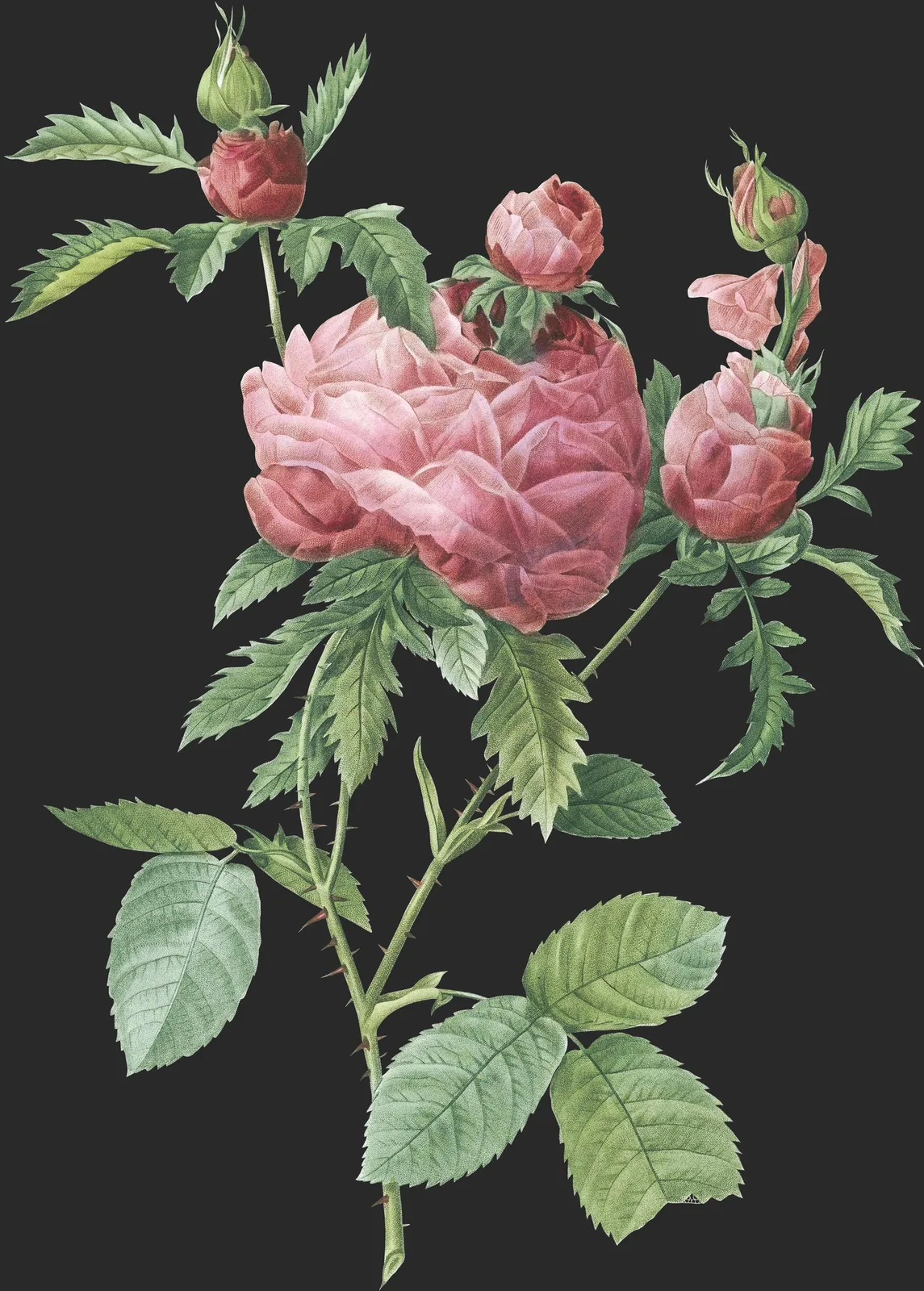
Ce Rosier est remarquable en ce qu’il réunit sur un même individu deux variétés distinctes, savoir: la Cent-feuilles folia-cée, et la Cent-feuilles prolifère. Converti en franc-de-pied par le procédé de la marcotte, il s’élève à deux pieds, ou environ. Ses tiges, et en général toute la partie foliacée de l’arbrisseau, sont semblables, à l’exception des longues divisions calicinales et des fleurs prolifères, à celles de toutes les Cent-feuilles connues; c’est pourquoi nous ne nous occuperons pas de sa description, ayant déja donné dans cet ouvrage celle de beaucoup d’individus de ce groupe.
Observations
Notre Rosier, ainsi qu’on peut en juger à la vue de la figure qui accompagne cette description est une modification du R. Centifolia gigantea, ou pictorum (nouv. Duhamel), dont les fleurs, les plus grandes du groupe des Rosiers à Cent-feuilles, sont si recherchées à cause de leur volume et de leur parfum.1
Quant au luxe de végétation que l’on remarque dans notre Cent-feuilles prolifère-foliacée, il est dû à la qualité du sol, aux engrais, à l’état de l’atmosphère, aux arrosements fréquents, et autres circonstances qui déterminent cette monstruosité. Toutefois ceux qui l’élèvent, franche ou greffée, ne doivent pas toujours compter sur le succès de leurs soins: souvent le Rosier ne leur donnera que des fleurs ordinaires. Du Pont la cultivait, et c’est en raison de ces variations continuelles qu’il ne l’a pas même consignée dans son catalogue. (Voyez Gymnasium Rosarum.)
- R. Centifolia prolifera. Nouv. Duham. vol. 7, p. 37, var. 17.
- R. Centifolia foliacea. Red. Ros: vol. 1, p. 78, var. υ. Idem. vol. 2, p. 59. Thy. Prod. groupe XII, p. 76, var. ο. De Chesnel, Histoire de la Rose,2 p. 72.
-
Quoique, jusqu’à présent, le Rosier à Cent-feuilles ait semblé obtenir la palme sur tous les autres, un auteur moderne s’est efforcé de la lui ravir pour la donner au Rosier des Quatre Saisons, ou de tous mois (R. Rifera). Voici en effet ce quon lit dans l’Almanach des Roses, de Guerrapin, p. 68:
Cet arbrisseau ne forme pas d’aussi beaux buissons et d’aussi belles touffes que beaucoup d’autres espèces, notamment que la tous mois. Ses fleurs ne sont pas accompagnées d’assez de feuilles; cet ornement les ferait ressortir et valoir davantage. Le bois en devient souvent galleux, meurt tous les deux ans, à peu près, et a besoin d’être renouvelé. Ses boutons n’ont pas la légèreté et l’élégance de ceux de tous mois, et ne forment pas d’aussi jolis bouquets. Leur parfum ne me paraît pas aussi délicat.
-
Histoire de la Rose chez les peuples de lantiquite ’et chez les modernes; description des espèces cultivées; culture des Rosiers; propriété des Roses, et leurs diverses préparations alimentaires, cosmétiques, etc. etc., par M. le marquis De Chesnel, lieutenant-colonel de la légion infanterie-légère des Pyrénées-Orientales, membre de plusieurs sociétés sa-vantes, etc., avec cette épigraphe:
La Rose est la fleur chère aux dieux: Dans ses cheveux Hébé la pose. Et le nectar qu’on boit aux cieux N’est rien que le suc de la Rose.
Toulouse, F. Vieusseux, 1820, I vol. in-8°, 174 pages.
Ten ways of seeing
- measured cast red
- upright 1.40 : 1
- published 1824
- Plate 146
Not a catalogue entry but a way of looking: how to stand, what to notice, how the line was cut — then, halfway, a line of Chinese poetry: how the ancients saw this same flower. After it, the flower's language, its season and homeland, its book; and at the end one line of classical prose — and a pair of eyes to take away.
-
First Look
真山水之川谷,远望之以取其势,近看之以取其质。
—— 宋·郭熙《林泉高致·山水训》
Mountains and valleys: from afar take their momentum, up close take their texture — the two distances from which any picture is read.
The sheet is vertical: the eye climbs and settles in the upper half. Let the plant stand before you look for detail. Then step in close: watch where colour meets line, and whether the line ever breaks. Third, find where the green is deepest: the whole tonal order is measured from that patch.
-
Name and Thing
The binomial is Rosa centifolia: the first word is the genus it belongs among, the second the epithet that sets it apart. Here the epithet centifolia means “hundred-leaved” — the name records the feature the namer noticed first. No established Chinese name exists, so it is cited by its binomial alone.
-
Form and Colour
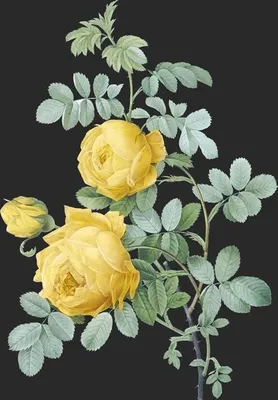
Measured on this plate: flower colour covers 9.3% of the sheet, foliage 13.5%, the cast red. No other plate shares exactly this measure. Roses are shrubs or scramblers with pinnate leaves of three to seven serrated leaflets; the double flowers open in crumpled, inward-curling layers around a small knot of yellow stamens. Filed under green — a moss green, a colour that comes mostly from leaf and stem. Three things fix the habit: leaf arrangement, tepal count, and how the flower is borne.
-
Composition
Tall and narrow, the plant rising in one movement with generous margins — the upright format of most floras. (about 1.40 : 1) No details are appended: a plate for looking, not for keying out. The plant takes about 35% of the sheet, centred near the centre — the easy measure most florists kept to. Old plates set the plant slightly off centre, with unequal margins — that small imbalance is what keeps it alive.
-
Line and Colour
The first half of the nineteenth century moved from copper to steel to lithography; stipple could render the softest transition. Craft leaves franker evidence than inscriptions. If you mean to copy it: take its skeleton, its margins and the order of its colours; the burin's hatching is the language of copper — suggest it with pencil density, do not imitate it stroke for stroke.
-
Poetic Resonance
红云夹路蔷薇障,翠羽成层薜荔幢。
—— 宋·陆游《家园赏花》
The poem gives the mood first and the picture supplies the form; set the line beside the plate and the green the corolla becomes its resting point.
-
Symbolism
In Europe the rose means love and secrecy ('sub rosa'); in Chinese verse the rambling rose leans and clings — lingering attachment rather than ardour. Flower language was added later; the flower knows nothing of it, and that innocence is part of its power.
-
Season and Place
Late spring into early summer, peaking in May — the first flush of the garden year. the ever-blooming modern rose is a nineteenth-century crossing of European and Chinese stock. The year 1824 on the plate is that of publication, not of flowering — the gathering came a year or two earlier. The volume was made in 1817-1824, when most of this knowledge came from living plants under glass.
-
The Book and the Hand
“Les Roses” was drawn by Pierre-Joseph Redouté and published 1817-1824. This plate is Plate 146, book page 146. The image is public domain; the hand-colouring is still one person's hand.
-
The Written Tradition
插花不可太繁,亦不可太瘦。多不过二种三种,高低疏密,如画苑布置方妙。
—— 明·袁宏道《瓶史·宜称》
Flowers should be set neither too crowded nor too sparse — two or three kinds at most, tall and low, dense and open, arranged as a painter would compose.
Tradition places roses in the Han imperial park; Song and Ming manuals named the double forms 'Baoxiang' and 'Ten Sisters', and Qing compendia separated rose, rugosa and monthly rose. Keep the line; it will surface the next time you meet the same plant.
What to Take Away
Carry three rules away: whole before detail; line before colour; picture before book. The flower of that year is dust, yet its image on paper has outlived every living cousin.