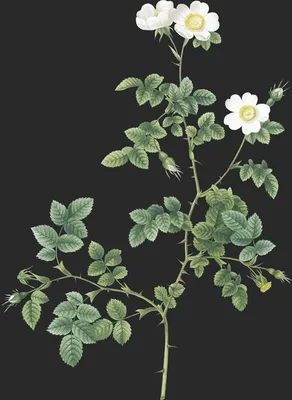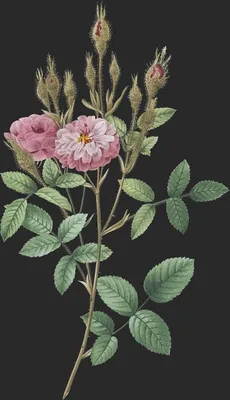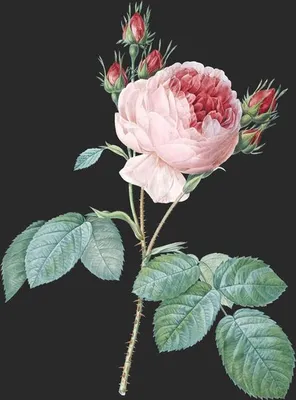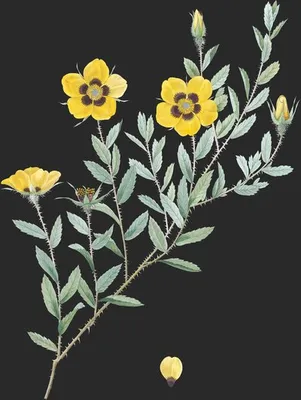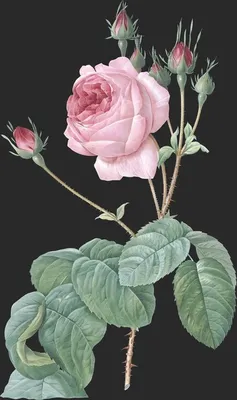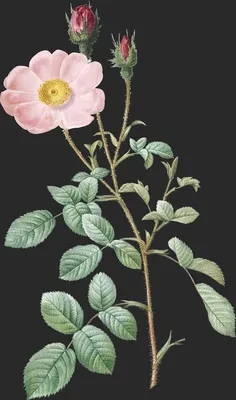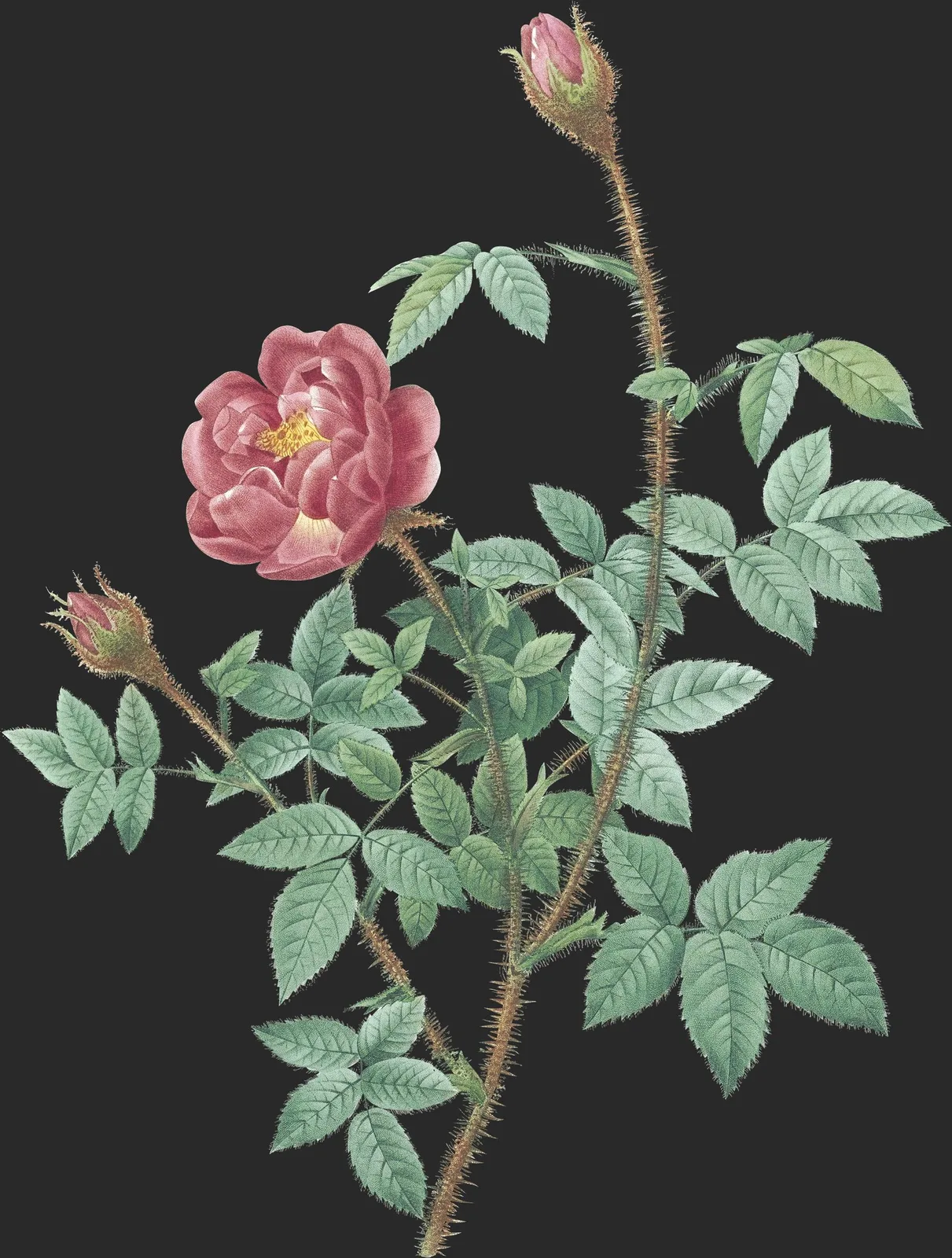
Rosa Mucosa Anemone-Flora
玫瑰犁瘿蜂
La Mousseuse de la Flèche
About this plate
Description
Ce Rosier a été obtenu de semence, par M. LEMEUNIER qui nous l’a communiqué, en exprimant le vou de le voir publier sous le nom de la ville qu’il habite, à laquelle il a cru pouvoir dédier cette nouveauté. Nous nous empressons de satisfaire à ses désirs, persuadés que nous sommes du bon accueil que recevra sa dédicace.1
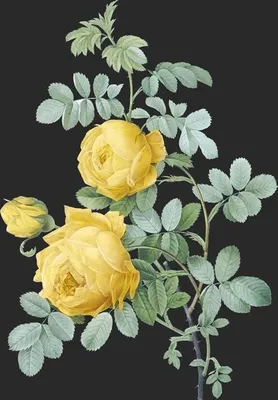
Notre arbrisseau forme un buisson de la hauteur de dix-huit à vingt pouces, et parait susceptible de s’élever encore davan-tage. Ses jeunes rameaux, d’abord d’un rouge brun, se convertissent en une couleur grisâtre en mûrissant. Ils sont armés d’un grand nombre d’aiguillons inégaux, droits, très-rappro-chés, qui s’étendent jusque sur le pédoncule commun et les pédicelles. Les feuilles se composent de cinq ou de sept folioles d’un vert-obscur, assez petites, allongées, pointues au sommet, arrondies à la base, glabres en-dessus, couvertes en-dessous, comme sur la bordure, de glandes très-rapprochées et souvent ramifiées. Les jeunes folioles se présentent avec une teinte rousseâtre prononcée et très-remarquable; mais elles finissent par prendre, en grandissant, la teinte verte générale. Les fleurs sont toujours droites, jamais penchées comme dans les mousseuses ordinaires, quelquefois solitaires, mais le plus souvent plusieurs ensemble à l’extrémité des rameaux. La corolle se compose de quatre à cinq rangs de pétales convergents vers le centre, comme dans la Rose cent-feuilles anémone, d’une teinte générale rose-foncé, quelques-uns cependant panachés de taches d’un rose plus tendre, quelquefois blanchâtres. Les tubes du calice, les pédoncules et les pédicelles sont armés de poils spinuliformes, longs, et qui résistent au toucher. Les étamines sont très-longues: nous n’avons pas vu le fruit.
Observations
Cet élégant arbrisseau est très-remarquable dans les divers degrés de sa végétation. Sommités, tiges, aiguillons, supports, diamètre des fleurs, leur couleur, rien n’est semblable aux Rosiers mousseux ordinaires; aussi distinguera-t-on toujours au premier coup-d’œil le Rosier mousseux de La Flèche. Il nous a semblé qu’on devait le cultiver à l’ombre, car les fleurs se sont flétries promptement sur le pied que M. Lemeunier a envoyé à l’auteur du texte de cet ouvrage, il y a plus de deux ans, et qui se trouve exposé à un très-grand soleil.
R. germinibus, caule, pedunculis pedicellisque spinulis inequa-libus, rectis, confertissimis horridis; laciniis calycinis glanduloso-viscidis; floribus erectis; petalis amone involutis. (N.) Ex semine R. muscosce subsimplicis, in hort. Lemeunier.
- Le sol Angevin est très-favorable à la culture du Rosier; aussi trouve-t-on à Angers, à La Flèche, au Mans, et dans les départements de la Sarthe, et Maine-et-Loire, une multitude de jardins dans lesquels on cultive cet arbrisseau avec un grand succès. Déja beaucoup de variétés curieuses ont été signalées dans les semis, et le zèle des cultivateurs et des amateurs en fait espérer encore beaucoup d’autres. Les collections les plus renommees sont celles de MM. Lemeunier, Goupil fils, receveur-général du département; Narcisse Desportes, botaniste distingué; Bizard, conseiller à la Cour royale; le général Delaage; Drouet, Dagonneau, Poilpré, Foulard, etc.
Ten ways of seeing
- measured cast red
- upright 1.32 : 1
- published 1824
- Plate 164
Not a catalogue entry but a way of looking: how to stand, what to notice, how the line was cut — then, halfway, a line of Chinese poetry: how the ancients saw this same flower. After it, the flower's language, its season and homeland, its book; and at the end one line of classical prose — and a pair of eyes to take away.
-
First Look
搜尽奇峰打草稿。
—— 清·石涛《苦瓜和尚画语录》
Exhaust the strange peaks, and then make the sketch.
The sheet is vertical: the eye climbs and settles in the upper half. Let the plant stand before you look for detail. Then step in close: watch where colour meets line, and whether the line ever breaks. Third, find where the green is deepest: the whole tonal order is measured from that patch.
-
Name and Thing
Only the genus Rosa is given; species-level names came later. The Chinese name 玫瑰犁瘿蜂 is a modern rendering of the Latin, not an old garden name.
-
Form and Colour
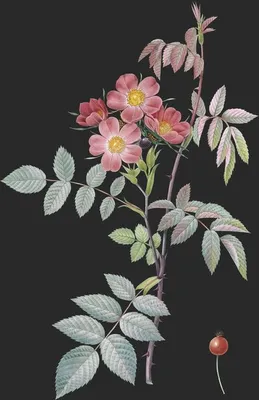
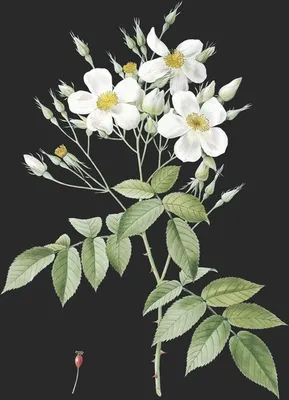
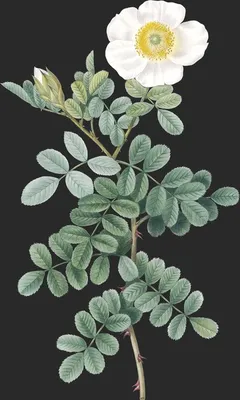
Measured on this plate: flower colour covers 6.2% of the sheet, foliage 6.5%, the cast red with a second note of amber. No other plate shares exactly this measure. Roses are shrubs or scramblers with pinnate leaves of three to seven serrated leaflets; the double flowers open in crumpled, inward-curling layers around a small knot of yellow stamens. Filed under green — a moss green, a colour that comes mostly from leaf and stem. Read the outline, then the colour layers, then the brush.
-
Composition
Tall and narrow, the plant rising in one movement with generous margins — the upright format of most floras. (about 1.32 : 1) No details are appended: a plate for looking, not for keying out. The plant takes about 30% of the sheet, centred near the centre — the easy measure most florists kept to. Cover the margins with your thumb and the plate suffocates; uncover them and the flower breathes again.
-
Line and Colour
The first half of the nineteenth century moved from copper to steel to lithography; stipple could render the softest transition. Craft leaves franker evidence than inscriptions. If you mean to copy it: take its skeleton, its margins and the order of its colours; the burin's hatching is the language of copper — suggest it with pencil density, do not imitate it stroke for stroke.
-
Poetic Resonance
有情芍药含春泪,无力蔷薇卧晓枝。
—— 宋·秦观《春日》
The peony, feeling, holds spring tears; the rose, strengthless, lies across the morning branch.
The poem gives the mood first and the picture supplies the form; set the line beside the plate and the green the corolla becomes its resting point.
-
Symbolism
In Europe the rose means love and secrecy ('sub rosa'); in Chinese verse the rambling rose leans and clings — lingering attachment rather than ardour. Meanings change their tune: the same flower can say opposite things within a century.
-
Season and Place
Late spring into early summer, peaking in May — the first flush of the garden year. Widespread in the temperate north. Chinese gardeners knew roses since the Han. The year 1824 on the plate is that of publication, not of flowering — the gathering came a year or two earlier. Read the locality and the flowering season both with a discount: one is hearsay, the other a ten-day peak.
-
The Book and the Hand
“Les Roses” was drawn by Pierre-Joseph Redouté and published 1817-1824. This plate is Plate 164, book page 164. The image is public domain; the hand-colouring is still one person's hand.
-
The Written Tradition
插花不可太繁,亦不可太瘦。多不过二种三种,高低疏密,如画苑布置方妙。
—— 明·袁宏道《瓶史·宜称》
Flowers should be set neither too crowded nor too sparse — two or three kinds at most, tall and low, dense and open, arranged as a painter would compose.
Tradition places roses in the Han imperial park; Song and Ming manuals named the double forms 'Baoxiang' and 'Ten Sisters', and Qing compendia separated rose, rugosa and monthly rose. You need not parse every word: take the line, and the flower acquires a second face.
What to Take Away
Next time you stand before a flowering plant, give it three minutes: leaf arrangement, direction of the flower, the darkest patch. Two centuries on, the plant may still flower in some garden; the one on this sheet stopped in the season of 1824.