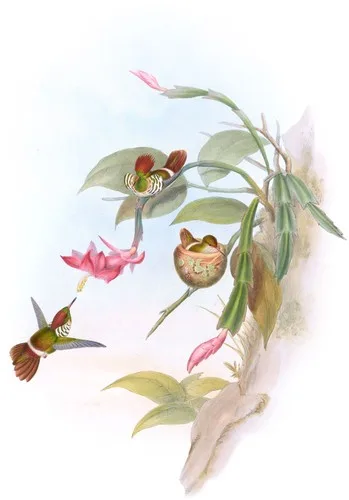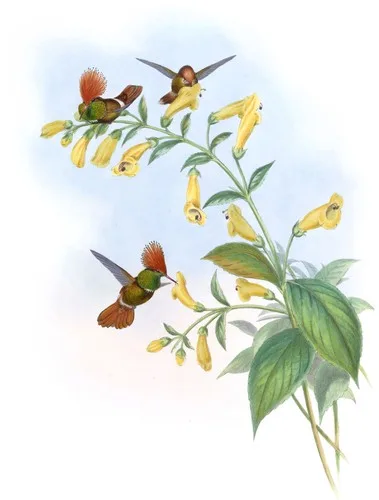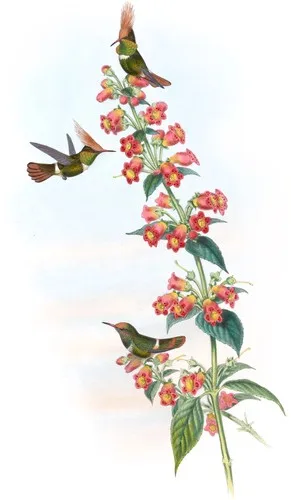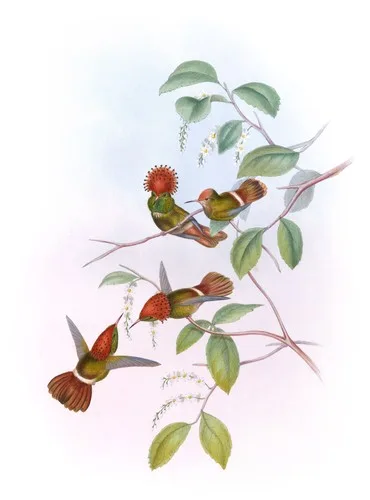
白冠蜂鸟
Lophornis adorabilis
Lophornis adorabilis
Salvin’s Coquette
- 中文名
- 白冠蜂鸟
- 学名
- Lophornis adorabilis
- 合集
- 古尔德蜂鸟图谱
- 绘者
- John Gould(约翰·古尔德)
- 年代
- 1887
- 图版号
- Pl. 395, Suppl. Vol.
- 原书页码
- p.395
- 授权
- CC0 1.0 Universal (Public domain)
十观
- 纵幅 1.60∶1
第一眼
江馆清秋,晨起看竹,烟光日影露气,皆浮动于疏枝密叶之间。
—— 清·郑板桥《题画竹》
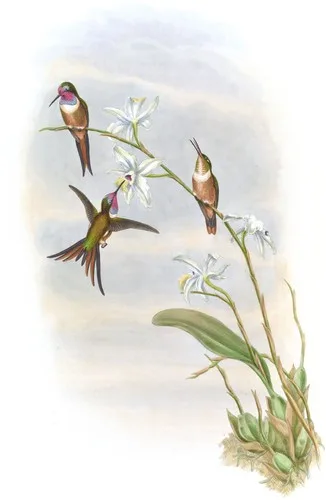
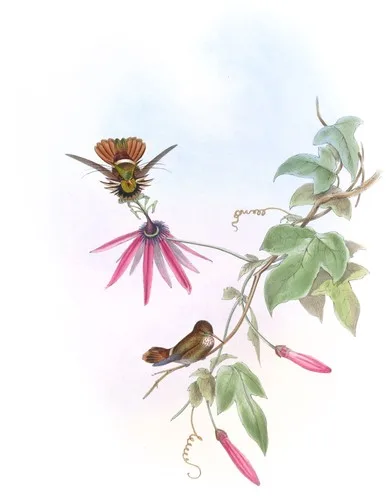
郑板桥说他画竹,是先看见“烟光日影露气”在枝叶间浮动,才动手。看画时找这一层空气,比记住花的名字更要紧。这一幅是竖的:眼睛从下往上走,落点在中段那只鸟身上。先别急着看羽毛,让姿态先立起来。第二步凑近一寸:看线与色的交界,色有没有压住线,线有没有断。第三步,把视线放到最深的那一小块:整幅的用色秩序,都是从那里排开的。
名与实
学名 Lophornis adorabilis:前一词是属,管它归在哪一类;后一词是种加词,管它在这一类里凭什么与众不同。一百多年前的命名者,把一种植物的来历压进了两个词。中文名“白冠蜂鸟”是后人据学名回译的通行叫法,与古书里的旧名未必对得上——名与物之间,总隔着一层翻译。
形与色
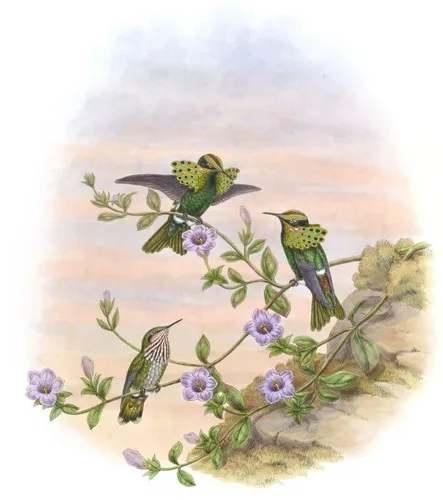
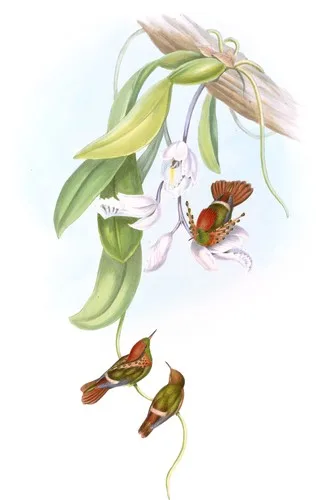
蜂鸟为美洲最小之鸟,喙细长如针,舌分叉成管,可伸入花心吸蜜;翼小而振频极高,能悬停、能倒飞。此幅未作色相归档,只能就形制论。画幅高而窄,形与色的关系因此看得格外清楚:先读轮廓,再读色层,最后才看笔触。
构图与呼吸
画幅高而窄,鸟栖在枝的中段,上下留白多——十九世纪鸟谱的标准版式,留给它飞走的余地。全幅只画一只,不作解剖附图——这类图更近于“观赏”,而非“鉴定”。空白不是没画完,是给眼睛留的落脚处:一张图若四边都塞满,花反而会闷。
一刀一色
十九世纪后半叶,石版与彩色石印渐成主流:颜色可以直接印出,不再依赖手工,线条反倒退居其次。图像的“准确”提高了,手性却淡了。还有一种证据在纸背:铜版压进纸里的那道痕、上色处微微凸起的颜料、再版时磨浅的线。扫描件里也能看出七分。想动笔临它的人记住一句:先铺大块的形与色,干后再收细部;石印的柔和层次来自薄涂与网点,水彩分两三遍淡铺即可逼近。
诗境
夫列子御风而行,泠然善也,旬有五日而后反。
—— 《庄子·逍遥游》
蜂鸟悬停于空,不落不飞,最近于“御风”。庄子说的是一种自由的姿态,蜂鸟把它做成了生理事实。诗以气行,画以形立;两种“看”叠在一起,才是看画的意思。
花语
阿兹特克以蜂鸟为战神与太阳的化身;欧洲维多利亚时代则以蜂鸟为收藏与装饰的极致,百万只羽毛被做成胸饰。中国旧籍无此鸟,故无象征——这空白本身,就是一部博物学交流史。花语是后人添上去的,花本身并不知道;但这层“不知道”,正是它最动人的地方。
时与地
热带美洲几乎全年可见,花期即其季节。仅产美洲,自阿拉斯加南部至火地岛,以安第斯山最为繁盛。中土无蜂鸟,汉籍不载,晚清海外游记始见其名。图上所记的 1887 年是刊行之年,不是采到那只鸟的年份;真正的观察记录通常比出版早一两年。同一株植物,春秋两季像两种东西;同一座山,一百年前与今天叫两个名字。图把这两样都冻结在了纸上。
书与人
《古尔德蜂鸟图谱》只署了约翰·古尔德一个人的名字。版画是集体工程:绘图、刻版、上色各有其人,真正决定这幅图好不好看的,常是没留下名字的刻工与上色师。
带走一双眼睛
把这三件事带走:先整体后细节;先线后色;先看画再翻书。任何一张老图版,都可以用这三条读。二百年后,这只鸟的后代或许仍在某处活着;而纸上这一只,永远停在 1887 年的那个季节。
关于本图版
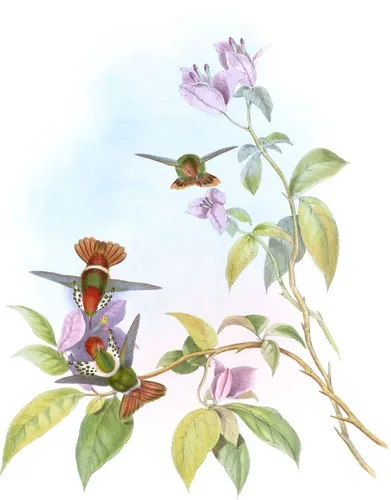
这幅图版出自《古尔德蜂鸟图谱》(Gould's Hummingbirds),由约翰·古尔德绘制,1849—1887 年间出版。图中描绘的是白冠蜂鸟,学名 Lophornis adorabilis,归入蜂鸟科(Trochilidae)。
全编共收录 421 幅图版,本图是其中一幅,原书将其列为 Pl. 395, Suppl. Vol.,见第 395 页,版式为纵幅。扫描件取自公有领域原件,经高分辨率修复与色彩校正,可按原大放大查看线条与设色。
原书文字(英文 / 法文)
Mr. Savin must have been pleased when the male of this Humming-bird came under his notice, and when he saw how different it was from all its immediate allies.
The extreme beauty of the little fairy demanded some pretty euphonious name; and he applied to it that of adorabilis, one which, I doubt not, will last to the end of time. The well-read Trochilidist will not require to be told that there are now ten species of this ornamental group, nine of which have been figured in vol. iii. of the ‘Monograph,’ published twenty years ago.
The tenth, which I now figure, will, I trust, with many others equally rare, add materially to the usefulness and interest of this ‘Supplement.’
In my former work I placed all the species enumerated below in the single genus Lophornis; but since that date they have been separated into no less than five genera, none of which was proposed by myself, though I think that they are very fairly recognizable:—
- Lophornis ornatus. Trinidad.
- Lophornis gouldiæ. North Brazil.
- Lophornis magnificus. South Brazil.
- Telamon regulus. Bolivia.
- Telamon delattrii. Colombia.
- Telamon reginæ. Colombia.
- Dialia adorabilis. Veragua.
- Paphosia helenæ. Guatemala.
- Bellatrix chalybeus. Bolivia.
- Bellatrix verreauxi. Peru, Columbia.
The following is Mr. Osbert Salvin’s account of this novelty:—
This beautiful species is singularly distinct from any of its congeners, but perhaps belongs rather to the L. magnifica group than to that containing L. helenæ. In the whole genus, however, no other member has the erectile feathers on the forehead, the thread-like white plumes of the crest, or the long pointed feathers of the throat, all of which render this bird most distinct when compared with its allies.
The first specimen obtained by Arcé was a female, which, though evidently belonging to a distinct species, I hesitated to describe. The specimen was shot at Bugaba. ‘The last collection includes the male, which Arcé tells me his brother David obtained high up on the volcano of Chiriqui. That so fine a bird should have remained so long undiscovered seems singular; but the fact, I think, shows that the range of the species is extremely limited.
No less than two other species of Lophornis are found in this portion of Central America, viz.:—L. helenæ, the Mexican and Guatemalan bird, which is also to be met with in Costa Rica; and the southern L. delattrii, which seems to be abundant about Calobre and on the Isthmus of Panama.
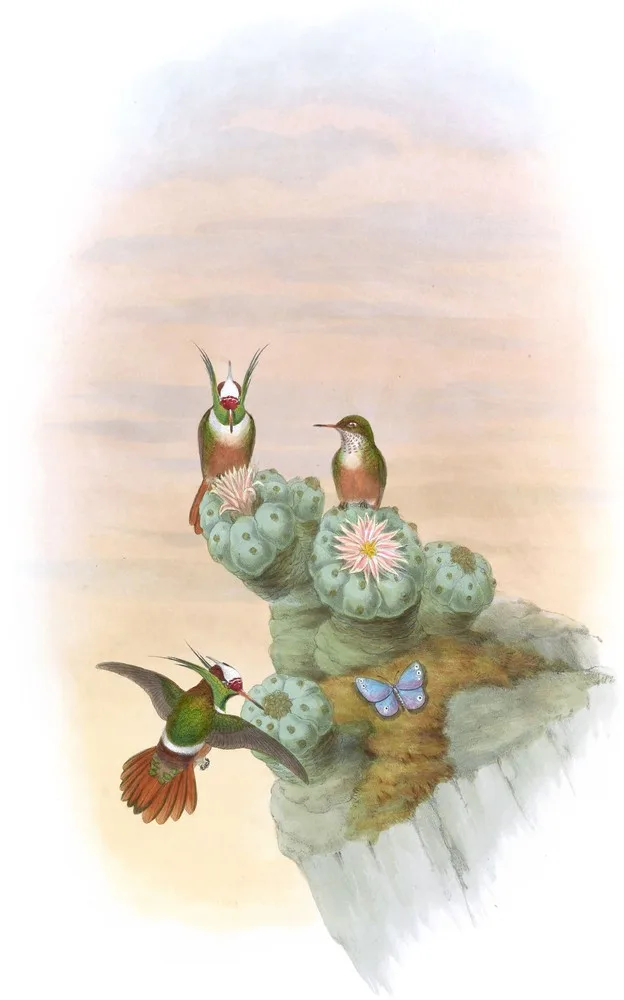
Mr. Elliot states that the male has the forehead ruby-red; crown pure white, narrowing to a point on the occiput, from each side of which springs a few narrow, lengthened, dark green feathers; sides of the head, bordering the white, dark brown; back and wing-coverts bronzy green; rump dark purple, crossed by a narrow white band; throat metallic dark green; upper part of the breast white; flanks bronzy green; abdomen and under tail-coverts dark rufous; tail deep rufous, with the tips of the median feathers and edges of the others greenish brown; wings purple.
Female. Head and ears black; throat white, sparingly spotted with golden green; tail banded with a broad bar near the extremity; median rectrices tinged in the middle with a greenish tint.
Total length 2
References
- Lophorms adorabilis, Salvin, Proc. Zool. Soc. 1870, p. 207.—Elhiot, Syn. p. 135.
- Matha adorabilis, Muls. Hist. Nat. Oiseaux-Mouches, vol. iii. p: 208, pl., 1876.