Allium Subhirsutum
Allium Subhirsutum
Ail Velu
About this plate
Description
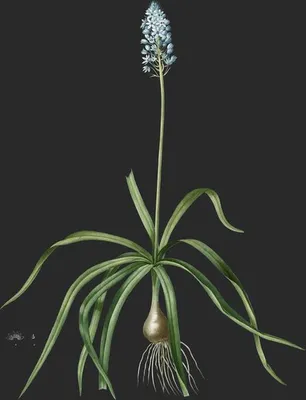
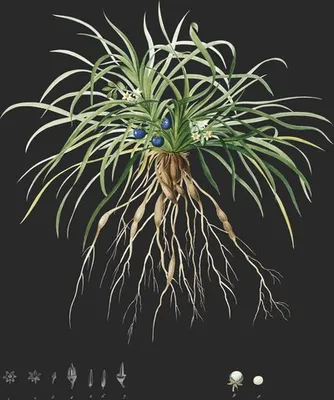
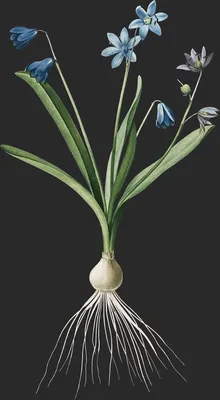
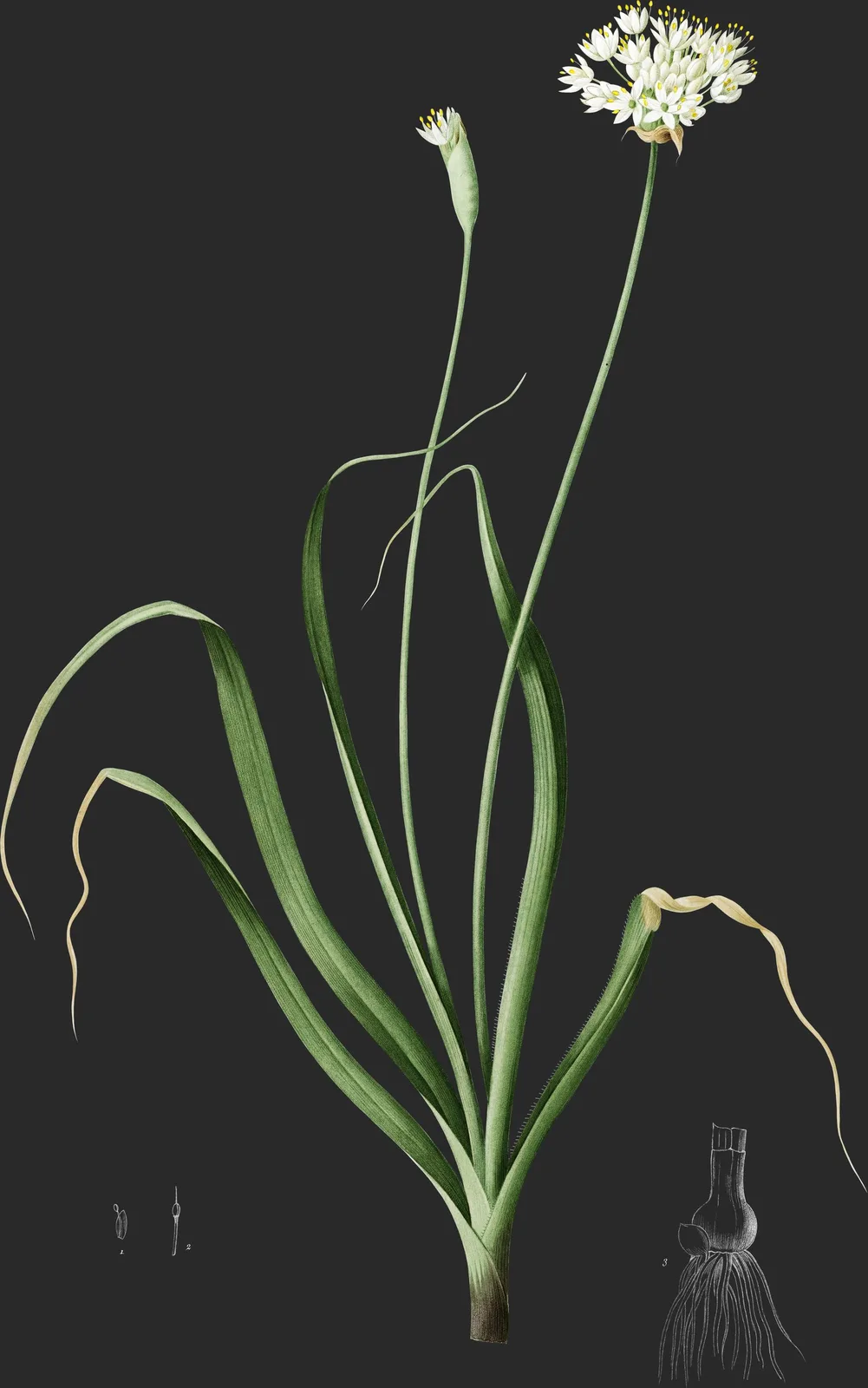
Une bulbe arrondie, blanchâtre, de la grosseur d’une cerise, donne naissance à des feuilles molles, linéaires, larges de quinze millimètres environ, pliées en gouttière, relevées en carène sur le dos, aigués, entières, ciliées sur les bords, surtont dans le bas, quelquefois aussi longues que la hampe, d’autrefois plus courtes. Dans la variété A, ces feuilles sont glauques et velues sur le dos, dans une grande partie de leur longueur. Dans la variété B, elles sont vertes, glabres sur le dos, et simplement ciliées.
La hampe est droite, presque cylindrique ou légèrement comprimée, haute de trois à cinq décimètres, glabre, couverte à sa base par les gaines des feuilles, nue dans la plus grande partie de sa longueur. Les fleurs sont blanches, et forment à son sommet une ombelle un peu aplatie, assez serrée, dépourvue de bulbes. Elles exhalent une odeur asser forte et très-agréable. La spathe est à une feuille verte, lancéolée, aussi longue que les pédicelles et se déchirant le plus souvent d’un seul côté. Les pédicelles sont verts et longs de deux centimètres.
Les divisions du périgone sont blanches, linéaires-lancéolées, entières, rétrécies en pointe au sommet, médiocrement étalées.
Les étamines sont égales en longueur aux divisions du périgone; leurs fila-ments, blancs et en forme d’alene, supportent des anthères d’un beau jaune.
L’ovaire est arrondi, non marqué de sillons, un peu plus large dans le bas que dans le haut, et d’une comleur verte. Il est surmonté par un style en forme d’alène, égal en longueur aux étamines, et terminé par un stigmate simple.
Le fruit est une capsule arrondie, a trois angles obtus, terminé supérieurement en pointe. Chacune de ces loges renferme deux graines noires irrégulièrement triangulaires.
Histoire
L’Ail velu est originaire du midi de l’Europe et de Barbarie. On ne le cultive guère que dans les jardins de botanique, où il est introduit depuis longtemps. Il fleurit en mai et en juin.
Fam. des Asphodèles. Juss.—Hexandrie monogynie. Lin.
- Allium subbirsutum. A. foliis latè linearibus ciliatis, umbellâ fastigiatâ capsuliferâ, staminibus subulatis, petala lineari-lanceolata æquantibus.
- Allium subhirsutam. A. caule planifolio umbellifero, umbellâ fastigiatâ, staminibus subulatis, foliis linearibus ciliatis. Willd. hort. Berol. 357.
- Allium subbirsutum. A. caule planifolio umbellifero, foliis inferioribus hirsutis, staminibus subulatis. Osb. it. 49. Lin. sp. pl. 424. Mill. dict. 1. n. 16. Lam. dict. 1. p. 65. Willd. sp. 2. p. 66. Desfont. Atl. 1. Pers. enchir. 1. p. 355. Fl. Franç. éd. 3. n. 1956.
- Allium foliis radicalibus subhirsutis, caulinis glabris, lloribus umbellatis. Hall. de all. 18.
- Allium folis lanceolato-linearibus, floram umbellâ fastigiatâ. Roy. Lugd-b. 39.
- Moly angustifolium umbellatum. Bauh. pin. 75.
- Moly dioscoridis. Clus. hist. 1. p. 192.
- Moly dioscorideum putatum. Lob. ic. 1. t. 160. f. 1.
- A. foliis dorso hirsutis.
- B. foliis dorso glabris.
Twelve ways of seeing
- measured cast yellow-green
- upright 1.60 : 1
- published 1811
- Plate 305
Not a catalogue entry but a way of looking: how to stand, what to notice, how the line was cut, when it flowers, where it came from, who made it — and then the poems and the classics that taught China to see the same flower. Read the twelve in order and the plate opens.
-
First Look
竖划三寸,当千仞之高;横墨数尺,体百里之迥。
—— 南朝宋·宗炳《画山水序》
A vertical stroke of three inches stands for a cliff of a thousand fathoms; a few feet of ink holds a hundred li.
The sheet is vertical: the eye climbs and settles in the upper half. Let the plant stand before you look for detail. Then step in close: watch where colour meets line, and whether the line ever breaks. Third, find where the green is deepest: the whole tonal order is measured from that patch. The pose leans right: the upper half carries 10 points further right than the lower — a living thing, not a diagram.
-
Name and Thing
The binomial is Ail velu: the first word is the genus it belongs among, the second the epithet that sets it apart. Two words carry a whole provenance. The older system filed it under Asparagaceæ by overall affinity; Linnaeus, counting stamens only, placed it in Hexandria — two ways of asking what a plant is. No established Chinese name exists, so it is cited by its binomial alone.
-
Form and Colour
Measured on this plate: flower colour is sparing, 0.6% of the sheet against 4.8% of foliage, the cast tending yellow-green — as with pale or white blooms, outline and tone do the talking. A bulb of overlapping fleshy scales gives the lily its Chinese name, 'hundred-fold'; six tepals reflex as the flower opens, around six stamens with long, T-shaped anthers. Filed under green — a moss green, a colour that comes mostly from leaf and stem. Three things fix the habit: leaf arrangement, tepal count, and how the flower is borne.
-
Composition
Tall and narrow, the plant rising in one movement with generous margins — the upright format of most floras. (about 1.60 : 1) No details are appended: a plate for looking, not for keying out. The plant covers only 9% of the sheet, centred near the centre; the emptiness is where the eye rests. Old plates set the plant slightly off centre, with unequal margins — that small imbalance is what keeps it alive.
-
Line and Colour
The first half of the nineteenth century moved from copper to steel to lithography; stipple could render the softest transition. Craft leaves franker evidence than inscriptions.
-
Season
Early to high summer, June and July; the flowers last only days, so artists drew them just as they opened. The year 1811 on the plate is that of publication, not of flowering — the gathering came a year or two earlier. Note the season. Phenology is the most practical tool of appreciation.
-
Provenance
Temperate north — China, Japan, Europe. Long used in Chinese medicine, lilies were hunted in East Asia by nineteenth-century collectors and transformed European gardens. In the same volume the kin are shelved together; set several plates side by side.
-
The Book and the Hand
“The Liliaceae” was drawn by Pierre-Joseph Redouté and published 1802-1816. This plate is Plate 305, book page 305. The image is public domain; the hand-colouring is still one person's hand.
-
Poetic Resonance
方石斛栽香百合,小盆山养水黄杨。
—— 宋·陆游《龟堂杂兴十首 其五》
The poem gives the mood first and the picture supplies the form; set the line beside the plate and the green the corolla becomes its resting point.
-
The Written Tradition
多识于鸟兽草木之名。
—— 《论语·阳货》
…and from the Songs one learns the names of birds, beasts, plants and trees.
The Bencao Gangmu describes the bulb as garlic-like, edible and medicinal; Song writers already noted that the leaves vary while the flowers stay white. The difference is not of quality but of question: Europe asks what it is, China asks whom it resembles.
-
Symbolism
In the West the white lily is Marian purity, held by the angel of the Annunciation; in China the name sounds like 'a hundred years in harmony', a wedding wish. In a flora it is a species first and a symbol second; the order is worth keeping.
-
What to Take Away
Appreciation is not knowledge but habit — one more look each time. Two centuries on, the plant may still flower in some garden; the one on this sheet stopped in the season of 1811.