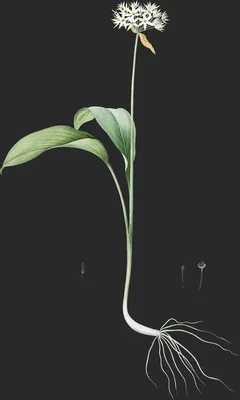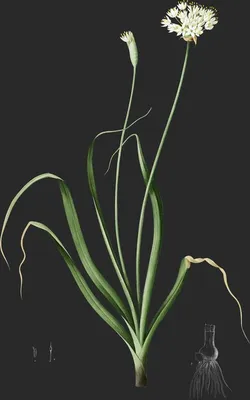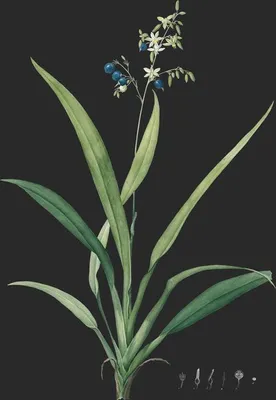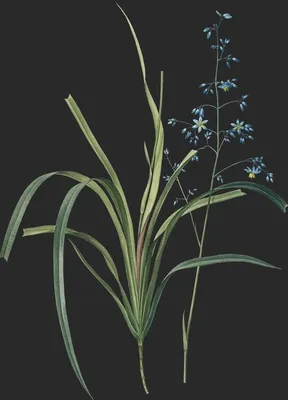
Scilla Italica
Scille d’Italie
Scille d’Italie
Ten ways of seeing
- measured cast yellow-green
- upright 1.31 : 1
First Look
六法者何?一、气韵生动是也;二、骨法用笔是也;三、应物象形是也;四、随类赋彩是也;五、经营位置是也;六、传移模写是也。
—— 南齐·谢赫《古画品录》
The six laws: spirit resonance alive; bone-method in the brush; matching form; colour by kind; planning the placing; copying the masters.
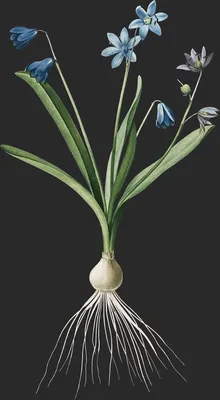
The sheet is vertical: the eye climbs and settles in the upper half. Let the plant stand before you look for detail. Then step in close: watch where colour meets line, and whether the line ever breaks. Third, find where the green is deepest: the whole tonal order is measured from that patch.
Name and Thing
The binomial is Scilla italica: the first word is the genus it belongs among, the second the epithet that sets it apart. Two words carry a whole provenance. The older system filed it under Asparagaceæ by overall affinity; Linnaeus, counting stamens only, placed it in Hexandria — two ways of asking what a plant is. No established Chinese name exists, so it is cited by its binomial alone.
Form and Colour
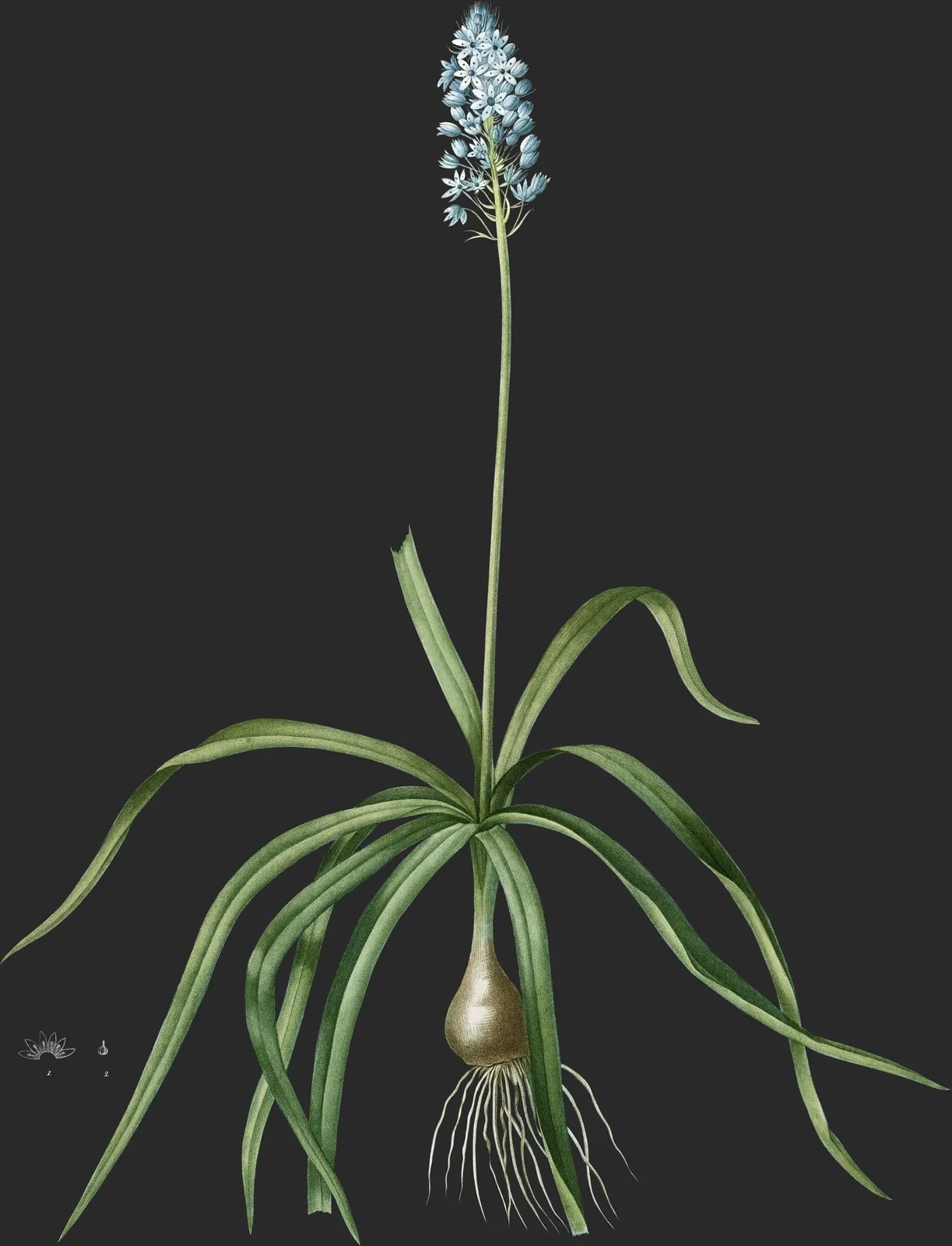
Measured on this plate: flower colour is sparing, 0.5% of the sheet against 7.1% of foliage, the cast tending yellow-green — as with pale or white blooms, outline and tone do the talking. Bulbous plants store the year underground — bulb, corm or tuber — then send up a few thick leaves and a single scape, with six tepals in cup, funnel or star. a moss green. A single plant, laid out with nothing hidden.
Composition
The sheet is tall. No details are appended: a plate for looking, not for keying out. The plant covers only 10% of the sheet, centred below centre; the emptiness is where the eye rests.
Line and Colour
The first half of the nineteenth century moved from copper to steel to lithography; stipple could render the softest transition. Decide first whether it was printed or painted; only then discuss whether it is beautiful. If you mean to copy it: take its skeleton, its margins and the order of its colours; the burin's hatching is the language of copper — suggest it with pencil density, do not imitate it stroke for stroke.
Poetic Resonance
东风夜放花千树,更吹落、星如雨。
—— 宋·辛弃疾《青玉案·元夕》
East wind at night sets a thousand trees of flowers alight, then blows them down like rain of stars.
The poem gives the mood first and the picture supplies the form; set the line beside the plate and the green the corolla becomes its resting point.
Symbolism
The tulip was an imperial emblem in Istanbul and a speculative bubble in Amsterdam; the hyacinth sprang from a boy's blood in Greek myth. What bulbs share is concealment: next year kept underground. Meanings change their tune: the same flower can say opposite things within a century.
Season and Place
Early spring to early summer, genus by genus: tulips and hyacinths first, gladiolus and amaryllis later. Three homelands: the Mediterranean, Central Asia and South Africa. The tulip came from Ottoman gardens and became a Dutch mania. The year 1811 on the plate is that of publication, not of flowering — the gathering came a year or two earlier. See this kind of plate in the flowering season if you can: once you have met the living flower, you stop reading only colour.
The Book and the Hand
“The Liliaceae” carries only Pierre-Joseph Redouté's name. The image is public domain; the hand-colouring is still one person's hand.
What to Take Away
Next time you stand before a flowering plant, give it three minutes: leaf arrangement, direction of the flower, the darkest patch. The flower of that year is dust, yet its image on paper has outlived every living cousin.
About this plate
Description
La racine de cette Scille est une bulbe ovale-arrondie, grosse comme une noix, et couverte de tuniques membraneuses.
Du sommet de cette bulbe sort un faisceau de feuilles linéaires, molles, larges d’un décimètre, pliées sur leur ligne moyenne de manière à former une gouttière triangolaire, un peu aiguës, égales en longueur aux hampes. Celles-ci sont droites, hautes de quinze à vingt centimètres, ou plus, glabres, lisses, cylindriques.
Les fleurs sont petites, nombreuses, bleues, disposées en une grappe termi-nale, courte et très-serrée. Leurs pédicelles sont droits, demi-étalés, assez épais, et longs de douze à quinze millimètres. A la base de chacun d’eux est une bractée linéaire, membraneuse, plus longue que lui.
Le périgone est trésétalé, d’un bleu pale, un peu grisâtre. Il est divisé jusqu’à sa base en six segments, ovales, égaux entre eux, un peu obtus, longs de cinq millimètres.
Les étamines sont un peu plus courtes que les divisions du périgone. Leurs filaments sont bleus, en forme d’alène. Les anthères sont ovales, vacillantes, d’un bleu foncé.
Lovaire est libre, arrondi, bleu, a six sillons. Le style est un peu plus court que les étamines, assez épais, d’une couleur améthyste foncée. Le stigmate est simple.
Nous n’avons pas vu le fruit.
Histoire
Malgré le nom que porte cette plante, quelques anteurs, et Linné lui-même, ont eu des doutes sur sa véritable patrie. Il parait cependant qu’elle est bien réellement originaire d’Italie. Suivant Allioni, on la trouve dans les lieux pierreux et ombragés, aux environs de Nice. On la cultive dans quelques parterres. Elle fleurit dans nos climats à la fin d’avril.
Explication de la planche
La Plante entière de grandeur naturelle.
- Le périgone fenda et étalé avec les étamines.
- L’ovaire et le style.
Fam. des Asphodèles. Juss.—Hexandrie monogynie. Lin.
- Scilla Italica. S, racemo conico oblongo. Syst. veget., éd. 13. p. 388. Willd. sp. pl. 2. p. 126. Poiret. in Lam. dict. 6. p. 736. Fl. Fr. éd. 3. n. 1940.
- Scilla Italica. S. corymbo conferto hemisphærico. Lin. sp. pl. 442. Mill. dict. n. 3.
- Scilla radice solidâ, floribus corymbosis confertissimis. Hort. Cliff. 123. Roy. Lugd-b. 32.
- Ornithogalum spicatum cinereum. Tournef. inst. 380.
- Hyacinthas stellatos multiflorus cineracci coloris. J. Bauh. hist. 2. p. 582. ic.
- Ilyacinthus stellaris spicatus cinereus. Bauh. pin. 46.
- Hyacinthus stellatos Italicus. Besl. hort. Eyst. vern. ord. 2. t. 11. f. 1.
- Hyacinthus stellaris cineracei coloris. Clus. hist. 1. p. 184.