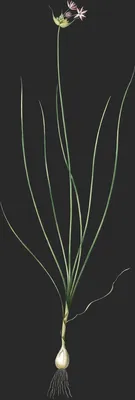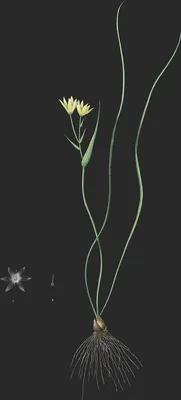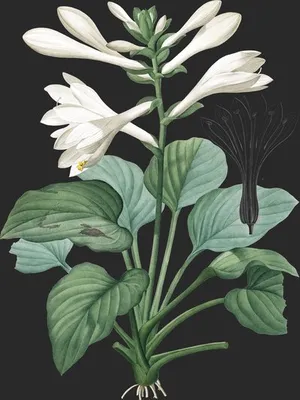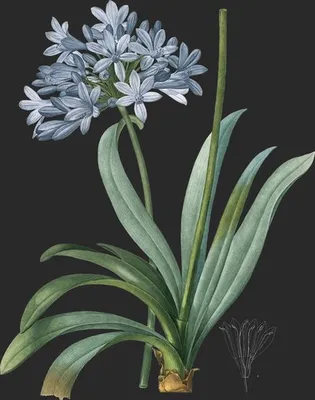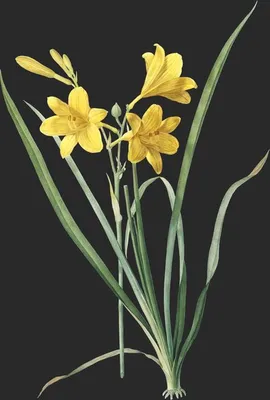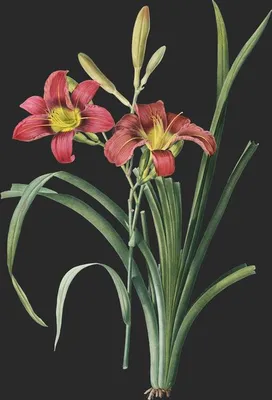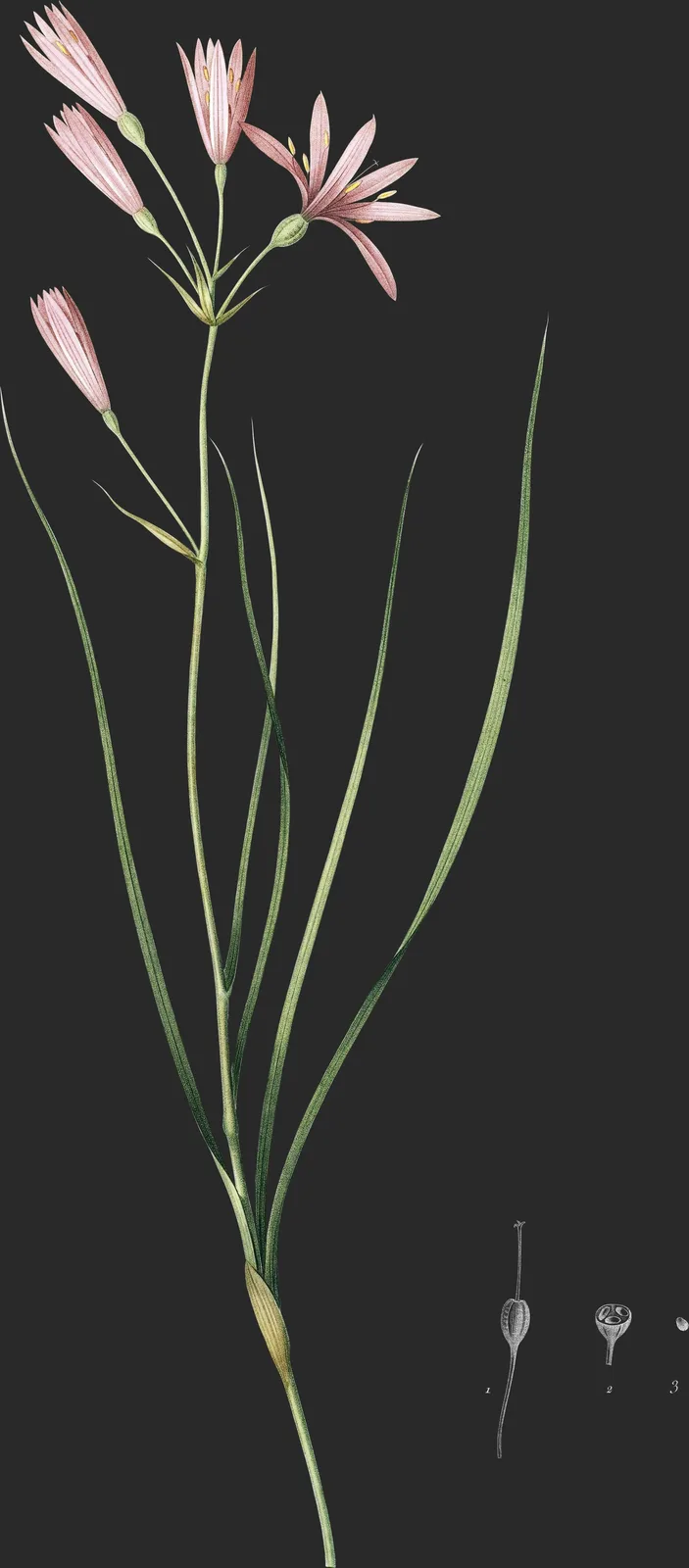
Amaryllis Montana
石蒜科
Amaryllis des Montagnes
Ten ways of seeing
- measured cast red
- upright 2.27 : 1
First Look
凡画山水,意在笔先。
—— 唐·王维《山水论》
In painting, the intention precedes the brush.
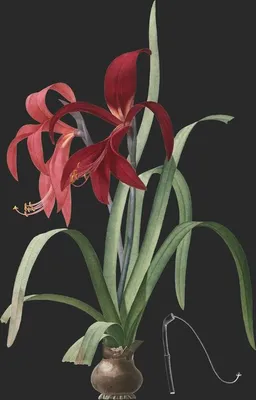
The sheet is vertical: the eye climbs and settles in the upper half. Let the plant stand before you look for detail. Then step in close: watch where colour meets line, and whether the line ever breaks. Third, find where the yellow is deepest: the whole tonal order is measured from that patch. The pose leans left: the upper half carries 10 points further left than the lower — a living thing, not a diagram.
Name and Thing
The binomial is Amaryllis montana: the first word is the genus it belongs among, the second the epithet that sets it apart. Here the epithet montana means “of mountains” — the name records the feature the namer noticed first. The older system filed it under Amaryllidaceæ by overall affinity; Linnaeus, counting stamens only, placed it in Hexandria — two ways of asking what a plant is. The Chinese name 石蒜科 is a modern rendering of the Latin, not an old garden name.
Form and Colour
Measured on this plate: flower colour is sparing, 1.2% of the sheet against 2.8% of foliage, the cast tending red — as with pale or white blooms, outline and tone do the talking. Bulbous plants store the year underground — bulb, corm or tuber — then send up a few thick leaves and a single scape, with six tepals in cup, funnel or star. Filed under yellow — a honey-yellow, built in washes from a pale ground. Three things fix the habit: leaf arrangement, tepal count, and how the flower is borne.
Composition
The sheet is tall. No details are appended: a plate for looking, not for keying out. The plant covers only 8% of the sheet, centred a little left of centre; the emptiness is where the eye rests.
Line and Colour
The first half of the nineteenth century moved from copper to steel to lithography; stipple could render the softest transition. Take a loupe to three places: petal edge, leaf vein, caption. An unbroken line means engraving; colour crossing the outline means a hand. If you mean to copy it: take its skeleton, its margins and the order of its colours; the burin's hatching is the language of copper — suggest it with pencil density, do not imitate it stroke for stroke.
Poetic Resonance
兰陵美酒郁金香,玉椀盛来琥珀光。
—— 唐·李白《客中行》
The poem gives the mood first and the picture supplies the form; set the line beside the plate and the yellow the corolla becomes its resting point.
Symbolism
The tulip was an imperial emblem in Istanbul and a speculative bubble in Amsterdam; the hyacinth sprang from a boy's blood in Greek myth. What bulbs share is concealment: next year kept underground. This plate leans yellow, which in flower language adds one more degree of feeling. In a flora it is a species first and a symbol second; the order is worth keeping.
Season and Place
Early spring to early summer, genus by genus: tulips and hyacinths first, gladiolus and amaryllis later. Three homelands: the Mediterranean, Central Asia and South Africa. The tulip came from Ottoman gardens and became a Dutch mania. The year 1809 on the plate is that of publication, not of flowering — the gathering came a year or two earlier. Read the locality and the flowering season both with a discount: one is hearsay, the other a ten-day peak.
The Book and the Hand
“The Liliaceae” carries only Pierre-Joseph Redouté's name. From drawing to plate the sheet passed through several hands — the engraver aimed at accuracy, the colourist at speed, and between them lies each plate's unevenness.
What to Take Away
If you keep one line, keep Guo Xi's: from afar its momentum, up close its texture. The flower of that year is dust, yet its image on paper has outlived every living cousin.
About this plate
Description
La tige grele et élancée de cette Amaryllis, ses feuilles linéaires, ses fleurs bleues, dont le périgone régulier est fendu jusqu’à l’ovaire, ses étamines droites, la distinguent sullisamment des autres espèces du même genre, parmi lesquelles elle ne tient peut-être pas un des premiers rangs pour son éclat, mais est loin d’occuper un des derniers quant à l’élégance de son port. Sa tige est haute de trois à quatre décimètres, grêle, flexueuse, cylindrique, glabre, a peine striée, feuillée, simple ou un peu rameuse vers le haut. Elle est entourée à sa base par cinq ou six feuilles radicales plus courtes qu’elle, linéaires, très-étroites, engainées et enveloppées elles-mêmes dans leur partie inférieure par une gaine commune, membraneuse et brunâtre. Les feuilles caulinaires sont beaucoup plus courtes, très-peu nombreuses, embrassantes à leur base, qui est membraneuse sur les bords.
Les fleurs sont terminales, disposées en panicule ou ombelle irréguliere, et supportées par des pédoncules simples ou rameux. Celles qui terminent les rameaux sont solitaires. Les pédoneales qui supportent ces dernières sont embrassés à leur base par deux bractées opposées, lancéolées et membra-neuses, beaucoup plus courtes qu’eux. Des bractées semblables, et en nombre égal a celui des pédoncules de l’ombelle qui termine la tige, forment autour de celle-ci une sorte de spathe ou collerette.
Le périgone est bleu, régulier, a demi ouvert, divise jusqu’à l’ovaire en six laniaires lanceolées-linéaires, longues de trois centimètres environ, dont trois sont obtuses au sommet, et les trois autres, alternes avec les premières, sont terminées par une petite pointe.
Les filaments des étamines sont droits, filiformes, inégaus, insérés à la base des laniaires du périgone. Les trois plus courts tiennent à celles de ces laniaires qui portent une petite pointe à leur sommet. Les anthères sont oblongues, marquées de quatre sillons.
L’ovaire est en forme de toupie et adhère au périgone. Le style est filiforme, droit, plus long que les étamines, et terminé par trois stigmates oblongs et recourbés en dehors.
Le fruit est une capsule ovale-oblongue, rétrécie dans le bas, à trois valves, à trois loges, dont chacune renferme plusieurs graines noires et ovales.
Histoire
L’on doit la première connaissance de cette plante à M. La Billardière, qui la découverte dans les hautes montagnes du Liban, et c’est d’après des échantillons rapportés par ce célèbre voyageur que nous l’avons décrite et figurée. Il ne parait pas qu’on l’ait encore introduite dans les jardios.
Explication de la planche
La Plante de grandeur naturelle.
- L’ovaire et le style.
- La capsule coupée transversalement.
- Une graine.
Fam. des Narcisses. Juss.—Hexandrie monogynie. Lin.
- Amaryllis montana. A. spathâ multiflorâ, foliis lineari-subulatis, petalis alternis mueronatis, genitalibas erectis. La Billard. ic. pl. syr. decas 2. p. 5. t. 1. Pers. enchir. p. 354.
- Amaryllis montana. A. corollis campanulatis æqualibus, laciniis alternis aristatis, genitalibus rectis corollâ daplò brevioribus, seapo folioso, foliis linearibus. Willd. spec. pl. 2. p. 56.