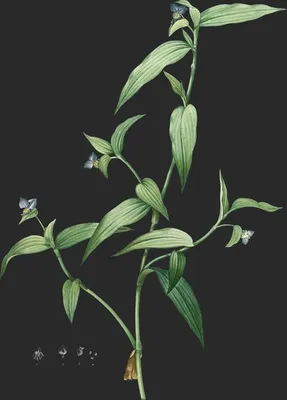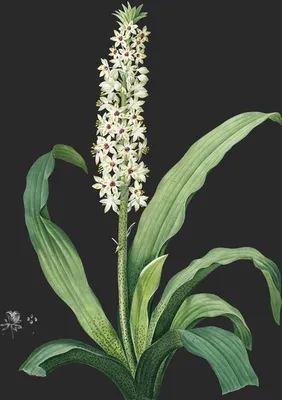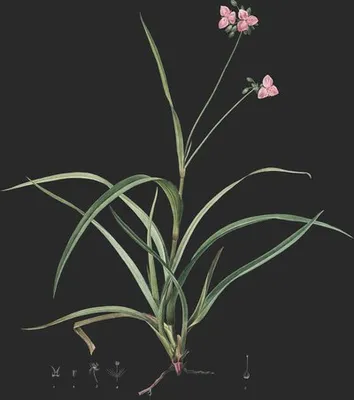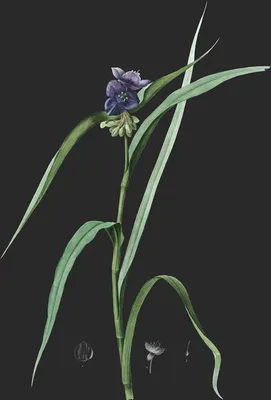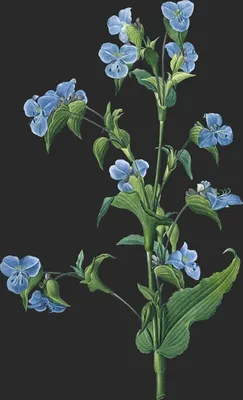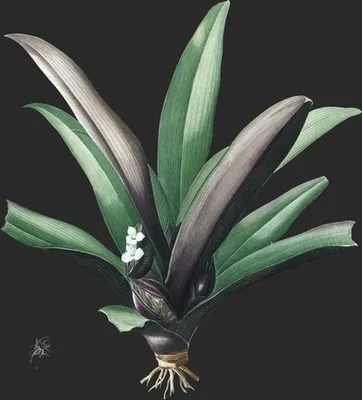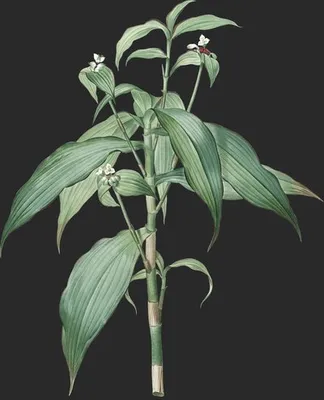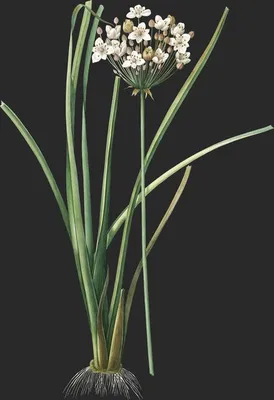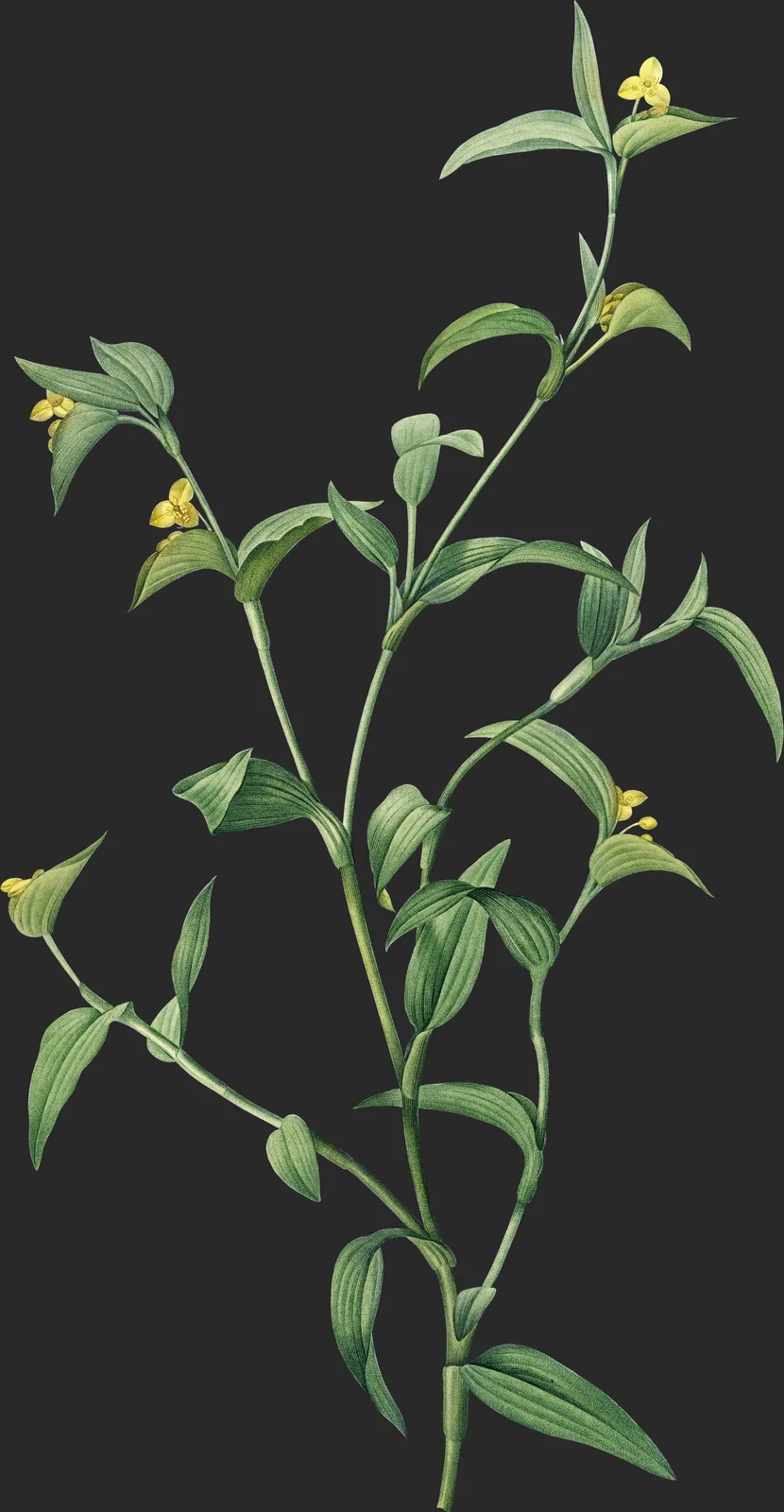
Commelina Africana
Comméline d’Afrique
Comméline d’Afrique
Ten ways of seeing
- measured cast yellow-green
- upright 1.93 : 1
First Look
江馆清秋,晨起看竹,烟光日影露气,皆浮动于疏枝密叶之间。
—— 清·郑板桥《题画竹》
On an autumn morning at the river lodge I looked at the bamboo: mist, sunlight, dew, all drifting among the sparse and dense leaves.
The sheet is vertical: the eye climbs and settles in the upper half. Let the plant stand before you look for detail. Then step in close: watch where colour meets line, and whether the line ever breaks. Third, find where the green is deepest: the whole tonal order is measured from that patch.
Name and Thing
The binomial is Commelina africana: the first word is the genus it belongs among, the second the epithet that sets it apart. Here the epithet africana means “of Africa” — the name records the feature the namer noticed first. The older system filed it under Juncaceæ by overall affinity; Linnaeus, counting stamens only, placed it in Triandria — two ways of asking what a plant is. No established Chinese name exists, so it is cited by its binomial alone.
Form and Colour
Measured on this plate: flower colour is sparing, 0.6% of the sheet against 11.5% of foliage, the cast tending yellow-green — as with pale or white blooms, outline and tone do the talking. A bulb of overlapping fleshy scales gives the lily its Chinese name, 'hundred-fold'; six tepals reflex as the flower opens, around six stamens with long, T-shaped anthers. a moss green. Three things fix the habit: leaf arrangement, tepal count, and how the flower is borne.
Composition
The sheet is tall. No details are appended: a plate for looking, not for keying out. The plant covers only 14% of the sheet, centred near the centre; the emptiness is where the eye rests.
Line and Colour
The first half of the nineteenth century moved from copper to steel to lithography; stipple could render the softest transition. There is evidence on the back too: the plate mark pressed into the paper, the slight relief of the pigment, lines worn shallow in a later printing. If you mean to copy it: take its skeleton, its margins and the order of its colours; the burin's hatching is the language of copper — suggest it with pencil density, do not imitate it stroke for stroke.
Poetic Resonance
更乞两丛香百合,老翁七十尚童心。
—— 宋·陆游《窗前作小土山蓻兰及玉簪最后得香百合并种之戏作》
The poem gives the mood first and the picture supplies the form; set the line beside the plate and the green the corolla becomes its resting point.
Symbolism
In the West the white lily is Marian purity, held by the angel of the Annunciation; in China the name sounds like 'a hundred years in harmony', a wedding wish. Meanings change their tune: the same flower can say opposite things within a century.
Season and Place
the flowers last only days, so artists drew them just as they opened. Temperate north — China, Japan, Europe. Long used in Chinese medicine, lilies were hunted in East Asia by nineteenth-century collectors and transformed European gardens. The year 1807 on the plate is that of publication, not of flowering — the gathering came a year or two earlier. The bud and the ripe fruit on one branch tell the season; the name in the title often tells the journey.
The Book and the Hand
“The Liliaceae” carries only Pierre-Joseph Redouté's name. From drawing to plate the sheet passed through several hands — the engraver aimed at accuracy, the colourist at speed, and between them lies each plate's unevenness.
What to Take Away
Next time you stand before a flowering plant, give it three minutes: leaf arrangement, direction of the flower, the darkest patch. A flora exists to be consulted; look long enough and you forget to consult — someone in 1807 gave a whole day to a single flower.
About this plate
Description
Cette Comméline a une tige non rampante, mais couchée à sa base, ra-meuse, genouillée, glabre, cylindrique, un peu creusée en gouttière d’un côté: ses feuilles sont lancéolées, pointues, glabres, longues de 6–9 centimètres sur 10–15 millimètres de largeur, engainantes à leur base et munies de cils longs et peu nombreux, placés sur les bords de la gaine: celle-ci est assez large, un peu membraneuse, entière, excepté dans les feuilles de l’aisselle desquelles il est né un rameau, parce que celui-ci déchire la gaine longitu-dinalement.
Les pédoncules sont opposés aux feuilles: chacun d’eux porte i son sommet une feuille qui n’a point de gaine et joue le rôle de spathe; elle est en forme de cœur, arrondie à la base, pointue au sommet, et pliée en deux de manière à renfermer les fleurs: celles-ci sont portées chacune sur un pédicelle et s’épanouissent successivement. Leur périgone est à six parties disposées sur deux rangs; les trois extérieures, qui sont analogues à un vrai calice, sont ovales, concaves, verdatres; les trois intérieures, qui sont semblables à une corolle, sont d’un jaune un peu pale et mat, d’une consistance délicate; elles sont plus grandes que les lobes externes, et deux d’entre elles sont un peu plus grandes que la troisième, rétrécies en onglet à leur base, arrondies, concaves et crés nelées en leur limbe.
Les étamines, le pistil et le fruit, n’offient pas de différences notables d’avec l’espèce précédente.
Histoire
ante est indigène de la partie de l’Afrique voisine du Cap-de-Bonne-Espérance. ♃.
Elle est cultivée depuis longtemps dans les jardins de botanique, et ne se trouvait cependant figurée dans aucun ouvrage. On la conserve dans la serre chaude pendant l’hiver, et en plein air pendant l’été.
Fam. des Joncs. Juss.—Triandrie monogynie. Lin.
- Commelina africana. C. corollis inæqualibus, foliis lanceolatis glabris, caule decumbente. Lin. Spec. 6o. Mill. Dict. n. 3. Berg. cap. p. 9. Lam. Dict. 2. p. 67. Willd. Spec. 1. p. 250. Willich. illustr. n. 19. Pers. ench. 1. p. 55.
- Commelina procumbens flore luteo. Roy. Lugd-b. 538.
- Commelina radice perenni, foliis lanceolatis, caule repente glabro, petalis duobus majoribus. Wach. ultraj. 323.