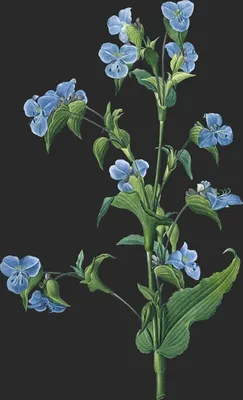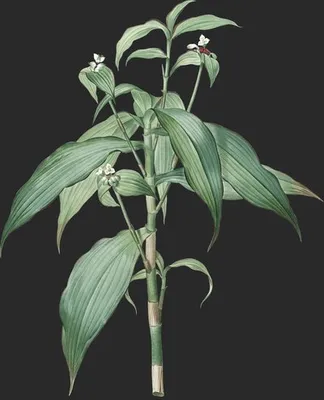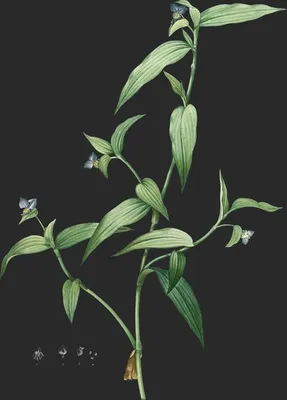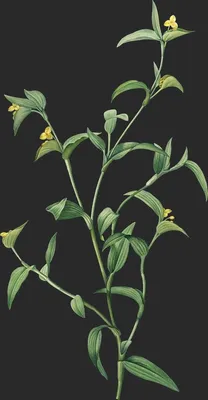
Tradescantia Discolor
Éphémère Bicolore
Éphémère Bicolore
About this plate
Description
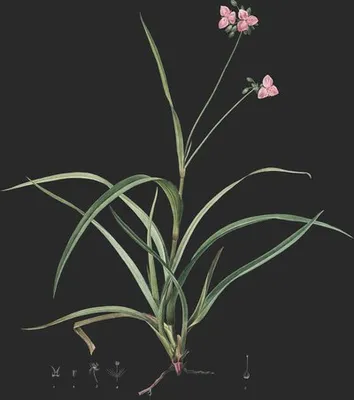
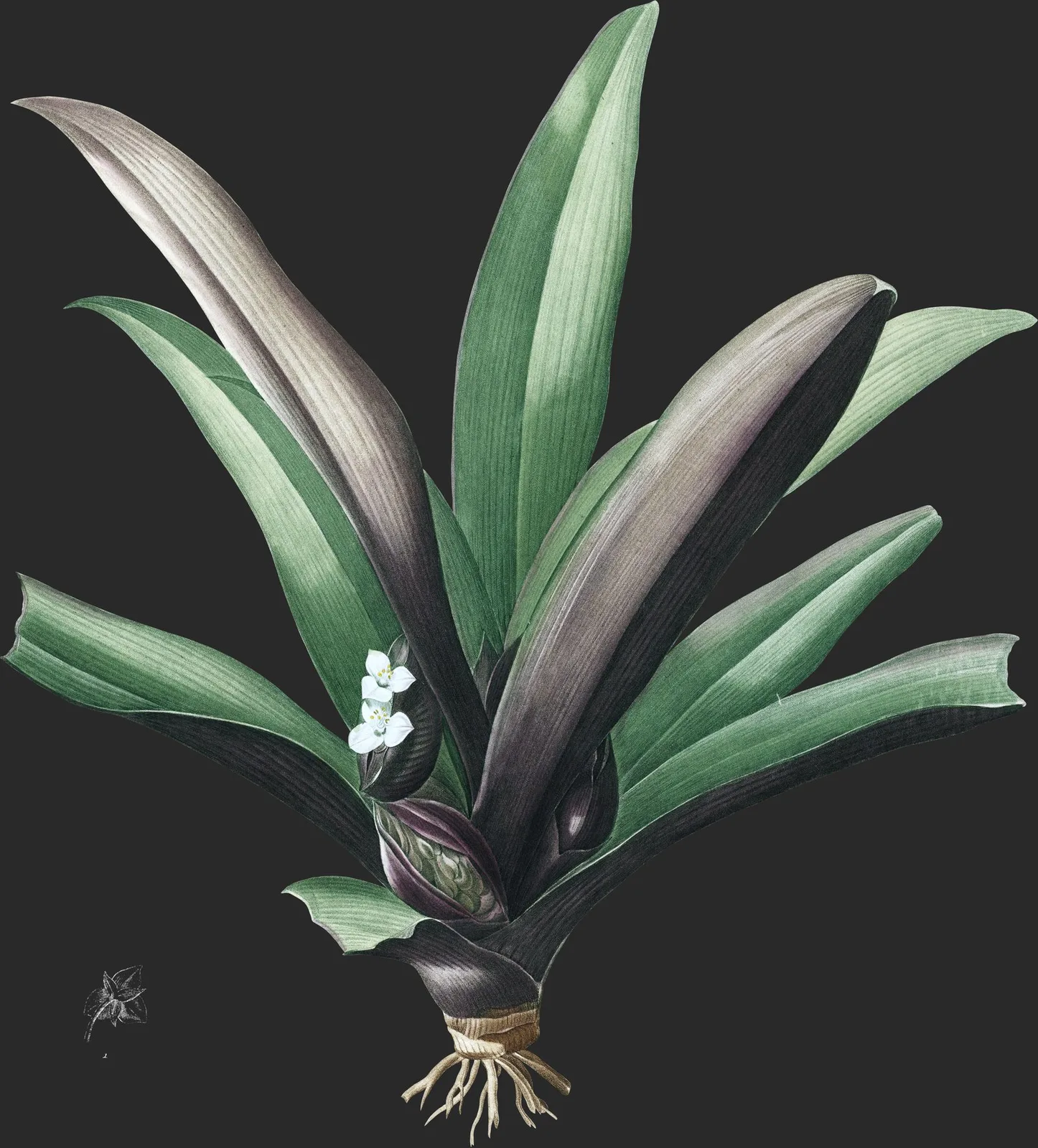
Cette plante se reconnait sans dilliculté à ses feuilles vertes en dessus, et d’un beau rouge-pourpre en dessous. Ce caractère frappant, et qui lui est par-ticulier, a aussi motivé le nom spécifique qu’elle porte. Sa racine est composée de plusieurs fibres cylindriques et blanchâtres. Sa tige est une souche courte garnie de feuilles, souvent rameuse des le collet, longue de 1 à 2 décimètres, et trop apparente pour que, dans la plupart des cas, la plante puisse être dite acaulis, terme qui d’ailleurs n’est jamais exact. Les feuilles sont glabres, ainsi que le reste de la plante, un peu lisses, de consistance ferme, un peu épaisses, légèrement courbées en gouttière, lancéolées, pointues, longues de deux à trois décimètres, sur 4 à 6 centimètres de largeur.
De l’aisselle de chaque feuille inférieure sort un pédoncule glabre, tendre, cylindrique, épais, long de 4 centimètres, caché sous les feuilles, terminé par deux bractées membraneuses, fermes, concaves, rougeâtres en dehors, lisses et blanchâtres en dedans, larges, obtuses, et qui enveloppent une tête de 15 à 20 petites fleurs: dans l’intérieur même des bractées, se trouvent quelques fragments membraneux de bractées avortées. Les fleurs sont serrées, peu appa-rentes, blanchâtres, portées chacune sur un pédicelle court, un peu charnu et de nature analogue à la fleur, d’abord droit, ensuite tortueux.
Le périgone est en cloche, composé de six lanières disposées sur deux rang» tres-distinets; les trois extérieures sont un peu fermes, membraneuses, persis-tantes, ovales-oblongues; les trois intérieures, plus analogues à de vrais pétales, sont très-minces, et se roulent sur elles-mêmes du sommet à la base, peu après la fécondation.
Les étamines sont au nombre de six, insérées au fond de la fleur avec les lanières internes du périgone; leurs filaments sont blancs, de consistance tendre et délicate; leurs anthères sont presque triangulaires, jaunes et à deux loges. L’ovaire est libre, blanc, triangulaire, à trois sillons; le style est filiforme, violet à sa base, blanc dans le reste de son étendue, un peu plus long que le périgone; le stigmate est simple, légèrement violet. Le fruit est une capsule à trois loges et à trois valves, que je n’ai pas vu parvenir à sa maturité complète.
Histoire
L’Ephémère bicolore est indigène des régions de l’Amérique méridionale voisines du golphe du Mexique. ♃.
On la cultive abondamment dans les jardins de botanique, dont elle orne les serres à cause de la singulière disposition de ses couleurs. On la multiplie par la division des racines. Elle est presque toute l’année en fleur.
Fam. des Joncs. Juss.—Hexandrie monogynie. Lin.
- Tradescantia discolor. T. acauli lævis, bracteis equitantibus compressis, foliis lanceolatis subtùs coloratis. Smith. ic. pict. p. 10. t. 10. Swartz. Fl. Ind. occid. 1. p. 607. Willd. Spec. 2. p. 18. Pers. ench. 1. p. 347.
- Tradescantia discolor. T. spathâ triphyllâ compressâ; floribus subexsertis, foliis lenceolatis subtùs violaceis. L’her. sert. angl.p. 8. t. 12. Lam. illustr. t. 226. f. 2.
- Tradescantia discolor. T. acaulis lævis, foliis oblongo-lanceolatis canaliculatis carnosis discoloribus. Ait. Kew. 1. p. 403.
- Tradescantia spathacea. T. acaulis, foliis sessilibus, scapis radicalibus. Swartz. prod. 57.
Twelve ways of seeing
- measured cast amber
- slightly upright 1.11 : 1
- published 1805
- Plate 168
Not a catalogue entry but a way of looking: how to stand, what to notice, how the line was cut, when it flowers, where it came from, who made it — and then the poems and the classics that taught China to see the same flower. Read the twelve in order and the plate opens.
-
First Look
六法者何?一、气韵生动是也;二、骨法用笔是也;三、应物象形是也;四、随类赋彩是也;五、经营位置是也;六、传移模写是也。
—— 南齐·谢赫《古画品录》
The six laws: spirit resonance alive; bone-method in the brush; matching form; colour by kind; planning the placing; copying the masters.
Slightly taller than wide; the eye lands above centre. Then step in close: watch where colour meets line, and whether the line ever breaks. Third, find where the green is deepest: the whole tonal order is measured from that patch.
-
Name and Thing
The binomial is Tradescantia discolor: the first word is the genus it belongs among, the second the epithet that sets it apart. Two words carry a whole provenance. The older system filed it under Juncaceæ by overall affinity; Linnaeus, counting stamens only, placed it in Hexandria — two ways of asking what a plant is. No established Chinese name exists, so it is cited by its binomial alone.
-
Form and Colour
Measured on this plate: flower colour is sparing, 0.3% of the sheet against 9.0% of foliage, the cast tending amber — as with pale or white blooms, outline and tone do the talking. A bulb of overlapping fleshy scales gives the lily its Chinese name, 'hundred-fold'; six tepals reflex as the flower opens, around six stamens with long, T-shaped anthers. Filed under green — a moss green, a colour that comes mostly from leaf and stem. A single plant, laid out with nothing hidden.
-
Composition
Slightly taller than wide, the plant set a little above centre. (about 1.11 : 1) No details are appended: a plate for looking, not for keying out. The plant covers only 27% of the sheet, centred above centre; the emptiness is where the eye rests. Old plates set the plant slightly off centre, with unequal margins — that small imbalance is what keeps it alive.
-
Line and Colour
The first half of the nineteenth century moved from copper to steel to lithography; stipple could render the softest transition. Decide first whether it was printed or painted; only then discuss whether it is beautiful.
-
Season
Early to high summer, June and July; the flowers last only days, so artists drew them just as they opened. The year 1805 on the plate is that of publication, not of flowering — the gathering came a year or two earlier. The plate records ten days of peak; the other three hundred are leaf, fruit and rest.
-
Provenance
Temperate north — China, Japan, Europe. Long used in Chinese medicine, lilies were hunted in East Asia by nineteenth-century collectors and transformed European gardens. The volume was made in 1802-1816, when most of this knowledge came from living plants under glass.
-
The Book and the Hand
“The Liliaceae” was drawn by Pierre-Joseph Redouté and published 1802-1816. This plate is Plate 168, book page 168. The image is public domain; the hand-colouring is still one person's hand.
-
Poetic Resonance
梨花淡白柳深青,柳絮飞时花满城。
—— 宋·苏轼《东栏梨花》
Pear blossoms pale white, willows deep green; when the catkins fly, flowers fill the town.
The poem gives the mood first and the picture supplies the form; set the line beside the plate and the green the corolla becomes its resting point.
-
The Written Tradition
多识于鸟兽草木之名。
—— 《论语·阳货》
…and from the Songs one learns the names of birds, beasts, plants and trees.
The Bencao Gangmu describes the bulb as garlic-like, edible and medicinal; Song writers already noted that the leaves vary while the flowers stay white. You need not parse every word: take the line, and the flower acquires a second face.
-
Symbolism
In the West the white lily is Marian purity, held by the angel of the Annunciation; in China the name sounds like 'a hundred years in harmony', a wedding wish. In a flora it is a species first and a symbol second; the order is worth keeping.
-
What to Take Away
Appreciation is not knowledge but habit — one more look each time. The flower of that year is dust, yet its image on paper has outlived every living cousin.