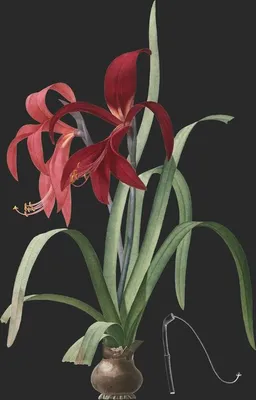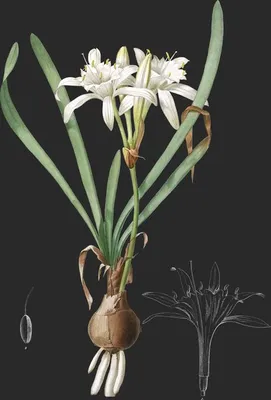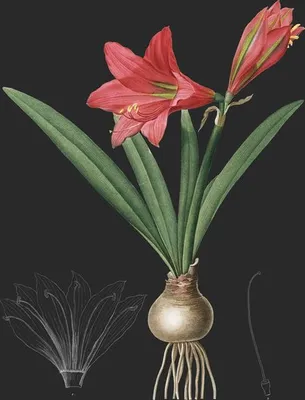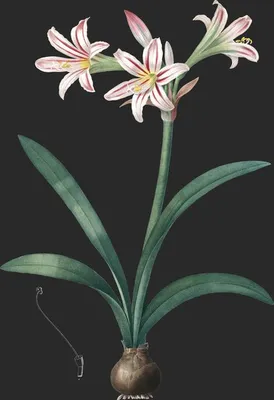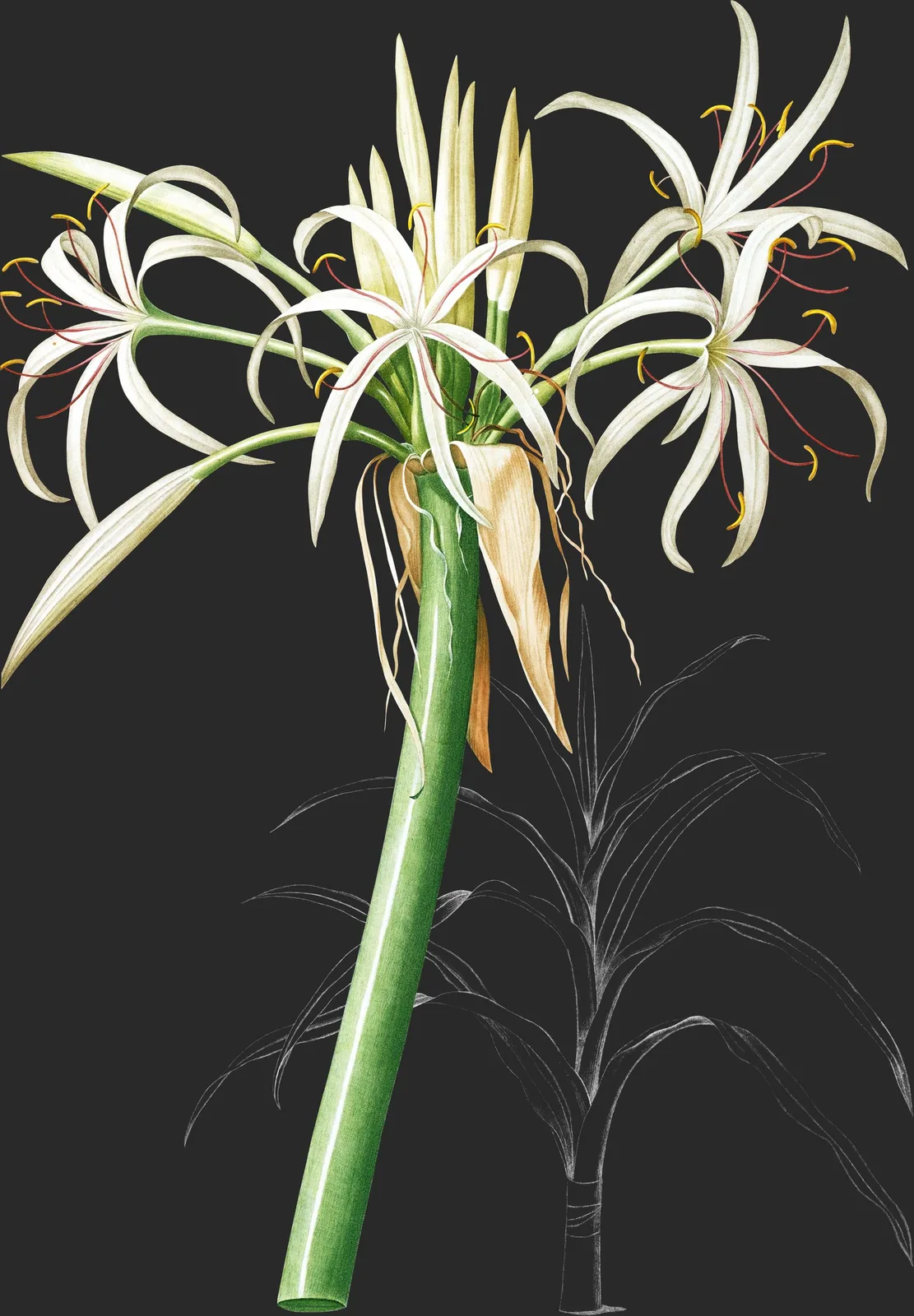
Crinum Taïtense
Crinum d’Otaïti
Crinum d’Otaïti
About this plate
Description
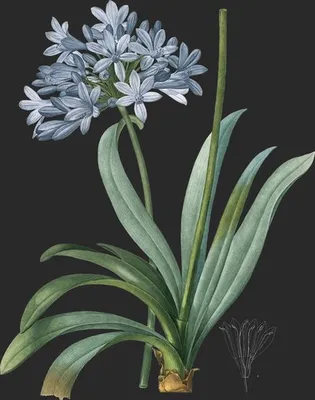
La tige comprimée à deux tranchants de ce Crinum suflit pour le distinguer de la plupart des espèces du même genre. La grandeur à laquelle il parvient, l’absence d’un rebord cartilagineux sur les feuilles, l’éloignent du Crinum bracteatum décrit et figuré par Jacquin dans l’Hortes Schoenbrunensis. Son port le rapproche du Crinm Americanum, dont nous avons donné précédemment la description; mais il en diffère par sa tige beaucoup plus comprimée, et par les divisions du périgone qui sont plus longues que le tube.
Une racine fibreuse donne naissance à une sorte de tige charnue formée par la base des feuilles, haute de trois décimètres, épaisse de huit centimètres, couverte de tuniques blanchâtres.
Les feuilles sont longues d’un mètre, ou d’un mètre et demi, linéaires-lancéolées, aigués, un peu courbées en gouttière, glabres, entières, nullement ondulées, ni cartilagineuses sur les bords, marquées de nervures peu saillantes, plissées longitudinalement vers leur sommet.
La hampe sort de laisselle de l’une des feuilles inférieures. Elle est haute d’un métre, très-fortement comprimée, à deux tranchants aigus.
Les fleurs, au nombre de trente environ, forment une ombelle demi-sphé-rique, láche. Elles sont supportées par des pédicelles épais, longs de trois centi-mètres. La spathe est à deux valves membraneuses, longues d’un décimètre, qui se renversent promptement en dehors et viennent s’appliquer contre la hampe; des bractées linéaires, membraneuses, très-étroites, également longues d’un décimètre, séparent les fleurs.
Le tube du périgone est cylindrique, vert; sa longueur, en y comprenant l’ovaire, est de huit centimètres. Les divisions du limbe sont un peu plus longues que le tube, linéaires-lancéolées, étalées, fortement arquées, légèrement courbées en gouttière. Les trois intérieures sont nu peu ondulées à leur extrémité. Les trois extérieures portent en dedans, à leur sommet, une petite pointe dirigée en arrière.
Les étamines sont de moitié plus courtes que les divisions du périgone. Leurs filaments sont droits, filiformes, blanes inférieurement, violets supérieurement. Les anthères sont linéaires, vacillantes, insérées vers le tiers de leur longueur. Le pollen est d’un jaune orangé.
L’ovaire est ovale-oblong, lisse, vert. Le style est filiforme, un peu plus long que les étamines, courbé à sa sortie du tube, blanc inférieurement, violet dans le haut. Le stigmate est petit, à trois lobes peu distincts.
Histoire
Le nom sous lequel on a reçu ce beau Crinum au jardin du Muséum d’Histoire naturelle semble indiquer qu’il est originaire de Tile célèbre d’Otaïti; mais nous n’avons pas d’autres données sur sa patrie. On le cultive depuis une dixaine d’années dans les serres de ce jardin, où il a fleuri, pour la première fois, l’année dernière, dans les mois de juillet et d’août. Les fleurs exhalent une odeur très-suave.
Fam. des Narcisses. Juss.—Hexandrie monogynie. Lin.
- Crinum Taïtense. C. foliis lineari-lanceolatis, scapo elongato compresso ancipiti paulò longioribus, corollæ tubo lanciniis lineari-lanceolatis brevoire, floribus pedicellatis.
Twelve ways of seeing
One plate, read twelve times over: its name, its colour, the burin and the brush, the shape of the sheet, the season, the soil it came from, the book it belongs to, its language of flowers, the poem it answers to, the lore behind it, how to look, and what remains.
-
The Name
The plate is titled “Crinum Taïtense”, numbered Plate 408 (book page 408). The plate gives only the genus, Crinum; species-level names came later. No established Chinese name exists for this plate, so it is cited by its binomial alone.
-
Form and Colour
Bulbous plants store the year underground — bulb, corm or tuber — then send up a few thick leaves and a single scape, with six tepals in cup, funnel or star. Filed under yellow — a honey-yellow. The colour is built in washes: a pale ground first, then deepening at the petal base and in shadow. A single plant, laid out on the sheet with nothing hidden.
-
Line and Colour
The first half of the nineteenth century moved from copper to steel to lithography. Stipple could render the softest transition — Redouté's roses depend on it — while lithography suited broad, gentle washes. Look closely at the line and the colour: an unbroken line means engraving, colour crossing the outline by half a millimetre means hand-colouring. Craft leaves franker evidence than inscriptions.
-
Composition
Tall and narrow, the plant rising in one movement with generous margins above and below — the upright format of most floras. (about 1.44 : 1). No details are appended: this is a plate for looking, not for keying out.
-
Season
Early spring to early summer, genus by genus: tulips and hyacinths first, gladiolus and amaryllis later. The year 1812 on the plate is the year of publication, not of flowering — the gathering came a year or two earlier.
-
Provenance
Three homelands: the Mediterranean, Central Asia and South Africa. The tulip came from Ottoman gardens and became a Dutch mania; South African bulbs filled European glasshouses after 1800. The volume was made in 1802-1816, when most of this knowledge came from living plants under glass rather than from the wild.
-
The Book
“The Liliaceae” was drawn by Pierre-Joseph Redouté and published 1802-1816. This plate is Plate 408, book page 408. The image is in the public domain; the hand-colouring on the paper is still one person's hand, two centuries ago.
-
Symbolism
The tulip was an imperial emblem in Istanbul and a speculative bubble in Amsterdam; the hyacinth sprang from a boy's blood in Greek myth. What bulbs share is concealment: next year kept underground. This plate leans yellow, which in flower language adds one more degree of feeling. Flower language was added later; the flower knows nothing of it, and that innocence is part of its power.
-
Poetic Resonance
兰陵美酒郁金香,玉碗盛来琥珀光。
—— 唐·李白《客中行》
Fine wine of Lanling, fragrant with turmeric; poured in a jade bowl, it glows like amber.
The poem gives the mood first and the picture supplies the form; set the line beside the plate and the yellow the corolla becomes its resting point.
-
Classical Lore
Li Bai's 'orchid wine, fragrant with yujin' is often misread as tulips; the Tang yujin was a turmeric-like root used to scent wine — same name, different plant. Chinese flower books ranked plants by character; European floras described them by form and name. This plate belongs to the second tradition, yet bears reading by the first. Books fill in what the picture omits, and also hide what it shows: look first, read after.
-
How to Look
Look at the base: tulips overlap in two whorls to make a cup, hyacinths pack small flowers into a spike, gladiolus sets its blooms in a single row facing one way. If you look at one thing, look at how flower meets stem; that joint is the hardest to draw and the surest to identify.
-
Afterword
Two centuries on, the plant may still flower in some garden; the one on this sheet stopped in the season of 1812.