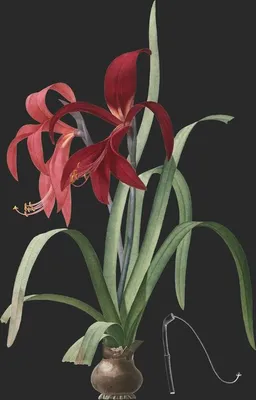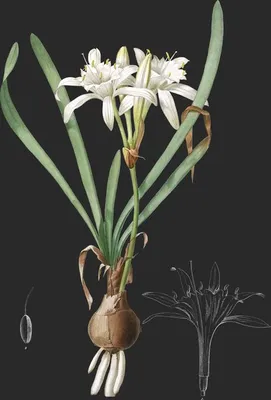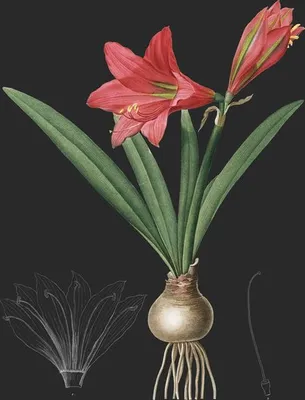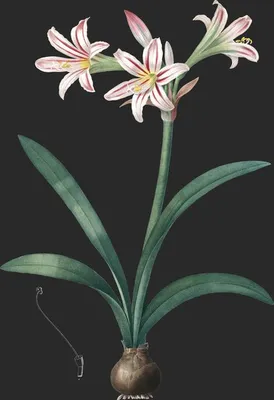
Narcissus Pumilus
水仙属·Narcissus Pumilus
Narcisse Nain
About this plate
Description
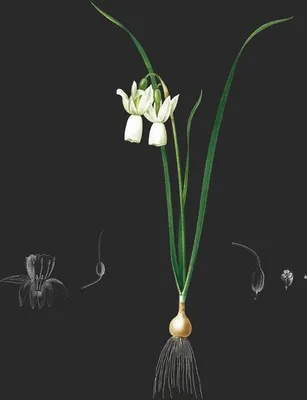
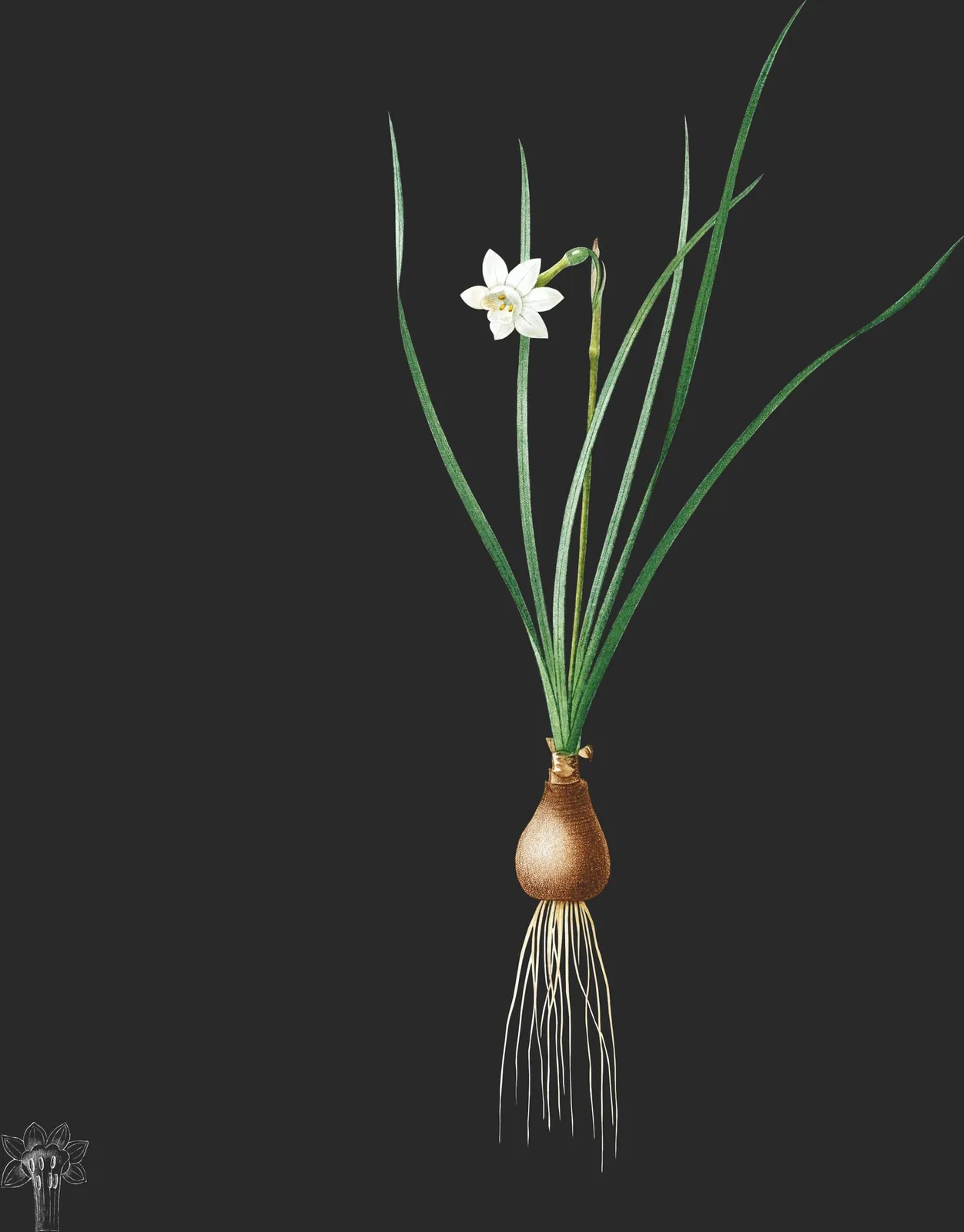
Depuis quelques années le nombre des espèces connues de Narcisses a singulièrement augmenté, et cependant il en existe beaucoup dans les jardins qui n’ont point encore été décrites: telle est, à ce que nous eroyons, celle dont nous donnons ici la figure. La petitesse de ses dimensions sulfit pour la faire reconnaitre au premier aspect, et ses caractères distinctifs sont assez tranchés pour qu’on ne puisse la réunir à aucune des espèces dont la figure ou la description ont été consignées dans les ouvrages de botanique.
Cette petite plante sort d’une bulbe ovale, grosse comme une noix, couverte de tuniques brunes et liches. Ses feuilles sont peu nombreuses, linéaires, obtuses, glabres, tréeglauques, convexes sur le dos, planes en dessus, dressées, longues de dix-huit ou vingt centimètres, larges de trois ou quatre millimètres. La hatape qui nait au milieu d’elles ne sélève qu’à sept ou huit centimètres. Elle est droite, glauque, comprimée, à deux tranchants peu aigus. Elle supporte une fleur solitaire assex petite, blanche. La spathe est lancéolée, terminée par une petite pointe, égale au pédicelle, qui ost long de vingt-cinq millimètres, glabre, dressé jusqu’à son sommet, où il se léchit subitement. La fleur est hori-zontale, et même un pen pendante.
Le tube du périgone est adhérent, verdâtre dans le bas, blane dans le haut, à peu près cylindrique, long de quinze millimètres, Les divisions du limbe sont ovales arrondies, blanches, terminées par une petite pointe, plus marquée dans les extérieures que dans les intérieures, qui sont un peu plus courtes. Le nectaire est en forme de godet, trois fois plus court que les divisions du périgone, de la mème couleur qu’elle. Sou bord, qui n’est nullement froncé, présente quelques crénelures peu nombreuses, irrégulières, séparées par autant de petits lobes arrondis et entiers.
Les filaments des étamines sont extrêmement courts, blanes, en forme d’alène. Les anthères sont jaunes, oblongues, insérées vers le milieu de leur longueur: trois d’entre elles sont entièrement cachées dans le tube; les trois autres sont contenues dans le nectaire.
L’ovaire est ovale, un peu triangulaire, d’un vert glauque. Le style est fili-forme, blanchâtre, à peine plus long que le tube, terminé par un petit stigmate irrégulier, un peu en forme de godet.
Histoire
Nous ignorons de quel pays le Narcisse nain est originaire. Nous le décrivons d’après quelques individus cultivés dans les couches du Jardin du Muséum d’Histoire naturelle. Il fleurit au commencement d’avril.
Fam. des Narcisses. Juss.—Hexandrie monogynie. Lin.
- Narcissus pumilus. N. unillorus, folis linearibus, petalis ovato-subrotundis, neetario concolore crassé crenato triplò longioribus, antheris tribus tubo inclusis, tribus exsertis.
Ten ways of seeing
- measured cast amber
- slightly upright 1.28 : 1
- published 1812
- Plate 409
Not a catalogue entry but a way of looking: how to stand, what to notice, how the line was cut — then, halfway, a line of Chinese poetry: how the ancients saw this same flower. After it, the flower's language, its season and homeland, its book; and at the end one line of classical prose — and a pair of eyes to take away.
-
First Look
论画以形似,见与儿童邻。
—— 宋·苏轼《书鄢陵王主簿所画折枝》
To judge painting by likeness alone is the view of a child.
Slightly taller than wide; the eye lands above centre. Then step in close: watch where colour meets line, and whether the line ever breaks. Third, find where the green is deepest: the whole tonal order is measured from that patch. The pose leans right: the upper half carries 8 points further right than the lower — a living thing, not a diagram.
-
Name and Thing
The binomial is Narcisse nain: the first word is the genus it belongs among, the second the epithet that sets it apart. Two words carry a whole provenance. The older system filed it under Amaryllidaceæ by overall affinity; Linnaeus, counting stamens only, placed it in Hexandria — two ways of asking what a plant is. No established Chinese name exists, so it is cited by its binomial alone.
-
Form and Colour
Measured on this plate: flower colour is sparing, 0.7% of the sheet against 1.8% of foliage, the cast tending amber — as with pale or white blooms, outline and tone do the talking. Bulbous plants store the year underground — bulb, corm or tuber — then send up a few thick leaves and a single scape, with six tepals in cup, funnel or star. Filed under green — a moss green, a colour that comes mostly from leaf and stem. A single plant, laid out with nothing hidden.
-
Composition
Slightly taller than wide, the plant set a little above centre. (about 1.28 : 1) No details are appended: a plate for looking, not for keying out. The plant covers only 5% of the sheet, centred a little right of centre; the emptiness is where the eye rests. Blank paper is not unfinished work: it is where the eye rests.
-
Line and Colour
The first half of the nineteenth century moved from copper to steel to lithography; stipple could render the softest transition. Take a loupe to three places: petal edge, leaf vein, caption. An unbroken line means engraving; colour crossing the outline means a hand. If you mean to copy it: take its skeleton, its margins and the order of its colours; the burin's hatching is the language of copper — suggest it with pencil density, do not imitate it stroke for stroke.
-
Poetic Resonance
燕麦青青游子悲,河堤弱柳郁金枝。
—— 唐·李白《春日獨坐寄鄭明府》
The poem gives the mood first and the picture supplies the form; set the line beside the plate and the green the corolla becomes its resting point.
-
Symbolism
The tulip was an imperial emblem in Istanbul and a speculative bubble in Amsterdam; the hyacinth sprang from a boy's blood in Greek myth. What bulbs share is concealment: next year kept underground. Meanings change their tune: the same flower can say opposite things within a century.
-
Season and Place
Early spring to early summer, genus by genus: tulips and hyacinths first, gladiolus and amaryllis later. South African bulbs filled European glasshouses after 1800. The year 1812 on the plate is that of publication, not of flowering — the gathering came a year or two earlier. Read the locality and the flowering season both with a discount: one is hearsay, the other a ten-day peak.
-
The Book and the Hand
“The Liliaceae” was drawn by Pierre-Joseph Redouté and published 1802-1816. This plate is Plate 409, book page 409. The image is public domain; the hand-colouring is still one person's hand.
-
The Written Tradition
宁古无时,宁朴无巧,宁俭无俗。
—— 明·文震亨《长物志》
Better old than fashionable, better plain than clever, better spare than vulgar.
Li Bai's 'orchid wine, fragrant with yujin' is often misread as tulips; the Tang yujin was a turmeric-like root used to scent wine — same name, different plant. The difference is not of quality but of question: Europe asks what it is, China asks whom it resembles.
What to Take Away
If you keep one line, keep Guo Xi's: from afar its momentum, up close its texture. The flower of that year is dust, yet its image on paper has outlived every living cousin.