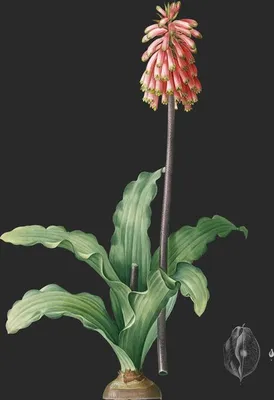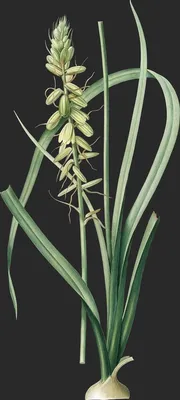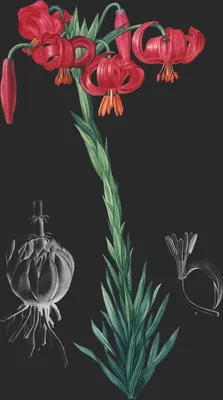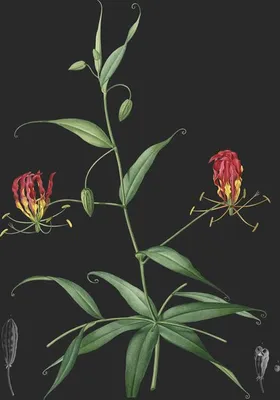
Erythronium Dens Canis
蒲公英属
Erythrone Dent de Chien
About this plate
Description
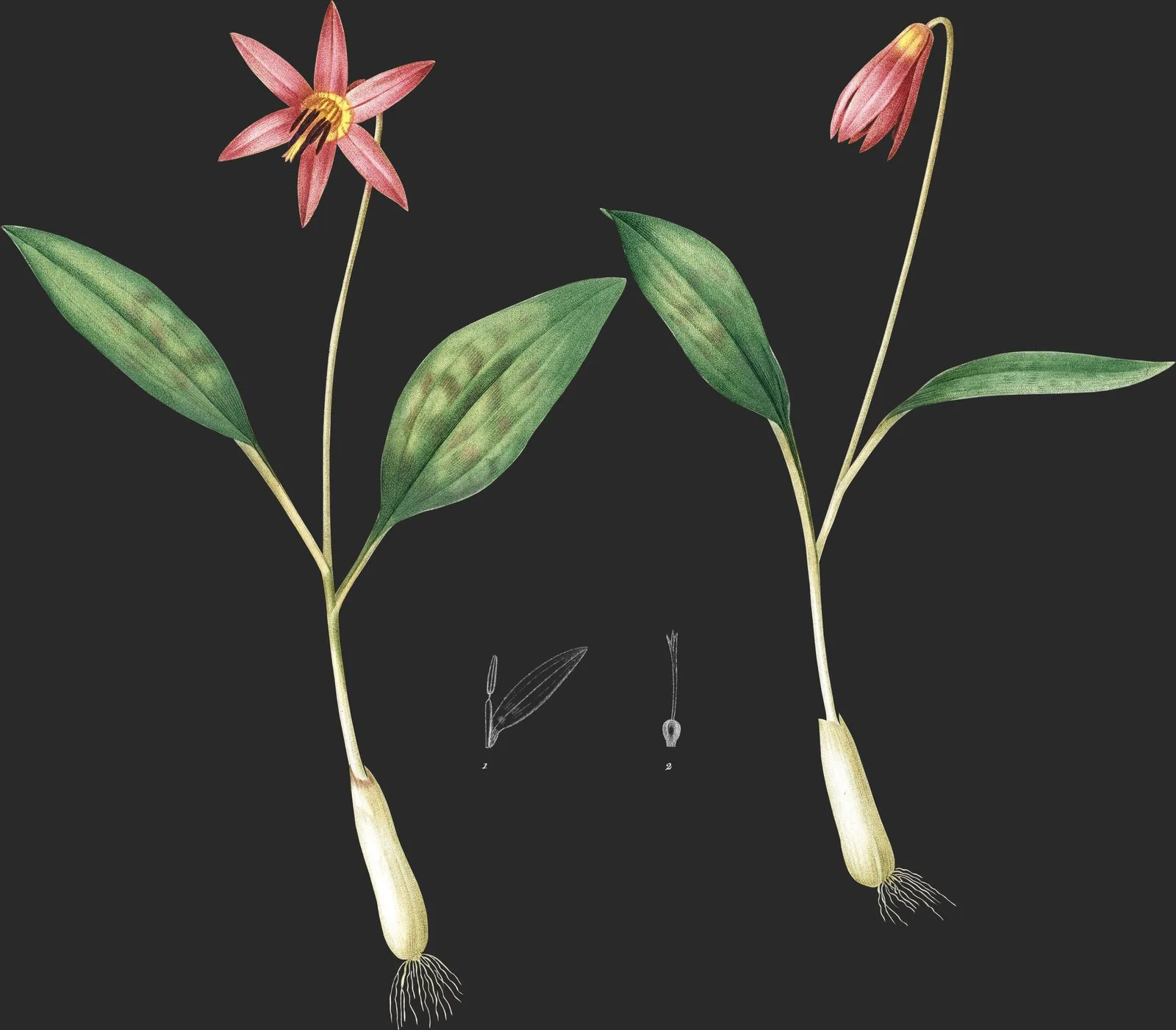
La racine de cette jolie plante est une bulbe alongée recouverte de tuniques lâches. Elle se divise pour l’ordinaire, dans sa partie inférieure, en trois ou quatre segments qui sont analogues, pour leur forme, à des dents incisives, et qui émettent des fibres radicales, nombreuses et fort grêles. De son extrémité supérieure naissent deux feuilles radicales, ovales-lancéolées, aigues, longues de 1o à 12 centimètres, larges de trois dans la variété A, plus étroites dans la variété B, verte, et le plus souvent marquées de taches d’un rouge obscur, rétrécies à leur base en un pétiole qui se termine par une gaine de deux à trois centimètres de longueur.
Du milieu de cette gaine il sort une hampe un peu plus longue que les feuilles et terminée par une fleur solitaire pendante, dont la couleur est blanchâtre ou d’un pourpre plus ou moins foncé dans les variétés A et B, jaune dans la variété C.
Le périgone est à six divisions très-profondes. Les segments en sont longs, de trois centimètres environ, étalés, lancéolés, aigus, entiers sur les bords, à demi-réfléchis en dessus. Les trois intérieurs sont munis à leur base interne de deux callosités.
Les étamines, au nombre de six, sont insérées à la base des segments du périgone, et dépassent à peine la moitié de leur longueur. Les filaments sont aplatis, larges dans leur partie moyenne, et rétrécis à leur sommet en une pointe fine qui supporte une anthère oblongue et redressée.
L’ovaire est oblong et triangulaire. Le style qui le surmonte est plus long que les étamines, et terminé par trois stigmates obtus et étalés. La capsule est triangulaire, à trois valves et à trois loges, et renferme des graines arrondies.
Histoire
L’Erythrone Dent de Chien croit naturellement dans les montagnes des contrées méridionales de l’Europe et dans la Sibérie. La variété C, remarquable par sa fleur jaune, est indigène des régions les plus froides de l’Amérique septentrionale.
Cette plante réussit assex bien dans les plates-bandes des jardias, où elle fleurit dans le commencement d’avril.
Les Tartares mangent la racine de l’Erythrone desséchée, réduite en poudre et délayée dans du lait, ou cuite dans du bouillon. Gmelin, à qui l’on doit cette observation, a goûté lui-même plusieurs fois de cet aliment, qu’il a trouvé agréable, fort nourrissant et sans aucune acreté.
Explication de la planche
- Une des lanières de la fleur détachée avee l’étamine qu’elle porte.
- Le pistil.
Fam. des Lis. Juss.—Hexandrie monogynie. Lin.
- Erythronium dens canis. Hort. Cliff. 119. Hall, Helvet, № 1234. Gmel. Sib. 1. p. 39. f. 7. Roy. Lugd-b. 3o. Lin. Spec. pl. 437. Scop. Carn. éd. 2. № 406. Gouan. illustr. 25. Knorr. del. hort. 1. t. h. 8. Willd. 2. p. 96. Curt. t. 5. Fl. franç. éd. 3. № 1902.
- A. Foliis ovatis.
- Brythronium foliis ovatis. Mill. Dict. № 2.
- Dens canis latiore rotundioreque folio. Bauh. pin. 87.
- Dens caninus. Dod. pempt. 203.
- B. Foliis lanecolatis.
- Erythronium (longifolium) folis lanceolatis. Mill. Dict. № 2.
- Dens canis angustiore longioreque folio. Bauh. pin. 87.
- C. Flore luteo.
- Erythronium folis lanceolato-oblongis flore flavescente. Mich. Fl. Bor. amer. 1. p. 198.
- Erythronium foliis ovato-oblongis glabris nigro maculatis Gron. Virg. 151. Flore flavo.
Twelve ways of seeing
One plate, read twelve times over: its name, its colour, the burin and the brush, the shape of the sheet, the season, the soil it came from, the book it belongs to, its language of flowers, the poem it answers to, the lore behind it, how to look, and what remains.
-
The Name
The plate is titled “Erythronium Dens Canis”, numbered Plate 194 (book page 194). No reliable binomial survives on the plate, so it must be cited by its original title. The Chinese name 蒲公英属 is a modern rendering of the Latin, not an old garden name — between a plant and its names there is always translation.
-
Form and Colour
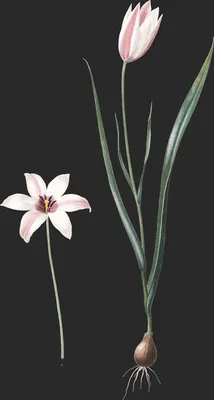
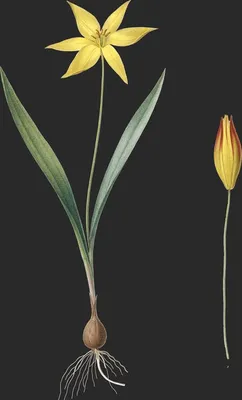
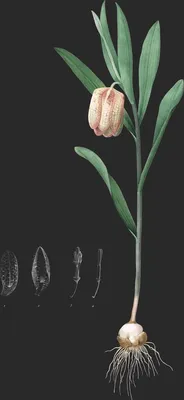
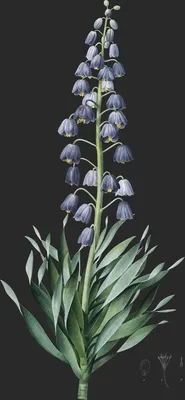
A bulb of overlapping fleshy scales gives the lily its Chinese name, 'hundred-fold'; six tepals reflex as the flower opens, around six stamens with long, T-shaped anthers. Filed under green — a moss green. That colour comes mostly from leaf, calyx and stem; the flower occupies a small patch. A botanical plate establishes the plant before it points at the bloom. A single plant, laid out on the sheet with nothing hidden.
-
Line and Colour
The first half of the nineteenth century moved from copper to steel to lithography. Stipple could render the softest transition — Redouté's roses depend on it — while lithography suited broad, gentle washes. Look closely at the line and the colour: an unbroken line means engraving, colour crossing the outline by half a millimetre means hand-colouring. Craft leaves franker evidence than inscriptions.
-
Composition
Nearly square, plant and details sharing the corners — an arrangement of a plate rather than a picture. (about 0.88 : 1). No details are appended: this is a plate for looking, not for keying out.
-
Season
Early to high summer, June and July; the flowers last only days, so artists drew them just as they opened. The year 1807 on the plate is the year of publication, not of flowering — the gathering came a year or two earlier.
-
Provenance
Temperate north — China, Japan, Europe. Long used in Chinese medicine, lilies were hunted in East Asia by nineteenth-century collectors and transformed European gardens. The volume was made in 1802-1816, when most of this knowledge came from living plants under glass rather than from the wild.
-
The Book
“The Liliaceae” was drawn by Pierre-Joseph Redouté and published 1802-1816. This plate is Plate 194, book page 194. The image is in the public domain; the hand-colouring on the paper is still one person's hand, two centuries ago.
-
Symbolism
In the West the white lily is Marian purity, held by the angel of the Annunciation; in China the name sounds like 'a hundred years in harmony', a wedding wish. In a flora it is a species first and a symbol second; the order is worth keeping.
-
Poetic Resonance
木末芙蓉花,山中发红萼。涧户寂无人,纷纷开且落。
—— 唐·王维《辛夷坞》
Lotus blossoms at the branch tips put forth red calyces in the hills. By the silent ravine, they open and fall, open and fall.
The poem gives the mood first and the picture supplies the form; set the line beside the plate and the green the corolla becomes its resting point.
-
Classical Lore
The Bencao Gangmu describes the bulb as garlic-like, edible and medicinal; Song writers already noted that the leaves vary while the flowers stay white. Chinese flower books ranked plants by character; European floras described them by form and name. This plate belongs to the second tradition, yet bears reading by the first. Printed in 1807, at the moment the two traditions began to see each other.
-
How to Look
Watch how far the tepals reflex, and the anther colour: green before opening, brown as the flower fades. A sectioned bulb is the mark of a botanical plate. And read the caption and number: not part of the picture, but the door through which it entered knowledge.
-
Afterword
A flora exists to be consulted; look long enough and you forget to consult — someone in 1807 gave a whole day to a single flower.