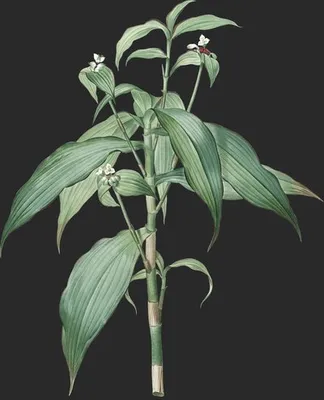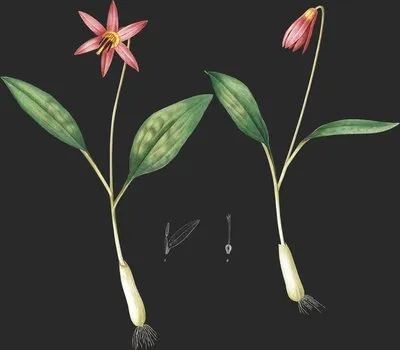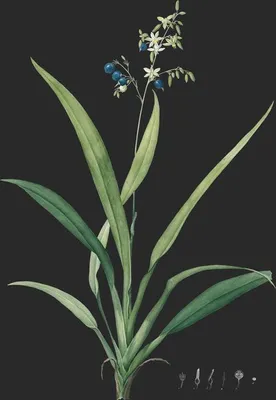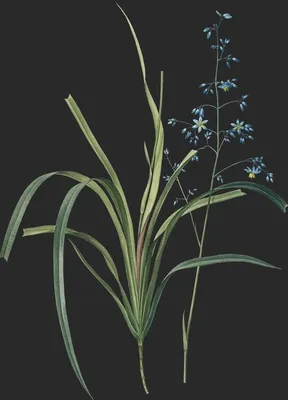
Veltheimia Capensis
Veltheimie du Cap
About this plate
Description
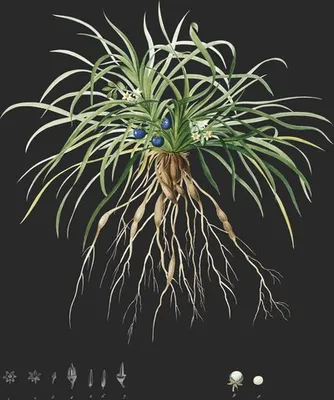
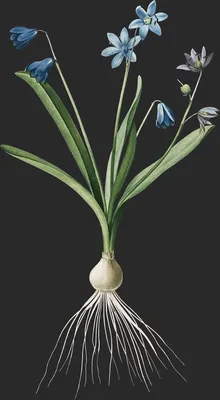
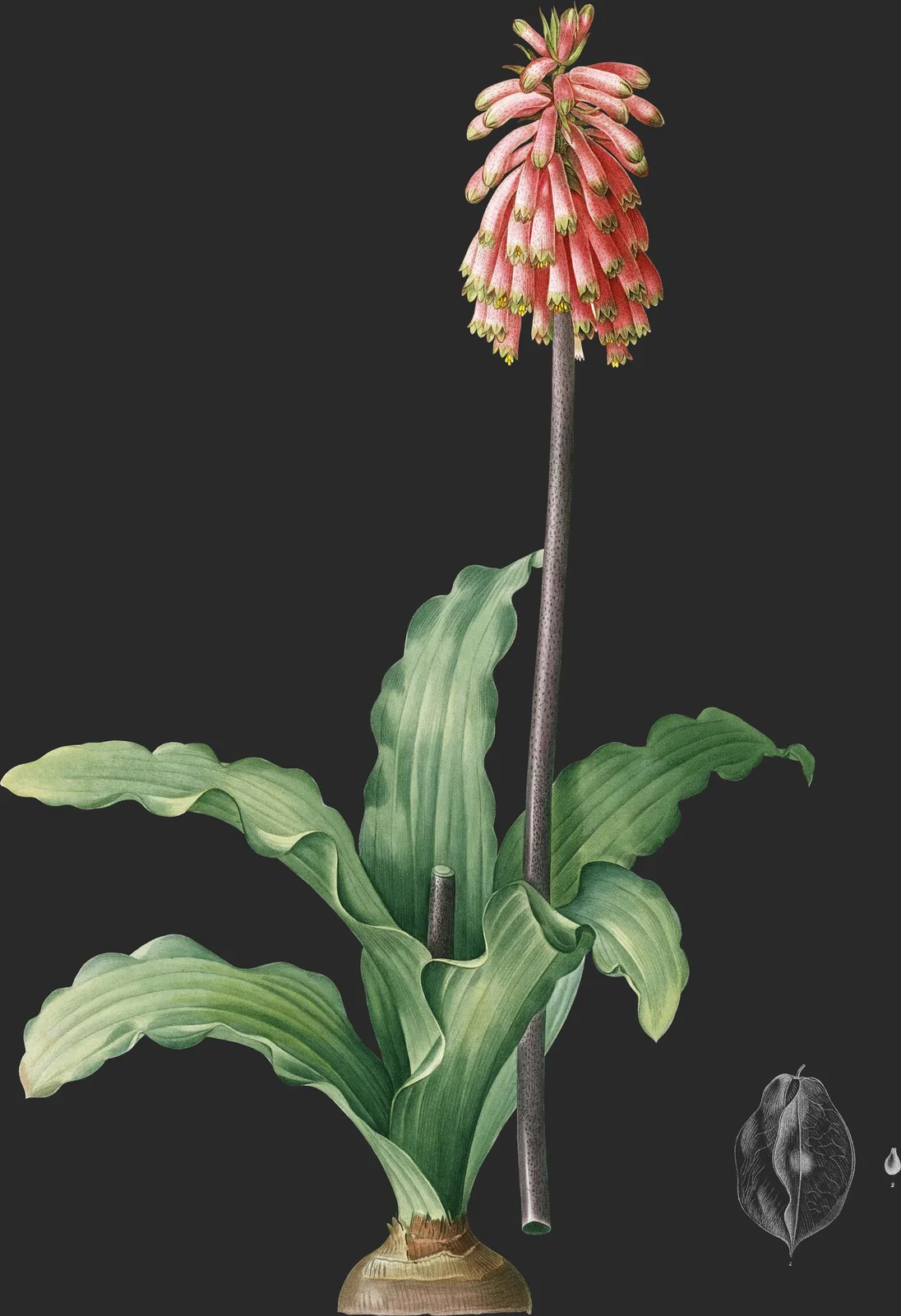
Une bulbe de la grosseur d’une pomme, et revêtue de tuniques láches et violettes, émet supérieurement un faisceau de cing à six feuilles oblongues, lancéolées, pointues, longues de 4–5 décimètres, un peu étalées, ondulées sur les bords, épaisses dans leur partie moyenne, et surtout à leur base. Ces feuilles sont vertes, glabres et marquées de nervures longitudinales, jointes entre elles par des nervures transversales irrégulières.
Entre les feuilles s’élève à la hauteur de 5 à 6 décimètres une hampe droite, cylindrique, glabre, verte, tachetée de violet et surmontée par un épi de fleurs de forme ovale. Celles-ci sont nombreuses, pendantes et soutenues par des pédicelles colorés longs de cinq millimètres, à la base desquels sont des bractées verdâtres, lancéolées, aigués, qui atteignent à peine la moitié de la longueur de la fleur.
Le périgone est en forme de tube un peu renflé au dessous de son orifice, long de quatre centimètres, de couleur blanchâtre, moucheté de rose et formé d’une substance délicate et charnue. Le limbe est court, à six divisions peu profondes, larges et arrondies, dont trois plus extérieures que les autres.
Les filets des étamines sont rougeâtres, un peu aplatis. Us adhèrent au périgone dans toute la longueur du tube, mais s’en séparent à la gorge, où ils supportent des anthères ovales-oblongues, redressées et pleines d’un pollen jaune.
L’ovaire est libre, de couleur verte, ovale-oblong, à six canelures très-sensibles. Le style est filiforme, d’un blanc rougeâtre, droit, plus court que la corolle, et terminé par un stigmate simple peu aigu.
La capsule est à trois ailes membraneuses, à trois loges, dont chacune renferme deux graines en forme de poire insérées à son angle interne.
Histoire
Cette plante est originaire du Cap-de-Bonne-Espérance. On la cultive assez. communément dans les jardins. Elle demande à être abritée pendant l’hiver, dans une serre tempérée.
Explication de la planche
La Plante entière de grandeur naturelle.
- La capsule dans son état de maturité.
- Une graine détachée.
Fam. des Asphodèles. Juss.—Hexandrie monogynie. Lin.
- Veltheimia capensis. V. foliis lanceolatis plicato-undulatis obtusis, dentibus limbi rotundatis rectis.
- Veltheimia viridifolia, Jacy. hort. Schœnbr. 1. p. 41. t. 78. Willd. Spec. pl. 2. p. 181. Pers. enchir. 1. p. 377.
- Aletris capensis. A. acaulis foliis lanceolatis undulatis, spicâ ovatâ, floribus mutantibus. Lin. Sp. plant. 456. Burm. prodr. to. Murr. prodr. 205. Act. Holm. 1770. p. 227. t. 5. Lam. Dict. 1. p. 78. Curt. bor. mag. 501.
- Scilla radice solidâ, corymbo contorto conico. Fabr. Helmst, 33, ex Willd.
- Hyacinthus africanus orchioides. Pluck. Alm. 187. t. 195. f. 6?
- Orchis hyacinthoides, foliis caule et floribus maculatis. Buxb. cent. 3. p. 12. Tab. 20.
Twelve ways of seeing
- measured cast red
- upright 1.46 : 1
- published 1807
- Plate 193
Not a catalogue entry but a way of looking: how to stand, what to notice, how the line was cut, when it flowers, where it came from, who made it — and then the poems and the classics that taught China to see the same flower. Read the twelve in order and the plate opens.
-
First Look
竖划三寸,当千仞之高;横墨数尺,体百里之迥。
—— 南朝宋·宗炳《画山水序》
A vertical stroke of three inches stands for a cliff of a thousand fathoms; a few feet of ink holds a hundred li.
The sheet is vertical: the eye climbs and settles in the upper half. Let the plant stand before you look for detail. Then step in close: watch where colour meets line, and whether the line ever breaks. Third, find where the green is deepest: the whole tonal order is measured from that patch. The pose leans right: the upper half carries 15 points further right than the lower — a living thing, not a diagram.
-
Name and Thing
The binomial is Veltheimia capensis: the first word is the genus it belongs among, the second the epithet that sets it apart. Two words carry a whole provenance. The older system filed it under Asparagaceæ by overall affinity; Linnaeus, counting stamens only, placed it in Hexandria — two ways of asking what a plant is. No established Chinese name exists, so it is cited by its binomial alone.
-
Form and Colour
Measured on this plate: flower colour covers 4.4% of the sheet, foliage 10.7%, the cast red with a second note of amber. No other plate shares exactly this measure. Bulbous plants store the year underground — bulb, corm or tuber — then send up a few thick leaves and a single scape, with six tepals in cup, funnel or star. Filed under green — a moss green, a colour that comes mostly from leaf and stem. Read the outline, then the colour layers, then the brush.
-
Composition
Tall and narrow, the plant rising in one movement with generous margins — the upright format of most floras. (about 1.46 : 1) No details are appended: a plate for looking, not for keying out. The plant covers only 20% of the sheet, centred below centre; the emptiness is where the eye rests. Cover the margins with your thumb and the plate suffocates; uncover them and the flower breathes again.
-
Line and Colour
The first half of the nineteenth century moved from copper to steel to lithography; stipple could render the softest transition. Craft leaves franker evidence than inscriptions.
-
Season
Early spring to early summer, genus by genus: tulips and hyacinths first, gladiolus and amaryllis later. The year 1807 on the plate is that of publication, not of flowering — the gathering came a year or two earlier. The best time to read such a plate is its flowering season: three minutes under the tree explains what no text can.
-
Provenance
Three homelands: the Mediterranean, Central Asia and South Africa. The tulip came from Ottoman gardens and became a Dutch mania; South African bulbs filled European glasshouses after 1800. The volume was made in 1802-1816, when most of this knowledge came from living plants under glass.
-
The Book and the Hand
“The Liliaceae” was drawn by Pierre-Joseph Redouté and published 1802-1816. This plate is Plate 193, book page 193. The image is public domain; the hand-colouring is still one person's hand.
-
Poetic Resonance
郁金垂嫩柳,罯画委高笼。
—— 唐·元稹《春六十韻》
The poem gives the mood first and the picture supplies the form; set the line beside the plate and the green the corolla becomes its resting point.
-
The Written Tradition
论画以形似,见与儿童邻。
—— 宋·苏轼《书鄢陵王主簿所画折枝》
To judge a painting by likeness alone is the view of a child.
Li Bai's 'orchid wine, fragrant with yujin' is often misread as tulips; the Tang yujin was a turmeric-like root used to scent wine — same name, different plant. Keep the line; it will surface the next time you meet the same plant.
-
Symbolism
The tulip was an imperial emblem in Istanbul and a speculative bubble in Amsterdam; the hyacinth sprang from a boy's blood in Greek myth. What bulbs share is concealment: next year kept underground. Meanings change their tune: the same flower can say opposite things within a century.
-
What to Take Away
Appreciation is not knowledge but habit — one more look each time. A flora exists to be consulted; look long enough and you forget to consult — someone in 1807 gave a whole day to a single flower.