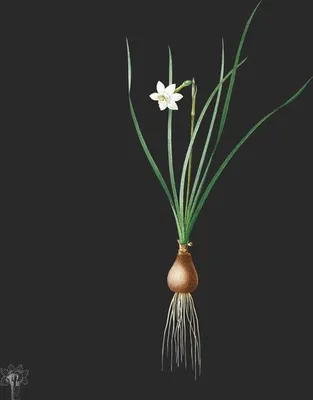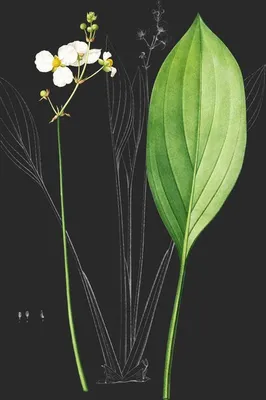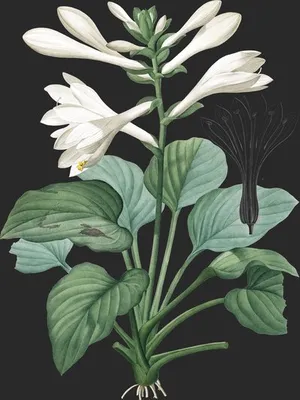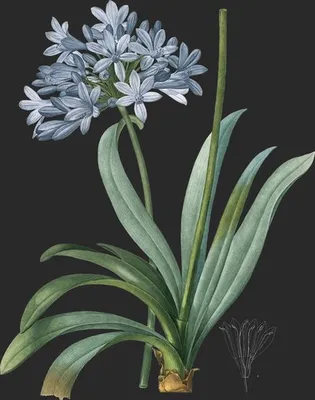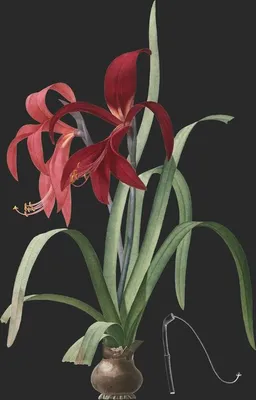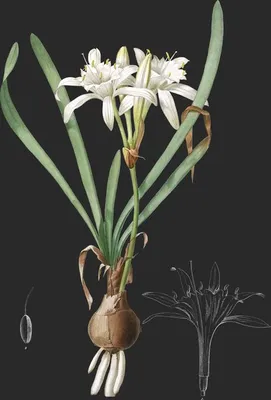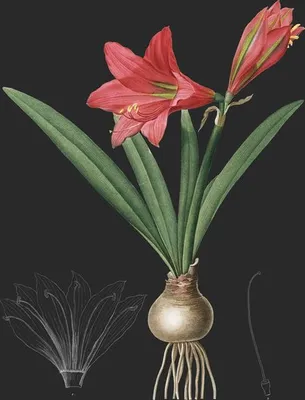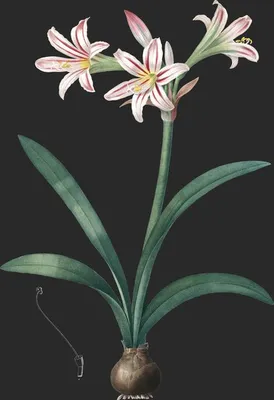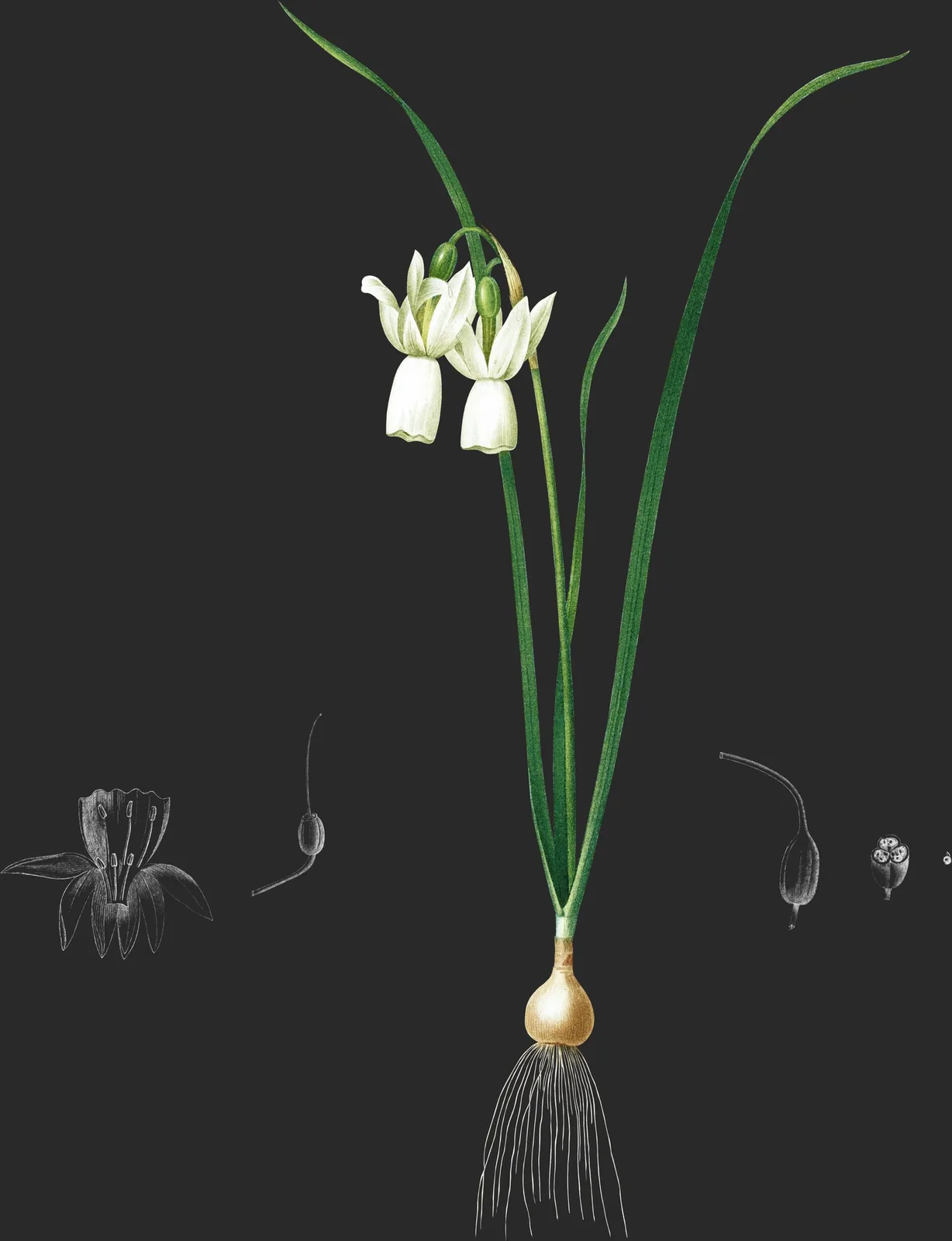
Narcissus Calathinus var B
水仙属·Narcissus Calathinus var B
Narcisse a Grande Coupe
About this plate
Description
Nous pensons que la plante dont nous ollions ici la figure est une simple variété de celle que nous avons fait précédemment connaître sous le même nom: cependant, comme elle en diffère à plasieurs égards, nous allons en donner une description séparée.
Une bulbe ovale, blanche, donne naissance à des feuilles radicales peu nombreuses, droites, longues de deux ou trois décimètres, larges de eing milli-mètres, d’u t foncé, planes en dedans, convexes sur le dos, que ses nervures longitadinales très-saillantes font paraitre strié. La hampe est haute de quinze centimètres, lisse, glabre, a peu près cylindrique, ou légèrement comprimée. Les fleurs sont au nombre de deux, pendantes, portées sor des pédicelles inégaux; courbes subitement an sommet, et enfermés dans une spathe membrancuse aussi longue qu’eux.
L’ovaire est gros, ovale-triangulaire, aussi long que le tabe du périgone, qui est triangulaire, d’un vert pale. Les divisions du limbe sont blanches avec une tres-légère teinte jaunâtre, ovale lancéolées, aiguës, striées longitadinalement, recourbées à leur base en dehors, et dirigées en haut un peu comme les divisions des fleurs de eyelamen. Le nectaire est grand, en forme de cloche, aussi long que les divisions du périgone et de la même couleur qu’elles. Son bord, qui ne se renverse point en dehors, et qui n’est nullement froncé, présente six échancrures ou crénelures un peo profondes. Les étamines sont au nombre de six, dont trois sont entièrement cachées dans le tube, et les trois autres atteignent presque le bord du nectaire. Les filaments de ces dernières sont blanes, en forme d’alene, assez longs. Ceux des premières sont très-courts et jaunatres. Les anthères sont d’un blanc jaunatre, oblongues, obtuses, dressées. Le style est filiforme, un peu plas long que les étamines, terminé par un stig. mate en forme de godet.
Histoire
Ce Narcisse a été trouvé, suivant M. Loiseleur Delonchamps, dans les iles de Glénan. M. le comte de Hollmansegg l’a également trouvé en Portugal. On le cultive dans le jardin de M. Vilmorin, à Paris, où nous l’avons vu en fleur à la fin do mois d’avril.
Observations
M. Gawler a fait connaitre dans le Botanical magazine de Cartis, sous le nom de Narcissas colathinus, une plante très-diflérente de celle à laquelle nous avons donné ce nom, et il rapporte cette dernière à son Narcissus triandrus. Nous ne comprenons pas bien ce qui a pu le porter à ce changement, et à adopter une opinion si diflèrente de celle de la plupart des botanistes. Nous nous sommes assurés que la figure de Rudbeck citée par Linné s’accorde bien avec notre plante. La phrase caractéristique donnée par ce dernier ne s’y accorde pas moins, tandis qu’elle ne s’accorde point avec la plante figurée dans le Botanical magazine. L’inspection de l’herbier de Linné pourrait seule décider cette question; et M. Gawler ne nous apprend pas que ce soit sur un pareil fondement qu’il a formé son opinion; opinion que nous ne prétendons cependant point rejeter d’une manière positiv
Fam. des Narcisses. Juss.—Hexandrie monogynie. Lin.
- Narcissus calathinus. N. spatha multiflora, nectario campanulato subaquante petala, foliis planis.
- A. floribus horizontalibus lateis, laciniis perigonii patentibus.
- Narcissus calathinus. Liliac. 177. ubi vide de synonym.
- B. floribas pendulis albis, laciniis perigonii reflexis.
- Narcissus reflexus. N. folis angusto-linearibus virentibus dorso subconvexis binerviisque, scapo cylindrico lævi 1–2 floro, nectario campanulato margine sexcrenulato, petalis reflexis alterne latioribus subaquali, floribus cernuis. Lois. Mem. sur les Narc. indig. p. 44. Mém. des Savans étrang. 2. p. 633.
- Narcissas reflexus. N. scapo tereti paucifloro, foliis carinatis, corollæ laciniis lanceolatis, reflexiuscalis, coronâ campanulatâ, sexcrenulatâ vix longioribus. Broter. fl. Lusit.
Twelve ways of seeing
- measured cast amber
- upright 1.30 : 1
- published 1812
- Plate 410
Not a catalogue entry but a way of looking: how to stand, what to notice, how the line was cut, when it flowers, where it came from, who made it — and then the poems and the classics that taught China to see the same flower. Read the twelve in order and the plate opens.
-
First Look
六法者何?一、气韵生动是也;二、骨法用笔是也;三、应物象形是也;四、随类赋彩是也;五、经营位置是也;六、传移模写是也。
—— 南齐·谢赫《古画品录》
The six laws: spirit resonance alive; bone-method in the brush; matching form; colour by kind; planning the placing; copying the masters.
The sheet is vertical: the eye climbs and settles in the upper half. Let the plant stand before you look for detail. Then step in close: watch where colour meets line, and whether the line ever breaks. Third, find where the green is deepest: the whole tonal order is measured from that patch.
-
Name and Thing
The binomial is Narcissus calathinus: the first word is the genus it belongs among, the second the epithet that sets it apart. The genus name Narcissus: Narcissus is the youth of Greek myth who fell in love with his own reflection. The older system filed it under Amaryllidaceæ by overall affinity; Linnaeus, counting stamens only, placed it in Hexandria — two ways of asking what a plant is. No established Chinese name exists, so it is cited by its binomial alone.
-
Form and Colour
Measured on this plate: flower colour is sparing, 0.4% of the sheet against 2.2% of foliage, the cast tending amber — as with pale or white blooms, outline and tone do the talking. A layered bulb, upright strap leaves, six white tepals and a small golden cup — the Chinese name is 'silver terrace with a golden cup'. Filed under green — a moss green, a colour that comes mostly from leaf and stem. Read the outline, then the colour layers, then the brush.
-
Composition
Tall and narrow, the plant rising in one movement with generous margins — the upright format of most floras. (about 1.30 : 1) No details are appended: a plate for looking, not for keying out. The plant covers only 5% of the sheet, centred near the centre; the emptiness is where the eye rests. Old plates set the plant slightly off centre, with unequal margins — that small imbalance is what keeps it alive.
-
Line and Colour
The first half of the nineteenth century moved from copper to steel to lithography; stipple could render the softest transition. Craft leaves franker evidence than inscriptions.
-
Season
Late winter into early spring: forced in water in the twelfth month, blooming at the New Year. The year 1812 on the plate is that of publication, not of flowering — the gathering came a year or two earlier. The plate records ten days of peak; the other three hundred are leaf, fruit and rest.
-
Provenance
Native to the Mediterranean, reaching China by sea in the late Tang; Zhangzhou in Fujian has grown it since Ming times. The volume was made in 1802-1816, when most of this knowledge came from living plants under glass.
-
The Book and the Hand
“The Liliaceae” was drawn by Pierre-Joseph Redouté and published 1802-1816. This plate is Plate 410, book page 410. The image is public domain; the hand-colouring is still one person's hand.
-
Poetic Resonance
苍苍烟树闭古庙,中有蛾眉成水仙。
—— 唐·韦应物《鼋头山神女歌》
The poem gives the mood first and the picture supplies the form; set the line beside the plate and the green the corolla becomes its resting point.
-
The Written Tradition
凌波微步,罗袜生尘。
—— 三国魏·曹植《洛神赋》
She moves as if treading on waves, dust rising from her silken socks — the line from which the narcissus took its Chinese name, “fairy of the waves”.
Song poets made it famous — Huang Tingjian wrote that southern gardeners grew it widely; Qing manuals describe the Zhangzhou practice of raising it in sand and water, still used today. The difference is not of quality but of question: Europe asks what it is, China asks whom it resembles.
-
Symbolism
In China it is the New Year's offering — clear, fragrant, a little otherworldly; in Europe, because of Narcissus, it means self-love and the gaze turned inward. In a flora it is a species first and a symbol second; the order is worth keeping.
-
What to Take Away
Carry three rules away: whole before detail; line before colour; picture before book. A flora exists to be consulted; look long enough and you forget to consult — someone in 1812 gave a whole day to a single flower.