Ornithogalum Aureum
Ornithogale Doré
Ornithogale Doré
About this plate
Description
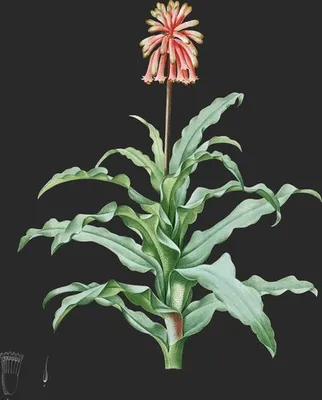
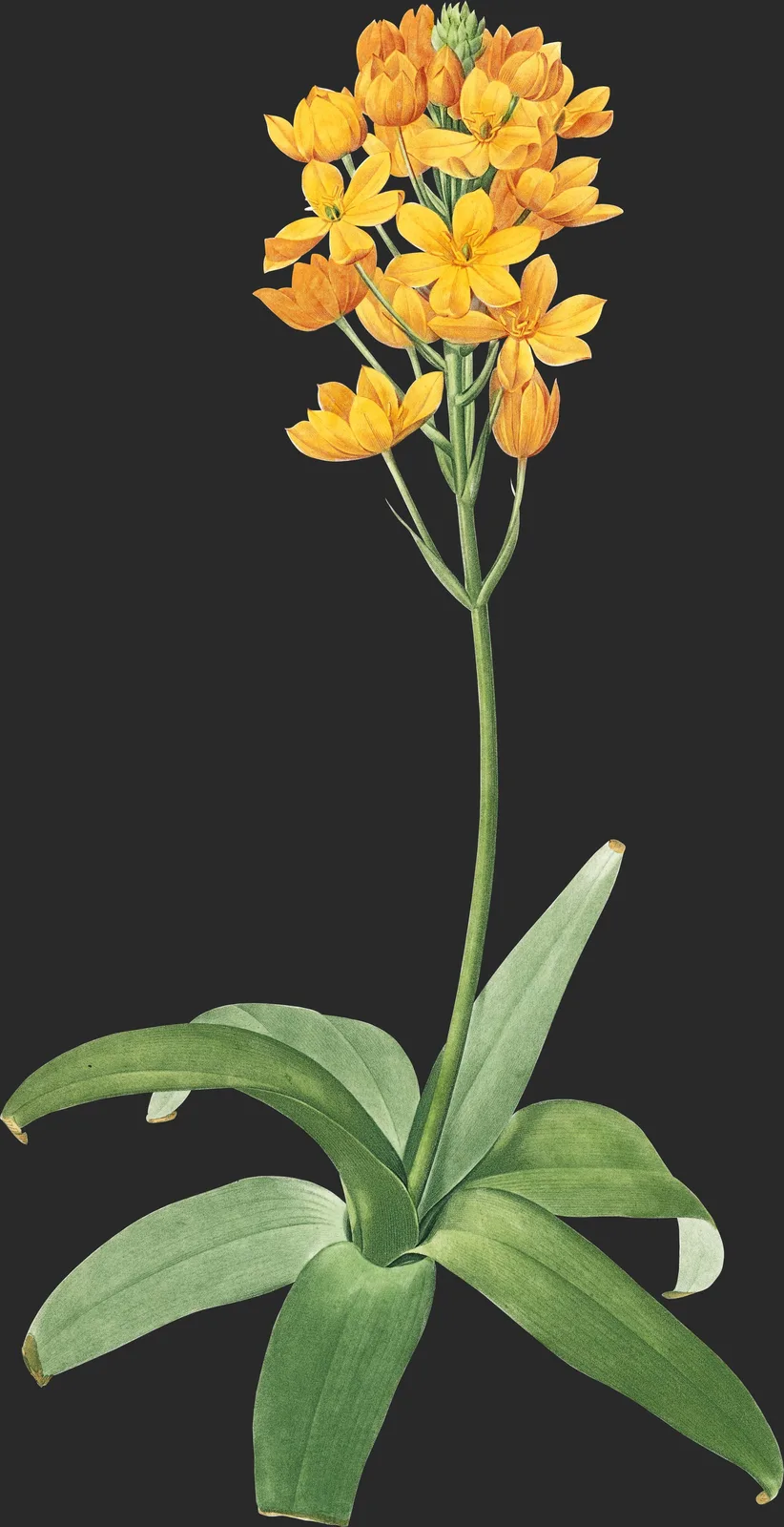
Sa racine est une bulbe blanche; ses feuilles sont en ruban, lancéolées, aigués, plus courtes que la hampe, longues de treixe centimètres et demi à seize centimètres (cinq à six pouces), larges de quatre centimetres (un pouce et demi) dans le milieu, insensiblement rétrécies depuis leur tiers inférieur jusqu’à leur sommet, recourbées en dessous, légèrement creusées en dessus sur leur ligne moyenne, un peu cartilagineuses sur les bords, qui, étant vus à la loupo, paraissent blanes et très-finement dentés.
Hampe eylindrique, de la grosseur d’une plume à éerire, portant une grappe très-fournie de fleurs. Pédicelles un peu en massue, longs de eing centimètres (près de deux pouces). Bractées lancéolées très aigues, solitaires sous les pédicelles qu’elles embrassent comme dans un tube fendu en dessus, à bords minces et membraneux.
Périgone à six divisions égales, ovales-renversées, obtuses-acuminées, concaves en dedans, convexes en dehors, marquées de stries longitudinales qui se ramifient de bas en haut. Ces divisions sont d’une couleur jaune orangée, à l’exception de leur base qui est verte en dessous, très-pris du pédicelle; elles sont soudées entre elles seulement par leur base; trois sont intérieures, et les trois autres estericures.
Six étamines des deux tiers plus courtes que les divisions du périgone, sont opposées à ces divisions et insérées à leur base. Les filets pyramidaux et longs de sept millimètres (trois lignes) se courbent en dedans, et émettent latéralement par leur base, une petite membrane en gouttière, étroite sur les côtés de trois des filets, et plus larges sur les trois autres filets alternes. Les anthères sont linéaires. L’ovaire est à trois angles mousses et à trois silions; il est vert olive, et non luisant. Le stigmate reposant sur le sommet aminci de L’ovaire est à trois crètes mousses, et d’un jaune d’or.
Histoire
L’Ornithogale doré est indigène du Cap de Bonne-Espérance. On le voit, à Paris, chez un très-petit nombre de eultivateurs. On le tient dans la serre tem-pérée. L’individu que nous avons décrit et dessiné a fleuri au mois de juin chez M. Boursaut, et est resté plus de trois semaines en fleurs, sans avoir donné de fruit.
Observations
Plus les fleurs de l’Ornithogale doré sont d’une couleur vive orangée, et plus elles sont belles; il y a des fleurs pales dans des variétés. Jacquin a donné les figures peintes des Ornithogales que nous rapportons à l’Ornithogale doré, et qui ne sont peut-être, comme il le dit, que des variétés de l’Ornithogole thyrsoïde. Les caractères tirés de la forme de la grappe, de la grandeur des bractées et des fleurs, de la largeur ou du rétrécissement des feuilles, ne coïncident pas toujours, suivant les mêmes rapports, dans l’Ornithogale doré.
Le nectaire de la fleur, ainsi appelé dans la phrase de Curtis, n’est autre chose que la membrane dilatée, et terminée par une dent obtuse sur les côtés de trois des filaments des étamines.
Fam. des Asphodèles. Juss.—Hexandrie monogynie. Lin.
- Ornithogalum aureum.O, racemo coarclato, sub-corymboso; filamentis alternis emarginatis; foliis lanceolatis, cartilagineo-denticulatis. Willd. spec. pl. 2. p. 124. Persoon. enchirid. 1. p. 365.
- A. Ornithogalum miniatum. O. filamentis alternis emarginatis; racemo corymboso; foliis lanceolatis, ad oras subtilissimè muricatis; floribus miniatis. Jacq. collect. 3 p. 233. Icon. rar. 2. 438.
- B. Ornithogalum aurenm. O. foliis ovato-lanceolatis, albo-emarginatis; floribus racemosis confertis, filamentis nectario emarginato insidentibus. Curt. botan. mag. tab. 190.
- C. Ornithogalum flavescens. O. filamentis alternis emarginatis; racemo corymboso, ad oras minutissimé muricatis; floribus albidis, flavisque. Jacq. Collect. 3. p. 233. Icon. rar. 2. 437.
- D. Ornithogalum flavissimum. O. Glamentis alternis emarginatis; racemo corymboso, ob pedunculos valdè approximatos coaretato; foliis linearibus canaliculatis. Jacq. Collect. 5. p. 65. Icon. rar. 2. 436.
- Ornithogalum flavissimum. Andrews botanist’s reposit. tab. 505.
Twelve ways of seeing
- measured cast yellow-green
- upright 1.95 : 1
- published 1814
- Plate 439
Not a catalogue entry but a way of looking: how to stand, what to notice, how the line was cut, when it flowers, where it came from, who made it — and then the poems and the classics that taught China to see the same flower. Read the twelve in order and the plate opens.
-
First Look
江馆清秋,晨起看竹,烟光日影露气,皆浮动于疏枝密叶之间。
—— 清·郑板桥《题画竹》
On an autumn morning at the river lodge I looked at the bamboo: mist, sunlight, dew, all drifting among the sparse and dense leaves.
The sheet is vertical: the eye climbs and settles in the upper half. Let the plant stand before you look for detail. Then step in close: watch where colour meets line, and whether the line ever breaks. Third, find where the green is deepest: the whole tonal order is measured from that patch.
-
Name and Thing
The binomial is Ornithogalum aureum: the first word is the genus it belongs among, the second the epithet that sets it apart. Two words carry a whole provenance. The older system filed it under Asparagaceæ by overall affinity; Linnaeus, counting stamens only, placed it in Hexandria — two ways of asking what a plant is. No established Chinese name exists, so it is cited by its binomial alone.
-
Form and Colour
Measured on this plate: flower colour covers 8.2% of the sheet, foliage 16.7%, the cast yellow-green with a second note of amber. No other plate shares exactly this measure. Bulbous plants store the year underground — bulb, corm or tuber — then send up a few thick leaves and a single scape, with six tepals in cup, funnel or star. Filed under green — a moss green, a colour that comes mostly from leaf and stem. A single plant, laid out with nothing hidden.
-
Composition
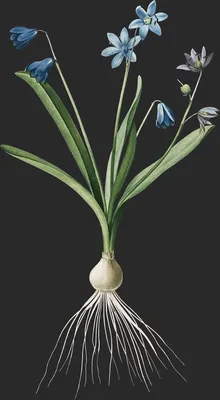
Tall and narrow, the plant rising in one movement with generous margins — the upright format of most floras. (about 1.95 : 1) No details are appended: a plate for looking, not for keying out. The plant covers only 26% of the sheet, centred below centre; the emptiness is where the eye rests. Cover the margins with your thumb and the plate suffocates; uncover them and the flower breathes again.
-
Line and Colour
The first half of the nineteenth century moved from copper to steel to lithography; stipple could render the softest transition. There is evidence on the back too: the plate mark pressed into the paper, the slight relief of the pigment, lines worn shallow in a later printing.
-
Season
Early spring to early summer, genus by genus: tulips and hyacinths first, gladiolus and amaryllis later. The year 1814 on the plate is that of publication, not of flowering — the gathering came a year or two earlier. The plate records ten days of peak; the other three hundred are leaf, fruit and rest.
-
Provenance
Three homelands: the Mediterranean, Central Asia and South Africa. The tulip came from Ottoman gardens and became a Dutch mania; South African bulbs filled European glasshouses after 1800. The volume was made in 1802-1816, when most of this knowledge came from living plants under glass.
-
The Book and the Hand
“The Liliaceae” was drawn by Pierre-Joseph Redouté and published 1802-1816. This plate is Plate 439, book page 439. The image is public domain; the hand-colouring is still one person's hand.
-
Poetic Resonance
卢家少妇郁金堂,海燕双栖玳瑁梁。
—— 唐·沈佺期《古意呈補闕喬知之》
The poem gives the mood first and the picture supplies the form; set the line beside the plate and the green the corolla becomes its resting point.
-
The Written Tradition
庭下如积水空明,水中藻荇交横,盖竹柏影也。
—— 宋·苏轼《记承天寺夜游》
The courtyard seemed flooded with clear water, weeds crossing in it — in fact the shadows of bamboo and cypress.
Li Bai's 'orchid wine, fragrant with yujin' is often misread as tulips; the Tang yujin was a turmeric-like root used to scent wine — same name, different plant. Keep the line; it will surface the next time you meet the same plant.
-
Symbolism
The tulip was an imperial emblem in Istanbul and a speculative bubble in Amsterdam; the hyacinth sprang from a boy's blood in Greek myth. What bulbs share is concealment: next year kept underground. Flower language was added later; the flower knows nothing of it, and that innocence is part of its power.
-
What to Take Away
Carry three rules away: whole before detail; line before colour; picture before book. The flower of that year is dust, yet its image on paper has outlived every living cousin.