Ornithogalum Luteum
春慵花属·Ornithogalum Luteum
Ornithogale Jaune
Ten ways of seeing
- measured cast amber
- upright 4.15 : 1
First Look
江馆清秋,晨起看竹,烟光日影露气,皆浮动于疏枝密叶之间。
—— 清·郑板桥《题画竹》
On an autumn morning at the river lodge I looked at the bamboo: mist, sunlight, dew, all drifting among the sparse and dense leaves.
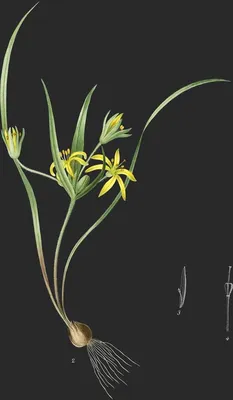
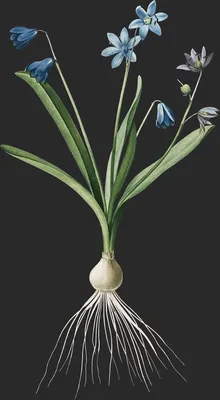
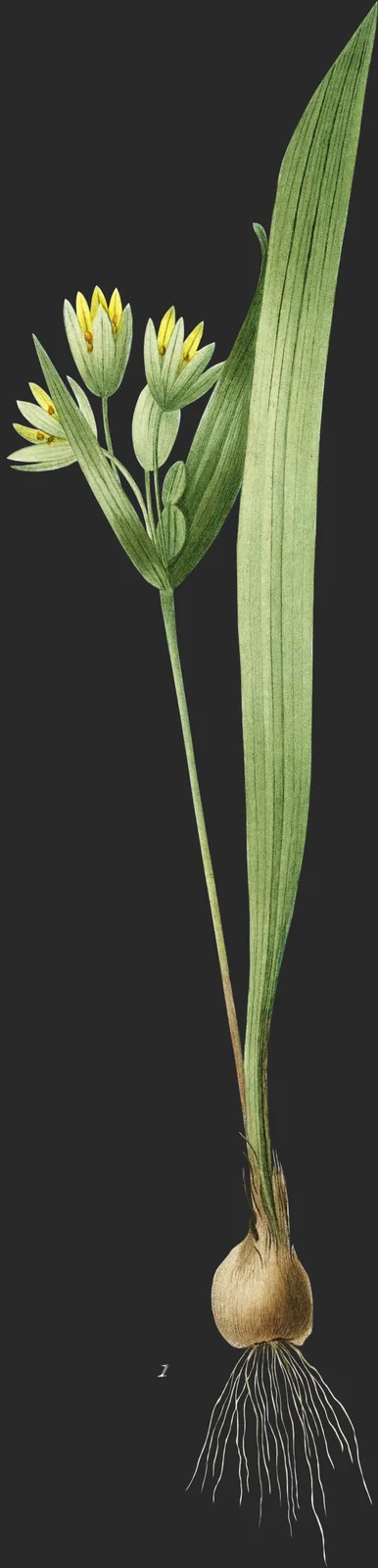
The sheet is vertical: the eye climbs and settles in the upper half. Let the plant stand before you look for detail. Then step in close: watch where colour meets line, and whether the line ever breaks. Third, find where the green is deepest: the whole tonal order is measured from that patch. The pose leans left: the upper half carries 8 points further left than the lower — a living thing, not a diagram.
Name and Thing
The binomial is Ornithogale jaune: the first word is the genus it belongs among, the second the epithet that sets it apart. Two words carry a whole provenance. The older system filed it under Asparagaceæ by overall affinity; Linnaeus, counting stamens only, placed it in Hexandria — two ways of asking what a plant is. No established Chinese name exists, so it is cited by its binomial alone.
Form and Colour
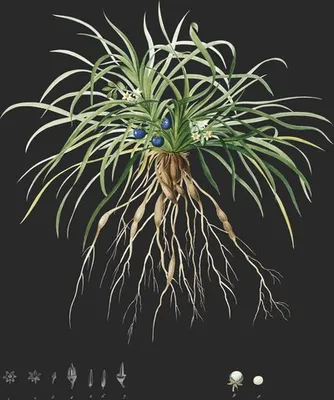
Measured on this plate: flower colour covers 2.7% of the sheet, foliage 15.7%, the cast amber with a second note of yellow-green. No other plate shares exactly this measure. A bulb of overlapping fleshy scales gives the lily its Chinese name, 'hundred-fold'; six tepals reflex as the flower opens, around six stamens with long, T-shaped anthers. a moss green. Read the outline, then the colour layers, then the brush.
Composition
The sheet is tall. No details are appended: a plate for looking, not for keying out. The plant covers only 20% of the sheet, centred a little right of centre; the emptiness is where the eye rests.
Line and Colour
The first half of the nineteenth century moved from copper to steel to lithography; stipple could render the softest transition. Take a loupe to three places: petal edge, leaf vein, caption. An unbroken line means engraving; colour crossing the outline means a hand. If you mean to copy it: take its skeleton, its margins and the order of its colours; the burin's hatching is the language of copper — suggest it with pencil density, do not imitate it stroke for stroke.
Poetic Resonance
方石斛栽香百合,小盆山养水黄杨。
—— 宋·陆游《龟堂杂兴十首 其五》
The poem gives the mood first and the picture supplies the form; set the line beside the plate and the green the corolla becomes its resting point.
Symbolism
In the West the white lily is Marian purity, held by the angel of the Annunciation; in China the name sounds like 'a hundred years in harmony', a wedding wish. Meanings change their tune: the same flower can say opposite things within a century.
Season and Place
Early to high summer, June and July. Temperate north — China, Japan, Europe. Long used in Chinese medicine, lilies were hunted in East Asia by nineteenth-century collectors and transformed European gardens. The year 1811 on the plate is that of publication, not of flowering — the gathering came a year or two earlier. Read the locality and the flowering season both with a discount: one is hearsay, the other a ten-day peak.
The Book and the Hand
“The Liliaceae” carries only Pierre-Joseph Redouté's name. The image is public domain; the hand-colouring is still one person's hand.
What to Take Away
Next time you stand before a flowering plant, give it three minutes: leaf arrangement, direction of the flower, the darkest patch. A flora exists to be consulted; look long enough and you forget to consult — someone in 1811 gave a whole day to a single flower.
About this plate
Description
Une bulbe ovale, grosse comme une noisette, couverte de tuniques grises un peu coriaces, donne naissance par sa base à des fibres radicales, courtes, tres-fines et très-nombreuses. Un peu au-dessous de son sommet, sortent, par une ouverture commune, une hampe et une feuille solitaire. Celle-ci est droite, linéaire-lancéolée, haute de deux à trois décimètres, large de dix à quinze mil-limètres, courbée en gouttière, surtout dans sa partie inférieure qui embrasse la hampe, glabre, entière, aiguë, et renflée à son sommet en manière de capu-chon. La hampe est droite, simple, anguleuse, glabre, plas grosse dans le haut que dans le bas. De son sommet naissent deux feuilles ou bractées opposées, lancéolées, aigués, ciliées, inégales. La plas grande atteint souvent la longueur d’un décimètre. Il y en a quelquefois une troisième plas petite que les deux autres. Les fleurs, au nombre de trois à sept, forment au milieu de l’espèce de collerette qui résulte de la réunion de ces feuilles une ombelle terminale à rayons inégaux. Leurs pédicelles sont glabres, simples, un peu triangulaires, longs de un à quatre centimètres.
Le périgone est verdatre en dehors, d’un jaune plus ou moins vif en dedans, divisé jusqu’à sa base en six segments, ovales, lancéolés, obtus, qui ne s’étalent qu’après la fécondation du germe.
Les filaments des étamines sont en forme d’alene. Les anthères sont ovales-oblongues, jaunes, redressées, insérées par leur base. A près l’émission du pollen, elles prennent une forme arrondie.
L’ovaire est blanc, libre, ovale-triangulaire. Le style est droit, filiforme, triangulaire, plus long que les étamines, crensé à son extrémité d’une sorte de godet, que l’on doit considérer comme le véritable stigmate.
Le fruit, que nous n’avons pas vu nous-mèmes, est une capsule triangulaire; À trois valves, à trois loges, dont chacune renferme une graine blanche.
Histoire
L’Ornithogale jaune se trouve dans la plus grande partie de l’Europe. La variété A croit dans les prés. La variété B habite dans les bois et les bosquets. L’une et l’autre fleurissent au premier printemps.
Observations
M. Persoon, et, depuis lui, plusieurs botanistes distingués, ont considéré les deux variétés que nous avons indiquées comme des espèces distinetes. Il est très-possible que cette opinion soit fondée; mais nous pensons qu’aueun des caractères assignés jusqu’à présent à ces deux espèces n’est assez tranché pour nécessiter leur séparation. Nous croyons en conséquence devoir les laisser réu-nies. C’est à la dernière des deux, celle que M. Persoon a désignée par le nom d’Ornithogalum sylvaticum, que s’appliquent notre description et notre figure.
Explication de la planche
- L’Ornithogale jaune.
Fam. des Asphodèles. Juss.—Hexandrie monogynie. Lin.
- Ornithogalum luteum. O. scapo basi monophyllo, foliis radicalibus linearibus, pedunculis umbellatis glabris, petalis lanceolatis. Willd. sp. pl. 2. p. 113.
- Ornithogalam luteum. O. scapo anguloso diphyllo, peduncolis umbellatis simplicibus. Fl. Suec. 270. 285. Lin. spec. pl. 439. Mill. dict. n. 5. Poll. Palat. 332. Scop. Carn. 410. Roth. Germ. 1. p. 150; 2. p. 393. Fl. F. éd. 3. n. 1942. Pers. enchir. 1. p. 363.
- Ornithogalum lateum. var. α. Lam. dict. 4. p. 612.
- Ornithoralum scapo diphyllo, pedanculis simplicibus terminalibos, filamentis omnibus subulatis. Hort. Cliff. 124. Roy. Lugd-b. 31.
- Gagea lutea. Gawl. in Curt. bot. mag. n. 1200.
- Phalangiam radice balbosâ, stipulis maximis, hirsutis, floribus umbellatis, petiolis unifloris. Hall. Helv. 1213.
- Ornithogalam luteum. Bauh. pin. 71.
- Pyrochiton. Renealm. sp. 91. t. 90.
- A. Minus involucris polyphyllis.
- Ornithogalam lateum. O. folio radicali lineari solitario plano, floralibus imis oppositis, peduncolis simplicibus subumbellatis, petalis obtusis glabris, balbo aggregato. Willd. hort. Berol. 367.
- Ornithogalum luteum. O. bolbis ternis, foliis lineari-lanceolatis, canalicolatis, scapo subtriquetro, angulato striato, bracteis pluribus margine subpiloso-cilintis; foliolo inferiori remoto, filamentis dilatatis. Hoppe in Regensb. botan. Zeit. ann. 6. p. 138.
- Ornithogalum pratense. O. scapo polyphyllo, peduncalis simplicibus glabris. Pers. in Uster. n. annal. st. 5. p. 8. t. 2. f. 1.
- B. Majus involacris diphyllis.
- Ornithogalam sylvaticam. O. folio radicali lineari-lanceolato solitario plano, floralibus imis oppositis, peduncolis simplicibus subumbellatis, petalis obtusis glabris, bulbo solitario. Willd. hort. Berol. 1. p. 368.
- Ornithogalum sylvaticum. O. scapo anguloso, aphyllo; folio radicali unico, trinervi, apice cucullato; bracteis duabus margine pilosis; pedunculis triquetris glabris; floribus dispariliter umbellatis. Donnesmark in Regensb. bot. Zeit. ann. 6. p. 151.
- Ornithogalum sylvaticum. O, scapo anguloso diphyllo, pedunculis simplicibus triquetris glabris. Pers. in Ust. n. annal. st. 5. p. 7. tab. 1. f. 1.
- Ornithogalum Persoonii. O. bulbo unico, foliis linearibos, canaliculatis, apice tubulosis, scapo subcompresso angulato, bracteis binis ambellatis, margine tomentoso-ciliatis, filamentis subulatis. Hoppe in Regensb. bot. Zeit. ann. 6. p. 138. cum icone.