Ornithogalum Pyramidale
春慵花属·Ornithogalum Pyramidale
Ornithogale Pyramidal
About this plate
Description
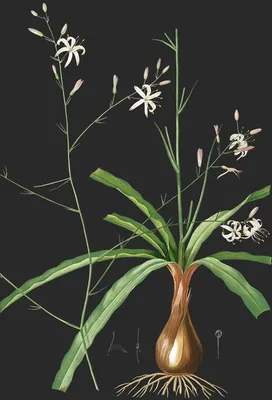
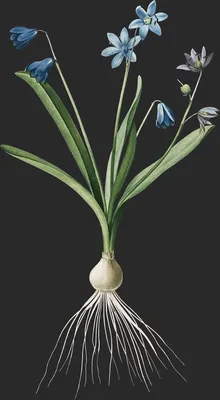
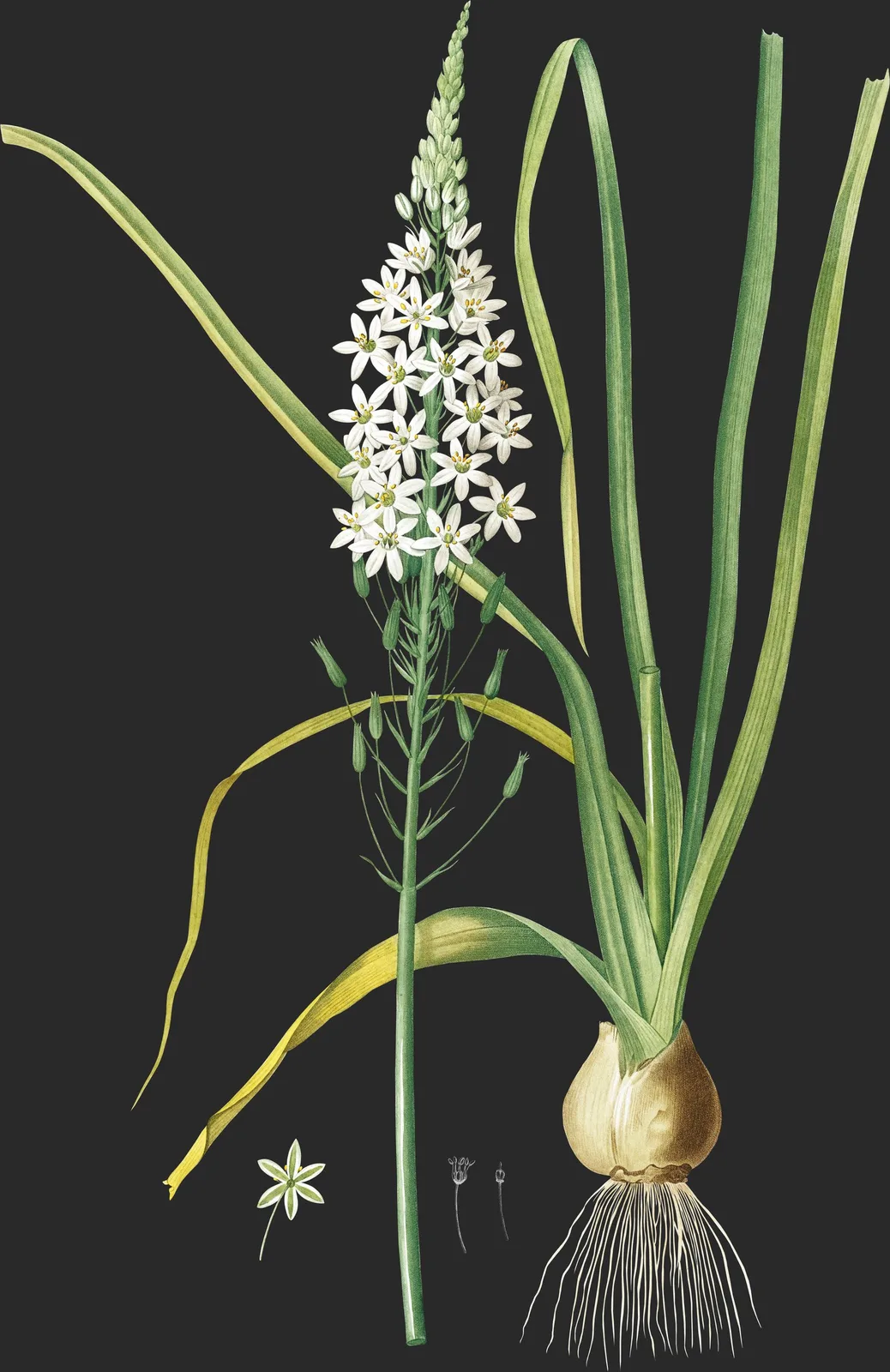
Une bulbe ovale, globnlense, d’un brun verdatre en dehors, épaisse de deux pouces (quinze centimètres et demi), soutient plusieurs feuilles linéaires-lancéolées, longues d’un pied et demi ou environ (quarante-huit centimètres). Ces feuilles sont glabres, taillées en angle sur le dos, amincies sur les bords, pliées en gouttière à leur face supérieure, retombantes, d’un vert pale, et se fanent bientôt. Elles se rétrécissent insensiblement en pointe de la base au sommet.
La hampe cylindrique, lisse et effilée, grosse comme un tuyau de plume de cygne, est droite au milieu des feuilles, et séleve à deux ou trois pieds (trois ou six décimètres). Les fleurs forment une belle grappe conique composée de pédicelles, quelquefois un peu verticillés ou opposés. Ces pédicelles sont longs d’un pouce et demi (quatre centimètres); ils se dirigent presque horizontalement lorsqu’ils portent des fleurs ouvertes, et se redressent ensuite lorsque les fleurs se passent. Les bractées, placées sous les pédicelles, sont aiguës et en fer d’alène.
Le périgone est ouvert à six divisions presque égales, les trois intérieures étant un peu plus étroites que les trois extérieures. Les six divisions sont toutes blanches en dedans, et vertes en dehors, avec des bords blancs.
Les étamines, moitié plas courtes que le périgone, ont des filets en fer d’alène, élargis à leur base, acumines à leur sommet. Les trois filets qui se trouvent opposés aux trois divisions intérieures do périgone sont un peu plus larges que les trois autres filets. Les anthères sont grandes, versatiles, oblongues; d’un jaune pâle.
L’ovaire est brillant, à trois cotes et à trois sillons, court, aussi large que haut. Le style ne dépasse point les étamines. Il est blane, filiforme, et se termine par un stigmate peu distinct, triquètre et un peu hérissé.
Histoire
L’Ornithogale pyramidal est indigène du Portugal. Il a été introduit depuis long temps, comme plante d’ornement, dans divers jardins de l’Europe. On le cultivait en Allemagne avant l’année 1613; il a été figuré et décrit, pour la première fois, par Bealer, dans l’Hortus Eystetensis, imprimé sous cette date.
Observation
Cet Ornithogale fleurit au Jardin des Plantes au mois de juin. Ses fleurs sont sans odeur.
Fam. des Asphodèles. Juss.—Hexandrie monogynie. Lin.
- Ornithogalum pyramidale. O. racemo conico; floribus numerosis ascendentibus; petalis elliptico oblongis, planis; stami inibus lanceolatis, æqualibus stylo brevissimo. Ait. Kew. 1. p. 441. Willd. spec. pl. 2. p. 121. Pers. enchir. 1. p. 364.
- Ornithogalum pyramidale. O. filamentis lanceolato-acuminatis; racemo longissimo; foliis sublinearibus, canaliculatis, superne recurvatis. Lin. syst. Jacq. collect. vol. 2. p. 317. Icon. rar. 2. 425. Poiret. Encyel. 4. p. 614.
- Ornithogalum angustifoliam, spicatum maximum. Bauh. pin. 70. Rudb. Elys. 2. p. 134. fig. 4.
- Ornithogalum lacteum maximum. Besl. Eyst. vern. O. 5. t. 14. fig. 2.
Twelve ways of seeing
- measured cast yellow-green
- upright 1.54 : 1
- published 1814
- Plate 422
Not a catalogue entry but a way of looking: how to stand, what to notice, how the line was cut, when it flowers, where it came from, who made it — and then the poems and the classics that taught China to see the same flower. Read the twelve in order and the plate opens.
-
First Look
论画以形似,见与儿童邻。
—— 宋·苏轼《书鄢陵王主簿所画折枝》
To judge painting by likeness alone is the view of a child.
The sheet is vertical: the eye climbs and settles in the upper half. Let the plant stand before you look for detail. Then step in close: watch where colour meets line, and whether the line ever breaks. Third, find where the green is deepest: the whole tonal order is measured from that patch.
-
Name and Thing
The binomial is Ornithogale pyramidal: the first word is the genus it belongs among, the second the epithet that sets it apart. Two words carry a whole provenance. The older system filed it under Asparagaceæ by overall affinity; Linnaeus, counting stamens only, placed it in Hexandria — two ways of asking what a plant is. No established Chinese name exists, so it is cited by its binomial alone.
-
Form and Colour
Measured on this plate: flower colour covers 3.4% of the sheet, foliage 11.1%, the cast yellow-green with a second note of amber. No other plate shares exactly this measure. A bulb of overlapping fleshy scales gives the lily its Chinese name, 'hundred-fold'; six tepals reflex as the flower opens, around six stamens with long, T-shaped anthers. Filed under green — a moss green, a colour that comes mostly from leaf and stem. Read the outline, then the colour layers, then the brush.
-
Composition
Tall and narrow, the plant rising in one movement with generous margins — the upright format of most floras. (about 1.54 : 1) No details are appended: a plate for looking, not for keying out. The plant covers only 20% of the sheet, centred a little right of centre; the emptiness is where the eye rests. Blank paper is not unfinished work: it is where the eye rests.
-
Line and Colour
The first half of the nineteenth century moved from copper to steel to lithography; stipple could render the softest transition. Craft leaves franker evidence than inscriptions.
-
Season
Early to high summer, June and July; the flowers last only days, so artists drew them just as they opened. The year 1814 on the plate is that of publication, not of flowering — the gathering came a year or two earlier. The best time to read such a plate is its flowering season: three minutes under the tree explains what no text can.
-
Provenance
Temperate north — China, Japan, Europe. Long used in Chinese medicine, lilies were hunted in East Asia by nineteenth-century collectors and transformed European gardens. The localities on the plate are those of a century ago; plants travel and places change their names.
-
The Book and the Hand
“The Liliaceae” was drawn by Pierre-Joseph Redouté and published 1802-1816. This plate is Plate 422, book page 422. The image is public domain; the hand-colouring is still one person's hand.
-
Poetic Resonance
梨花淡白柳深青,柳絮飞时花满城。
—— 宋·苏轼《东栏梨花》
Pear blossoms pale white, willows deep green; when the catkins fly, flowers fill the town.
The poem gives the mood first and the picture supplies the form; set the line beside the plate and the green the corolla becomes its resting point.
-
The Written Tradition
多识于鸟兽草木之名。
—— 《论语·阳货》
…and from the Songs one learns the names of birds, beasts, plants and trees.
The Bencao Gangmu describes the bulb as garlic-like, edible and medicinal; Song writers already noted that the leaves vary while the flowers stay white. The difference is not of quality but of question: Europe asks what it is, China asks whom it resembles.
-
Symbolism
In the West the white lily is Marian purity, held by the angel of the Annunciation; in China the name sounds like 'a hundred years in harmony', a wedding wish. Meanings change their tune: the same flower can say opposite things within a century.
-
What to Take Away
If you keep one line, keep Guo Xi's: from afar its momentum, up close its texture. A flora exists to be consulted; look long enough and you forget to consult — someone in 1814 gave a whole day to a single flower.