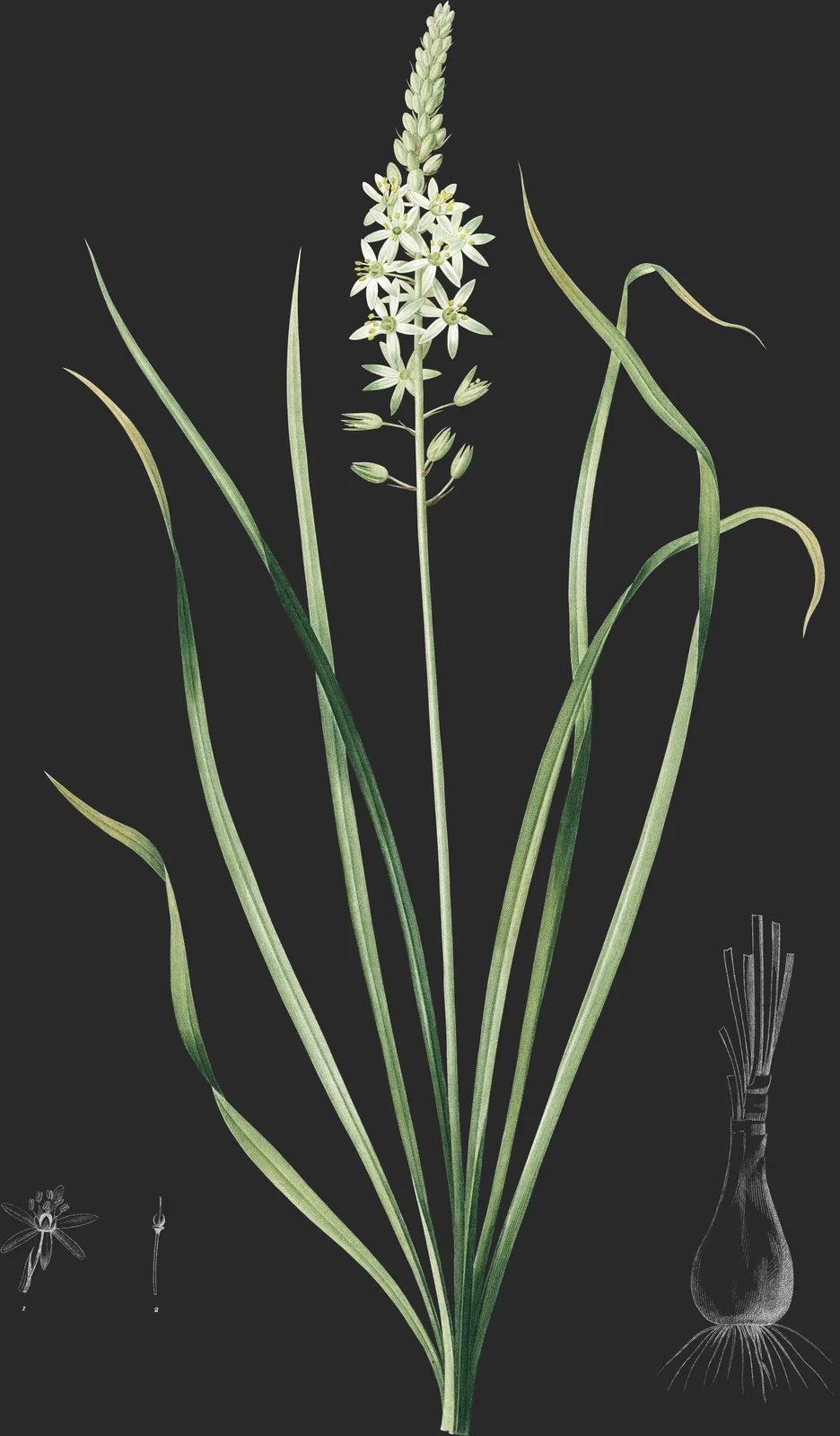
Ornithogalum Pyrenaicum
庇里牛斯虎眼萬年青
Ornithogale des Pyrénées
Ten ways of seeing
- measured cast yellow-green
- upright 1.71 : 1
First Look
真山水之川谷,远望之以取其势,近看之以取其质。
—— 宋·郭熙《林泉高致·山水训》
Mountains and valleys: from afar take their momentum, up close take their texture — the two distances from which any picture is read.
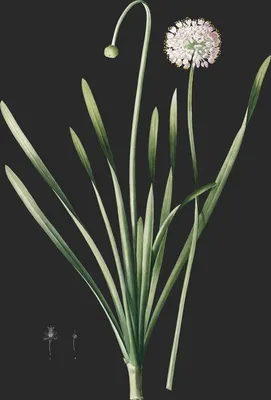
The sheet is vertical: the eye climbs and settles in the upper half. Let the plant stand before you look for detail. Then step in close: watch where colour meets line, and whether the line ever breaks. Third, find where the green is deepest: the whole tonal order is measured from that patch.
Name and Thing
The binomial is Ornithogalum pyrenaicum: the first word is the genus it belongs among, the second the epithet that sets it apart. Two words carry a whole provenance. The older system filed it under Asparagaceæ by overall affinity; Linnaeus, counting stamens only, placed it in Hexandria — two ways of asking what a plant is. The Chinese name 庇里牛斯虎眼萬年青 is a modern rendering of the Latin, not an old garden name.
Form and Colour
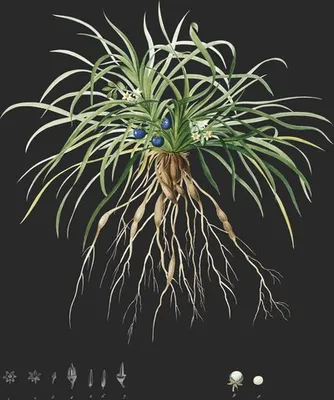
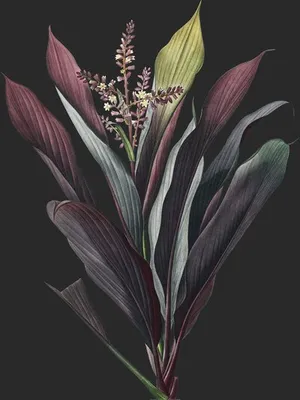
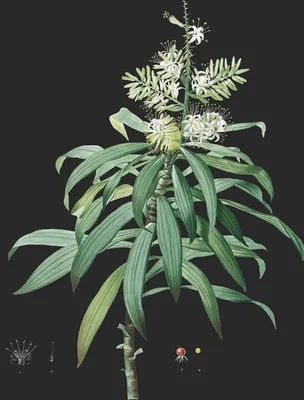
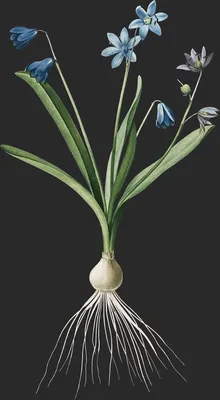
Measured on this plate: flower colour is sparing, 0.4% of the sheet against 5.7% of foliage, the cast tending yellow-green — as with pale or white blooms, outline and tone do the talking. Bulbous plants store the year underground — bulb, corm or tuber — then send up a few thick leaves and a single scape, with six tepals in cup, funnel or star. a moss green. Three things fix the habit: leaf arrangement, tepal count, and how the flower is borne.
Composition
The sheet is tall. No details are appended: a plate for looking, not for keying out. The plant covers only 12% of the sheet, centred near the centre; the emptiness is where the eye rests.
Line and Colour
The first half of the nineteenth century moved from copper to steel to lithography; stipple could render the softest transition. There is evidence on the back too: the plate mark pressed into the paper, the slight relief of the pigment, lines worn shallow in a later printing. If you mean to copy it: take its skeleton, its margins and the order of its colours; the burin's hatching is the language of copper — suggest it with pencil density, do not imitate it stroke for stroke.
Poetic Resonance
卢家少妇郁金堂,海燕双栖玳瑁梁。
—— 唐·沈佺期《古意呈補闕喬知之》
The poem gives the mood first and the picture supplies the form; set the line beside the plate and the green the corolla becomes its resting point.
Symbolism
The tulip was an imperial emblem in Istanbul and a speculative bubble in Amsterdam; the hyacinth sprang from a boy's blood in Greek myth. What bulbs share is concealment: next year kept underground. In a flora it is a species first and a symbol second; the order is worth keeping.
Season and Place
Early spring to early summer, genus by genus: tulips and hyacinths first, gladiolus and amaryllis later. South African bulbs filled European glasshouses after 1800. The year 1807 on the plate is that of publication, not of flowering — the gathering came a year or two earlier. The bud and the ripe fruit on one branch tell the season; the name in the title often tells the journey.
The Book and the Hand
“The Liliaceae” carries only Pierre-Joseph Redouté's name. The image is public domain; the hand-colouring is still one person's hand.
What to Take Away
Carry three rules away: whole before detail; line before colour; picture before book. The flower of that year is dust, yet its image on paper has outlived every living cousin.
About this plate
Observations
Cette espèce, telle que nous la présentons ici, se distingue très-facilement de toutes les autres, à la longuenr de sa grappe, à ses pédoneules à-peu-près tous égaux en longueur, étalés horizontalement pendant la fleuraison, redressés à la maturation, à ses bractées membraneuses très-pointues au sommet et élargies à la base; enfin à son périgone, dont les lobes sont ouverts, obtus, linéaires-oblongs.
Elle ressemble par son port à l’Ornithogale de Narbonne; mais celui-ci a lex fleurs blanches avec une raie verte sur le dos des segments, et notre plante a les fleurs d’un jaune-verdatre. C’est probablement à l’Ornithogale de Nar-bonne qu’appartient le Stellaris erecta de Mœnch et la figure 6, planche 13, section 4 de Morison, quoique ces deux noms soient cités par Mench comme synonymes de l’Ornithogale des Pyrénées de Linné.
Aiton, et d’après lui, plusieurs auteurs ont cru quon avait jusqu’ici confondu deux espèces sous le nom d’Ornithogale des Pyrénées; mais les caractères d’après lesquels on prétend les distinguer sont si peu importants, que, dans le plus grand nombre des cas, on ne peut déterminer & laquelle des deux espèces d’Aiton appartiennent et les échantillons recueillis dans divers pays et les figures données par les auteurs. C’est ce qui fait que je n’ai pas même osé les distinguer comme variétés.
Histoire
L’Ornithogale des Pyrénées croit dans les prés et sur les collines de presque toute l’Europe. En France, il est plus commun dans plusieurs provinces que dans les Pyrénées. ♃.
Il fleurit à la fin du printemps et à l’entrée de l’été.
Fam. des Asphodèles. Juss.—Hexandrie monogynie. Lin.
- Ornithogalam pyrenaicum. O. racemo longissimo, perigonii laciniis linearibus obtusis, bracteis membranaceis acutissimis basi dilatatis. Fl. fr. 3. p. 216. Syn. n. 1945.
- Ornithogalam pyrenaicum. O. racemo longissimo, filamentis lanceolatis, pedunculis floriferis patentibus cequalibus, fructiferis scapo approximatis. Lin. Spec. 440. syst. pl. 2. p. 54. Lam. Dict. 4. p. 613. Pers. ench. 1. p. 364. Desf. Fl. atl. 1. p. 295. Smith. Fl. brit. 1. p. 363. Gouan. illustr. p. 26. Monsp. 309.
- Ornithogalam prenaicum. Jacq. austr. t. 103.
- Ornithogalam pyrenaicum. O. racemo longissimo, petalis linearibus obtusis, filamentis lanceolatis æqualibus, stylo longitadine staminam. Ait. Kew. 1. p. 441. Huds. angl. 143. engl. bot. t. 499.
- Ornithogalum flavescens. Lam. Fl. f. 3. p. 277. illustr. t. 242. f. 2.
- Phalangiam longissime spicatum, filamentis latis lanceolatis. Hall. helv. n. 1210.
- Ornithogalum angustifoliam majos floribus ex albo virescentibus. C. Bauh. pin. 7o. Tournef. inst. 379. Moris. oxon. s. 4. t. 13. f. 5.
- Ornithogalum majus. Clus. hist. 187. ic.
- Hyacintho-asphodelus, fortè Galeni asphodelos byacinthinus et asphodelus fæmina Dodonæi. Lob. ic. 93.
- Asphodelus bulbosas Galeni. Dod. pempt. 209. ic. J. Bauh. hist. 2. p. 627. ic. Ger. hist. 97. ic.
- Ornithogalum stachyoides. O. racemo longissimo, petalis lanceolato-oblongis, filamentis latè lanceolatis alternis dimidio brevioribus. Ait. Kew. 1. p. 441.
- Stachyoides. Renealm. Spec. 93. t. 90.