Ornithogalum Trigynum
春慵花属·Ornithogalum Trigynum
Ornithogale a Trois Styles
About this plate
Description
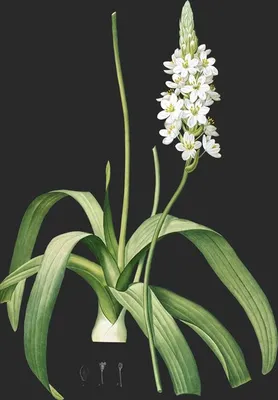
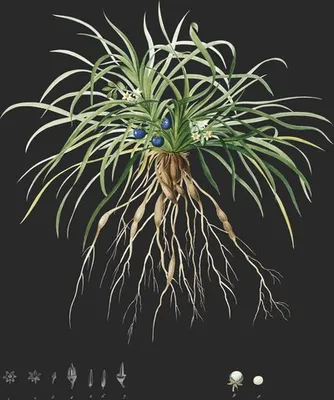
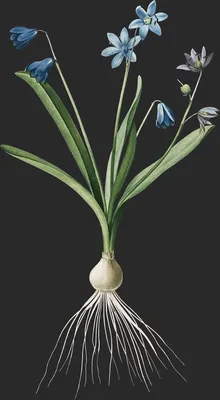
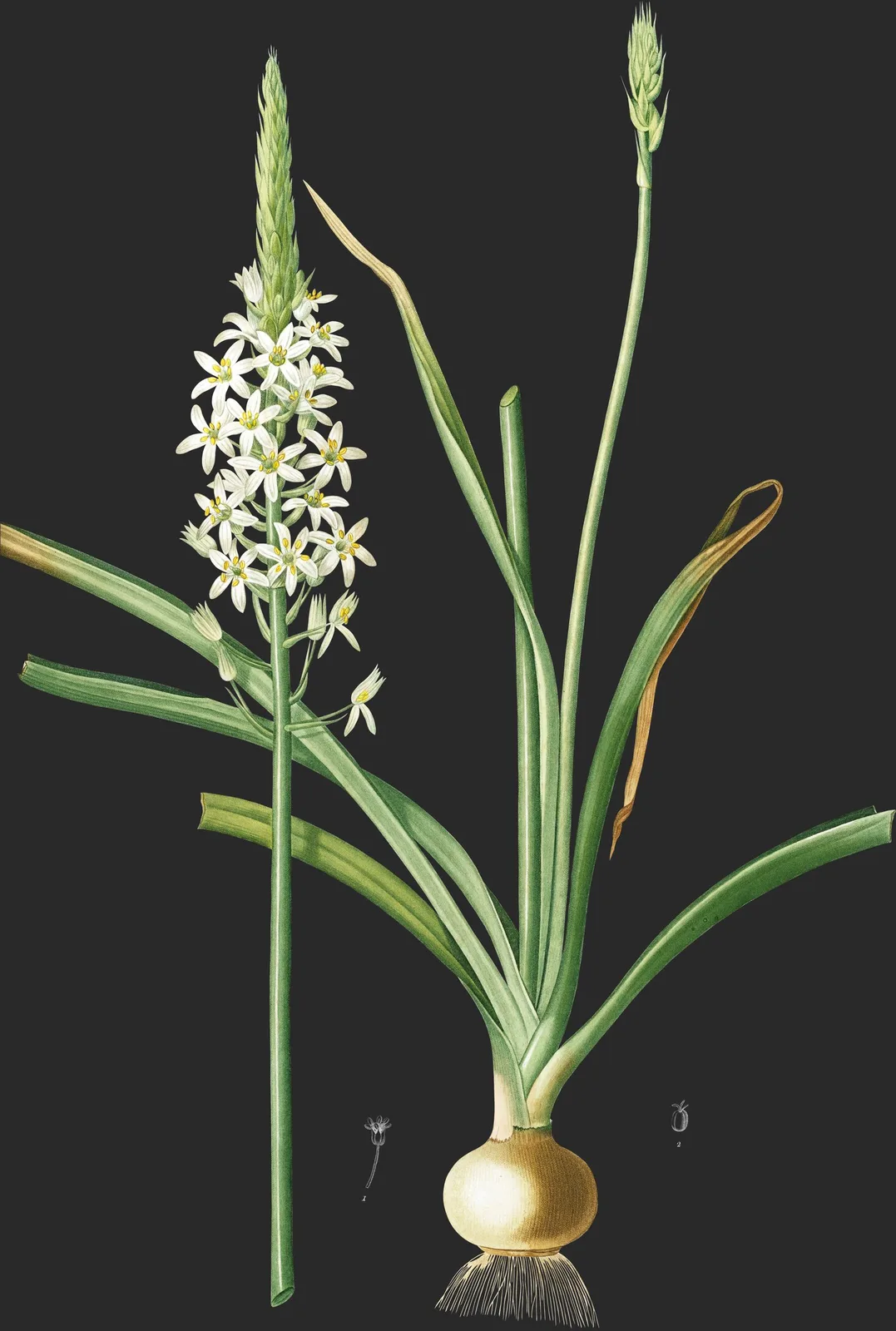
Une bulbe arrondie, légèrement déprimée, grosse comme un abricot, couverte de tuniques, d’un gris pale, émet en dessous des fibres radicales, déliées. courtes et nombreuses. De son sommet sortent des feuilles linéaires, aigues, pliées en gouttière, glabres, entières, molles, couchées sur la terre, longues de trois à cinq décimètres, larges de deux ou trois centimètres. Ces feuilles commencent deja à se faner à l’époque de la floraison.
La hampe est hante de six à huit décimètres, simple, cylindrique, lisse, glauque, dressée, grosse comme le petit doigt.
Les fleurs, qui sont fort nombreuses, forment une grappe cylindrique, très. allongée, lache dans le bas, serrée dans le haut. Leurs pédicelles sont longs d’un ou deux centimètres, plas que demi-étalés. Chacun d’eux a à sa base une bractée foliacée, lancéolée-linéaire, rétrécie en pointe, un peu plas longue que lui.
Les divisions du périgone sont oblongues, obtuses, rétrécies à la base, un peu pliées en gouttière, blanchâtres en dessus, d’un vert pale en dessous, excepté sur les bords, qui sont blanchatres. Les trois extérieures portent en dedans, vers leur sommet, une petite pointe velue. Les trois intérieures sont un peu plus petites, proportionnellement plus étroites, et striées longitudinalement sur leur face supérieure.
Les étamines sont de moitié plus courtes que le périgone. Leurs filaments sont blancs, dilatés dans le bas, rétrécis dans le haut en une pointe simple. Ceux qui sont opposés aux divisions extérieures du calice sont un peu plus étroits que les autres. Les anthères sont ovales, blanchâtres, insérées par le milieu, échancrées à la base, qui, après l’épanouissement de la fleur, se dirige vers le haut.
L’ovaire est libre, ovale, un peu triangulaire, d’un vert pale, luisant. Il supporte trois styles filiformes, blanchâtres, plus courts que les étamines, parfai tement distincts josqu’à leur origine, et terminés par des stigmates simples.
Histoire
Nous ignorons quelle est la patrie de l’Ornithogale à trois styles. On le cultive dans les couches du Jardin du Muséum d’Histoire naturelle. Ses fleurs, qui s’épanouissent au mois de juin, sont inodores.
Observations
Cet Ornithogale se rapproche beaucoup, par le port, de l’Ornithogale des Pyrénées; mais il en est bien distinet, soit par les trois styles qui surmontent son ovaire, soit par la largeur plus grande des divisions da périgone et leur couleur plus blanche. Le caractère singulier d’avoir trois styles, caractère que nous avons observé sur un grand nombre de pieds, sullirait pour qu’on séparat cette plante des autres Ornithogales, si la ressemblance de port ne forcait pas de l’y réunir.
Explication de la planche
La Plante entière de grandeur naturelle.
- Une fleur dont le périgone a été enlevé.
- L’ovaire et les styles grossis.
Fam. des Asphodèles. Juss.—Hexandrie trigynie. Lin.
- Ornithogalum trigynum. O. foliis linearibus, racemo cylindrico elongato, floribus trigynis.
Twelve ways of seeing
- measured cast amber
- upright 1.49 : 1
- published 1812
- Plate 417
Not a catalogue entry but a way of looking: how to stand, what to notice, how the line was cut, when it flowers, where it came from, who made it — and then the poems and the classics that taught China to see the same flower. Read the twelve in order and the plate opens.
-
First Look
竖划三寸,当千仞之高;横墨数尺,体百里之迥。
—— 南朝宋·宗炳《画山水序》
A vertical stroke of three inches stands for a cliff of a thousand fathoms; a few feet of ink holds a hundred li.
The sheet is vertical: the eye climbs and settles in the upper half. Let the plant stand before you look for detail. Then step in close: watch where colour meets line, and whether the line ever breaks. Third, find where the green is deepest: the whole tonal order is measured from that patch. The pose leans left: the upper half carries 11 points further left than the lower — a living thing, not a diagram.
-
Name and Thing
The binomial is Ornithogalum trigynum: the first word is the genus it belongs among, the second the epithet that sets it apart. Two words carry a whole provenance. The older system filed it under Asparagaceæ by overall affinity; Linnaeus, counting stamens only, placed it in Hexandria — two ways of asking what a plant is. No established Chinese name exists, so it is cited by its binomial alone.
-
Form and Colour
Measured on this plate: flower colour covers 2.3% of the sheet, foliage 9.8%, the cast amber with a second note of yellow-green. No other plate shares exactly this measure. Bulbous plants store the year underground — bulb, corm or tuber — then send up a few thick leaves and a single scape, with six tepals in cup, funnel or star. Filed under green — a moss green, a colour that comes mostly from leaf and stem. A single plant, laid out with nothing hidden.
-
Composition
Tall and narrow, the plant rising in one movement with generous margins — the upright format of most floras. (about 1.49 : 1) No details are appended: a plate for looking, not for keying out. The plant covers only 17% of the sheet, centred near the centre; the emptiness is where the eye rests. Old plates set the plant slightly off centre, with unequal margins — that small imbalance is what keeps it alive.
-
Line and Colour
The first half of the nineteenth century moved from copper to steel to lithography; stipple could render the softest transition. Decide first whether it was printed or painted; only then discuss whether it is beautiful.
-
Season
Early spring to early summer, genus by genus: tulips and hyacinths first, gladiolus and amaryllis later. The year 1812 on the plate is that of publication, not of flowering — the gathering came a year or two earlier. The plate records ten days of peak; the other three hundred are leaf, fruit and rest.
-
Provenance
Three homelands: the Mediterranean, Central Asia and South Africa. The tulip came from Ottoman gardens and became a Dutch mania; South African bulbs filled European glasshouses after 1800. The localities on the plate are those of a century ago; plants travel and places change their names.
-
The Book and the Hand
“The Liliaceae” was drawn by Pierre-Joseph Redouté and published 1802-1816. This plate is Plate 417, book page 417. The image is public domain; the hand-colouring is still one person's hand.
-
Poetic Resonance
郁金香是兰陵酒,枉入诗人赋咏来。
—— 宋·王安石《答熊本推官金陵寄酒》
The poem gives the mood first and the picture supplies the form; set the line beside the plate and the green the corolla becomes its resting point.
-
The Written Tradition
庭下如积水空明,水中藻荇交横,盖竹柏影也。
—— 宋·苏轼《记承天寺夜游》
The courtyard seemed flooded with clear water, weeds crossing in it — in fact the shadows of bamboo and cypress.
Li Bai's 'orchid wine, fragrant with yujin' is often misread as tulips; the Tang yujin was a turmeric-like root used to scent wine — same name, different plant. The difference is not of quality but of question: Europe asks what it is, China asks whom it resembles.
-
Symbolism
The tulip was an imperial emblem in Istanbul and a speculative bubble in Amsterdam; the hyacinth sprang from a boy's blood in Greek myth. What bulbs share is concealment: next year kept underground. Flower language was added later; the flower knows nothing of it, and that innocence is part of its power.
-
What to Take Away
Carry three rules away: whole before detail; line before colour; picture before book. Two centuries on, the plant may still flower in some garden; the one on this sheet stopped in the season of 1812.