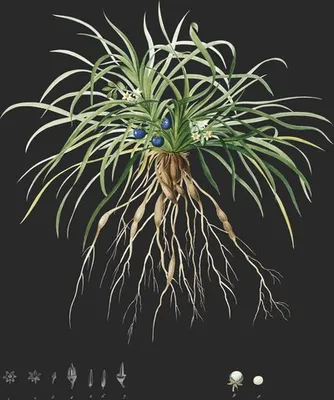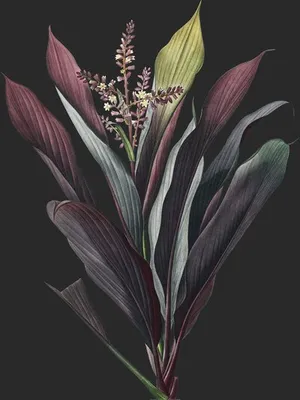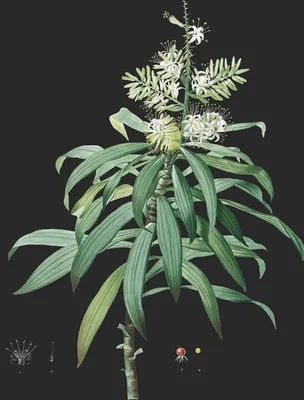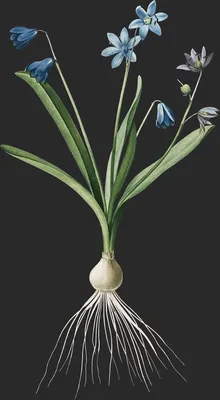
Paris Quadrifolia
Parisette a Quatre Feuilles
About this plate
Description
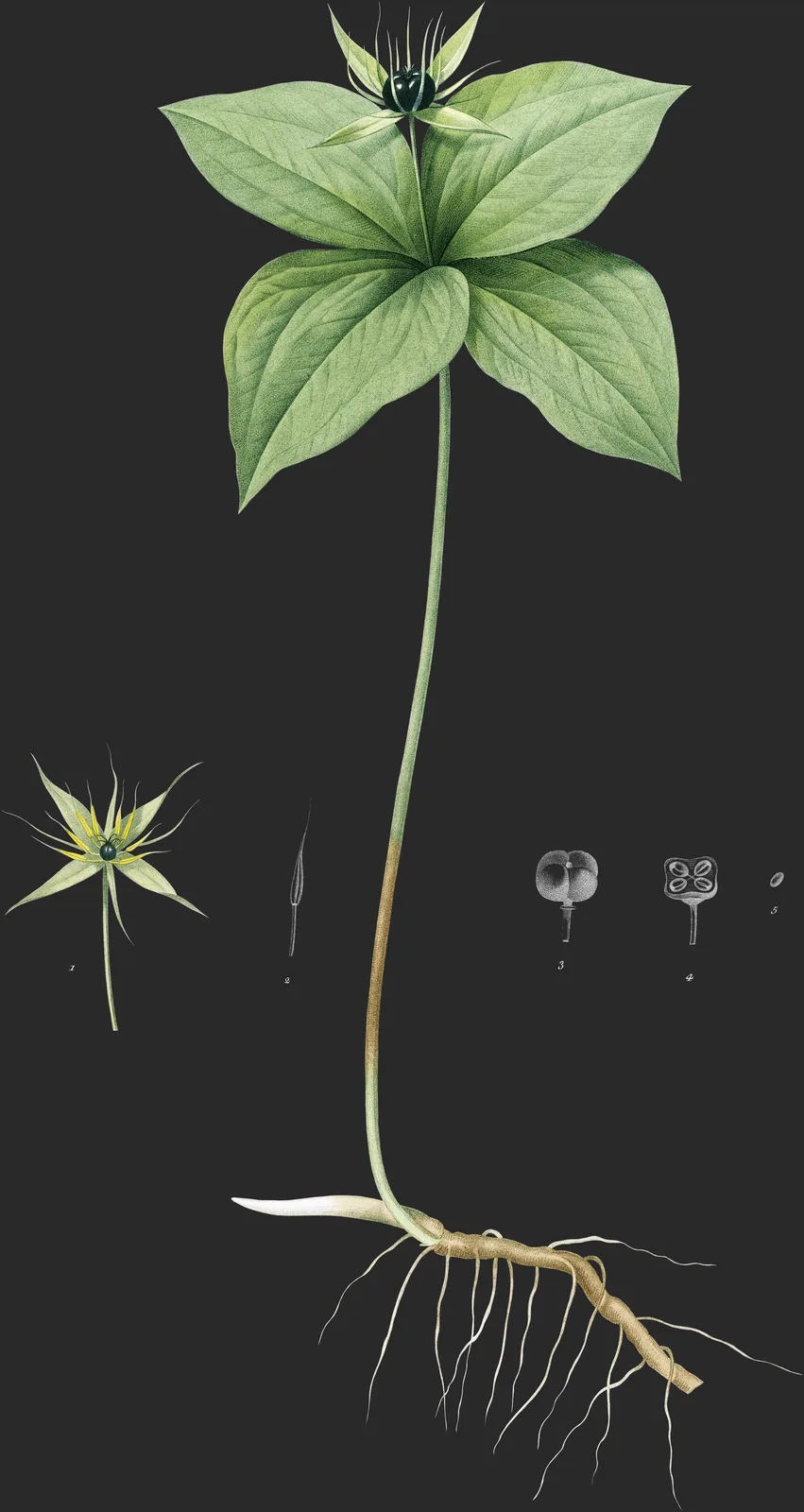
Une racine cylindrique, traçante, donne naissance à une tige simple, grèle, cylindrique, droite ou légèrement flexueuse, et haute d’un ou deux décimètres. Celleci, dont la base est entourée par une ou deus gaines foliacées, est nue dans tout le reste de sa longueur, mais supporte à son sommet quatre feuilles verticillées, étalées, ovales, rétrécies au sommet en une petite pointe, glabres, parfaitement entières, longues de sept à dix centimètres, larges de cing à sept. Du milieu de ces feuilles sort un pédoncule beaucoup plus grêle que la tige, long de trois i six centimètres, et surmonté par une fleur solitaire assez grande, verdatre et inodore.
Le périgone est divisé, jusqu’à sa base, en huit segments foliacés, étalés et disposés sur deux plans. Les quatre extériens sont lancéoles, rétrécis en pointe au sommet, longs de deux à trois centimètres environ. Les quatre intérieurs, que l’on a considérés comme la corolle, quoiqu’ils soient de la même couleur que les précédentes, sont un peu plus courts, et larges de deux millimètres au plus. Les uns et les autres sont persistants, et continuent à se développer après la floraison.
Les filaments des étamines, au nombre de huit, sont en forme d’alene, presque aussi longs que les segments intérieurs du périgone; ils sont nus à leur base et à leur sommet, mais leur partie moyenne est renfermée entre les deux loges desanthères qui sont oblongues, et leur adhèrent dans toute leur longueur.
Lovaire, noir et arrondi, supporte quatre stigmates filiformes recourbés en dehors; il se tranforme en une baie de la même couleur, tétragone et à quatre loges, dont chacune renferme six ou huit graines disposées sur deux rangs.
Histoire
La Parisette à quatre feuilles, connue vulgairement sous le nom de raisin de renard, est assez commune dans les bois ombragés et humides de presque toute l’Europe et de la Sibérie. Son fruit passe pour vénéneux. Le suc de la plante est narcotique. On a vanté la racine comme un émétique propre à remplacer lipécacuanha.
Observations
La Parisette a le plus grand rapport avec les Trilliums, dont elle ne diffère que par son périgone non-coloré, par ses étamines, dont les filaments ne dépassent pas les anthères, et par le nombre des parties qui est quaternaire chez elle, tandis quil est ternaire dans les Trilliums. Ce dernier caractère, qui a servi à séparer les deux genres, est d’autant moins important, qu’il est peu constant. Lion trouve en effet des variétés de la Parisette dans lesquelles le nombre des parties est porté à cinq, ou réduit à trois.
Explication de la planche
La Plante entière de grandeur naturelle.
- Une fleur.
- Une étamine.
- La capsule.
- La même, coupée en travers.
- Une graine.
Fam. des Asperges. Juss.—Octandrie tétragynie. Lin.
- Paris quadrifolia. P. foliis quaternis. Mort. Cliff. 153. Roy. Lugd-b. 461. Fl. lap. 155. Fl. succ. 325. 346. Lin. Spec. pl. 526. FI. dan. t. 139. Kniph. cent. 12. n. 73. Gmel. Sib. 4. p. 176. Scop. Carn. éd. 2. n. 472. Poll. Palat. n. 389. Bull. herb. 119. Lam. ill. tab. 319. Dict. sol. 5. p. 19. Smith. Fl. brit. 1. p. 431. Pers. ench. 1. p. 456. Fl. fr. éd. 3. n. 1857.
- Paris. Hall. helv. 1006.
- Solano congener non ramosum tetraphyllum. Moris. hist. 3. p. 532. sect. 16. t. 3. f. 6.
- Solanum quadrifoliam baceiferum. Bauh. pin. 167.
- Aconitam salutiferam. Tabern. list. 720.
- Solanum tetraphyllum. Lob. ic. p. 267.
- Herba Paris. Math. Diosc. 767. Camer. épit. p. 835. Dod. pempt. 444. J. Bauh. hist. 3. p. 613. Raji, hist. 670. Tourn. instit. 233. Garid. p. 227. ic. 49.
- Aconitum pardalianches. Fuchs. hist. 86. 87.
Twelve ways of seeing
- measured cast amber
- upright 1.88 : 1
- published 1807
- Plate 226
Not a catalogue entry but a way of looking: how to stand, what to notice, how the line was cut, when it flowers, where it came from, who made it — and then the poems and the classics that taught China to see the same flower. Read the twelve in order and the plate opens.
-
First Look
论画以形似,见与儿童邻。
—— 宋·苏轼《书鄢陵王主簿所画折枝》
To judge painting by likeness alone is the view of a child.
The sheet is vertical: the eye climbs and settles in the upper half. Let the plant stand before you look for detail. Then step in close: watch where colour meets line, and whether the line ever breaks. Third, find where the green is deepest: the whole tonal order is measured from that patch.
-
Name and Thing
The binomial is Paris quadrifolia: the first word is the genus it belongs among, the second the epithet that sets it apart. Two words carry a whole provenance. The older system filed it under Asparagaceæ by overall affinity; Linnaeus, counting stamens only, placed it in Octandria — two ways of asking what a plant is. No established Chinese name exists, so it is cited by its binomial alone.
-
Form and Colour
Measured on this plate: flower colour is sparing, 1.0% of the sheet against 11.4% of foliage, the cast tending amber — as with pale or white blooms, outline and tone do the talking. A bulb of overlapping fleshy scales gives the lily its Chinese name, 'hundred-fold'; six tepals reflex as the flower opens, around six stamens with long, T-shaped anthers. Filed under green — a moss green, a colour that comes mostly from leaf and stem. Read the outline, then the colour layers, then the brush.
-
Composition
Tall and narrow, the plant rising in one movement with generous margins — the upright format of most floras. (about 1.88 : 1) No details are appended: a plate for looking, not for keying out. The plant covers only 15% of the sheet, centred above centre; the emptiness is where the eye rests. Blank paper is not unfinished work: it is where the eye rests.
-
Line and Colour
The first half of the nineteenth century moved from copper to steel to lithography; stipple could render the softest transition. Take a loupe to three places: petal edge, leaf vein, caption. An unbroken line means engraving; colour crossing the outline means a hand.
-
Season
Early to high summer, June and July; the flowers last only days, so artists drew them just as they opened. The year 1807 on the plate is that of publication, not of flowering — the gathering came a year or two earlier. Note the season. Phenology is the most practical tool of appreciation.
-
Provenance
Temperate north — China, Japan, Europe. Long used in Chinese medicine, lilies were hunted in East Asia by nineteenth-century collectors and transformed European gardens. The volume was made in 1802-1816, when most of this knowledge came from living plants under glass.
-
The Book and the Hand
“The Liliaceae” was drawn by Pierre-Joseph Redouté and published 1802-1816. This plate is Plate 226, book page 226. The image is public domain; the hand-colouring is still one person's hand.
-
Poetic Resonance
木末芙蓉花,山中发红萼。涧户寂无人,纷纷开且落。
—— 唐·王维《辛夷坞》
Lotus blossoms at the branch tips put forth red calyces in the hills. By the silent ravine, they open and fall, open and fall.
The poem gives the mood first and the picture supplies the form; set the line beside the plate and the green the corolla becomes its resting point.
-
The Written Tradition
论画以形似,见与儿童邻。
—— 宋·苏轼《书鄢陵王主簿所画折枝》
To judge a painting by likeness alone is the view of a child.
The Bencao Gangmu describes the bulb as garlic-like, edible and medicinal; Song writers already noted that the leaves vary while the flowers stay white. The difference is not of quality but of question: Europe asks what it is, China asks whom it resembles.
-
Symbolism
In the West the white lily is Marian purity, held by the angel of the Annunciation; in China the name sounds like 'a hundred years in harmony', a wedding wish. In a flora it is a species first and a symbol second; the order is worth keeping.
-
What to Take Away
Next time you stand before a flowering plant, give it three minutes: leaf arrangement, direction of the flower, the darkest patch. The flower of that year is dust, yet its image on paper has outlived every living cousin.