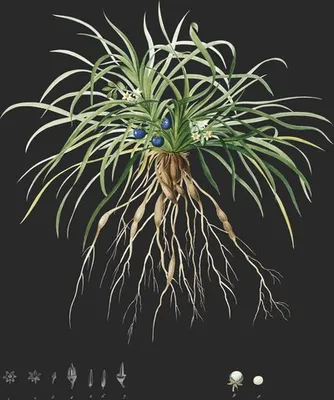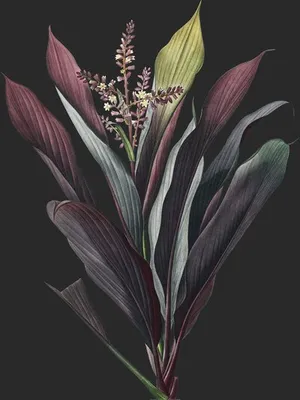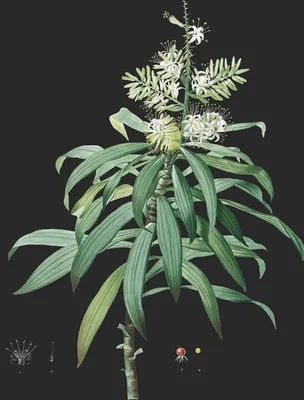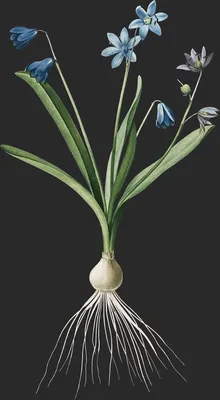
Sanseviera Guineensis
虎尾兰属
Sanseviera de Guinée
Ten ways of seeing
- measured cast yellow-green
- upright 1.46 : 1
First Look
凡画山水,意在笔先。
—— 唐·王维《山水论》
In painting, the intention precedes the brush.
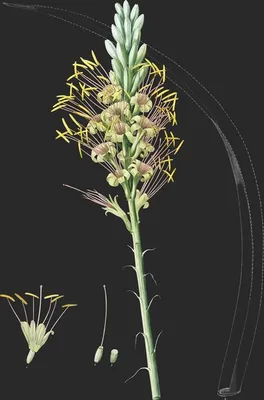
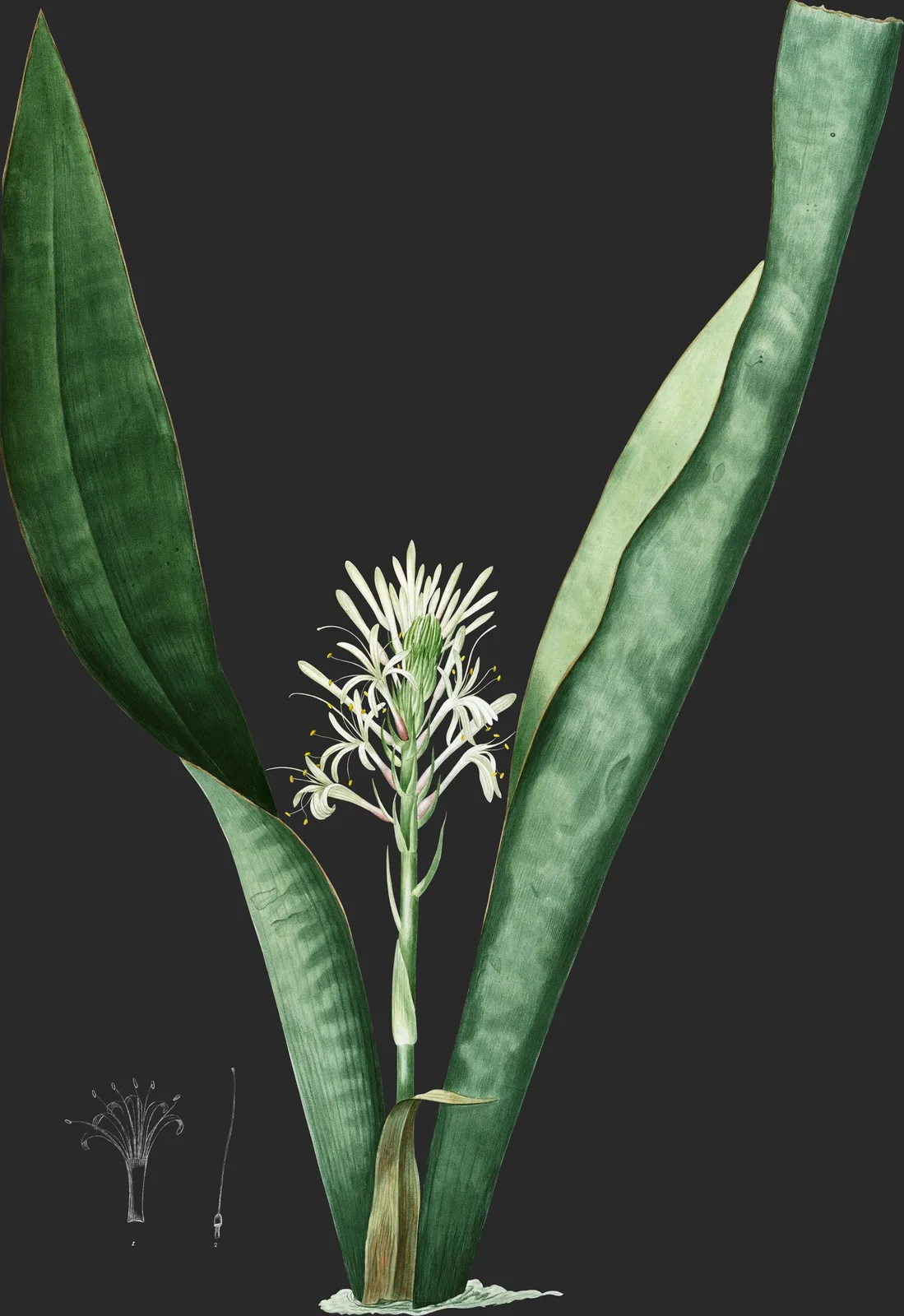
The sheet is vertical: the eye climbs and settles in the upper half. Let the plant stand before you look for detail. Then step in close: watch where colour meets line, and whether the line ever breaks. Third, find where the green is deepest: the whole tonal order is measured from that patch. The pose leans right: the upper half carries 16 points further right than the lower — a living thing, not a diagram.
Name and Thing
The binomial is Sanseviera guineensis: the first word is the genus it belongs among, the second the epithet that sets it apart. Two words carry a whole provenance. The older system filed it under Asparagaceæ by overall affinity; Linnaeus, counting stamens only, placed it in Hexandria — two ways of asking what a plant is. The Chinese name 虎尾兰属 is a modern rendering of the Latin, not an old garden name.
Form and Colour
Measured on this plate: flower colour is sparing, 0.6% of the sheet against 10.4% of foliage, the cast tending yellow-green — as with pale or white blooms, outline and tone do the talking. A bulb of overlapping fleshy scales gives the lily its Chinese name, 'hundred-fold'; six tepals reflex as the flower opens, around six stamens with long, T-shaped anthers. a moss green. Read the outline, then the colour layers, then the brush.
Composition
The sheet is tall. No details are appended: a plate for looking, not for keying out. The plant covers only 18% of the sheet, centred a little right of centre; the emptiness is where the eye rests.
Line and Colour
The first half of the nineteenth century moved from copper to steel to lithography; stipple could render the softest transition. Take a loupe to three places: petal edge, leaf vein, caption. An unbroken line means engraving; colour crossing the outline means a hand. If you mean to copy it: take its skeleton, its margins and the order of its colours; the burin's hatching is the language of copper — suggest it with pencil density, do not imitate it stroke for stroke.
Poetic Resonance
故乡寒食荼醾发,百合香浓邸舍深。
—— 宋·宋祁《山橙花》
The poem gives the mood first and the picture supplies the form; set the line beside the plate and the green the corolla becomes its resting point.
Symbolism
In the West the white lily is Marian purity, held by the angel of the Annunciation; in China the name sounds like 'a hundred years in harmony', a wedding wish. Meanings change their tune: the same flower can say opposite things within a century.
Season and Place
the flowers last only days, so artists drew them just as they opened. Temperate north — China, Japan, Europe. Long used in Chinese medicine, lilies were hunted in East Asia by nineteenth-century collectors and transformed European gardens. The year 1811 on the plate is that of publication, not of flowering — the gathering came a year or two earlier. Read the locality and the flowering season both with a discount: one is hearsay, the other a ten-day peak.
The Book and the Hand
“The Liliaceae” carries only Pierre-Joseph Redouté's name. From drawing to plate the sheet passed through several hands — the engraver aimed at accuracy, the colourist at speed, and between them lies each plate's unevenness.
What to Take Away
If you keep one line, keep Guo Xi's: from afar its momentum, up close its texture. A flora exists to be consulted; look long enough and you forget to consult — someone in 1811 gave a whole day to a single flower.
About this plate
Description
Une souche souterraine, demi-ligneuse, divisée en rameaux horizontaux, brunâtres et de la grosseur du pouce, émet en dessous des fibres radicales, gréles et nombreuses. De sa partie supérieure sortent deux ou trois feuilles per-sistantes, lancéolées, droites, roides, légèrement charnues dans le bas, qui est courbé en gouttière, planes dans le haut, aigués, hautes de six a dix décimètres, larges de sept à dix centimètres, glabres, d’un vert très-foncé avec des bandes transversales, irrégulières, plus claires.
Entre ces feuilles s’élève une hampe droite, cylindrique, verte, haute de deux à quatre décimètres, grosse comme le petit doigt, chargée, dans toute sa longueur, de bractées ou folioles membraneuses, embrassantes, ovales-lancéolées.
Les fleurs forment une grappe terminale assez serrée, plus ou moins longue. Elles sont nombreuses, réunies deux à deux, et portées sur des pédicelles un peu redressés, longs de deux ou trois millimètres. A la base de chaque groupe, est une bractée linéaire-lancéolée, aigué, concave, verte dans le milicu, blanchâtre sur les bords, deux ou trois fois plus longue que les pédicelles.
Le périgone est en forme de tube dans le bas, et à six divisions étalées dans le haut. Le tube est gréle, blanchätre, long de trois centimètres, un peu renflé à sa base. Les divisions du limbe sont linéaires, étroites, blanches, molles, longues de vingt à vingt-cing millimètres.
Les étamines sont insérées à l’entrée du tube. Leurs filaments sont en forme de soies, déjetés vers le côté inférieur de la fleur, égaux en longueur aux divisions du périgone. Les anthères sont de couleur citron, oblongues, vacillantes, à deux loges qui s’ouvrent en dedans.
L’ovaire est libre, vert, ovale, à six sillons peu profonds. Le style est filiforme et dépasse les étamines de deux centimètres. Il se fléchit à la sortie du tube du périgone, et prend dans toute sa partie libre une direction horizontale. Le stigmate, qui s’en distingue à peine, est petit, et à deux lobes.
Le fruit est, suivant Jacquin, une baie molle, jaune, arrondie, succulente, renfermant une seule semence molle et déprimée.
Histoire
Cette plante est, dit-on, originaire de Guinée. Elle a été introduite, depuis près d’un siècle, dans les jardins d’Europe, mais y fleurit rarement. Elle demande à étre abritée dans la serre chaude, et fleurit au printemps.
Explication de la planche
La Plante entière de grandeur naturelle.
- Une fleur fendue latéralement et étalée.
- L’ovaire et le style.
Fam. des Asperges. Juss.—Hexandrie monogynie. Lin.
- Sanseviera Guineensis. S. foliis lanceolatis planiusculis paucis scapo altioribus, floribus conjugatis, bracteis pedicellos multùm superantibus, stylo staminibus duplò longiore.
- Sanseviera Guineensis. S. foliis lanceolatis uniformibus, stylo staminibus duplò longiore, bracteis tubo corollæ triplò brevioribus, floribus sessilibus. Willd. sp. pl. 3. p. 159? Hort. Berol. 1. p. 375? Pers. enchir. 1. p. 372.
- Sanseviera thyrsiflora. S. acaulis foliis canaliculatis carnosis, floribus geminatis. Thunb. prodr. 651.
- Aletris Guineensis. Jacq. hort. Vindeb. t. 84. Lam. dict. 1. p. 79.
- Aletris hyacinthoides var. Guineensis. Lin. sp. pl. 456.
- Aloe Guineensis, radice geniculata, foliis è viridi et atro undulatim variegatis. Commel. hort. 2. p. 39. t. 11. Præl. 84. t. 33.