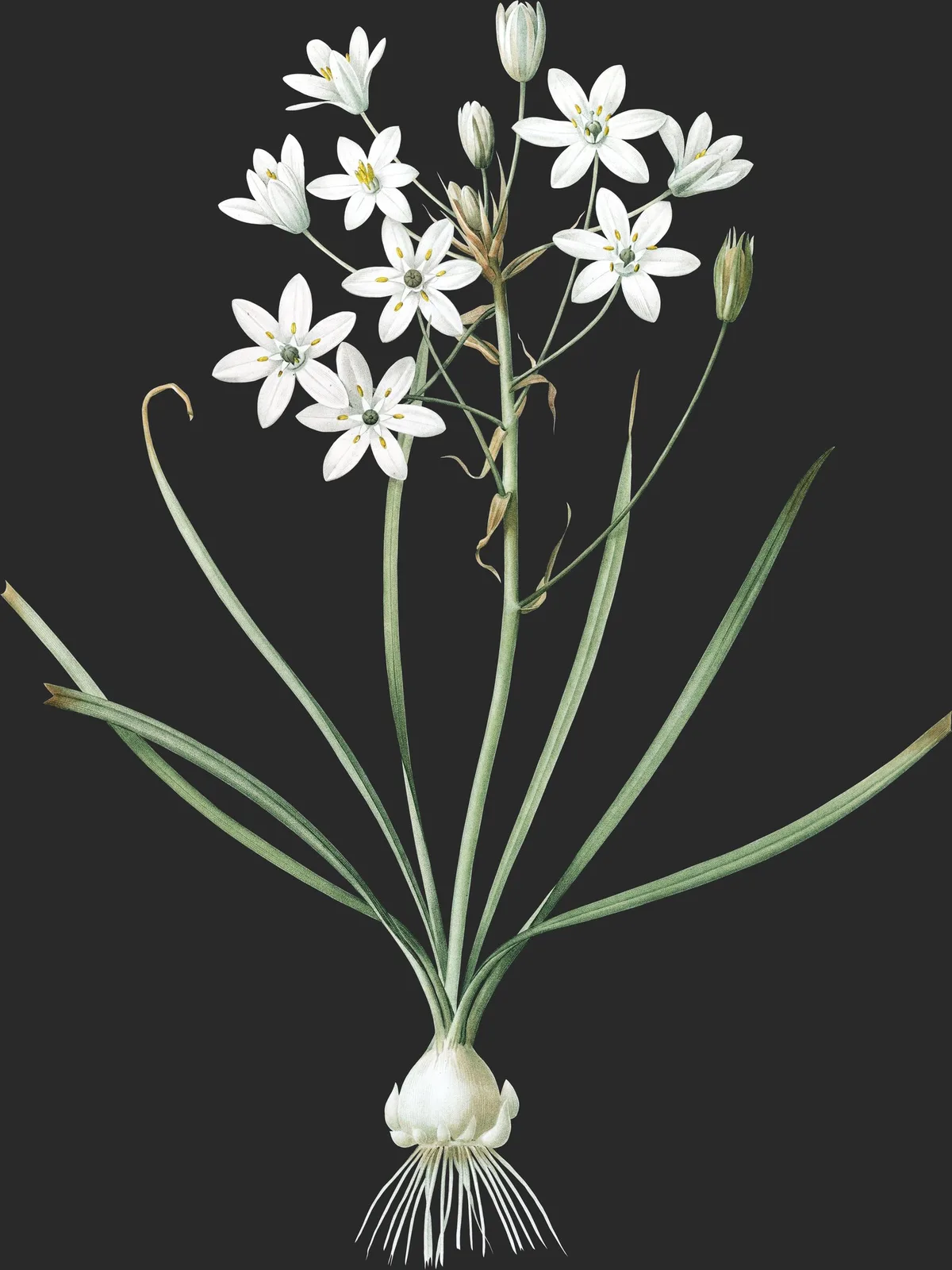
Ornithogalum Umbellatum
伞花虎眼万年青
Ornithogale en Ombelle
Ten ways of seeing
- measured cast yellow-green
- upright 1.33 : 1
First Look
凡画山水,意在笔先。
—— 唐·王维《山水论》
In painting, the intention precedes the brush.
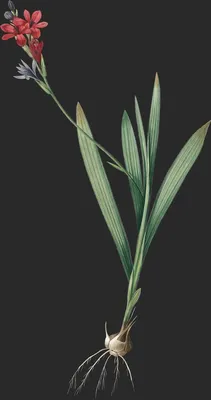
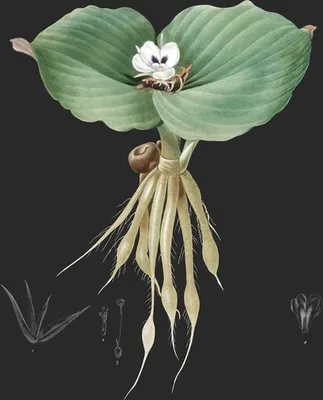
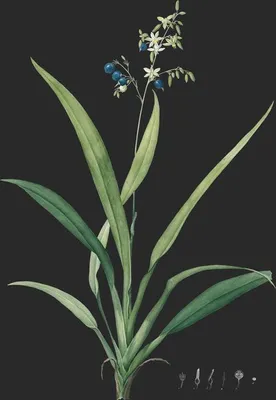
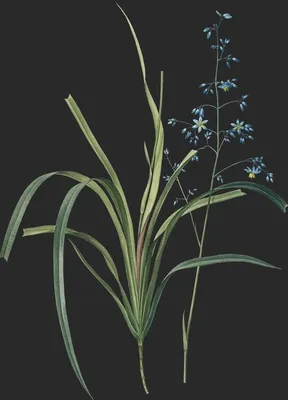
The sheet is vertical: the eye climbs and settles in the upper half. Let the plant stand before you look for detail. Then step in close: watch where colour meets line, and whether the line ever breaks. Third, find where the green is deepest: the whole tonal order is measured from that patch.
Name and Thing
The binomial is Ornithogalum umbellatum: the first word is the genus it belongs among, the second the epithet that sets it apart. Two words carry a whole provenance. The older system filed it under Asparagaceæ by overall affinity; Linnaeus, counting stamens only, placed it in Hexandria — two ways of asking what a plant is. The Chinese name 伞花虎眼万年青 is a modern rendering of the Latin, not an old garden name.
Form and Colour
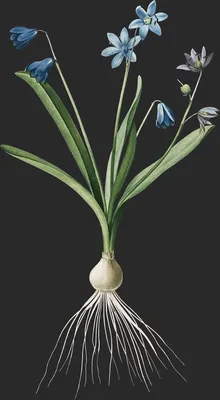
Measured on this plate: flower colour is sparing, 0.8% of the sheet against 2.4% of foliage, the cast tending yellow-green — as with pale or white blooms, outline and tone do the talking. Bulbous plants store the year underground — bulb, corm or tuber — then send up a few thick leaves and a single scape, with six tepals in cup, funnel or star. a moss green. A single plant, laid out with nothing hidden.
Composition
The sheet is tall. No details are appended: a plate for looking, not for keying out. The plant covers only 15% of the sheet, centred above centre; the emptiness is where the eye rests.
Line and Colour
The first half of the nineteenth century moved from copper to steel to lithography; stipple could render the softest transition. There is evidence on the back too: the plate mark pressed into the paper, the slight relief of the pigment, lines worn shallow in a later printing. If you mean to copy it: take its skeleton, its margins and the order of its colours; the burin's hatching is the language of copper — suggest it with pencil density, do not imitate it stroke for stroke.
Poetic Resonance
东风夜放花千树,更吹落、星如雨。
—— 宋·辛弃疾《青玉案·元夕》
East wind at night sets a thousand trees of flowers alight, then blows them down like rain of stars.
The poem gives the mood first and the picture supplies the form; set the line beside the plate and the green the corolla becomes its resting point.
Symbolism
The tulip was an imperial emblem in Istanbul and a speculative bubble in Amsterdam; the hyacinth sprang from a boy's blood in Greek myth. What bulbs share is concealment: next year kept underground. Flower language was added later; the flower knows nothing of it, and that innocence is part of its power.
Season and Place
Early spring to early summer, genus by genus: tulips and hyacinths first, gladiolus and amaryllis later. South African bulbs filled European glasshouses after 1800. The year 1805 on the plate is that of publication, not of flowering — the gathering came a year or two earlier. Read the locality and the flowering season both with a discount: one is hearsay, the other a ten-day peak.
The Book and the Hand
“The Liliaceae” carries only Pierre-Joseph Redouté's name. From drawing to plate the sheet passed through several hands — the engraver aimed at accuracy, the colourist at speed, and between them lies each plate's unevenness.
What to Take Away
Appreciation is not knowledge but habit — one more look each time. The flower of that year is dust, yet its image on paper has outlived every living cousin.
About this plate
Description
Une bulbe ovoïde, solide, blanche, garnie de cayeux nombreux autour de sa base, et placée profondément en terre, donne naissance à plusieurs feuilles étroites, entières, courbées en canal, convexes en dehors, peu pointues, droites à leur base, étalées dans leur partie supérieure: d’entre ces feuilles s’élève une hampe longue de a décimètres, droite, terminée par un petit nombre de fleurs blanches; ces fleurs sont portées sur des pédoncules, dont les inférieurs sont fort longs, de sorte qu’elles paraissent disposées en corymbe lâche, ou en fausse ombelle, quoiqu’elles soient réellement disposées en grappe, comme dans presque toutes les liliacées; à la base de chaque pédicelle est une bractée longue, étroite, membraneuse et blanchâtre.
La corolle est à six parties profondes, de forme oblongue, pointues au sommet, d’un blane de lait en dedans, marquées en dehors d’une large bande verte; devant chaque lanière de la corolle est une étamine dont le filet est blanc, comprimé, pointu; les trois filets placés devant les lanières extérieures sont plus larges que les autres. L’ovaire est d’un jaune verdâtre, surmonté d’un style et de 3 stigmates; la capsule est à six angles, à trois loges, à trois valves, chargées chacune d’une cloison sur leur face interne.
Histoire
Cette plante croit dans les champs et les lieux cultivés; on la trouve dans toute l’Europe tempérée et méridionale, et dans le nord de l’Afrique. ♃.
Elle fleurit à la fin du printemps et au commencement de l’été; sa fleur s’épanouit à peu près à onze heures du matin; se referme à trois heures de l’après midi, et exécute ces mouvements plusieurs jours de suite. La ponctualité de sa fleuraison a fait donner à cette plante le nom vulgaire de Dame d’onze heures: malgré cette régularité singulière, j’ai eu occasion d’observer que, si on laisse un pied de cet ornithogale enlevé de terre et trempé dans l’eau par sa base, pendant quelques heures alternativement, au soleil et à l’obscurité totale, sa fleur s’ouvre constamment au soleil, et se ferme à l’obscurité. Comment done, dans l’état naturel des choses, cette même plante demeure-t-elle depuis le matin jusqu’à onze heures sans s’épanouir?
Les bulbes de cet ornithogale sont douces, et peuvent servir d’aliment dans les temps de disette; on peut, comme les châtaignes, les torrélier, les faire cuire à l’eau, ou sous la cendre. M. Poiret atteste s’être servi de cet aliment avec utilité.
Fam. des Asphodèles. Juss.—Hexandrie monogynie. Lin.
- Ornithogalum umbellatum. O. floribus corymbosis, pedunculis scapo altioribus, Glamentis basi dilatatis. Lin. syst. veg. 328. Poll. pal. n. 333. Hoffm. germ. 119. Roth. germ. I. 151. II. 395. Dosf. ail. 1. p. 296. Lam. Dict. 4. p. 615.
- Ornithogalum umbellatum. O. floribus corymbosis, pedunculis scapo altioribus, filamentis emarginatis. Lin. Spec. 441. Hort. Cliff. 124. Hort. Ups. 84. Roy. Lugd. 22. Gron. Orient. 111. Scop. carn. n. 403. Mill. Dict. n. 7.
- Ornithogalum umbellatum. O, corymbo paucilloro, pedunculis bracteis longioribus, filamentis subulatis. Ait. Kew. 1. p. 440. Willd. Spec. 2. p. 116.
- Ornithogalum umbellatum. Jacq. austr. 4. p. 22. t. 343. Lam. Fl. fr. ed. 1. n. 862, VIII. ed. 3. n. 1948.
- Ornithogalum stipulis maximis, petiolis lateralibus longissimis. Hall. Helv. n. 1215.
- Ornithogalum umbellatum medium angustifolium. C. Bauh. pin. 70.
- Ornithogalum vulgare, et verius majus et minus. J. Bauh. hist. 2. p. 630. ic. Swert. flor. 1. 57. f. 4.
- Ornithogalon. Lab. ic. t. 148.
- Ornithogalum Dodontæi, seu bulbus leucanthemus. Dalech. hist. 1582. ic.
- Bulbus leucanthemus minor, seu ornithogalum. Dod. pempt. 221. ic.
- Eliocarmos. Ren. Spec. 88. t. 87.