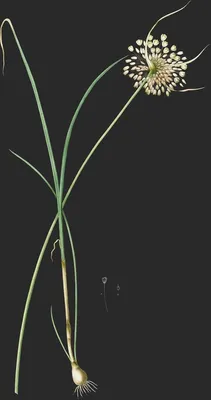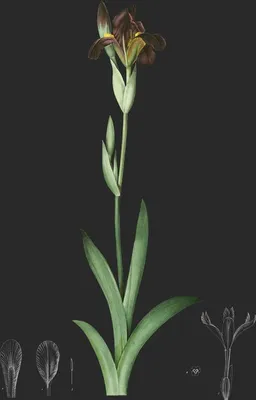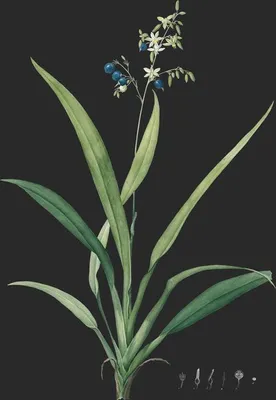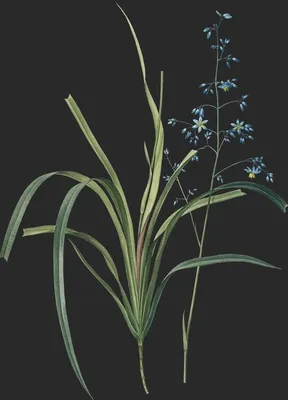
Scilla Autumnalis
Scille d’Automne
Scille d’Automne
About this plate
Description
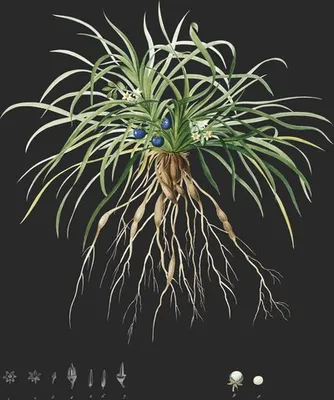
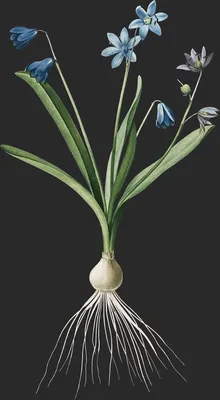
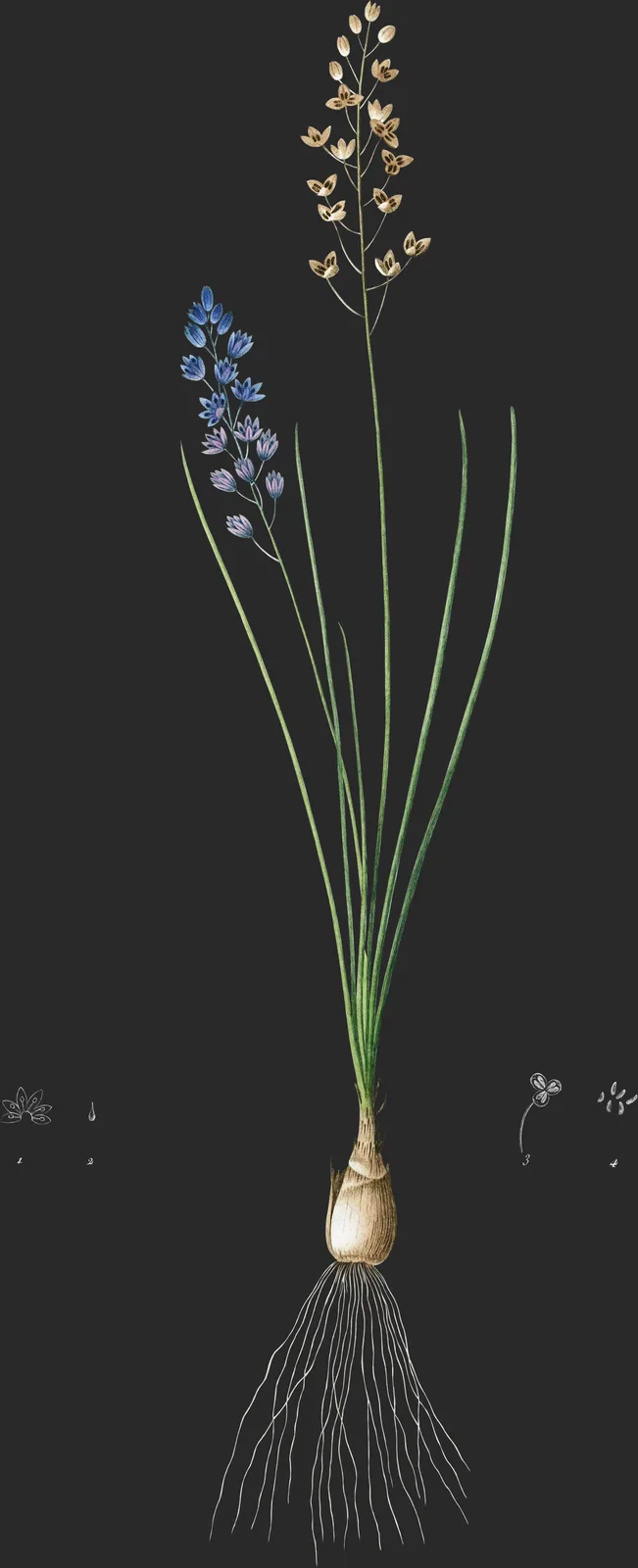
Une bulbe arrondie, grosse comme une petite noix et couverte de tuniques grises, émet par sa base des fibres radicales courtes et nombreuses. De son sommet sortent deux ou trois hampes nues, cylindriques, grêles, droites, hautes de deux centimètres environ, et cinq ou six feuilles linéaires, étroites, presque filiformes, aigués, un peu roides et charnues, creusées d’une gouttière sur leur bord supérieur, de moitié plus courtes que les hampes.
Les fleurs sont, pour l’ordinaire, d’un bleu pale, et quelquefois d’une couleur rosée. Elles forment une grappe läche. Leurs pédicelles, d’abord aussi courts qu’elles, s’allongent peu à peu, et lors de la maturité du fruit atteignent près de deux centimètres de longueur. Ils sont grêles et recourbés en haut. On n’aperçoit à leur base aucun vestige des bractées, du moins dans les nombreux échantillons que nous avons sous les yeux. Nous avons lieu de croire que la plante dans laquelle M. Gawler a vu de petites bractées est une espèce distincte de la nôtre.
Le périgone est à six divisions ovales, lancéolées, aigués, concaves, demi-étalées, longues de cinq millimètres environ.
Les filaments des étamines sont bleus, en forme d’aléne, de moitié plus courts que les segments du périgone. Les anthères sont ovales, d’un bleu foncé.
L’ovaire est libre, ovale, rétréci au sommet en un style filiforme, de la même longueur que les étamines. Le stigmate est en forme de tête. La capsule est arrondie, à trois loger, à trois valves. Chacune de ses loges renferme deux graines noires, chagrinées, oblongues, insérées par leur extrémité inférieure, qui se rétrécit un peu en pointe, à la base de l’axe formé par la réunion des cloisons.
Histoire
La Seille d’automne croit communément dans les bois sablonneux de l’Angleterre, de la France, d’une grande partie de l’Europe méridionale et de la Barbarie. On la trouve également dans le voisinage de la mer Caspienne. Elle fleurit à la fin de l’été. Ainsi que la remarqué M. Gawler, d’après M. Sims, et que nous l’avons observé nous-mêmes, lorsque l’époque de la floraison est retardée par l’humidité de la saison, les feuilles sont développées au moment où elle a lieu. Elles le sont au contraire très-peu lorsque la saison plus sèche avance cette époque.
Explication de la planche
La Plante entière de grandeur naturelle.
- Une fleur fendue latéralement et étalée.
- L’ovaire et le style.
- Une capsule dans son état de maturité parfaite.
- Les graines.
Fam. des Asphodèles. Juss.—Hexandrie monogynie. Lin.
- Seilla autumnalis. S. foliis filiformibus linearibus, floribus corymbosis, pedunculis ebracteatis nudis adscendentibus longitudine floris. Lin. spec. pl. 443. Mill. dict. n. 7. Desfont. atl. 1. p. 301. Willd. sp. pl. 2. p. 130. Engl. bot. t. 78. Curt. Lond. fasc. 6. t. 25. e Smith. Poiret. in Lam. dict. 6. 741. Fl. Fr. éd. 3.n. 1935.
- Scilla autumnalis. S. foliis linearibus, floribus racemosis, peduncalis ebracteatis longitudine floris. Marsch. fl. Taur. Caucas. p. 279.
- Scilla autumnalis var. β. Gawl. in Curt. bot. mag. n. 919.
- Scilla autumnalis. S. radice tunicatâ: foliis angustissimis, linearibus: floribus subcorymbosis, paucis, laxis: pedunculis adscendentibus, flore longioribus. Broter. fl. Lusit. 527?
- Scilla autumnalis. S. foliis linearibus, floribus corymboso-racemosis, pedunculis ebracteatis adscendentibus longitudine florum. Smith. fl. Brit. 1. p. 366.
- Scilla autumnalis. S. floribus racemosis, foliis linearibus. Cavan. ic. 3. p. 38. tab. 274. f. 2.
- Scilla radice solidâ, foliis setaceis, floribus fastigiatis, pedunculis arcuatis ex alâ tubercali mammillaris. Guett. Stamp. 131. Dalib. Paris. 102.
- Seilla radice solidâ, scapo multifloro, floribus capitatis Sauv. Monsp. 19.
- Ornithogalum autumnale. Lam. fl. Franç. 3. p. 274.
- Anthericum autumnale. Scop. Carn. n. 415.
- Ornithogalum autumnale minus floribus cæruleis, et flore dilutè purpureo. Tournef. inst. 381.
- Hyacinthus autumnalis minor. Bauh. pin. 47.
- Hyacinthus autumnalis minor. Clus. hist. 1. p. 185. J. Bauh. hist. 2. 574. Raji syn. 374.
Twelve ways of seeing
- measured cast amber
- upright 2.46 : 1
- published 1811
- Plate 317
Not a catalogue entry but a way of looking: how to stand, what to notice, how the line was cut, when it flowers, where it came from, who made it — and then the poems and the classics that taught China to see the same flower. Read the twelve in order and the plate opens.
-
First Look
六法者何?一、气韵生动是也;二、骨法用笔是也;三、应物象形是也;四、随类赋彩是也;五、经营位置是也;六、传移模写是也。
—— 南齐·谢赫《古画品录》
The six laws: spirit resonance alive; bone-method in the brush; matching form; colour by kind; planning the placing; copying the masters.
The sheet is vertical: the eye climbs and settles in the upper half. Let the plant stand before you look for detail. Then step in close: watch where colour meets line, and whether the line ever breaks. Third, find where the yellow is deepest: the whole tonal order is measured from that patch.
-
Name and Thing
The binomial is Scilla autumnalis: the first word is the genus it belongs among, the second the epithet that sets it apart. Here the epithet autumnalis means “autumnal” — the name records the feature the namer noticed first. The older system filed it under Asparagaceæ by overall affinity; Linnaeus, counting stamens only, placed it in Hexandria — two ways of asking what a plant is. No established Chinese name exists, so it is cited by its binomial alone.
-
Form and Colour
Measured on this plate: flower colour covers 1.3% of the sheet, foliage 1.5%, the cast amber with a second note of blue. No other plate shares exactly this measure. Bulbous plants store the year underground — bulb, corm or tuber — then send up a few thick leaves and a single scape, with six tepals in cup, funnel or star. Filed under yellow — a honey-yellow, built in washes from a pale ground. Three things fix the habit: leaf arrangement, tepal count, and how the flower is borne.
-
Composition
Tall and narrow, the plant rising in one movement with generous margins — the upright format of most floras. (about 2.46 : 1) No details are appended: a plate for looking, not for keying out. The plant covers only 5% of the sheet, centred near the centre; the emptiness is where the eye rests. Blank paper is not unfinished work: it is where the eye rests.
-
Line and Colour
The first half of the nineteenth century moved from copper to steel to lithography; stipple could render the softest transition. Decide first whether it was printed or painted; only then discuss whether it is beautiful.
-
Season
Early spring to early summer, genus by genus: tulips and hyacinths first, gladiolus and amaryllis later. The year 1811 on the plate is that of publication, not of flowering — the gathering came a year or two earlier. The plate records ten days of peak; the other three hundred are leaf, fruit and rest.
-
Provenance
Three homelands: the Mediterranean, Central Asia and South Africa. The tulip came from Ottoman gardens and became a Dutch mania; South African bulbs filled European glasshouses after 1800. In the same volume the kin are shelved together; set several plates side by side.
-
The Book and the Hand
“The Liliaceae” was drawn by Pierre-Joseph Redouté and published 1802-1816. This plate is Plate 317, book page 317. The image is public domain; the hand-colouring is still one person's hand.
-
Poetic Resonance
兰陵美酒郁金香,玉椀盛来琥珀光。
—— 唐·李白《客中行》
The poem gives the mood first and the picture supplies the form; set the line beside the plate and the yellow the corolla becomes its resting point.
-
The Written Tradition
写气图貌,既随物以宛转;属采附声,亦与心而徘徊。
—— 南朝梁·刘勰《文心雕龙·物色》
In tracing the spirit and drawing the shape one follows the object; in choosing colour and sound one lingers with the heart.
Li Bai's 'orchid wine, fragrant with yujin' is often misread as tulips; the Tang yujin was a turmeric-like root used to scent wine — same name, different plant. Keep the line; it will surface the next time you meet the same plant.
-
Symbolism
The tulip was an imperial emblem in Istanbul and a speculative bubble in Amsterdam; the hyacinth sprang from a boy's blood in Greek myth. What bulbs share is concealment: next year kept underground. This plate leans yellow, which in flower language adds one more degree of feeling. Flower language was added later; the flower knows nothing of it, and that innocence is part of its power.
-
What to Take Away
Appreciation is not knowledge but habit — one more look each time. Two centuries on, the plant may still flower in some garden; the one on this sheet stopped in the season of 1811.