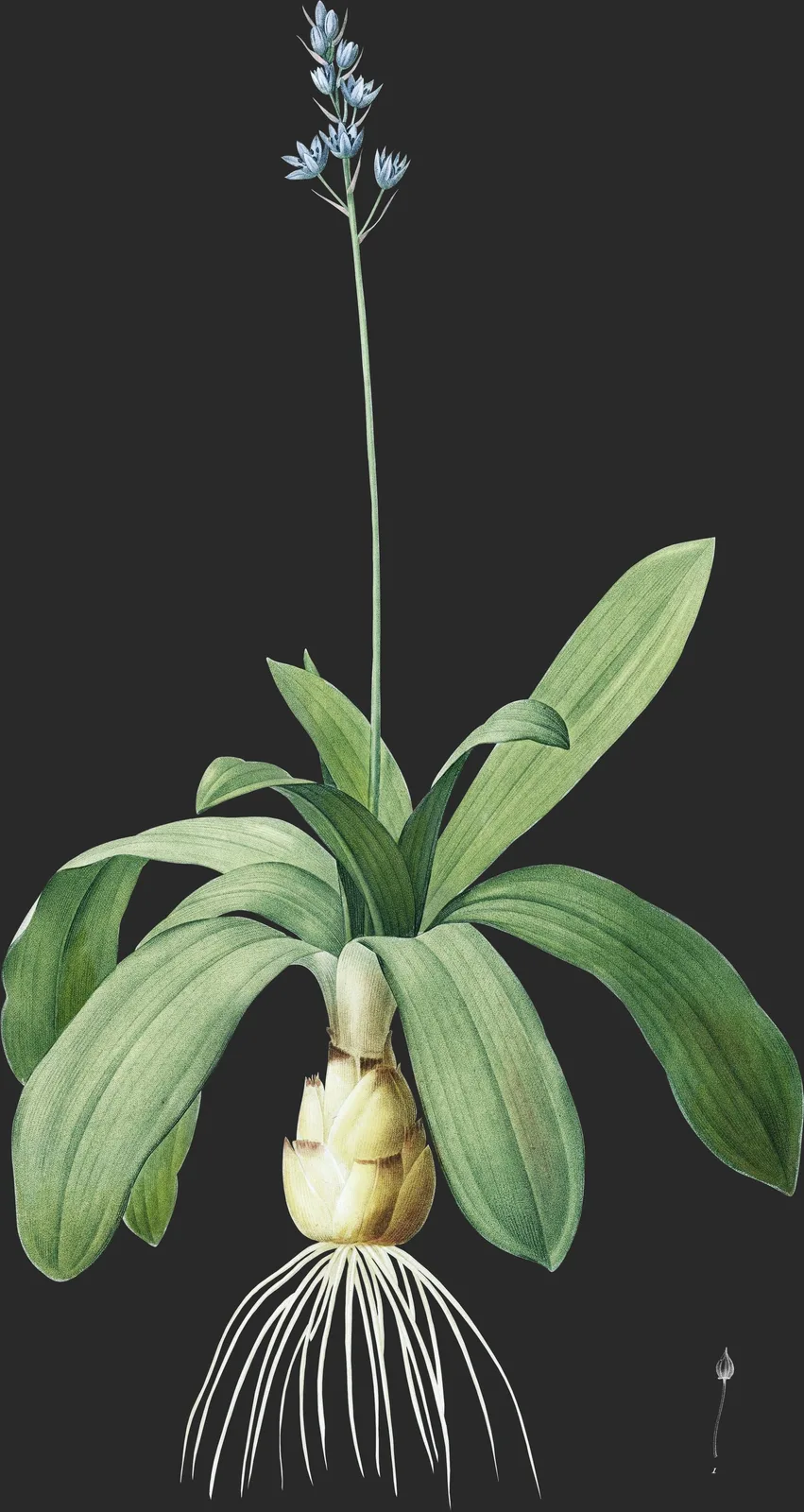
Scilla Lilio-Hyacinthus
Scille Fausse-Jacinthe
About this plate
Description
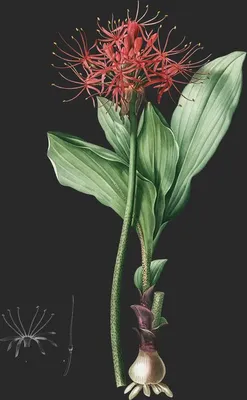
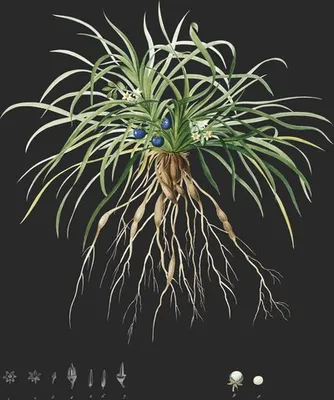
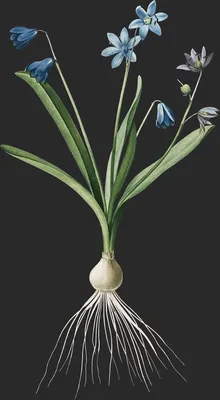
Cette plante est fort remarquable par la structure de sa bulbe, qui ressemble à celle des lis. Cette bulbe est jaunâtre, ovoïde, composée de plusieurs écailles charnues, tronquées au sommet. De la base partent des fibrilles radicales nombreuses, et presque toutes simples: du sommet sortent cing à six feuilles oblongues, étalées, glabres, d’un vert gai, très-entières, peu pointues, rétrécies à leur base, longues de 15–18 centimètres, sur 2–3 de largeur.
La hampe est droite, grele, plus longue que les feuilles, terminée par une grappe composée de cing à six fleurs d’un bleu tendre: chaque fleur est portée sur un pédicelle long de 15–20 millimètres. A la base des pédicelles se trouvent des bractées linéaires, pointues, membraneuses, longues de to à 18 millimètres.
La fleur est composée d’un périgone à six parties ouvertes, oblongues, poin-tues; de six étamines placées devant chacun des lobes du périgone et chargées d’anthères bleuâtres; d’un ovaire ovoide à six côtes, surmonté d’un style simple. Le fruit est une capsole à trois angles saillants.
Histoire
La Scille Fausse-Jacinthe croit dans les lieux frais et ombragés des Pyré-nées, au mont Laurenti, a Esquierri, au mont Larhune, à Pau dans le voi sinage du Pare: elle se retronve dans les Landes, près Bayonne et Saint-Sever, et jusques aux environs d’Orléans. ♃.
Elle fleurit en été.
Sa bulbe est employée comme purgatif par les habitants de la vallée de Luchon, qui désignent cette plante sous le nom de Liergue.
Fam. des Asphodèles. Juss.—Hexandrie monogynie. Lin.
- Scilla Lilio-Hyacinthus. S. radice squamatâ. Lin. hort. Cliff. 123. Spec. 442. Roy. Lugd-b. 32. Mill. Dict. n. 2.
- Scilla Lilio-Hyacinthus, S. racemo paucilloro, pedunculis ebracteatis, folis lanceolatis humi adpressis, bulbo squamato. Willd. Spec. 2. p. 126. Poir. Dict. enc. 6. p. 738.
- Scilla Lilio-Hyacinthus. S. foliis lanceolatis humi adpressis scapo brevioribus, floribus pancis racemosis, bulbo squamato. Fl. fr. ed. 3. et Syn. n. 1939.
- Ornithogalum squamosum. Lam. Fl. fr. 3. p. 274.
- Lilio-Hyacinthus vulgaris flore caruleo. Tourn. inst. p. 372.
- Hyacinthus stellaris folio et radice Lilli. C. Bauh. pin. 46. Moris. hist. 2. p. 375. s. 4. t. 12. f. 21.
- Hyacinthus lilii-folius stellatus. J. Bauh. hist. 2. p. 589. ic.
- Hyacinthus stellaris lilio-folius floridas Mutoni. Lob. icon. t. 101. f. 1. 2. observ. app. p. 459. ic.
- Hyacinthus stellaris lyriophyllos. Clus. hist. et app. Alt. icon.
- Hyacinthus liliaceus vel septimus. Tabern. icon.
- Hivacinthus Miliacens Lobeli. Dalech. hist. 2. p. 1515. ic. Lob.
- Hyacinthus stellaris alius lilii-folios. Dalech. hist. 2. p. 1514. ic. Lob.
Ten ways of seeing
- measured cast yellow-green
- upright 1.88 : 1
- published 1807
- Plate 205
First Look
论画以形似,见与儿童邻。
—— 宋·苏轼《书鄢陵王主簿所画折枝》
To judge painting by likeness alone is the view of a child.
The sheet is vertical: the eye climbs and settles in the upper half. Let the plant stand before you look for detail. Then step in close: watch where colour meets line, and whether the line ever breaks. Third, find where the green is deepest: the whole tonal order is measured from that patch. The pose leans right: the upper half carries 18 points further right than the lower — a living thing, not a diagram.
Name and Thing
The binomial is Scille fausse-jacinthe: the first word is the genus it belongs among, the second the epithet that sets it apart. Two words carry a whole provenance. The older system filed it under Asparagaceæ by overall affinity; Linnaeus, counting stamens only, placed it in Hexandria — two ways of asking what a plant is. No established Chinese name exists, so it is cited by its binomial alone.
Form and Colour
Measured on this plate: flower colour covers 1.4% of the sheet, foliage 15.4%, the cast yellow-green with a second note of amber. No other plate shares exactly this measure. A bulb of overlapping fleshy scales gives the lily its Chinese name, 'hundred-fold'; six tepals reflex as the flower opens, around six stamens with long, T-shaped anthers. Filed under green — a moss green, a colour that comes mostly from leaf and stem. A single plant, laid out with nothing hidden.
Composition
Tall and narrow, the plant rising in one movement with generous margins — the upright format of most floras. (about 1.88 : 1) No details are appended: a plate for looking, not for keying out. The plant covers only 24% of the sheet, centred below centre; the emptiness is where the eye rests. Blank paper is not unfinished work: it is where the eye rests.
Line and Colour
The first half of the nineteenth century moved from copper to steel to lithography; stipple could render the softest transition. Take a loupe to three places: petal edge, leaf vein, caption. An unbroken line means engraving; colour crossing the outline means a hand. If you mean to copy it: take its skeleton, its margins and the order of its colours; the burin's hatching is the language of copper — suggest it with pencil density, do not imitate it stroke for stroke.
Poetic Resonance
两丛香百合,一架粉长春。
—— 宋·陆游《北窗偶题四首 其一》
The poem gives the mood first and the picture supplies the form; set the line beside the plate and the green the corolla becomes its resting point.
Symbolism
In the West the white lily is Marian purity, held by the angel of the Annunciation; in China the name sounds like 'a hundred years in harmony', a wedding wish. Flower language was added later; the flower knows nothing of it, and that innocence is part of its power.
Season and Place
Early to high summer, June and July. Temperate north — China, Japan, Europe. Long used in Chinese medicine, lilies were hunted in East Asia by nineteenth-century collectors and transformed European gardens. The year 1807 on the plate is that of publication, not of flowering — the gathering came a year or two earlier. The volume was made in 1802-1816, when most of this knowledge came from living plants under glass.
The Book and the Hand
“The Liliaceae” was drawn by Pierre-Joseph Redouté and published 1802-1816. This plate is Plate 205, book page 205. The image is public domain; the hand-colouring is still one person's hand.
What to Take Away
Carry three rules away: whole before detail; line before colour; picture before book. A flora exists to be consulted; look long enough and you forget to consult — someone in 1807 gave a whole day to a single flower.