Smilacina Racemosa
假黄精
Smilacine en Grappe
About this plate
Description
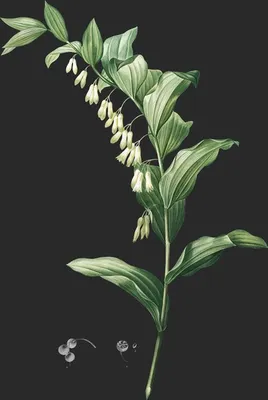
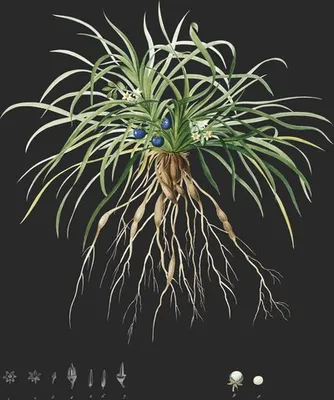
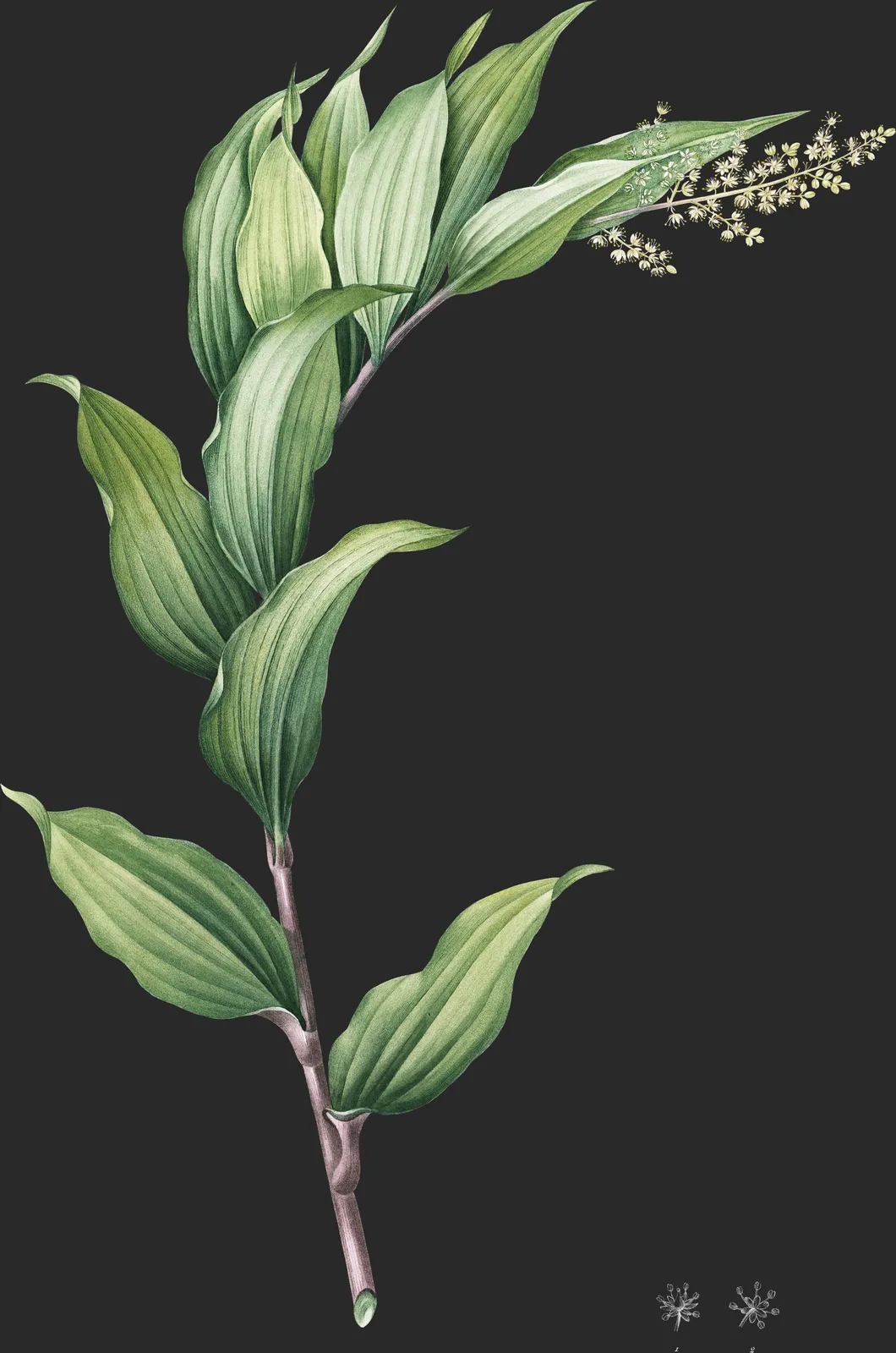
La racine de cette plante est épaisse, charnue, blanche, noueuse. Elle pousse une tige un peu tortueuse, anguleuse, haute de 2 à 3 décimètres, presque toujours simple, tres-rarement bifurquée, légèrement pubescente, ainsi que le reste de la surface, garnie dans toute sa longueur de feuilles alternes, et termi née par une grappe droite et rameuse, composée de petites flears blanches.
Les feuilles sont ovales-oblongues, terminées en pointe, marquées de nervures longitudinales, garnies de très-petits poils sur les nervures, et surtout sur les bords, presque sessiles et demi-embrassantes dans la partie supérieure de la tige, rétrécies en une gaine courte dans la partie inférieure de la plante.
La grappe de flears est droite, terminale, rameuse: ses pédicelles sont pu-bescents; chacun d’eux sort de l’aisselle d’une très-petite bractée. Les fleurs sont petites, en assex grand nombre; leur périgone est libre, divisé en six parties profondes, lancéolées, aiguës, ouvertes en étoile et facilement caduques. Les étamines placées devant chacun des lobes du périgone sont droites, écartées, un peu plas longue que le périgone, terminées par des anthères blanchâtres. L’ovaire est arrondi, surmonté din style court et simple. Le fruit est une baie ronde, parsemée d’un grand nombre de points rouges à sa maturité.
Histoire
La Smilacine en grappe croit naturellement dans la Virginie et dans le Canada. ♃.
On la caltive dans tous les jardins botaniques, où elle se distingue par son feuillage élégant et ses baies tachetées.
Observations
Le genre Smilacina est un démembrement des Convallaria de Linné. Tournefort avait réuni les espèces qui le composent au genre Smilax, avec lequel elles ont en effet de si grands rapports, qu’elles n’en diffèrent que par leur port herbacé et la réunion des sexes dans la meme fleur; ce seul exemple sullirait pour prouver que la division des Asparagées proposée par Ventenat est contraire aux analogies naturelles. Les Smilacines ont le périgone à six parties divisées jusqu’à la base; ce qui les distingue des Muguets et des Poly-gonates: leur périgone est à six parties, et non à quatre; ce qui les sépare des Mayanthèmes, avec lesquels elles ont cependant des rapports très-intimes. Ce genre a été établi par Mench sous le nom de Polygonastrum, et par Desfontaines sous celui de Smilacina, qui rappelle la classification de Tournefort.
Forskahl cite la Smilacina racemosa parmi les plantes indigènes de l’Egypte; mais il est très-probable que, sous ce nom, il a désigné une plante différente de celle d’Amérique.
Fam. des Asperges. Juss.—Hexandrie monogynie. Lin.
- Smilacina racemosa. S. folis sessilibus ovatis nervosis, floribus terminalibas racemoso-paniculatis. Desf. ann. Mus. 9. p. 51.
- Polygonastrum racemosum. P. caule flexuoso tereti erecto, foliis alternis semi-amplexicaulibus, racemo terminali erecto simplici. Mœnch. meth. 637.
- Convallaria racemosa. C. foliis sessilibus, racemo terminali composito. Lin. Spec. 459. Mill. Dict. n. 8. Lam. Dict. 4. p. 370.
- Convallaria racemosa. C. tota pubescens, foliis subpetiolatis oblongo-ovalibus longissime acuminatis, racemo terminali ramoso. Michaux. Fl. bor. amer. 1. p. 202.
- Convallaria racemo composito. Roy. Lugd-b. 26.
- Convallaria foliis alternis, racemo terminali. Hort. Cliff. 125. Gron. Virg. 38.
- Polygonatum racemosum. Corn. Canad. 36. t. 37.
- Polygonatam ramosum et racemosum spicatum. Moris. hist. 3. p. 537. s. 13. t. 4. f. 9.
- Polygonatum racemosum americanum Ellebori albi folis amplissimis. Pluk. alm. 301. t. 311. f. 2.
Ten ways of seeing
- measured cast yellow-green
- upright 1.51 : 1
- published 1807
- Plate 230
Not a catalogue entry but a way of looking: how to stand, what to notice, how the line was cut — then, halfway, a line of Chinese poetry: how the ancients saw this same flower. After it, the flower's language, its season and homeland, its book; and at the end one line of classical prose — and a pair of eyes to take away.
-
First Look
竖划三寸,当千仞之高;横墨数尺,体百里之迥。
—— 南朝宋·宗炳《画山水序》
A vertical stroke of three inches stands for a cliff of a thousand fathoms; a few feet of ink holds a hundred li.
The sheet is vertical: the eye climbs and settles in the upper half. Let the plant stand before you look for detail. Then step in close: watch where colour meets line, and whether the line ever breaks. Third, find where the green is deepest: the whole tonal order is measured from that patch.
-
Name and Thing
The binomial is Smilacina racemosa: the first word is the genus it belongs among, the second the epithet that sets it apart. Two words carry a whole provenance. The older system filed it under Asparagaceæ by overall affinity; Linnaeus, counting stamens only, placed it in Hexandria — two ways of asking what a plant is. The Chinese name 假黄精 is a modern rendering of the Latin, not an old garden name.
-
Form and Colour
Measured on this plate: flower colour is sparing, 0.2% of the sheet against 13.7% of foliage, the cast tending yellow-green — as with pale or white blooms, outline and tone do the talking. A bulb of overlapping fleshy scales gives the lily its Chinese name, 'hundred-fold'; six tepals reflex as the flower opens, around six stamens with long, T-shaped anthers. Filed under green — a moss green, a colour that comes mostly from leaf and stem. Three things fix the habit: leaf arrangement, tepal count, and how the flower is borne.
-
Composition
Tall and narrow, the plant rising in one movement with generous margins — the upright format of most floras. (about 1.51 : 1) No details are appended: a plate for looking, not for keying out. The plant covers only 20% of the sheet, centred a little left of centre; the emptiness is where the eye rests. Old plates set the plant slightly off centre, with unequal margins — that small imbalance is what keeps it alive.
-
Line and Colour
The first half of the nineteenth century moved from copper to steel to lithography; stipple could render the softest transition. Decide first whether it was printed or painted; only then discuss whether it is beautiful. If you mean to copy it: take its skeleton, its margins and the order of its colours; the burin's hatching is the language of copper — suggest it with pencil density, do not imitate it stroke for stroke.
-
Poetic Resonance
更乞两丛香百合,老翁七十尚童心。
—— 宋·陆游《窗前作小土山蓻兰及玉簪最后得香百合并种之戏作》
The poem gives the mood first and the picture supplies the form; set the line beside the plate and the green the corolla becomes its resting point.
-
Symbolism
In the West the white lily is Marian purity, held by the angel of the Annunciation; in China the name sounds like 'a hundred years in harmony', a wedding wish. In a flora it is a species first and a symbol second; the order is worth keeping.
-
Season and Place
Early to high summer, June and July. Temperate north — China, Japan, Europe. Long used in Chinese medicine, lilies were hunted in East Asia by nineteenth-century collectors and transformed European gardens. The year 1807 on the plate is that of publication, not of flowering — the gathering came a year or two earlier. The bud and the ripe fruit on one branch tell the season; the name in the title often tells the journey.
-
The Book and the Hand
“The Liliaceae” was drawn by Pierre-Joseph Redouté and published 1802-1816. This plate is Plate 230, book page 230. The image is public domain; the hand-colouring is still one person's hand.
-
The Written Tradition
百合之根,以众瓣合成也。
—— 明·李时珍《本草纲目·菜部》
The root of the lily is many scales gathered into one — hence the name bai he, “a hundred joined”.
The Bencao Gangmu describes the bulb as garlic-like, edible and medicinal; Song writers already noted that the leaves vary while the flowers stay white. The difference is not of quality but of question: Europe asks what it is, China asks whom it resembles.
What to Take Away
Next time you stand before a flowering plant, give it three minutes: leaf arrangement, direction of the flower, the darkest patch. The flower of that year is dust, yet its image on paper has outlived every living cousin.