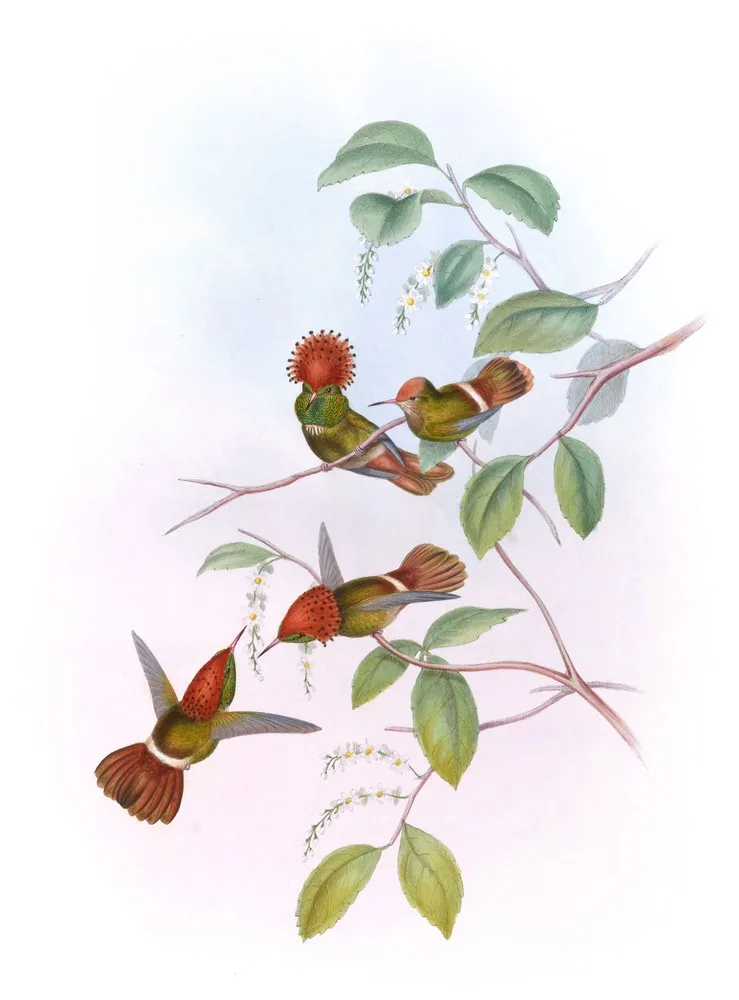
Lophornis Reginæ
Lophornis Reginæ
Spangled Coquette
About this plate
New Granada
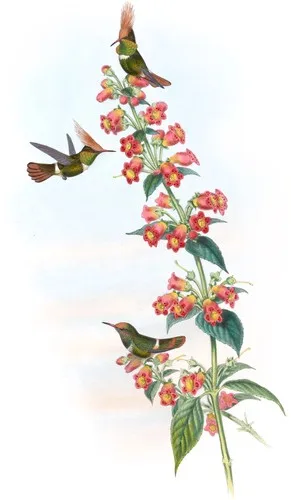
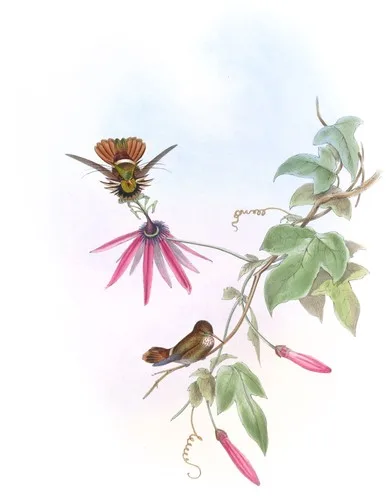
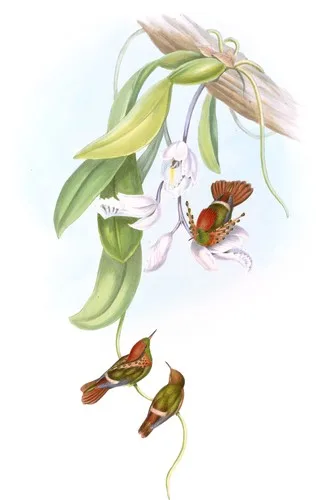
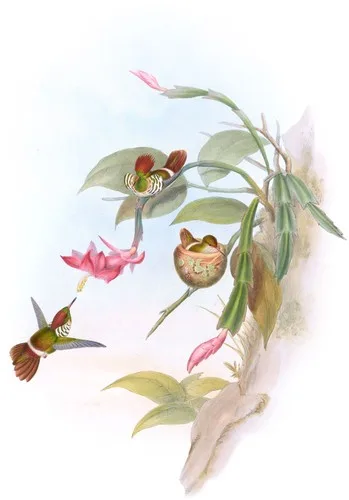
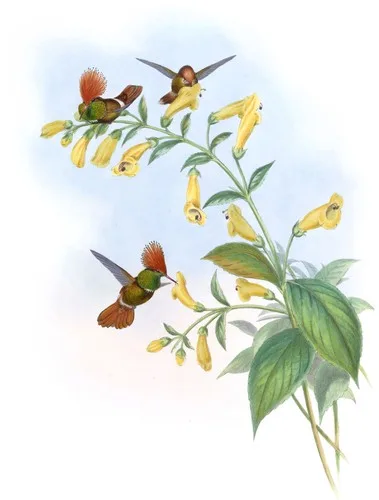
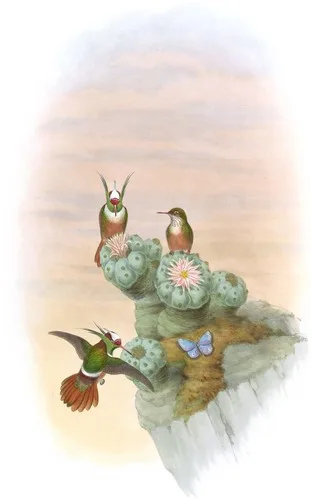
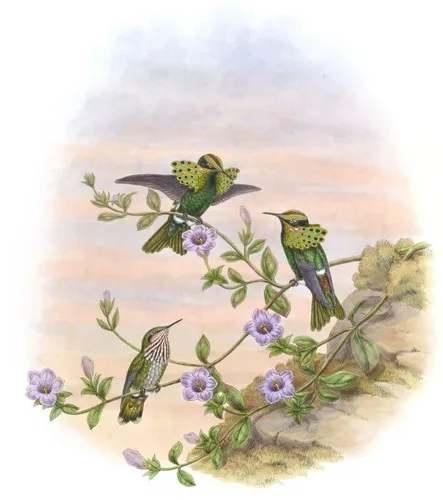
As I had frequently been informed of the existence of a species of Lophornis with a crest, which, when outspread, resembled the tail of a Peacock, it was with no ordinary sensations of pleasure I first beheld the lovely little bird here depicted; specimens of which arrived in Europe for the first time in the year 1847, through the instrumentality of M. Linden of Brussels, who received it direct from his brother, at that time travelling in the province of Antioquia in Columbia.
Since that period several other examples have been received from the same source, and from the neighbouring countries; the native locality of this beautiful species is therefore placed beyond doubt.
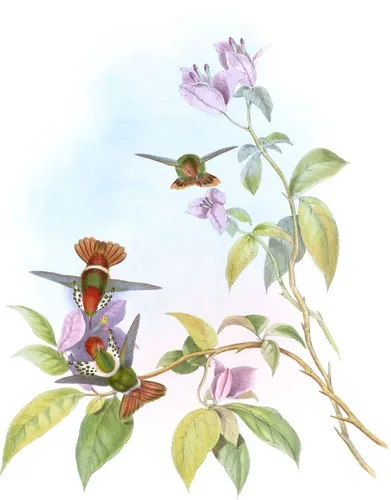
The Lophornis Reginæ differs from every other known member of the genus in its large, round, and well-defined crest, each feather of which is surmounted by a ball-like, dark bronzy-green tip, which must render the bird a most conspicuous and pleasing object when the feathers are fully displayed.
The sexes exhibit the usual difference, the female being entirely destitute of the fine crest and rich colouring of the male.
I regret to add that no information has reached us respecting the habits and manners.
The male has the crown of the head and crest bright rusty red, each feather with a beautiful dark bronzygreen spot at the tip; lores, throat and sides of the neck luminous metallic green, beneath which is a patch of white lanceolate feathers; back of the neck and upper part of the back shining green; lower part of the back, rump, and upper tail-coverts bronzy brown; rump crossed by a narrow band of white; tail chestnutbrown, the tips and margins of the external feathers rich bronzy green; wings purplish brown; abdomen light metallic green; bill fleshy at the base, dark brown at the tip; feet brown.
The female has the forehead and crown deep buff; upper surface and wing-coverts bronzy green; lower part of the back dark or blackish brown, crossed by a band of white; wings purplish brown; tail buff, crossed towards the apex by a broad dusky semicircular band; throat dusky; under surface bronzy green.
The figures are of the natural size.
References
- Lophorms Reginæ, Gould in Proce. of Zool. Soc., part xv. p. 95.
- Mellisuga reginæ, Gray and Mitch. Gen. of Birds, vol. i. p. 113, Mellisuga, sp. 92.
- Lophornis reginae, Bonap. Consp. Gen. Av., p. 84, Lophornis, sp. 8.
- Lophornis regine, Ib. Rev. et Mag. de Zool. 1854, p. 257.
- Bellatrix Reginae, Reichenb. Aufz. der Colibris, p. 12.
Twelve ways of seeing
- upright 1.35 : 1
- published 1852
- Pl. 122, Vol. III
Not a catalogue entry but a way of looking: how to stand, what to notice, how the line was cut, when it flowers, where it came from, who made it — and then the poems and the classics that taught China to see the same flower. Read the twelve in order and the plate opens.
-
First Look
江馆清秋,晨起看竹,烟光日影露气,皆浮动于疏枝密叶之间。
—— 清·郑板桥《题画竹》
On an autumn morning at the river lodge I looked at the bamboo: mist, sunlight, dew, all drifting among the sparse and dense leaves.
The sheet is vertical: the eye climbs and settles on the bird. Take the posture before the plumage. Then step in close: watch where colour meets line, and whether the line ever breaks. Third, find the darkest small patch: the whole tonal order is measured from there.
-
Name and Thing
Only the genus Lophornis is given; species-level names came later. No established Chinese name exists, so it is cited by its binomial alone.
-
Form and Colour
The smallest of birds: a needle-fine bill, a forked tubular tongue, wings beating so fast the bird hovers and even flies backwards. Its colour is not pigment but structure — light bent by feather barbules, changing with the angle.No colour group is recorded. Three things fix the habit: leaf arrangement, tepal count, and how the flower is borne.
-
Composition
Tall and narrow, the bird perched mid-branch with generous margins above and below. (about 1.35 : 1) No details are appended: a plate for looking, not for keying out. Old plates set the plant slightly off centre, with unequal margins — that small imbalance is what keeps it alive.
-
Line and Colour
In the later nineteenth century chromolithography took over: colour printed rather than painted, line demoted. Decide first whether it was printed or painted; only then discuss whether it is beautiful.
-
Season
In tropical America they are present all year, their season set by flowers; temperate hummingbirds follow the bloom north and back, thousands of kilometres a year. The year 1852 on the plate is that of publication, not of flowering — the gathering came a year or two earlier. Note the season. Phenology is the most practical tool of appreciation.
-
Provenance
Americas only, from southern Alaska to Tierra del Fuego, richest in the Andes. China has no hummingbirds and no classical record of them; the name arrives with late-Qing travel writing. The localities on the plate are those of a century ago; plants travel and places change their names.
-
The Book and the Hand
“Gould's Hummingbirds” was drawn by John Gould and published 1849-1887. This plate is Pl. 122, Vol. III, book page 122. The image is public domain; the hand-colouring is still one person's hand.
-
Poetic Resonance
穿花蛱蝶深深见,点水蜻蜓款款飞。
—— 唐·杜甫《曲江二首》
Butterflies thread the flowers, seen deep within; dragonflies touch the water and fly on, slow and deliberate.
The poem gives the mood first and the picture supplies the form; set the line beside the plate and the bird itself becomes its resting point.
-
The Written Tradition
多识于鸟兽草木之名。
—— 《论语·阳货》
…and from the Songs one learns the names of birds, beasts, plants and trees.
Gould's Hummingbirds (1849–1887) used hand-coloured lithography over gold leaf so the iridescence survived on paper — a monument to Victorian printing and collecting alike. Keep the line; it will surface the next time you meet the same plant.
-
Symbolism
For the Aztecs the hummingbird was warrior and sun; for Victorian Europe it was the ultimate ornament, millions killed for breast jewellery. China has no tradition here — and that blank is itself a history of exchange. In a flora it is a species first and a symbol second; the order is worth keeping.
-
What to Take Away
Next time you watch a bird: posture first, then where the plumage is deepest, and only then the field guide. The flower of that year is dust, yet its image on paper has outlived every living cousin.