Lophornis Helenæ
Lophornis Helenæ
Princess Helena’s Coquette
About this plate
Guatemala and Southern Mexico
It will be seen that the bird figured in the accompanying Plate exhibits many extraordinary and peculiar features,—such a combination, in fact, as is not to be found in any other species; it is, moreover, as beautiful as it is outré, and these circumstances, combined with its great rarity, render it a highly desirable species to all collectors; the small number of specimens, however, that have been transmitted to Europe, and the high price they bear, have confined them to but few collections.
The native country of the Lophornis Helenæ is “Vera Paz near Petinck in the Republic of Guatemala,” where I believe all the specimens that have yet been sent to Europe were obtained by M. De Lattre. Would that that gentleman had, prior to his sudden and untimely death, given to the world some account of the habits and manners of this curious bird, as well as of the many other interesting species which must have come under his notice during his lengthened sojourn among the Andean Humming Birds!
The female is so extremely rare, that, so far as I am aware, only two examples have been sent to Europe; one of these is in the collection of Mr. Leadbeater, who kindly lent it to me to complete my illustration of the species, and to whom I am also indebted for many other similar favours connected with my various works.
M. De Lattre named this species Helenæ, in honour of the Princesse Helene d’Orleans: “Cette noble princesse, protectrice des arts, qu’elle encourage et qu’elle cultive avec tant de goût, et dont la grande infortune rehausse le beau caractère. Puisse la Princesse Hélèene accueillir avec bonté cette hommage d’un voyageur, heureux, dans les contrées lointaines, de conquérir cette rarissime espèce pour lui donner le nom d’une épouse et d’une mere si chère a la France!”
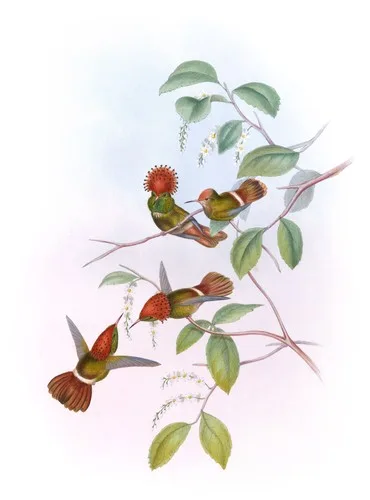
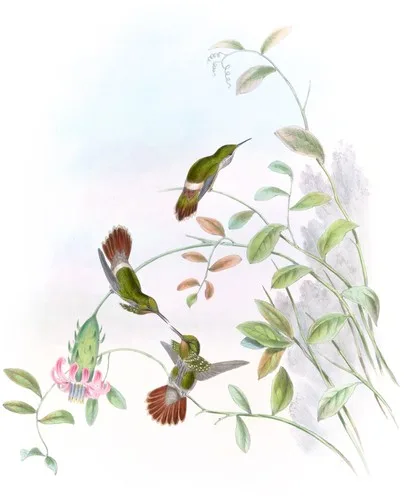
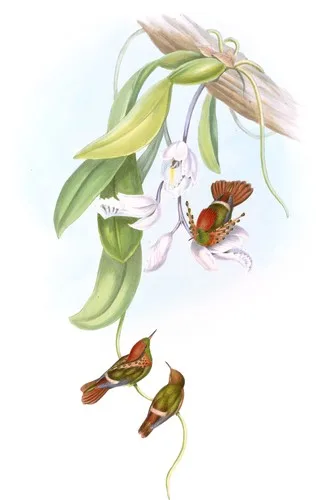
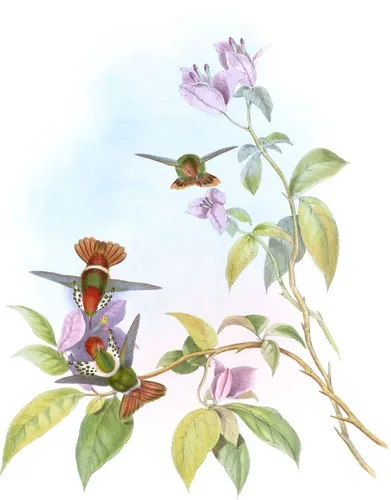
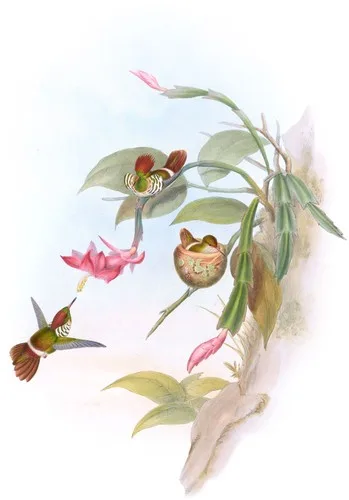
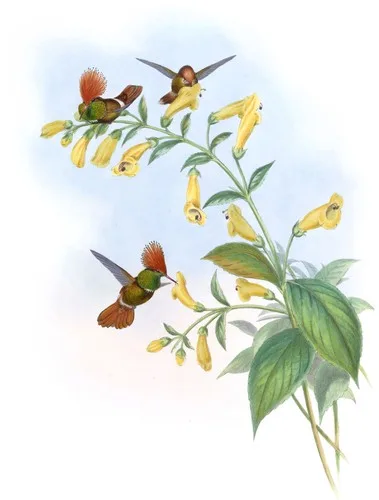
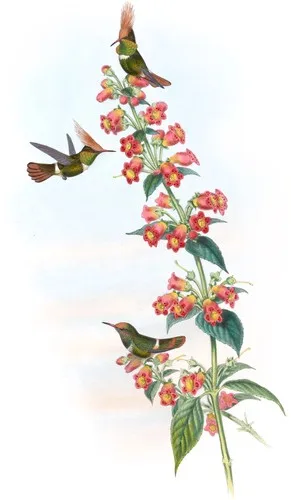
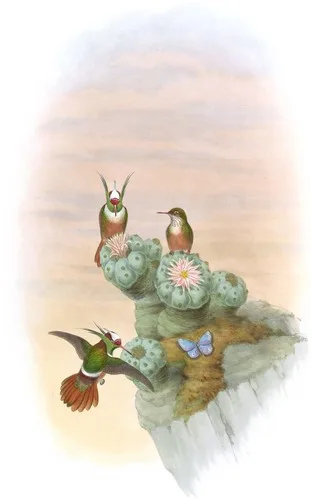
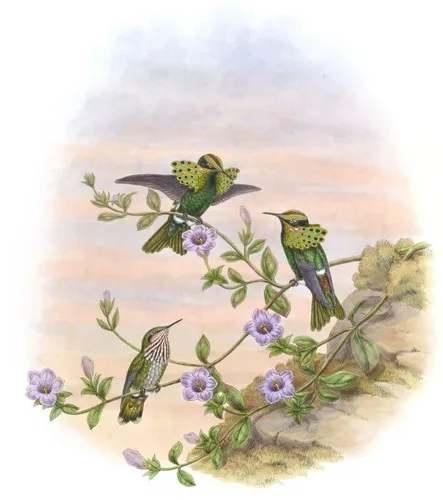
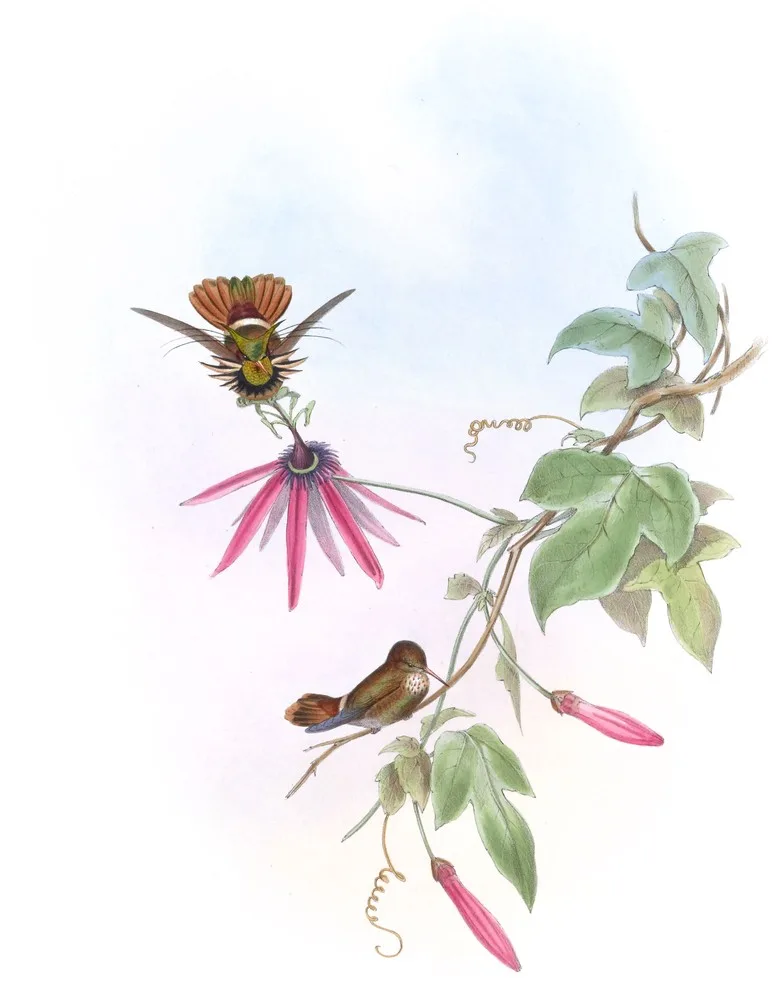
The male has the face and bifurcated crest green; throat luminous golden green; the luminous throat-mark surrounded by a series of elongated feathers, those on the sides of the neck, which are the longest, being buff streaked with bluish black, while those of the centre are wholly black; from the occiput, on either side, three very long, narrow, pointed and hair-like black feathers; upper surface and wing-coverts coppery bronze; wings purplish brown; rump deep bronzy brown, separated from the general hue of the upper surface by a narrow band of white; tail deep rufous, the central feathers glossed with bronzy green, and the remainder margined externally with dark brown; chest golden bronze; the remainder of the under surface white, with a spot of golden bronze at the tip of each feather; bill flesh-colour, darker at the point.
The female has the head, upper surface, wing-coverts and abdomen bronzy green; throat white, with a spot of bronzy green at the tip of each feather; rump dark brown, crossed by a band of white; tail buff, crossed by a dusky band near the tip.
The figures on the accompanying Plate represent a male and a female of the natural size.
References
- Ornismya Helenæ, De Latt. Rev. Zool. 1843, p. 133.
- Mellisuga Helenæ, Gray and Mitch. Gen. of Birds, vol. i. p. 113, Mellisuga, sp. 86.
- Lophornis helenae, Bonap. Consp. Gen. Av., p. 83, Lophornis, sp. 4.
- Lophornis helena, Ib. Rev. et Mag. de Zool. 1854, p. 257.
- Lophornis Helenae, Reichenb. Aufz. der Colibris, p. 12.
Twelve ways of seeing
One plate, read twelve times over: its name, its colour, the burin and the brush, the shape of the sheet, the season, the soil it came from, the book it belongs to, its language of flowers, the poem it answers to, the lore behind it, how to look, and what remains.
-
The Name
The plate is titled “Lophornis Helenæ”, numbered Pl. 123, Vol. III (book page 123). The plate gives only the genus, Lophornis; species-level names came later. No established Chinese name exists for this plate, so it is cited by its binomial alone.
-
Form and Colour
The smallest of birds: a needle-fine bill, a forked tubular tongue, wings beating so fast the bird hovers and even flies backwards. Its colour is not pigment but structure — light bent by feather barbules, changing with the angle. No colour group is recorded for this plate, but the palette still belongs to its season. Read the outline, then the colour layers, then the touch of the brush.
-
Line and Colour
In the later nineteenth century chromolithography took over: colour printed rather than painted, line demoted. Images grew more accurate and less personal. Look closely at the line and the colour: an unbroken line means engraving, colour crossing the outline by half a millimetre means hand-colouring. Craft leaves franker evidence than inscriptions.
-
Composition
Slightly taller than wide, the plant set a little above centre so the eye lands on the flower. (about 1.29 : 1). No details are appended: this is a plate for looking, not for keying out.
-
Season
In tropical America they are present all year, their season set by flowers; temperate hummingbirds follow the bloom north and back, thousands of kilometres a year. The year 1852 on the plate is the year of publication, not of flowering — the gathering came a year or two earlier.
-
Provenance
Americas only, from southern Alaska to Tierra del Fuego, richest in the Andes. China has no hummingbirds and no classical record of them; the name arrives with late-Qing travel writing. The localities on the plate are those of a century ago; plants travel and places change their names.
-
The Book
“Gould's Hummingbirds” was drawn by John Gould and published 1849-1887. This plate is Pl. 123, Vol. III, book page 123. The image is in the public domain; the hand-colouring on the paper is still one person's hand, two centuries ago.
-
Symbolism
For the Aztecs the hummingbird was warrior and sun; for Victorian Europe it was the ultimate ornament, millions killed for breast jewellery. China has no tradition here — and that blank is itself a history of exchange. Meanings change their tune: the same flower can say opposite things within a century.
-
Poetic Resonance
夫列子御风而行,泠然善也,旬有五日而后反。
—— 《庄子·逍遥游》
Liezi rode the wind and came back after fifteen days, so light was his going.
The poem gives the mood first and the picture supplies the form; set the line beside the plate and the bird itself becomes its resting point.
-
Classical Lore
Gould's Hummingbirds (1849–1887) used hand-coloured lithography over gold leaf so the iridescence survived on paper — a monument to Victorian printing and collecting alike. Chinese flower books ranked plants by character; European floras described them by form and name. This plate belongs to the second tradition, yet bears reading by the first. A flora asks what it is; a flower book asks what it means. Read both or half-read the plate.
-
How to Look
Look at the metallic throat and back: structural colour that needed gold leaf or layered washes to match. Then bill length against corolla depth — bird and flower evolved together. Stand back for the habit, step close for the meeting of line and colour.
-
Afterword
The flower of 1852 is dust, yet its image on paper has outlived every living cousin.