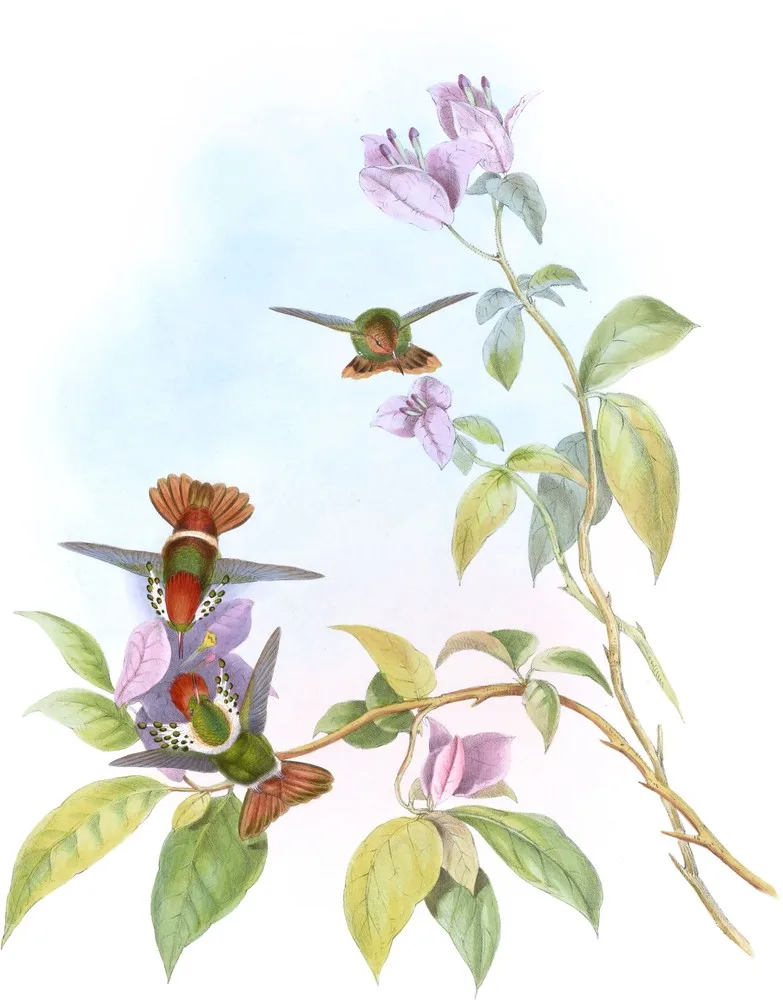
Lophornis Gouldi
Lophornis Gouldi
Gould’s Coquette
About this plate
Northern Brazil
If, in the course of my ornithological labours, I have seldom named new birds after individuals, it is not that I think there are not many living naturalists worthy of such an honour, but because I consider the practice an objectionable one; my opinion being that specific appellations should always express some peculiarity pertaining to the species to which they are applied: entertaining then this view of the subject, I must say, that, although fully sensible of the compliment paid me by M. Lesson, in naming the present bird after myself, I should have been better pleased if some more appropriate appellation had been given to such a beautiful species; a species, moreover, which is so rare in the collections of Europe, that few of them contain examples.
The first specimen known,—that from which M. Lesson took his description,—forms part of Mr. Leadbeater’s collection; another single example, gracing that of Mr. Loddiges, was brought to this country by the celebrated traveller Burchell. Those in my own collection were obtained by the indefatigable collector, Mr. Hauxwell, who shot four or five males and two females near the city of Para; these, with two or three more from the Upper Amazon, deposited in other collections, are nearly if not all that are known. It is evidently a continental species,—that is, it is never found, like its near ally the L. ornatus, in Trinidad or any other of the West Indian Islands. North Brazil and the banks of the Amazon, from the embouchure of that mighty river to its upper ramifications in Peru, are, I believe, its true habitat; and its rarity with us is doubtless due to the infrequency with which those remote districts are visited by travellers and collectors, for there seems to be no reason for supposing that in its own particular province it is less numerous than its congeners. In size and structure it very closely assimilates to L. ornatus, but the neckplumes, which in that species are light chestnut-red, are always pure white, and have the terminal spangles broader and rounder; it is also more delicate in form, a feature observable in both sexes. Of its habits and manners nothing is known.
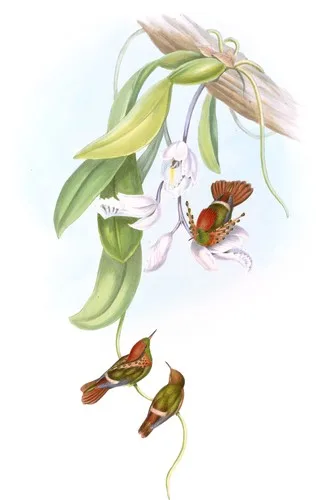
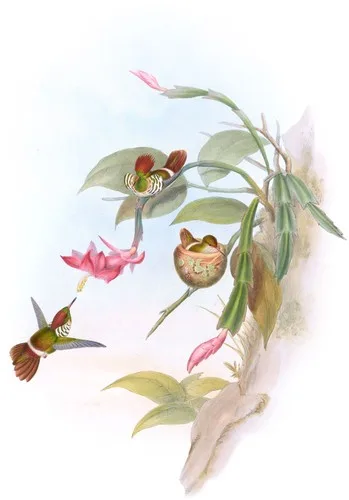
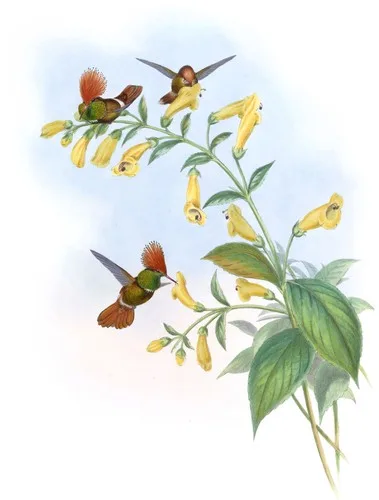
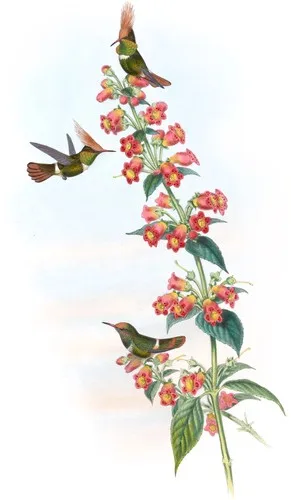
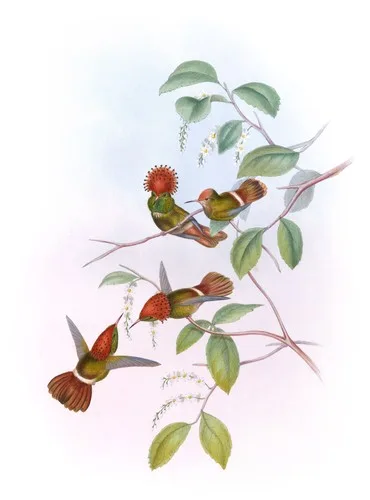
The male has the head and crest rich chestnut-red; upper surface and wing-coverts bronzy green; wings dark purplish brown; across the lower part of the back a band of white; rump chestnut-brown; upper tail-coverts bronzy green; tail dark chestnut-red, the two central feathers bronzy green on their apical half, and the lateral ones broadly edged with brownish black; forehead and throat luminous green; on each side of the neck a series of graduated white plumes, with a large spangle of luminous green at the tip of each; under surface bronzy green; bill fleshy red, becoming dark brown at the tip.
The female has the head and upper surface golden green; a narrow band of white across the lower part of the back; upper tail-coverts tipped with dark bronzy brown; tail bronzy green at the base, crossed by a broad dusky band, and tipped with buff; lores and throat rust-red; under surface bronzy green.
The figures are of the natural size, and represent the males engaged in one of the numerous aïrial combats which so frequently occur among the species of the present genus.
References
- Ornismya Gouldii, Less. Hist. Nat. des Troch., p. 103. pl. 36.
- Trochilus Gouldii, Jard. Nat. Lib. Humming Birds, vol. ii. p. 75. pl. 12.
- Lophornis Gouldii, Less., Jard. Gen. et Syn. des Ois. du Genre Trochilus, p. xli.
- Mellisuga Gouldi, Gray and Mitch. Gen. of Birds, vol. i. p. 118, Mellisuga, sp. 87.
- Lophornis gouldi, Bonap. Consp. Gen. Av., p. 83, Lophormis, sp. 5.—Ib. Rev. et Mag. de Zool 1854, p. 257.
- Bellatrix Gouldii, Reichenb. Aufz. der Colibris, p. 12.
Ten ways of seeing
- slightly upright 1.28 : 1
- published 1852
- Pl. 118, Vol. III
First Look
竖划三寸,当千仞之高;横墨数尺,体百里之迥。
—— 南朝宋·宗炳《画山水序》
A vertical stroke of three inches stands for a cliff of a thousand fathoms; a few feet of ink holds a hundred li.
Slightly taller than wide; the eye lands on the bird's head, a little above centre. Then step in close: watch where colour meets line, and whether the line ever breaks. Third, find the darkest small patch: the whole tonal order is measured from there.
Name and Thing
The binomial is Lophornis gouldi: the first word is the genus it belongs among, the second the epithet that sets it apart. Two words carry a whole provenance. No established Chinese name exists, so it is cited by its binomial alone.
Form and Colour
The smallest of birds: a needle-fine bill, a forked tubular tongue, wings beating so fast the bird hovers and even flies backwards. Its colour is not pigment but structure — light bent by feather barbules, changing with the angle.No colour group is recorded. Read the outline, then the colour layers, then the brush.
Composition
Slightly taller than wide, the bird set a little above centre, the eye landing at head and bill. (about 1.28 : 1) No details are appended: a plate for looking, not for keying out. Blank paper is not unfinished work: it is where the eye rests.
Line and Colour
In the later nineteenth century chromolithography took over: colour printed rather than painted, line demoted. Craft leaves franker evidence than inscriptions. If you mean to copy it: block in the broad shapes and colours first, detail last; lithographic softness comes from thin washes — two or three pale layers will get you close.
Poetic Resonance
穿花蛱蝶深深见,点水蜻蜓款款飞。
—— 唐·杜甫《曲江二首》
Butterflies thread the flowers, seen deep within; dragonflies touch the water and fly on, slow and deliberate.
The poem gives the mood first and the picture supplies the form; set the line beside the plate and the bird itself becomes its resting point.
Symbolism
For the Aztecs the hummingbird was warrior and sun; for Victorian Europe it was the ultimate ornament, millions killed for breast jewellery. China has no tradition here — and that blank is itself a history of exchange. Flower language was added later; the flower knows nothing of it, and that innocence is part of its power.
Season and Place
temperate hummingbirds follow the bloom north and back, thousands of kilometres a year. the name arrives with late-Qing travel writing. The year 1852 on the plate is that of publication, not of flowering — the gathering came a year or two earlier. Read the locality and the flowering season both with a discount: one is hearsay, the other a ten-day peak.
The Book and the Hand
“Gould's Hummingbirds” was drawn by John Gould and published 1849-1887. This plate is Pl. 118, Vol. III, book page 118. The image is public domain; the hand-colouring is still one person's hand.
What to Take Away
Next time you watch a bird: posture first, then where the plumage is deepest, and only then the field guide. The flower of that year is dust, yet its image on paper has outlived every living cousin.