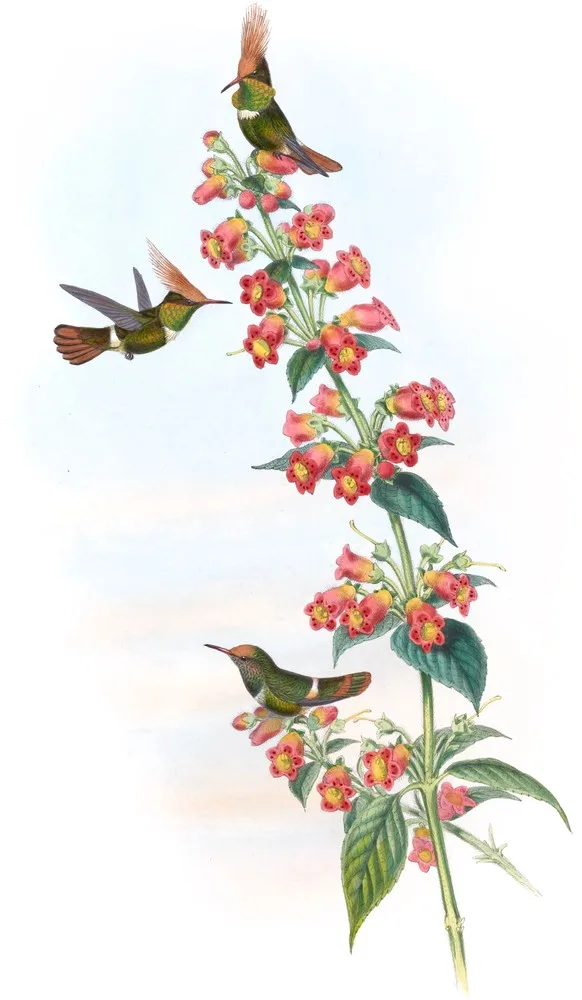
Lophornis Delattrei
Lophornis Delattrei
DeLattre’s Coquette
Ten ways of seeing
- upright 1.72 : 1
First Look
真山水之川谷,远望之以取其势,近看之以取其质。
—— 宋·郭熙《林泉高致·山水训》
Mountains and valleys: from afar take their momentum, up close take their texture — the two distances from which any picture is read.
The sheet is vertical: the eye climbs and settles on the bird. Take the posture before the plumage. Then step in close: watch where colour meets line, and whether the line ever breaks. Third, find the darkest small patch: the whole tonal order is measured from there.
Name and Thing
The binomial is Lophornis delattrei: the first word is the genus it belongs among, the second the epithet that sets it apart. Two words carry a whole provenance. No established Chinese name exists, so it is cited by its binomial alone.
Form and Colour
The smallest of birds: a needle-fine bill, a forked tubular tongue, wings beating so fast the bird hovers and even flies backwards. Its colour is not pigment but structure — light bent by feather barbules, changing with the angle.No colour group is recorded. Read the outline, then the colour layers, then the brush.
Composition
Tall and narrow, the bird perched mid-branch with generous margins above and below. No details are appended: a plate for looking, not for keying out. Cover the margins with your thumb and the plate suffocates; uncover them and the flower breathes again.
Line and Colour
In the later nineteenth century chromolithography took over: colour printed rather than painted, line demoted. Take a loupe to three places: petal edge, leaf vein, caption. An unbroken line means engraving; colour crossing the outline means a hand. If you mean to copy it: block in the broad shapes and colours first, detail last; lithographic softness comes from thin washes — two or three pale layers will get you close.
Poetic Resonance
穿花蛱蝶深深见,点水蜻蜓款款飞。
—— 唐·杜甫《曲江二首》
Butterflies thread the flowers, seen deep within; dragonflies touch the water and fly on, slow and deliberate.
The poem gives the mood first and the picture supplies the form; set the line beside the plate and the bird itself becomes its resting point.
Symbolism
For the Aztecs the hummingbird was warrior and sun; for Victorian Europe it was the ultimate ornament, millions killed for breast jewellery. China has no tradition here — and that blank is itself a history of exchange. Meanings change their tune: the same flower can say opposite things within a century.
Season and Place
temperate hummingbirds follow the bloom north and back, thousands of kilometres a year. Americas only, from southern Alaska to Tierra del Fuego, richest in the Andes. China has no hummingbirds and no classical record of them. The year 1852 on the plate is that of publication, not of flowering — the gathering came a year or two earlier. Read the locality and the flowering season both with a discount: one is hearsay, the other a ten-day peak.
The Book and the Hand
“Gould's Hummingbirds” carries only John Gould's name. The image is public domain; the hand-colouring is still one person's hand.
What to Take Away
If you keep one line, keep Guo Xi's: from afar its momentum, up close its texture. The flower of that year is dust, yet its image on paper has outlived every living cousin.
About this plate
New Granada
It must be admitted by every ornithologist that the members of the genus Lophornis are among the most interesting of the Trochilidæ,—their diminutive size and the high degree of their ornamentation, the elegance of their spangled neck-plumes and graceful crests, and the richness of their metallic colouring, all combining to call forth our admiration, and to show that here nature has been more lavish than usual.
The various species are very generally dispersed over the temperate and hotter parts of South America,—some being found in Brazil and the low countries generally, while, independently of the bird from Central America, five or six at least frequent the great Andean ranges, along which a distinct species is found at every four or five degrees of latitude. Three inhabit New Granada, one Ecuador, and two Bolivia, all of which bear a very general resemblance to each other, but are each distinguished by certain well-defined specific characters. None of the Andean birds have yet been found in Brazil; but the low countries, as before stated, have their own peculiar species, which almost form a distinct section, for their neck-plumes far exceed in length those of the birds inhabiting the Andes; on the other hand, these latter have their crests more largely developed than their neck-plumes, and some of them have very ample crests, as L. Regulus and L. lophotes. The present bird (L. Delattrei) differs from the two last-mentioned species more in this respect than in any other, its crest being composed of narrow, hair-like, and thinly disposed feathers.
Of the history and habits of the L. Delattrei, which has been named after the celebrated traveller, nothing is known. The specimens in my collection were obtained at Bogota; but I have seen others from Panama, which I believe to be the limit of its range in a northerly direction.
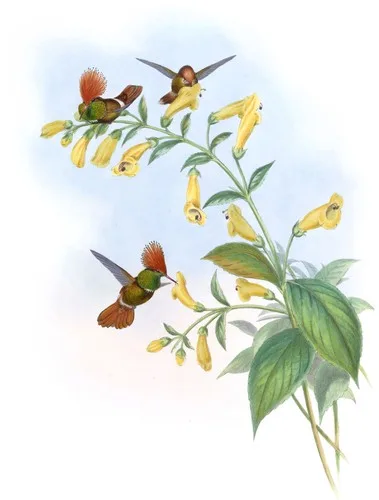
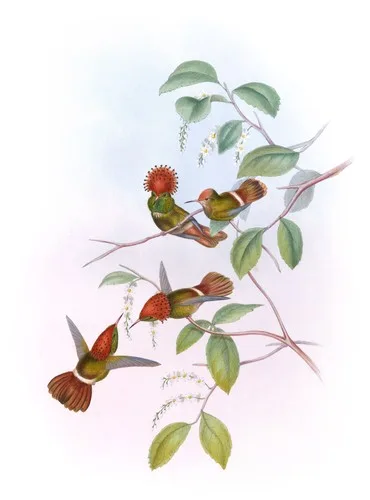
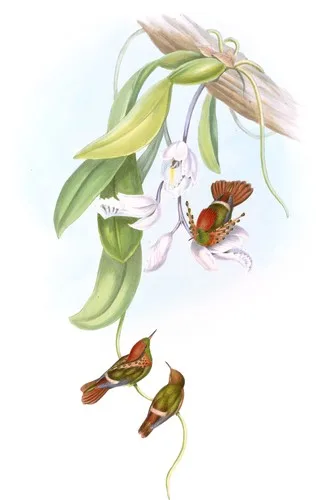
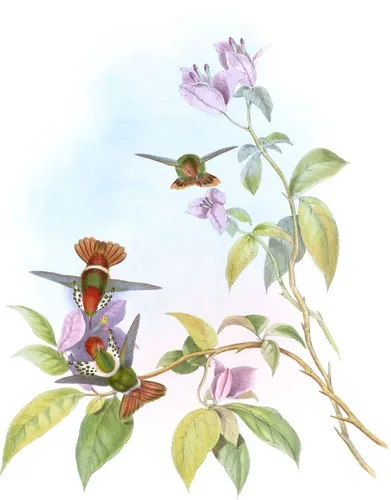
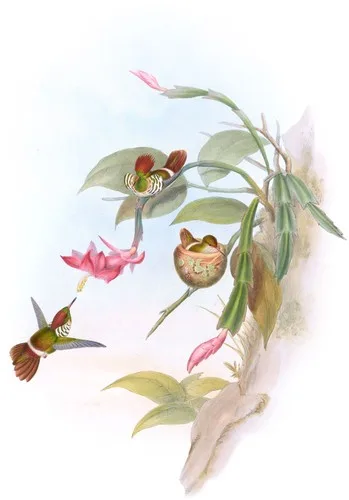
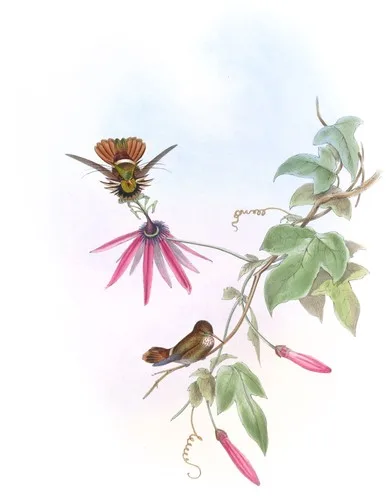
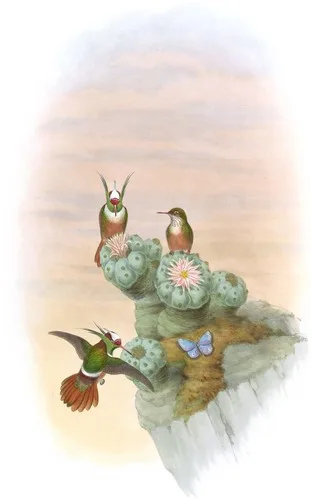
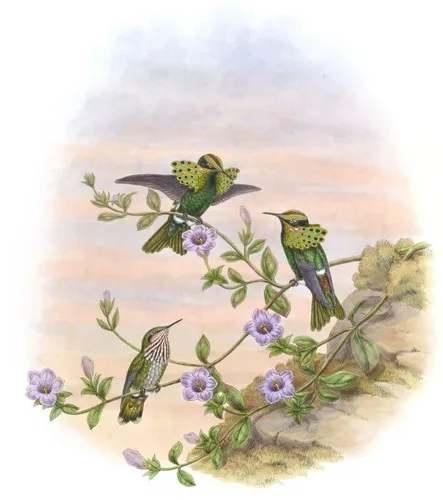
The male has the head and crest rufous, with a minute spangle of green at the tip of some of the crestfeathers; all the upper surface bronzy brown, becoming darker or purplish on the lower part of the back, where it is crossed by a band of white; wings dark purplish brown; throat metallic green, some of the rufous bases of the feathers showing at the sides of the neck; on the breast a tuft of white feathers; under surface dark golden green; under tail-coverts and tail rufous, glossed with bronzy green on the margins of the latter; bill fleshy red with a dark tip; feet fleshy brown.
The female has the forehead rufous; the remainder of the head dark brown; the body above and beneath dark brown glossed with gold; the wings purplish brown; and the tail light rufous, crossed near the tip with a broad zone of blackish brown, beyond which the tips of the lateral feathers are pale rufous; the basal portion of the two centre feathers glossed with bronzy green.
The figures are of the size of life. The plant is the Gesneria Seemanni.
References
- Ornismya (Lophorinus) De Lattrei, Less. Rev. Zool. 1839, p. 19.
- Mellisuga De Lattrei, Gray and Mitch. Gen. of Birds, vol. i. p. 113, Mellisuga, sp. 85.
- Lophornis Delattrii, Reichenb. Aufz. der Col., p. 12; Id. Troch. Enum., p. 9.
- Lophornis delattrei, Bonap. Rev. et. Mag. de Zool. 1854, p. 257.