Lophornis ornatus
缨冠蜂鸟
Lophornis ornatus
Tufted Coquette
Ten ways of seeing
- upright 1.55 : 1
First Look
真山水之川谷,远望之以取其势,近看之以取其质。
—— 宋·郭熙《林泉高致·山水训》
Mountains and valleys: from afar take their momentum, up close take their texture — the two distances from which any picture is read.
The sheet is vertical: the eye climbs and settles on the bird. Take the posture before the plumage. Then step in close: watch where colour meets line, and whether the line ever breaks. Third, find the darkest small patch: the whole tonal order is measured from there.
Name and Thing
The binomial is Lophornis ornatus: the first word is the genus it belongs among, the second the epithet that sets it apart. Two words carry a whole provenance. The Chinese name 缨冠蜂鸟 is a modern rendering of the Latin, not an old garden name.
Form and Colour
The smallest of birds: a needle-fine bill, a forked tubular tongue, wings beating so fast the bird hovers and even flies backwards. Its colour is not pigment but structure — light bent by feather barbules, changing with the angle.No colour group is recorded. Read the outline, then the colour layers, then the brush.
Composition
Tall and narrow, the bird perched mid-branch with generous margins above and below. No details are appended: a plate for looking, not for keying out. Cover the margins with your thumb and the plate suffocates; uncover them and the flower breathes again.
Line and Colour
In the later nineteenth century chromolithography took over: colour printed rather than painted, line demoted. Take a loupe to three places: petal edge, leaf vein, caption. An unbroken line means engraving; colour crossing the outline means a hand. If you mean to copy it: block in the broad shapes and colours first, detail last; lithographic softness comes from thin washes — two or three pale layers will get you close.
Poetic Resonance
夫列子御风而行,泠然善也,旬有五日而后反。
—— 《庄子·逍遥游》
Liezi rode the wind and came back after fifteen days, so light was his going.
The poem gives the mood first and the picture supplies the form; set the line beside the plate and the bird itself becomes its resting point.
Symbolism
For the Aztecs the hummingbird was warrior and sun; for Victorian Europe it was the ultimate ornament, millions killed for breast jewellery. China has no tradition here — and that blank is itself a history of exchange. Meanings change their tune: the same flower can say opposite things within a century.
Season and Place
In tropical America they are present all year, their season set by flowers. the name arrives with late-Qing travel writing. The year 1852 on the plate is that of publication, not of flowering — the gathering came a year or two earlier. Read the locality and the flowering season both with a discount: one is hearsay, the other a ten-day peak.
The Book and the Hand
“Gould's Hummingbirds” carries only John Gould's name. From drawing to plate the sheet passed through several hands — the engraver aimed at accuracy, the colourist at speed, and between them lies each plate's unevenness.
What to Take Away
Next time you watch a bird: posture first, then where the plumage is deepest, and only then the field guide. The flower of that year is dust, yet its image on paper has outlived every living cousin.
About this plate
Northern Brazil, Guiana, and Trinidad
The Lophornis ornatus does not appear to have been known to Linneus, for I find no mention of it in the 12th or last Edition of his “Systema Naturæ;” a good description of it, however, will be found in the 13th or Gmelin’s Edition; this then appears to be the only member known at that time of a genus now comprising many species, which, for grace and beauty, are second to none in the great family of the Trochilide, and all of which are decorated with elegant, lengthened and spangled neck-plumes, or magnificent crests; the former being most conspicuous in some of the species, while in others, such as L. Regulus and L. Reginæ, the beautiful crest is the more remarkable feature.
The L. ornatus, which is strictly an inhabitant of the lowland districts of tropical America, enjoys a somewhat extensive range over the eastern part of that continent, being found from the Caraccas on the north to Brazil on the south, and particularly numerous in all the intermediate countries, of Demerara, Surinam, and Cayenne; it is also equally abundant on the island of Trinidad. Prince Maximilian of Wied states, that in Brazil he found it on dry and arid plains clothed with a scanty and bushy vegetation; and such would seem to be the habit of the bird in Trinidad, since it there flies around the low flowering shrubs of the open parts of the country, rather than in the more wooded or forest districts.
The nest is a small round cup-shaped structure, composed of some cottony material bound together with cobwebs, and decorated externally with small pieces of lichens and mosses.
So great a similarity reigns among the females of many species of the genus Lophornis, that it is very difficult to distinguish the one from the other, especially as the highly ornamental neck-plumes of the male are entirely absent in the other sex.
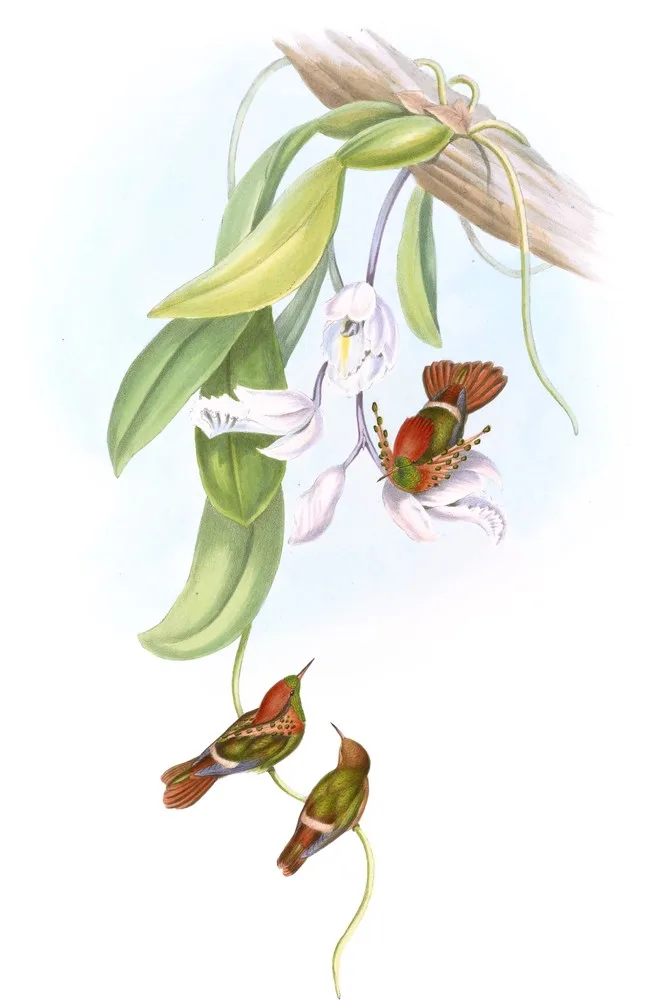
The male has the head and crest rich chestnut-red; upper surface and wing-coverts bronzy green; wings dark purplish brown; across the lower part of the back a band of white; rump chestnut-brown; upper tailcoverts bronzy green; tail dark chestnut-red, the two central feathers bronzy green on their apical half, and the lateral ones edged with brownish black; forehead and throat luminous green; on each side of the neck a series of graduated plumes of a light chestnut-red, with a spangle of luminous green at the tip of each; under surface bronzy green; bill fleshy red, dark brown at the tip.
The female has the head and upper surface bronzy green; a narrow band of white across the lower part of the back; upper tail-coverts tipped with bronzy red; tail bronzy green, crossed near the extremity by a broad dusky band and tipped with buff; lores and sides of the throat rufous; centre of the throat buffy white, with a small spot of black at the tip of each feather; an obscure band of white across the breast; under surface bronzy green.
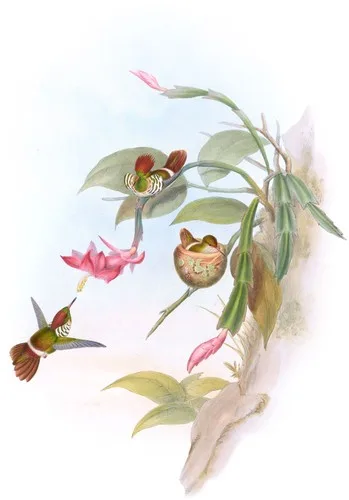
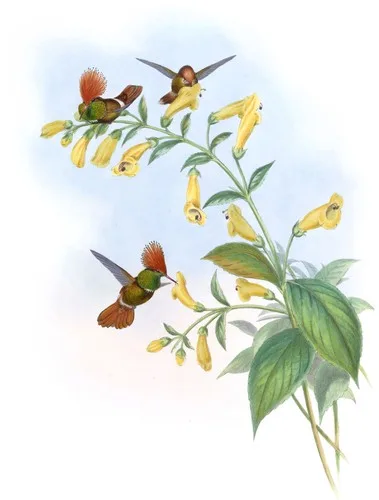
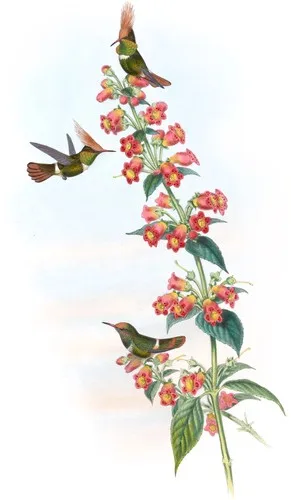
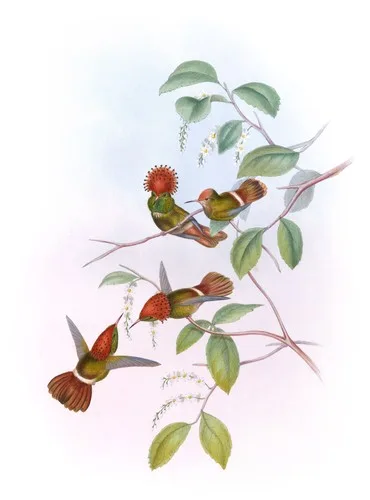
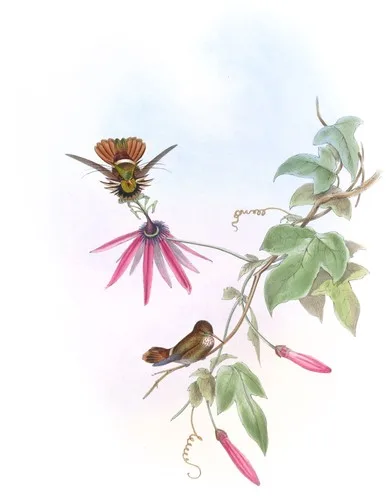
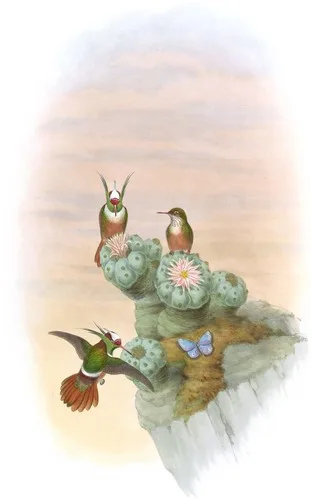
The Plate represents two males and a female of the natural size. The pretty Orchid is copied from a drawing of a Brazilian species kindly sent to me by Mr. Reeves of Rio de Janeiro.
References
- Trochilus ornatus, Lath. Ind. Orn., vol. i. p. 318.—Shaw, Mus. Leverianum, p. 1380. pl. 7.— Gmel. Edit. of Linn. Syst. Nat., tom. i. p. 497.—Shaw, Gen. Zool., vol. vii. p. 345.
- Le Hupe-Col, Buff. Hist. Nat. des Ois., tom. vi. p. 18.—Ib. Sonn. Edit., tom. vii. p. 165.
- L’Oiseau mouche, dit Hupecol de Cayenne, Buff. Pl. Enl. 640. fig. 3.
- Le Hupecol, Vieill. Ois. dor., tom. i. p. 94. pls. 49, 50, 51.—Ib. Nouv. Dict. d’Hist. Nat., tom. vii. p. 364.—Ib. Ency. Méth. Orn., part 1. p. 565.—Drapiez, Dict. Class. d’Hist. Nat., tom. iv. p. 324.
- Tufted-necked Humming Bird, Lath. Gen. Syn., vol. ii. p. 784.—Ib. Gen. Hist., vol. iv. p. 348. pl. Ixxviii—Jard. Nat. Lib. Humming Birds, vol. i. pp. 112 & 114. pls. 15 & 16.
- Ornismya ornata, Less. Hist. Nat. des Ois. mou., pp. xl et 139. pl. 41.—Ib. Hist. Nat. des Troch., p. 77. pl. 24.
- Mellisuga ornata, Gray and Mitch. Gen. of Birds, vol. i. p. 118, Mellisuga, sp. 84.
- Lophornis auratus, Bonap. Consp. Gen. Av., p. 88, Lophornis, sp. 1.
- Lophornis ornatus, Ib. Rev. et Mag. de Zool. 1854, p. 257.
- Lophornis ornata, Less. Ind. Gen. et Syn. des Ois. du Gen. Troch., p. xli.—Ib. Traité d’Orn., p. 285.—Gray, List of Gen. of Birds, 2nd edit., p. 19.—Reichenb. Aufz. der Colibris, p. 12.