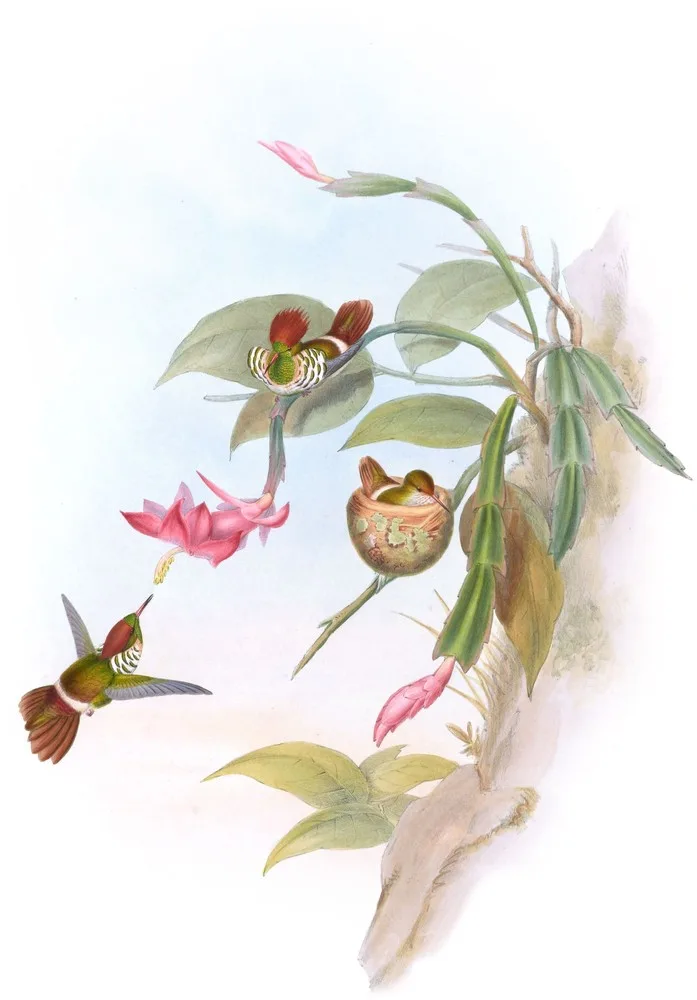
Lophornis magnificus
Lophornis magnificus
Frilled Coquette
Ten ways of seeing
- upright 1.43 : 1
First Look
六法者何?一、气韵生动是也;二、骨法用笔是也;三、应物象形是也;四、随类赋彩是也;五、经营位置是也;六、传移模写是也。
—— 南齐·谢赫《古画品录》
The six laws: spirit resonance alive; bone-method in the brush; matching form; colour by kind; planning the placing; copying the masters.
The sheet is vertical: the eye climbs and settles on the bird. Take the posture before the plumage. Then step in close: watch where colour meets line, and whether the line ever breaks. Third, find the darkest small patch: the whole tonal order is measured from there.
Name and Thing
The binomial is Lophornis magnificus: the first word is the genus it belongs among, the second the epithet that sets it apart. Two words carry a whole provenance. No established Chinese name exists, so it is cited by its binomial alone.
Form and Colour
The smallest of birds: a needle-fine bill, a forked tubular tongue, wings beating so fast the bird hovers and even flies backwards. Its colour is not pigment but structure — light bent by feather barbules, changing with the angle.No colour group is recorded. Three things fix the habit: leaf arrangement, tepal count, and how the flower is borne.
Composition
Tall and narrow, the bird perched mid-branch with generous margins above and below. No details are appended: a plate for looking, not for keying out. Cover the margins with your thumb and the plate suffocates; uncover them and the flower breathes again.
Line and Colour
In the later nineteenth century chromolithography took over: colour printed rather than painted, line demoted. Take a loupe to three places: petal edge, leaf vein, caption. An unbroken line means engraving; colour crossing the outline means a hand. If you mean to copy it: block in the broad shapes and colours first, detail last; lithographic softness comes from thin washes — two or three pale layers will get you close.
Poetic Resonance
穿花蛱蝶深深见,点水蜻蜓款款飞。
—— 唐·杜甫《曲江二首》
Butterflies thread the flowers, seen deep within; dragonflies touch the water and fly on, slow and deliberate.
The poem gives the mood first and the picture supplies the form; set the line beside the plate and the bird itself becomes its resting point.
Symbolism
For the Aztecs the hummingbird was warrior and sun; for Victorian Europe it was the ultimate ornament, millions killed for breast jewellery. China has no tradition here — and that blank is itself a history of exchange. In a flora it is a species first and a symbol second; the order is worth keeping.
Season and Place
temperate hummingbirds follow the bloom north and back, thousands of kilometres a year. the name arrives with late-Qing travel writing. The year 1852 on the plate is that of publication, not of flowering — the gathering came a year or two earlier. The bud and the ripe fruit on one branch tell the season; the name in the title often tells the journey.
The Book and the Hand
“Gould's Hummingbirds” carries only John Gould's name. The image is public domain; the hand-colouring is still one person's hand.
What to Take Away
If you keep one line, keep Guo Xi's: from afar its momentum, up close its texture. Two centuries on, the plant may still flower in some garden; the one on this sheet stopped in the season of 1852.
About this plate
South-eastern Brazil
The discovery of this beautiful little species of Lophornis is said to have been made by M. De Lalande, the celebrated French traveller, at the period of whose visit to Brazil and for some time afterwards the bird was very rarely to be met with in our collections; such, however, is no longer the case, for its proper habitat having been ascertained, it is killed and skinned by the negroes, and the skins, bearing a certain market value, are sent to this country and to France in great numbers.
Its native country is Brazil; and the localities in which it appears to be most abundant are the provinces of Rio de Janeiro and Minas Geraes. M. De Lalande procured examples in the forests bordering the river Paraiba, to the north of Rio de Janeiro; and MM. Quoy and Gaimard obtained others among the moderately dense vegetation bordering the torrents at the foot of the Organ Mountains. The notes transmitted to me by Mr. Reeves of Rio de Janeiro merely mention that it inhabits that province and Minas Geraes, but unfortunately give no account of its habits.
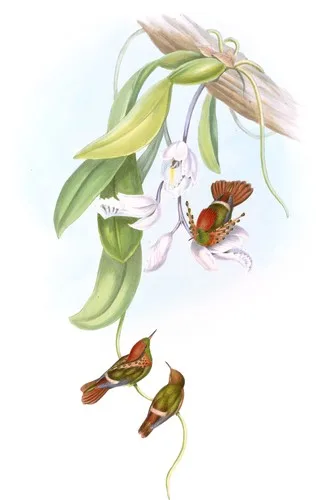
The nest is a small round cup-shaped structure, composed of a rufous-coloured fungus-like substance, coated externally with cobwebs and fine vegetable fibres, and decorated with small pieces of lichens.
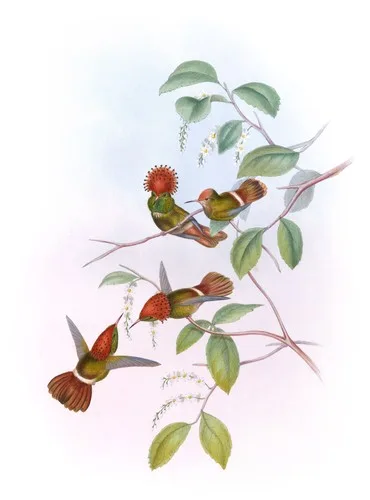
Like the other members of the genus, this species has the sides of the neck adorned with beautiful snowywhite plumelets; but these plumelets differ in form, being shorter and broader, and are moreover crossed by a band of luminous green at the extremity, instead of having a spot of that colour at the tip.
The same difference which exists between the sexes of the other species also occurs with the present, the female being destitute of the conspicuous decorations of the male.
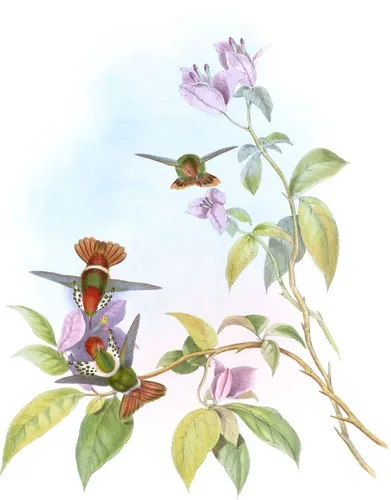
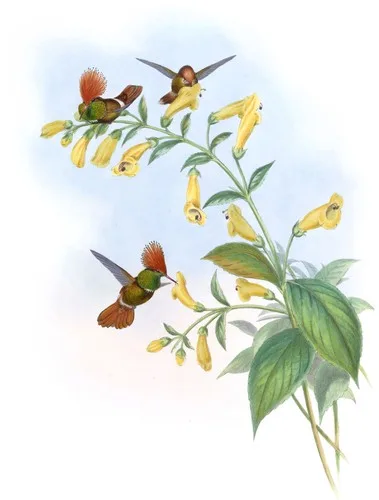
The male has a broad band across the forehead, face and throat luminous green; head and crest dark chestnut-red; upper surface and wing-coverts bronzy green; wings purplish brown; a band of white across the lower part of the back; upper tail-coverts bronzy brown; central tail-feathers bronzy green; lateral ones deep chestnut-red, bordered with brownish black; on each side the neck a series of broad white feathers advancing forward and meeting immediately beneath the green gorget; each of those on the sides of the neck crossed at the tip with a band of luminous green; under surface bronzy green; bill flesh-red at the base, deepening into black at the point.
The female has the head and upper surface bronzy green; a narrow band of white across the lower part of the back; upper tail-coverts tipped with bronzy red; tail deep fawn-colour, crossed towards the extremity by a broad dusky band; throat rufous; under surface bronzy green.
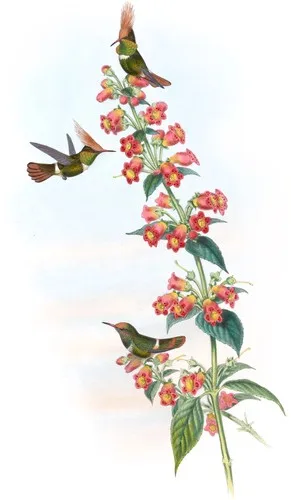
The Plate represents two males and a female with the nest, all of the natural size.
References
- Trochilus magnificus, Vieill. 2nde Edit. du Nouv. Dict. d’Hist. Nat., tom. vii. p. 367, et tom. xxill. p. 428. pl. G 36. fig. 3—Ib. Ency. Méth. Orn., part nu. p. 559.—Ib. Ois. dor., tom. i. pl. 8.—Temm. Pl. Col. 229. fig. 2.—Jard. Nat. Lib. Humming Birds, vol. i. pp. 119 & 121. pls. 19 & 20.—Pr. Max. Beitr. zur Nat. von Bras., p. 79.
- Trochilus decorus, Licht. Verz. der Doubl., p. 14.
- Colibri helios, Spix, Av. Sp. Nov. Bras., tom. i. p. 81. tab. lxxxii. fig. 2.
- Ornismya magnifica, Less. Man. d’Orn., tom. 1. p. 80.
- Ornismya strumaria, Less. Hist. Nat. des Ois. mou., pp. xl & 143. pls. 42 & 43.
- Lophornis strumaria, Less. Ind. Gen. et Syn. des Ois. du Genre Trochilus, p. xlii—lb. Traité d’Orn., p. 285.
- Mellisuga magnifica, Gray and Mitch. Gen. of Birds, vol. i. p. 118, Mellisuga, sp. 88.
- Lophornis magnificus, Bonap. Consp. Gen. Av., p. 83, Lophornis, sp. 2.—Ib. Rev. et Mag. de Zool. 1854, p. 257.
- Bellatrix magnifica, Reichenb. Aufz. der Colibris, p. 12.