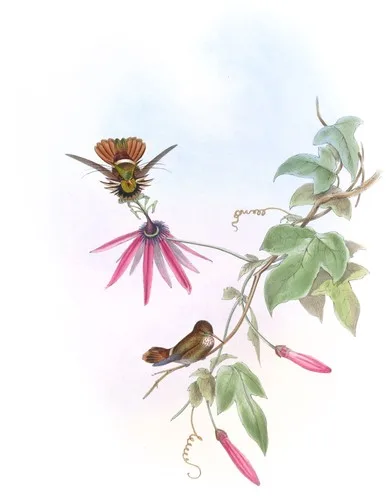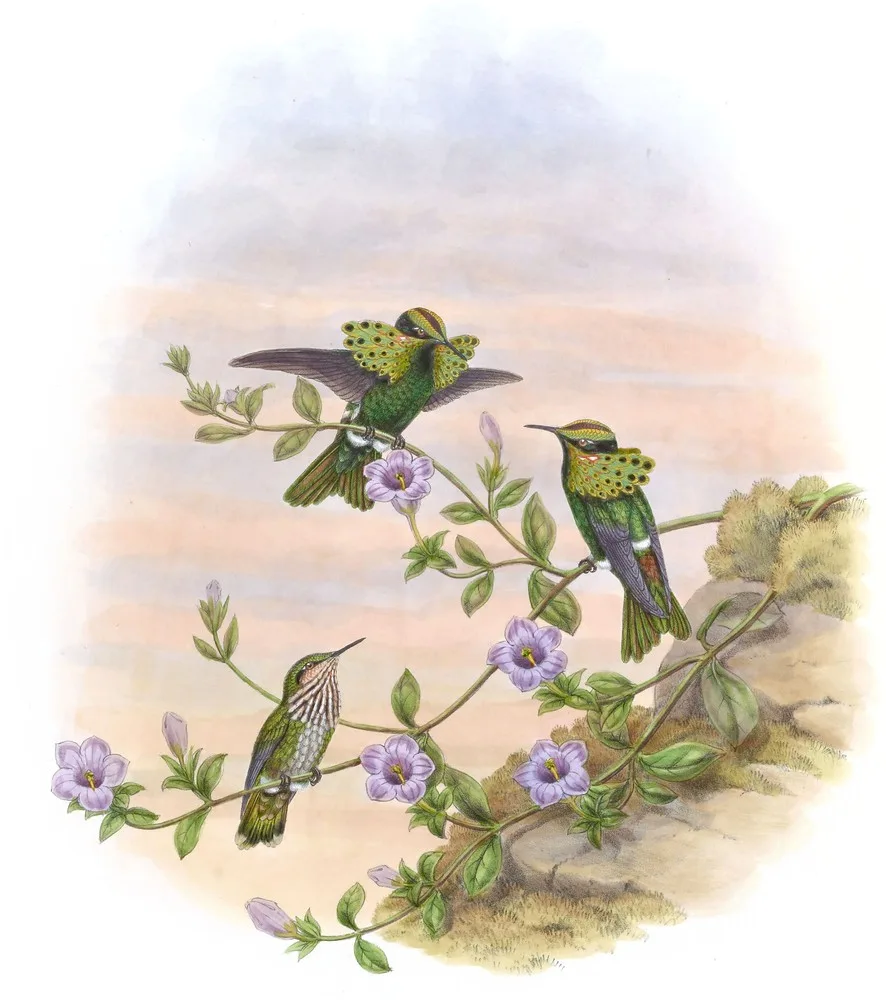
Lophornis pavoninus
孔雀冠蜂鸟
Lophornis pavoninus
Roraima Coquette
About this plate
The present species was discovered by Mr. Henry Whitely during his well-known exploration of British Guiana, where he met with it on the Merumé Mountains and on Roraima at a height of from 3000 to 3500 feet.
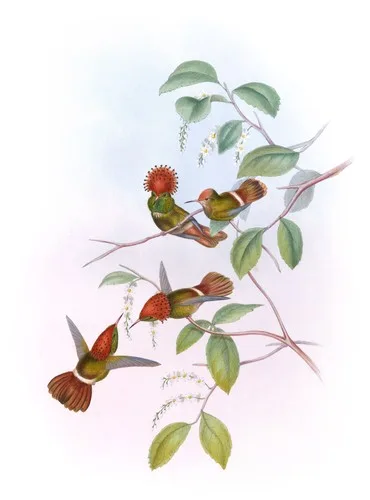
Messrs. Salvin and Godman state that it is allied to L. verreauxi, but differs in many particulars; the head, instead of having the forehead green and the occiput black, has a black central streak running from the base of the bill to the nape, on each side of which is a broad green streak. The elongated green feathers on each side of the neck are broad, and have a conspicuous black spot near the apex of each feather, this spot in the largest feathers being quite large. The feathers of the front extend much further along the culmen of the bill than in L. verreauxi, and in this respect recall this peculiarity in the genus Orthorhynchus.
Mr. Whitely’s first collection contained only a single example of this Humming-bird, which he obtained at a height of 2000 feet. He has kindly sent us the following account of its capture:—
After ascending the Merumé Mountains from the Merumé river-side, I met with a terrible gunpowder accident which deprived me of the use of my hands for over a month, and the Indians brought me to a hut amongst the hills, travelling about 17 miles in a northerly direction from the top of the Chichi falls on the Upper Mazarune. The hut was situated on the open savannah, with a large forest at the back, and here on my restoration to health my first collection from the mountainous country of British Guiana was made. At this season of the year (June and July 1881) there were many large trees in the forest bearing large bunches of white flowers, and these were frequented by numerous species of Humming-birds; but from the great height of the trees I was forced to get my Indians to climb halfway up, and then stand on some of the overhanging branches to shoot them, so that it was not possible to observe much of their habits.
This interesting bird was the only one obtained, and though we were constantly on the watch for more, we never got a second example, and I should fancy that it was a bird that had strayed out of its usual haunts, attracted by the flowers. The stomach contained remains of very minute insects.
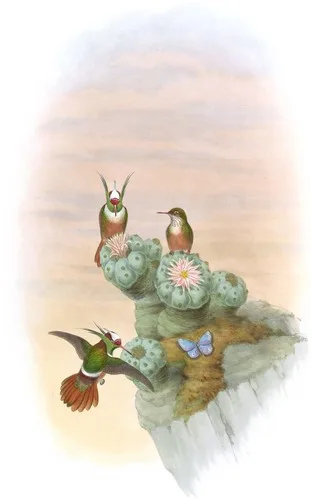
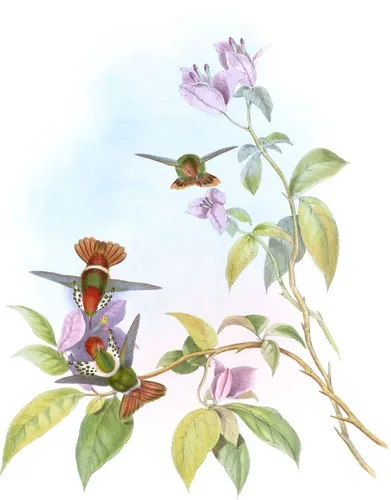
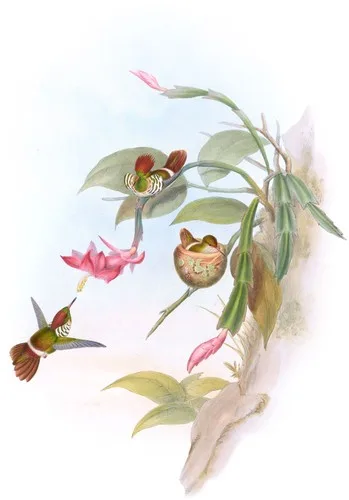
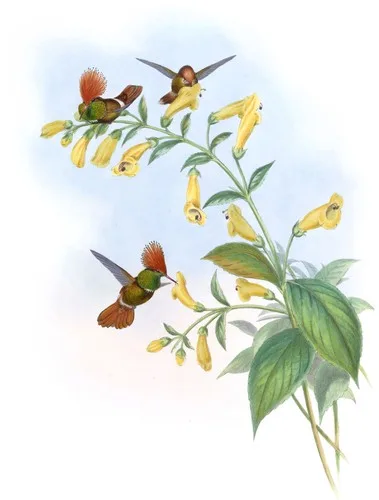
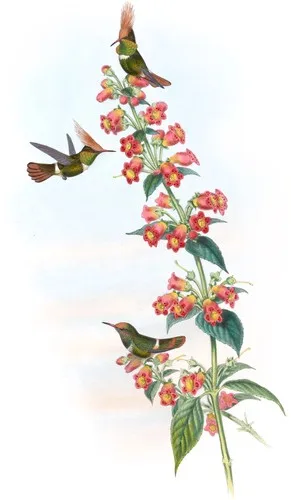
Two males and a female are figured on the Plate, drawn from a pair of specimens lent to us by Messrs. Salvin and Godman.
[R. B. S.]
References
- Lophornis pavoninus, Salvin & Godman, Ibis, 1882, p. 81.
- Polemistria pavonina, Salvin & Godman, Ibis, 1885, p. 433.
Twelve ways of seeing
- slightly upright 1.13 : 1
- published 1887
- Pl. 396, Suppl. Vol.
Not a catalogue entry but a way of looking: how to stand, what to notice, how the line was cut, when it flowers, where it came from, who made it — and then the poems and the classics that taught China to see the same flower. Read the twelve in order and the plate opens.
-
First Look
竖划三寸,当千仞之高;横墨数尺,体百里之迥。
—— 南朝宋·宗炳《画山水序》
A vertical stroke of three inches stands for a cliff of a thousand fathoms; a few feet of ink holds a hundred li.
Slightly taller than wide; the eye lands on the bird's head, a little above centre. Then step in close: watch where colour meets line, and whether the line ever breaks. Third, find the darkest small patch: the whole tonal order is measured from there.
-
Name and Thing
The binomial is Lophornis pavoninus: the first word is the genus it belongs among, the second the epithet that sets it apart. Two words carry a whole provenance. The Chinese name 孔雀冠蜂鸟 is a modern rendering of the Latin, not an old garden name.
-
Form and Colour
The smallest of birds: a needle-fine bill, a forked tubular tongue, wings beating so fast the bird hovers and even flies backwards. Its colour is not pigment but structure — light bent by feather barbules, changing with the angle.No colour group is recorded. A single plant, laid out with nothing hidden.
-
Composition
Slightly taller than wide, the bird set a little above centre, the eye landing at head and bill. (about 1.13 : 1) No details are appended: a plate for looking, not for keying out. Blank paper is not unfinished work: it is where the eye rests.
-
Line and Colour
In the later nineteenth century chromolithography took over: colour printed rather than painted, line demoted. Craft leaves franker evidence than inscriptions.
-
Season
In tropical America they are present all year, their season set by flowers; temperate hummingbirds follow the bloom north and back, thousands of kilometres a year. The year 1887 on the plate is that of publication, not of flowering — the gathering came a year or two earlier. The plate records ten days of peak; the other three hundred are leaf, fruit and rest.
-
Provenance
Americas only, from southern Alaska to Tierra del Fuego, richest in the Andes. China has no hummingbirds and no classical record of them; the name arrives with late-Qing travel writing. The localities on the plate are those of a century ago; plants travel and places change their names.
-
The Book and the Hand
“Gould's Hummingbirds” was drawn by John Gould and published 1849-1887. This plate is Pl. 396, Suppl. Vol., book page 396. The image is public domain; the hand-colouring is still one person's hand.
-
Poetic Resonance
夫列子御风而行,泠然善也,旬有五日而后反。
—— 《庄子·逍遥游》
Liezi rode the wind and came back after fifteen days, so light was his going.
The poem gives the mood first and the picture supplies the form; set the line beside the plate and the bird itself becomes its resting point.
-
The Written Tradition
竖划三寸,当千仞之高;横墨数尺,体百里之迥。
—— 南朝宋·宗炳《画山水序》
A vertical stroke of three inches stands for a cliff of a thousand fathoms; a few feet of ink holds a hundred li. Smallness of scale was never the obstacle.
Gould's Hummingbirds (1849–1887) used hand-coloured lithography over gold leaf so the iridescence survived on paper — a monument to Victorian printing and collecting alike. The difference is not of quality but of question: Europe asks what it is, China asks whom it resembles.
-
Symbolism
For the Aztecs the hummingbird was warrior and sun; for Victorian Europe it was the ultimate ornament, millions killed for breast jewellery. China has no tradition here — and that blank is itself a history of exchange. Meanings change their tune: the same flower can say opposite things within a century.
-
What to Take Away
If you keep one line, keep Guo Xi's: from afar its momentum, up close its texture. A flora exists to be consulted; look long enough and you forget to consult — someone in 1887 gave a whole day to a single flower.