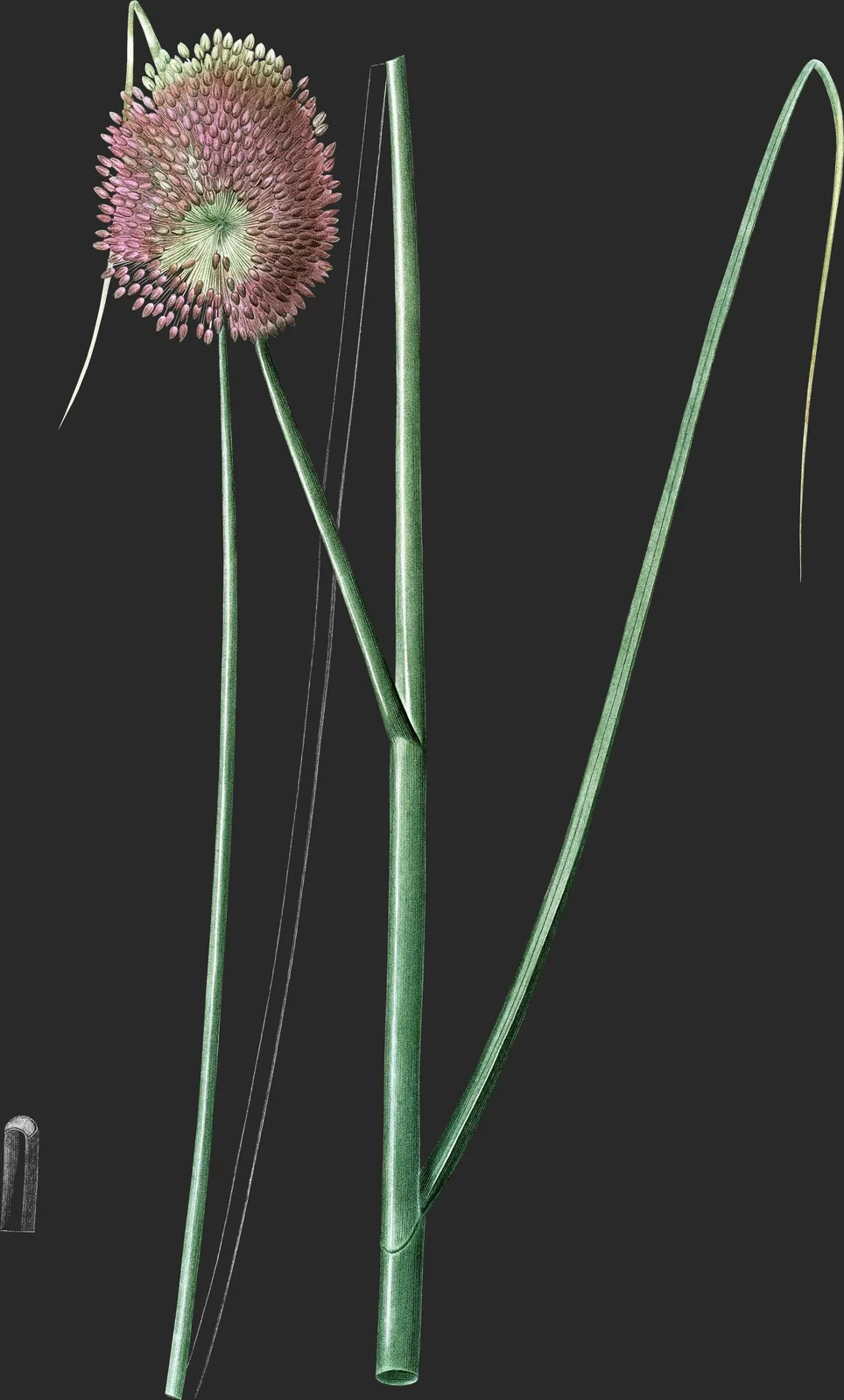
Allium Sphærocephalon
Ail a Tète Ronde
Ail a Tète Ronde
About this plate
Description
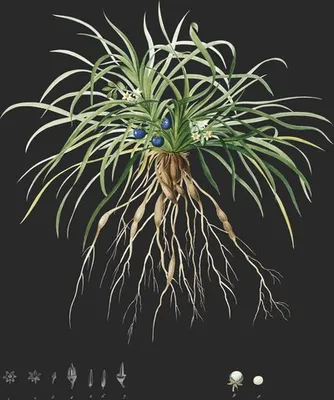
La bulbe de cet Ail est assez petite, ovale, couverte de tuniques membranes-ses, grises ou blanchätres. Au-dessus est une seconde bulbe plus petite, formée par la réunion d’un nombre plus ou moins grand de cayeux pédicellés qu’enveloppent des tuniques membraneuses, pareilles à celles de la bulbe inférieure.
La hampe, dans la variété, dont nous donnons ici la figure, séleve à la hauteur d’un mètre et demi. Elle est cylindrique, droite, grèle, couverte, dans son tiers inférieur, par les gaines des feuilles, nue dans le reste de son étendue, lisse, glabre, d’un vert foncé.
Les feuilles sont engainantes, fistuleuses, presque cylindriques, creusées d’une gouttière peu profonde sur leur côté interne, d’un vert foncé, glabres. entières, aigues, un peu plus courtes que la tige.
Les fleurs sont petites, tris-nombreuses, disposées en ombelle sphérique, extrèmement serrée et dépourvue de balbes. La spathe qui les entoure se déchire le plus souvent en deux valves arrondies.
Le périgone est d’une belle conleur rouge pourpre, disisé, jusqu’à sa base en six segments ovales, obtus, concaves, demi-étalés, longs de cinq à six milli-mètres. Les trois extérieurs sont souvent un peu plus courts que les autres.
Les filaments des étamines, opposés aus divisions extérieures du périgone, sont en forme d’alène, un peu dilatés dans le bas. Les trois autres sont un peu plas larges, divisés supérieurement en trois pointes, dont les deus latérales se prolongent en un filament capillaire, et la moyenne, un peu plas courte, porte une anthère jaune, ovale, vacillante. Tous dépassent le périgone. Lovaire est ovale, surmonté par un style filiforme, aussi long que les étamines.
Les individus sauvages de cette espèce acquièrent des dimensions beaucoup moins considérables dans toutes leurs parties que la variété dont nous venons de donner la description.
Histoire
WAil a tete ronde croit asses communément dans les bois sablonneux de la plus grande partie de la France, de la Suisse, de l’Allemagne, de l’Italie et de la Barbarie. Il Ileurit au mois d’août.
Fam. des Asphodèles. Juss.—Hexandrie monogynie. Lin.
- Alliam sphærocephalon. A. caule teretifolio umbellifero, foliis semiteretibus, staminibus tricuspidatis corolla longioribus. Lin. sp. pl. 496. Pollich. Pal. 328. Mill dict. n. 12. Lam. dict. 1. p. 66. Hoffm. Germ. 116. Roth. Germ. 1. p. 146; 2 p. 382, exclas. syn. Haller. Desfont. fl. Atl. 1. p. 291. Fl. Franç. éd. 3. 1975. Pers. enchir. 1. p. 356.
- Alliam staminibus alterne tritidis, foliis fistalosis, spicâ sphæricâ non balbiferâ suaverubente. Hall. Opuse. 353. n. 10.
- Alliam radice gemellâ, foliis fistulosis, capite sphærico, staminibus alternè trifidis. Hall. Helvet. n. 1220.
- Alliam montanum, capite rotundo. Bauh. pin. 75. Rudb. elys. 1. p. 157. f. 7. Tournef. inst. 291.
- Alliam seu Moly montanum purpurco flore. Clus. hist. 1. p. 195. f. 1.
- Scorodoprasum montamum juncifoliom, capite rotundo dilutè janthino, floribus parvis. Mich. gen. 25. t. 24. f. 2.
Twelve ways of seeing
- measured cast red
- upright 1.66 : 1
- published 1812
- Plate 391
Not a catalogue entry but a way of looking: how to stand, what to notice, how the line was cut, when it flowers, where it came from, who made it — and then the poems and the classics that taught China to see the same flower. Read the twelve in order and the plate opens.
-
First Look
夫象物必在于形似,形似须全其骨气。
—— 唐·张彦远《历代名画记》
Likeness is the threshold; bone-and-breath is the point.
The sheet is vertical: the eye climbs and settles in the upper half. Let the plant stand before you look for detail. Then step in close: watch where colour meets line, and whether the line ever breaks. Third, find where the green is deepest: the whole tonal order is measured from that patch.
-
Name and Thing
Only the genus Allium is given; species-level names came later. The older system filed it under Asparagaceæ by overall affinity; Linnaeus, counting stamens only, placed it in Hexandria — two ways of asking what a plant is. No established Chinese name exists, so it is cited by its binomial alone.
-
Form and Colour
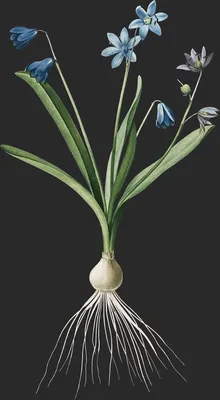
Measured on this plate: flower colour covers 2.5% of the sheet, foliage 3.2%, the cast red with a second note of amber. No other plate shares exactly this measure. Bulbous plants store the year underground — bulb, corm or tuber — then send up a few thick leaves and a single scape, with six tepals in cup, funnel or star. Filed under green — a moss green, a colour that comes mostly from leaf and stem. A single plant, laid out with nothing hidden.
-
Composition
Tall and narrow, the plant rising in one movement with generous margins — the upright format of most floras. (about 1.66 : 1) No details are appended: a plate for looking, not for keying out. The plant covers only 11% of the sheet, centred a little left of centre; the emptiness is where the eye rests. Old plates set the plant slightly off centre, with unequal margins — that small imbalance is what keeps it alive.
-
Line and Colour
The first half of the nineteenth century moved from copper to steel to lithography; stipple could render the softest transition. Craft leaves franker evidence than inscriptions.
-
Season
Early spring to early summer, genus by genus: tulips and hyacinths first, gladiolus and amaryllis later. The year 1812 on the plate is that of publication, not of flowering — the gathering came a year or two earlier. The plate records ten days of peak; the other three hundred are leaf, fruit and rest.
-
Provenance
Three homelands: the Mediterranean, Central Asia and South Africa. The tulip came from Ottoman gardens and became a Dutch mania; South African bulbs filled European glasshouses after 1800. In the same volume the kin are shelved together; set several plates side by side.
-
The Book and the Hand
“The Liliaceae” was drawn by Pierre-Joseph Redouté and published 1802-1816. This plate is Plate 391, book page 391. The image is public domain; the hand-colouring is still one person's hand.
-
Poetic Resonance
郁金垂嫩柳,罯画委高笼。
—— 唐·元稹《春六十韻》
The poem gives the mood first and the picture supplies the form; set the line beside the plate and the green the corolla becomes its resting point.
-
The Written Tradition
气之动物,物之感人,故摇荡性情,形诸舞咏。
—— 南朝梁·钟嵘《诗品序》
The vital breath moves things, things move men, and the stirred heart takes shape in song.
Li Bai's 'orchid wine, fragrant with yujin' is often misread as tulips; the Tang yujin was a turmeric-like root used to scent wine — same name, different plant. Keep the line; it will surface the next time you meet the same plant.
-
Symbolism
The tulip was an imperial emblem in Istanbul and a speculative bubble in Amsterdam; the hyacinth sprang from a boy's blood in Greek myth. What bulbs share is concealment: next year kept underground. In a flora it is a species first and a symbol second; the order is worth keeping.
-
What to Take Away
Appreciation is not knowledge but habit — one more look each time. Two centuries on, the plant may still flower in some garden; the one on this sheet stopped in the season of 1812.