Massonia Angustifolia
Massonie a Feuilles Étroites
Massonie a Feuilles Étroites
About this plate
Description
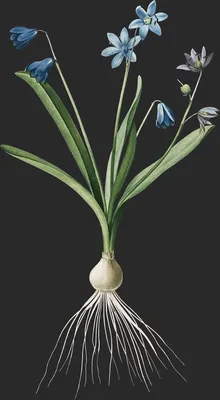
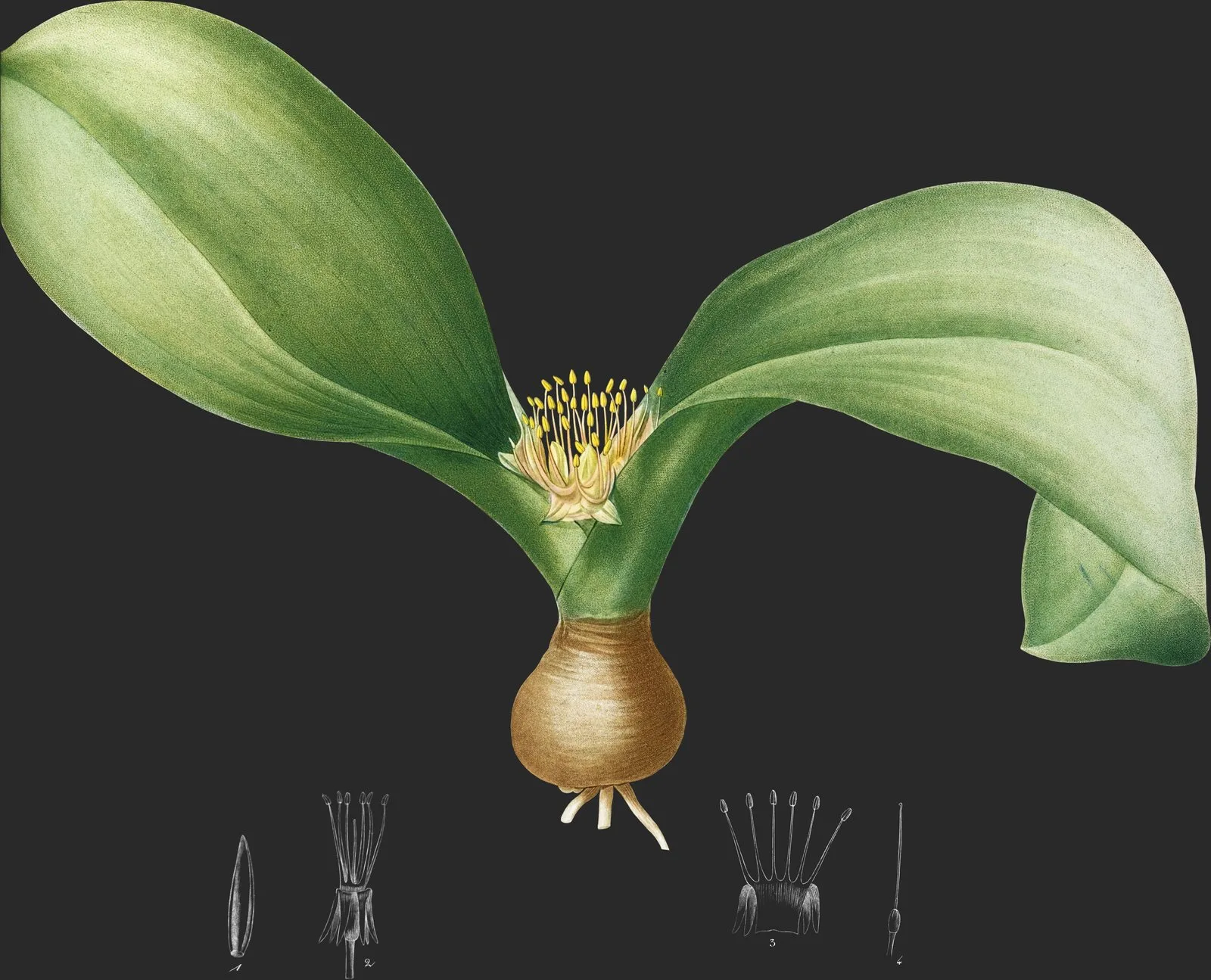
Une balbe ovale-arrondie, couverte de tuniques, d’un gris pale, donne naissance à deux feuilles ovales, lancéolées, dilatées dans le haut, aigues, entières, glabres, un peu charnues, courbées en gouttière dans leur partie infé rieure qui est assez étroite, planes dans le reste de leur étendue.
Les flears sortent immédiatement de la bulbe et fomrent une ombelle sessile, en partie cachée entre les bases de ces feuilles. La spathe qui les entoure est formée de trois folioles ovales-lancéolées, rétrécies en pointe au sommet, longues de trois centimètres: d’antres folioles un peu plus petites, mais semblables d’ailleurs, séparent les fleurs les unes des autres. Chaque Heuron est supporté par un pédicelle charnu, blane, long d’un centimètre environ.
La partie inférieure du périgone est en forme de tube blanchâtre, longue de douze millimètres. La moitié supérieure est partagée en six lanières lancéolées et pendantes.
Les étamines sont dressées, un peu plas longues que les divisions du péri-gone. Leurs filaments sont en forme d’alene, un peu renfles dans le lien de leur insertion qui se fait à l’entrée du tabe du périgone, dont ils ferment à peu pres louverture. Les anthères sont oblon gues, jaunes, dressées.
Lovaire est vert, ovale, un peu dilaté dans le haut, et triangulaire. Le style est filiforme, aussi long que les étamines. Le stigmate ext rougeatre, peu distinct.
Histoire
La Massonie à feuilles étroites, ainsi que toutes les espèces connues du même genre, est originaire du cap de Bonne-Espérance. L’individu dont nous donnons ici la figure est cultivé dans le riche jardin de M. Boursaut. Il était en fleur dans le mois de décembre.
Explication de la planche
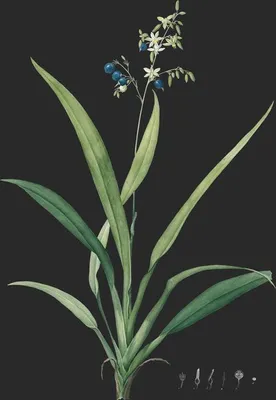
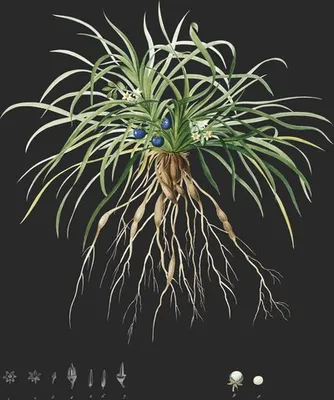
La Plante entière de grandeur naturelle.
- Une bractée.
- Une fleur détachée.
- Une fleur fendue et étalée.
- L’ovaire et le style.
Fam. des Asphodèles. Juss.—Hexandrie monogynie. Lin.
- Massonia angustifolia. M. foliis oblongo-lanceolatis erectis, laciniis corollæ reflexis. Ait. hort. Kew. 1. p. 405. t. 4. Willd. sp. pl. 2. p. 28. Pers. enchir. 1. p. 349.
- Massonia angustifolia. M. acaulis, foliis lanecolato-oblongis nodis, thyrso congesto, tubo pedicellis duplò breviore, lacimis oblongo-ovatis rellesis longiore filamentis æquali, ore fermè clauso. Gawl. in Curt. botan. mag. 736.
- Massonia angustifolia. M. foliis lanccolato-oblongia glabris. Lin. suppl. 193.
- Massonia lanceolata. M. foliis lanccolatis integris glabris. Thunb. prod. 60. Diss. nov. gen. 2. p. 40.
Twelve ways of seeing
- measured cast amber
- square 0.81 : 1
- published 1812
- Plate 392
Not a catalogue entry but a way of looking: how to stand, what to notice, how the line was cut, when it flowers, where it came from, who made it — and then the poems and the classics that taught China to see the same flower. Read the twelve in order and the plate opens.
-
First Look
竖划三寸,当千仞之高;横墨数尺,体百里之迥。
—— 南朝宋·宗炳《画山水序》
A vertical stroke of three inches stands for a cliff of a thousand fathoms; a few feet of ink holds a hundred li.
Nearly square, plant and detail each holding a corner. Then step in close: watch where colour meets line, and whether the line ever breaks. Third, find where the green is deepest: the whole tonal order is measured from that patch. The pose leans left: the upper half carries 19 points further left than the lower — a living thing, not a diagram.
-
Name and Thing
The binomial is Massonia angustifolia: the first word is the genus it belongs among, the second the epithet that sets it apart. Here the epithet angustifolia means “narrow-leaved” — the name records the feature the namer noticed first. The older system filed it under Asparagaceæ by overall affinity; Linnaeus, counting stamens only, placed it in Hexandria — two ways of asking what a plant is. No established Chinese name exists, so it is cited by its binomial alone.
-
Form and Colour
Measured on this plate: flower colour covers 2.8% of the sheet, foliage 21.2%, the cast amber with a second note of yellow-green. No other plate shares exactly this measure. A bulb of overlapping fleshy scales gives the lily its Chinese name, 'hundred-fold'; six tepals reflex as the flower opens, around six stamens with long, T-shaped anthers. Filed under green — a moss green, a colour that comes mostly from leaf and stem. Three things fix the habit: leaf arrangement, tepal count, and how the flower is borne.
-
Composition
Nearly square, plant and details sharing the corners. (about 0.81 : 1) No details are appended: a plate for looking, not for keying out. The plant takes about 30% of the sheet, centred above centre — the easy measure most florists kept to. Cover the margins with your thumb and the plate suffocates; uncover them and the flower breathes again.
-
Line and Colour
The first half of the nineteenth century moved from copper to steel to lithography; stipple could render the softest transition. Decide first whether it was printed or painted; only then discuss whether it is beautiful.
-
Season
Early to high summer, June and July; the flowers last only days, so artists drew them just as they opened. The year 1812 on the plate is that of publication, not of flowering — the gathering came a year or two earlier. The plate records ten days of peak; the other three hundred are leaf, fruit and rest.
-
Provenance
Temperate north — China, Japan, Europe. Long used in Chinese medicine, lilies were hunted in East Asia by nineteenth-century collectors and transformed European gardens. The volume was made in 1802-1816, when most of this knowledge came from living plants under glass.
-
The Book and the Hand
“The Liliaceae” was drawn by Pierre-Joseph Redouté and published 1802-1816. This plate is Plate 392, book page 392. The image is public domain; the hand-colouring is still one person's hand.
-
Poetic Resonance
故乡寒食荼醾发,百合香浓邸舍深。
—— 宋·宋祁《山橙花》
The poem gives the mood first and the picture supplies the form; set the line beside the plate and the green the corolla becomes its resting point.
-
The Written Tradition
百合之根,以众瓣合成也。
—— 明·李时珍《本草纲目·菜部》
The root of the lily is many scales gathered into one — hence the name bai he, “a hundred joined”.
The Bencao Gangmu describes the bulb as garlic-like, edible and medicinal; Song writers already noted that the leaves vary while the flowers stay white. Keep the line; it will surface the next time you meet the same plant.
-
Symbolism
In the West the white lily is Marian purity, held by the angel of the Annunciation; in China the name sounds like 'a hundred years in harmony', a wedding wish. Flower language was added later; the flower knows nothing of it, and that innocence is part of its power.
-
What to Take Away
Next time you stand before a flowering plant, give it three minutes: leaf arrangement, direction of the flower, the darkest patch. A flora exists to be consulted; look long enough and you forget to consult — someone in 1812 gave a whole day to a single flower.