Colchicum Alpinum
秋水仙属
Colchique des Alpes
About this plate
Description
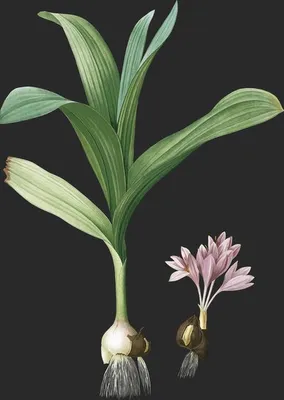
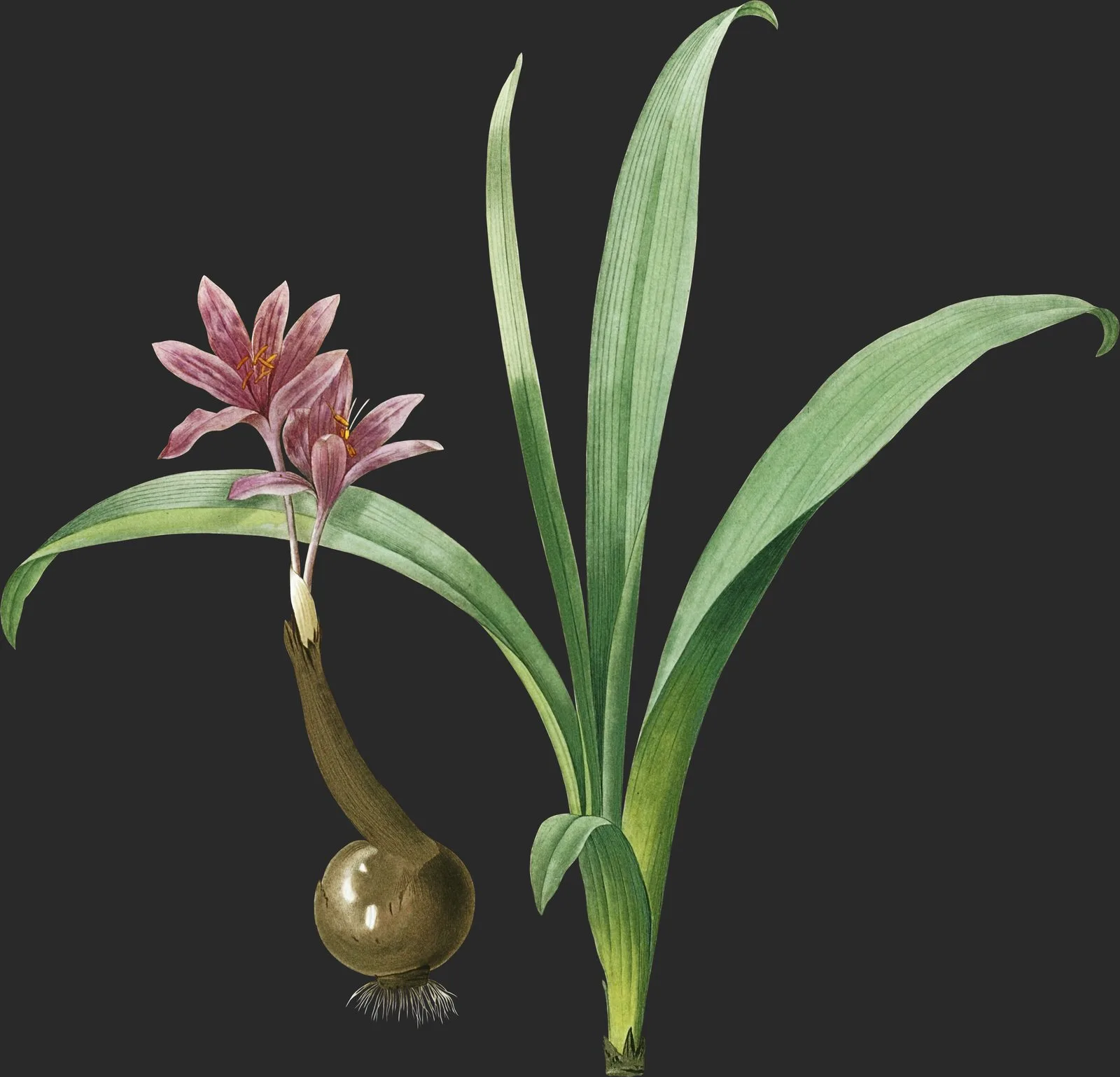
Sa bulbe est arrondie, enveloppée de tuniques, sèches, cassantes, qui se prolongent en longs tubes engaines les uns dans les autres, et dans lesquels est logée la spathe, qui nait de la base de la bulbe; cette spathe est proportionnée, pour sa longueur, a l’enfoncement de la balbe dans la terre; elle s’ouvre obliquement au sommet pour laisser sortir une ou deus fleurs, dont le tube est grêle, cylindrique, plas long que la spathe. Ces fleurs ont leur limbe à six divisions lancéolées, longues de trente-quatre millimètres (quinze lignes), dont trois extérieures, un peu plas longues que les intérieures. Les six divisions du limbe sont un peu pliées longitudinalement, roses, marquées de veines et de taches irrégulières violettes.
Les étamines sont insérées a l’entrée du tube, et plas courtes que le limbe; leurs anthères sont linéaires, vacillantes; l’ovaire est supère, à trois côtes oblongues, qui se terminent chacune par un style capillaire de la longueur de la fleur.
Les feuilles paraissent dans un autre temps que les fleurs; elles sortent en un faisceau radical, au nombre de quatre à cinq; elles sont linéaires-lancéolées, parfaitement glabres, un peu en gouttière, droites ou légèrement retombantes.
Histoire
Ce Colchique, naturel dans les Alpes, est cultivé au Jardin des Plantes, où il fleurit au mois de septembre, et où il ne pousse de feuilles qu’au printemps suivant.
Observations
Ce Colchique porte depuis long-temps, dans l’Ecole botanique du Jardin des Plantes, le nom de Colchicom montanum; il est vrai que c’est le Colchicum montanum d’Allioni: mais il y a un autre Colchicam montanum, auquel ce nom est aujourd’hui consacré; ensorte que nous avons adopté, pour l’espèce que nous venons de décrire, le nom de Colchicum Alpinum de la Flore Française, ouvrage dans lequel le Colchicum montanum est la plante figurée par l’Ecluse, pag. 200 et son, à feuilles lincaires, et dont les feuilles et les fleurs parsissent les unes en même temps que les autres.
Gawler, dans le Botanical Magazine, pag. 1098, prend le Merendera bathocodium de nos Liliacées, pag. 35, pour le Colchicam montanum de Linné, et réunit les genres Merendera et Balbocodium au Colchicum. Nous insistons sur ce que les différences que nous avons fait précédemment remarquer, pages 95 et 197, pour le style simple du Balbocodiam, et pour les anthères entre le Merendera et le Colchicum, distinguent suffisamment ces trois genres.
Alion décrit les Bleurs du Colchique des Alpes à segments lancéolés, rayés et violets, comme nous les avons observés: notre plante nous a seulement offert la dillèrence d’avoir deus fleurs, an lien d’une seule qu’elle produit dans les Alpes.
Fam. des Colchicacées. Fl. Franç.—Hexandrie trigynie. Lin.
- Colchicum alpinum. C. bulbo sab-unilloro; flore maculato, lineato; laciniis sulplicatis; foliis linearibus post florem prodeuntibus.
- Colchicum alpinum. C. bulbo unifloro; folis com flore sub-prodeuntibus, linearibus; laciniis perigoni ovato-oblongis. Lam. et Candol. Flor. Franç. n. 1898.
- Colchicum alpinum. C. floribus aphyllis, laciniis corolla ovali-oblongis, obtusis: foliis linearibus post florescentiam. Loiseleur. Flor. Gall. p. 217.
- Colchicum montanum. Allioni. Pedem. n. 434. tab. 74. fig. 2. exclus. synonymis.
- C’est par erreur que la Planche 467 porte le nom de Colchicum arenarium; il faut y substituer le nom de Colchicum Alpinum.
Twelve ways of seeing
- measured cast yellow-green
- square 0.96 : 1
- published 1814
- Plate 467
Not a catalogue entry but a way of looking: how to stand, what to notice, how the line was cut, when it flowers, where it came from, who made it — and then the poems and the classics that taught China to see the same flower. Read the twelve in order and the plate opens.
-
First Look
江馆清秋,晨起看竹,烟光日影露气,皆浮动于疏枝密叶之间。
—— 清·郑板桥《题画竹》
On an autumn morning at the river lodge I looked at the bamboo: mist, sunlight, dew, all drifting among the sparse and dense leaves.
Nearly square, plant and detail each holding a corner. Then step in close: watch where colour meets line, and whether the line ever breaks. Third, find where the green is deepest: the whole tonal order is measured from that patch.
-
Name and Thing
The binomial is Colchicum alpinum: the first word is the genus it belongs among, the second the epithet that sets it apart. Two words carry a whole provenance. The older system filed it under Colchicaceæ by overall affinity; Linnaeus, counting stamens only, placed it in Hexandria — two ways of asking what a plant is. The Chinese name 秋水仙属 is a modern rendering of the Latin, not an old garden name.
-
Form and Colour
Measured on this plate: flower colour covers 3.3% of the sheet, foliage 10.5%, the cast yellow-green with a second note of red. No other plate shares exactly this measure. Bulbous plants store the year underground — bulb, corm or tuber — then send up a few thick leaves and a single scape, with six tepals in cup, funnel or star. Filed under green — a moss green, a colour that comes mostly from leaf and stem. A single plant, laid out with nothing hidden.
-
Composition
Nearly square, plant and details sharing the corners. (about 0.96 : 1) No details are appended: a plate for looking, not for keying out. The plant covers only 17% of the sheet, centred near the centre; the emptiness is where the eye rests. Cover the margins with your thumb and the plate suffocates; uncover them and the flower breathes again.
-
Line and Colour
The first half of the nineteenth century moved from copper to steel to lithography; stipple could render the softest transition. Craft leaves franker evidence than inscriptions.
-
Season
Early spring to early summer, genus by genus: tulips and hyacinths first, gladiolus and amaryllis later. The year 1814 on the plate is that of publication, not of flowering — the gathering came a year or two earlier. The best time to read such a plate is its flowering season: three minutes under the tree explains what no text can.
-
Provenance
Three homelands: the Mediterranean, Central Asia and South Africa. The tulip came from Ottoman gardens and became a Dutch mania; South African bulbs filled European glasshouses after 1800. The localities on the plate are those of a century ago; plants travel and places change their names.
-
The Book and the Hand
“The Liliaceae” was drawn by Pierre-Joseph Redouté and published 1802-1816. This plate is Plate 467, book page 467. The image is public domain; the hand-colouring is still one person's hand.
-
Poetic Resonance
卢家少妇郁金堂,海燕双栖玳瑁梁。
—— 唐·沈佺期《古意呈補闕喬知之》
The poem gives the mood first and the picture supplies the form; set the line beside the plate and the green the corolla becomes its resting point.
-
The Written Tradition
人无癖不可与交,以其无深情也。
—— 明·张岱《陶庵梦忆》
Never make a friend of a man without an obsession: he has no deep feeling.
Li Bai's 'orchid wine, fragrant with yujin' is often misread as tulips; the Tang yujin was a turmeric-like root used to scent wine — same name, different plant. The difference is not of quality but of question: Europe asks what it is, China asks whom it resembles.
-
Symbolism
The tulip was an imperial emblem in Istanbul and a speculative bubble in Amsterdam; the hyacinth sprang from a boy's blood in Greek myth. What bulbs share is concealment: next year kept underground. In a flora it is a species first and a symbol second; the order is worth keeping.
-
What to Take Away
Next time you stand before a flowering plant, give it three minutes: leaf arrangement, direction of the flower, the darkest patch. The flower of that year is dust, yet its image on paper has outlived every living cousin.